
A Litigator's Guide to Production of Documents Under CPC

The production of documents under CPC is a make-or-break stage in any civil suit. Governed mainly by Orders XI and XIII, it forces parties to lay their cards on the table—all documentary evidence they plan to rely on—before the court frames the issues. This isn't just about ticking a procedural box; it's a strategic play that ensures a fair fight based on a complete record. Get this wrong, and you risk a trial full of nasty surprises.
Unpacking the Strategic Role of Document Production in Civil Cases
In the theatre of a courtroom, producing your documents under the Code of Civil Procedure (CPC) is more than just paperwork. It's the foundational act upon which you build your entire case—or watch it get dismantled. The whole process, from discovery and inspection to final production, is designed to bring transparency to the proceedings.
Think of it as the evidence-gathering phase that sets the stage for everything that follows. One of the costliest mistakes a lawyer can make is treating this step as a mere administrative task. The goal is twofold: you show your opponent the evidence you've got, and you force them to do the same. This simple exchange is what prevents "trial by ambush," where one side suddenly springs new evidence on the other, derailing the entire case.
Core Principles Underpinning the Process
The CPC gives us a clear roadmap for handling documentary evidence, primarily through two critical provisions:
Order XI (Discovery and Inspection): This is your tool to probe. It allows you to request information and documents from the other side, giving you a chance to test the strength of their claims and, just maybe, uncover that crucial piece of evidence they'd rather you didn't see.
Order XIII (Production, Impounding and Return of Documents): This is the mandatory part. It dictates that you must produce every single document in your possession that you intend to use to prove your case.
When used together, these orders create a system designed to get all the evidence out in the open long before the real trial fireworks begin.
The Critical Timing and Its Implications
The rules require parties to produce their original documents "on or before the settlement of issues." This creates a crucial, and often tight, window of opportunity. In a typical civil suit, you’re looking at roughly the first 6–12 months to get your evidence submitted under Order XIII, Rule 1.
Courts are incredibly strict about this deadline. Miss it, and you could face severe consequences, like the court refusing to look at your most important documents later on.
Insights: Many lawyers treat document production as a reactive chore. The sharpest legal minds, however, see it for what it is: a proactive opportunity. It’s your first real chance to shape the story of the case, challenge the other side's narrative, and back up your own arguments with solid proof.
Of course, the strategic value of your documents hinges entirely on their credibility. This is where the skill of evaluating credible sources becomes absolutely essential for any litigator.
How Draft Bot Pro Can HelpFor any lawyer, junior or senior, managing this phase efficiently is non-negotiable. This is where a Legal AI tool like Draft Bot Pro can be a game-changer. It helps organise, catalogue, and prepare the lists and applications you need, ensuring you stay compliant with the rules and freeing you up to focus on what really matters: winning your case.
Mastering Timelines And Procedures Under Order XI And XIII
The journey of document production under the CPC isn't some chaotic scramble. It's a structured path with a clear timeline, kicking off the moment a plaint is filed and wrapping up before the court settles the final issues for trial. If you don't get a handle on this chronological flow, you risk non-compliance and start your case on a weak footing.
The whole process really boils down to two main phases, governed by Orders XI and XIII. First, you have discovery under Order XI, which is your formal opportunity to ask the other side what documents they have that are relevant to the case. This is immediately followed by the mandatory production phase under Order XIII, where every party has to put their cards on the table and submit the documents they're relying on.
This whole system is designed to make sure evidence is exchanged transparently, which is the bedrock of a fair trial.
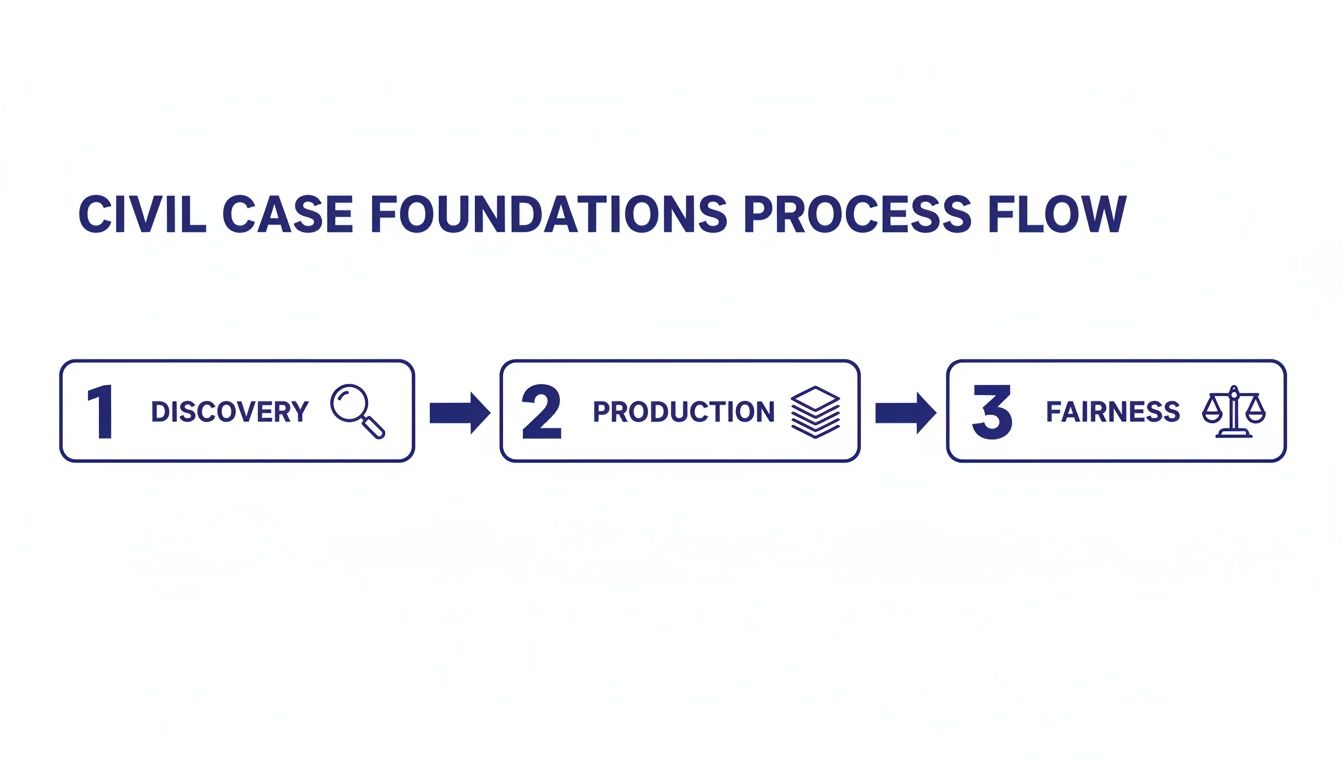
As you can see, it’s a logical sequence: find out what evidence exists, then produce it for the court. This strict order prevents trial-by-ambush and ensures everyone is working from a common set of facts.
From Pleadings To Production
The second a plaint is filed or a written statement is submitted, the clock officially starts ticking. You're immediately obligated to pull together a comprehensive list of every single document in your possession or that you plan to rely on. This isn't just some casual inventory; it's a formal declaration to the court and the opposing counsel.
This initial list must be filed right alongside your pleadings. It should meticulously detail everything from contracts and emails to receipts and official records. The goal here is complete transparency right from the get-go.
Insights: The single biggest procedural mistake is an incomplete or vaguely worded list of documents. Descriptions like "correspondence letters" are almost guaranteed to be rejected. Be specific: "Letter dated 15 March 2023 from Party A to Party B regarding payment default."
The Crucial Affidavit Requirement
Just handing over a list isn't enough. The production of documents under the CPC has to be backed by a sworn affidavit. Think of it as a solemn promise to the court, affirming that your list is complete and accurate to the very best of your knowledge.
This affidavit confirms you've disclosed all relevant documents in your possession, power, or custody. Skip this step, and your entire list of documents could be deemed inadmissible. To make sure you're hitting all the legal marks, check out our guide on how to properly draft an affidavit under CPC in India.
To help you navigate this, here’s a quick-glance table summarising the key stages.
Key Stages and Actions for Document Production Under CPC
This table breaks down the critical stages, the rules you need to know, the actions you must take, and a few strategic tips from the trenches.
Stage of Litigation | Relevant CPC Order/Rule | Action Required | Strategic Tip |
|---|---|---|---|
Filing of Pleadings | Order XIII, Rule 1 | File a list of all documents relied upon along with the plaint or written statement. | Be exhaustive. It's better to list a document you might not use than to be barred from introducing it later. |
Discovery | Order XI, Rules 12-14 | File an application for discovery of documents from the opposing party. | Frame your request specifically. Vague "fishing expeditions" are often denied by the court. |
Inspection | Order XI, Rule 15 | Serve a notice to the other party to inspect the documents they have disclosed. | Always inspect the original documents. Photocopies can sometimes omit crucial details or notations. |
Production Before Court | Order XIII, Rule 1 | Produce all original documents in court at or before the settlement of issues. | Keep a meticulous record of what has been filed and what has been returned by the court registry. |
Getting these procedural steps right is non-negotiable for building a solid case.
How Draft Bot Pro Can HelpDrafting compliant applications and lists of documents takes up a ton of time. Draft Bot Pro automates this entire process. You can generate perfectly formatted, legally sound applications, lists, and supporting affidavits in minutes, not hours. Our AI ensures no procedural detail gets overlooked, helping you dodge common mistakes and freeing up valuable time that you should be spending on case strategy. By handling the procedural grind, it lets you focus on what really matters: winning your case.
What Happens When You Miss a Document Production Deadline?
Let's be blunt: missing a deadline for producing documents under the CPC is a major misstep. This isn't just some procedural hiccup; it can seriously cripple your case. The court has every right to refuse to accept that crucial piece of evidence later on, leaving your best arguments hanging without support.
But it gets worse. A missed deadline can trigger an adverse inference against you. This is a legal way of saying the judge is allowed to assume the documents you didn't produce would have actually hurt your case. That kind of assumption can be devastating, sometimes more damaging than the content of the documents themselves.
Trying to File Documents Late
So, what if you stumble upon a game-changing document after the deadline has already passed? It’s not necessarily game over, but you’ve got a steep climb ahead of you. You'll need to file an application asking the court for permission—or 'leave'—to produce the document late.
Everything hinges on whether you can prove "sufficient cause."
You have to give the court a rock-solid, honest reason for the delay. Vague excuses just won't cut it. Your job is to convince the judge that the failure to produce the document on time wasn't because you were being negligent or, worse, trying to pull a fast one.
Here are a few arguments that courts often consider:
You Genuinely Just Found It: You need to show that you discovered the document after the deadline, despite having made diligent efforts to find everything earlier.
It Was Out of Your Hands: Maybe the document was with a third party who was dragging their feet or ignoring your requests.
An Honest Mistake: You might be able to argue there was a genuine clerical error in how documents were catalogued or filed, and you’ve since corrected the mistake.
InsightsWhen you're drafting that application for late production, specificity is your best friend. Don’t just say the document was 'unavailable.' Explain why it was unavailable. Detail the exact steps you took to find it and pinpoint the exact date you finally got your hands on it. A clear, chronological story backed by any proof you have is infinitely more persuasive.
The Real-World Costs of Missing Deadlines
Failing to stick to timelines isn't just about legal arguments; it has very real consequences. It causes delays and racks up costs. In fact, procedural studies have found that failing to produce documents on time is a factor in roughly 20–35% of all interlocutory litigation and trial extensions.
Courts don’t hesitate to impose costs under Order XI/XIII. A look at the numbers shows that in about one out of every five contested applications for late production, the applicant gets hit with a cost order. And in about 10–15% of those cases, the court flat-out refuses to admit the document at all. You can dive deeper into these procedural realities in this comprehensive analysis of document production in civil cases.
This is a high-stakes application where you can't afford to be sloppy.
How Draft Bot Pro Can HelpPutting together a compelling application for late production is all about weaving a persuasive narrative backed by solid legal reasoning. Draft Bot Pro can be a huge help here. The AI can assist in generating a well-structured, convincing application. It helps you clearly articulate your "sufficient cause," referencing relevant legal principles and framing your request for the best possible chance of success. This way, your critical evidence gets the consideration it deserves.
Can You Introduce New Documents on Appeal?
Getting new documents on the record during an appeal is one of the toughest fights you'll face in civil litigation. For good reason, the trial court's record is generally considered closed for business. Appellate courts are incredibly hesitant to reopen it. Their job, after all, is to review the lower court's decision based on the evidence it had—not to kick off a whole new trial.
The gatekeeper here is Order XLI Rule 27 of the CPC. This rule sets a very high bar for bringing in additional evidence at the appellate stage. It’s absolutely not a second chance for parties who were sloppy or negligent during the trial. Instead, think of it as a narrow, emergency-only exception for very specific and compelling situations.
The Three Strict Grounds for Admitting New Evidence
An appellate court will only even look at an application for new evidence if it fits squarely into one of three tight categories:
Improper Refusal by the Trial Court: You tried to introduce the evidence during the trial, but the lower court wrongly refused to admit it.
Evidence Wasn't Discoverable (Even with Due Diligence): You have to prove that despite your best efforts, the evidence was not something you knew about or could possibly have produced during the trial.
Essential for the Court to Pronounce Judgment: This is a big one. The appellate court itself decides it needs the document to properly deliver a judgment or for some other substantial reason. This ground is for the court's benefit, not yours.
Over time, courts have only gotten stricter about this. For example, the Supreme Court has recently emphasized the limitations on producing documents in appeals, particularly in cases where a plaint was rejected under Order VII Rule 11. The ruling was clear: the appellate review should stick to the contents of the plaint itself. You can't just bring in new documents later to patch up fundamental flaws in your original case.
InsightsThe most common pitfall? The "due diligence" test. This is where most Order XLI Rule 27 applications fall apart. You can't just say you "found" a document later on. You have to actively demonstrate that you conducted a thorough, proactive search during the trial. Courts have a keen sense for applications that feel like an afterthought or a tactical delay, and they'll dismiss them without a second thought.
Building a Winning Application
Getting this right is about more than just having a new piece of paper. You need to craft a compelling story that convinces the court. Your application must spell out, in meticulous detail, why this evidence couldn't have been produced earlier. You need to show a clear, logical sequence of events that justifies bringing it in so late.
If your appeal touches on different types of court orders, it’s a good idea to refresh your memory on what’s what. Our practical guide to Section 104 CPC on appealable orders can offer some useful context.
Filing an application under this rule is a high-stakes move where the odds are not in your favour. This is exactly where a data-driven strategy can give you a serious edge.
How Draft Bot Pro Can HelpDeciding whether to even file an Order XLI Rule 27 application is a massive strategic call. This is where Draft Bot Pro comes in. It can analyse thousands of recent appellate court judgments specifically on this issue. By looking at this data, the tool can predict the likelihood of your application succeeding based on the specific facts and grounds you plan to argue. This gives you a clear, data-backed insight to help you make a smarter, more informed decision before you pour time and resources into this uphill legal battle.
Drafting Insights for Flawless Production Applications
Crafting an application for the production of documents under the CPC is something of an art form. Get it right, and you can compel the other side to reveal crucial evidence. Get it wrong, and you’re left with a rejected application and a weaker case. The difference often comes down to small details—details that many lawyers, in their haste, tend to overlook.
The most common pitfall I see is vagueness. An application seeking "all correspondence related to the dispute" is almost guaranteed to fail. Courts rightly see these broad requests as "fishing expeditions," designed more to harass the other party than to seek specific, relevant evidence. Your application needs to be surgically precise, identifying the documents you need with as much clarity as possible.
Avoiding Common Drafting Mistakes
Precision is your greatest asset here. When you're describing the documents, think in terms of dates, parties involved, and the specific subject matter. Don't just ask for "financial records."
Instead, request "the ledger entries from 1 April 2022 to 31 March 2023 showing all payments made by the Defendant to XYZ Corp." This level of detail shows the court you have a clear, justifiable reason for your request and aren't just guessing.
Another frequent error is making a weak argument for relevance. It’s not enough to simply state that a document is relevant; you have to explain how it's relevant to a specific issue in the suit. You need to connect the dots for the judge.
Insights: Always frame your application from the court's perspective. The judge needs to see a direct line between the document you're requesting and a fact you need to prove. Make that connection impossible to ignore.
This is also a key area to manage after the fact. For instance, knowing the procedures for retrieving your filed papers is crucial. Our guide to the application for documents return in India offers practical steps on this often-overlooked part of the litigation cycle.
Nailing the Affidavit for Late Production
When you find yourself having to file an application for late production, the affidavit you attach is your most important tool. This document must tell a compelling story of "sufficient cause" that justifies why you're late. A simple "I forgot" or "it was an oversight" just won't cut it.
Your affidavit must clearly lay out:
The steps you took: Detail the diligent efforts you made to find the document before the deadline.
The reason for the delay: Was the document with a third party who wasn't cooperating? Was it only just discovered despite a thorough search? Be specific.
The date of discovery: Pinpoint the exact moment you found or received the document. This shows you didn't waste any time bringing it to the court's attention.
A well-drafted affidavit can be the difference between getting that game-changing piece of evidence admitted and having it shut out completely. For those looking to optimise the creation of formal requests and applications for document production, insights can be gained by exploring methods for leveraging AI in drafting legal motions.
This process can be complex, requiring a blend of factual storytelling and legal precision.
How Draft Bot Pro Can HelpThis is exactly where Draft Bot Pro becomes a strategic partner. Our AI can generate a precise, legally sound application for the production of documents under CPC. It helps you sidestep vague language and ensures every requested document is tied directly to a specific legal argument, just as the court requires. For those late production affidavits, Draft Bot Pro is brilliant at helping structure a compelling narrative that clearly articulates your grounds. By incorporating relevant case law and legal principles, it transforms a routine procedural task into a powerful strategic move, giving your arguments the support they need to succeed.
Common Questions About Document Production
When you're in the thick of civil litigation, navigating the rules for the production of documents under the CPC can throw up some tricky practical questions. Let's walk through a few of the most common queries that land on my desk, so you can handle these situations with a bit more confidence.
Can I Be Forced to Produce a Privileged Document?
In short, no. You can't be compelled to produce documents that are legally privileged. The classic example, of course, is communication between you and your client for the purpose of giving or receiving legal advice.
But here's the catch: the burden is on you to prove that privilege exists. You can't just slap a "privileged" label on a document and call it a day. If challenged, you need to be ready to justify exactly why it meets the legal standard for protection, all without revealing its confidential contents.
What Is the Difference Between Discovery and Production?
It's easy to mix these two up, but they are distinct, sequential stages of the process.
Discovery (Order XI): Think of this as the investigation phase. It's where you formally ask the other side what relevant documents they actually have in their possession.
Production (Order XIII): This is the next step—the physical act of presenting those documents to the court and, in turn, the opposing party.
A simple way to look at it: discovery is about identifying the evidence, while production is about getting it on the record.
InsightsA common strategic mistake is waiting for the other side to specifically ask for a document via discovery before thinking about producing it. Remember, Order XIII requires you to produce all documents you rely on right from the start, completely separate from any discovery requests.
What If a Document Is with a Third Party?
This happens all the time. A crucial bank statement, a government record, or a report is held by someone who isn't even part of the lawsuit. You can't just ask them for it.
The proper route is to file an application under Order XVI of the CPC to have the court issue a summons to that third party. This legally compels them to appear and produce the specific document in court. This formal order is known as a summons duces tecum, and the third party is legally obligated to comply.
How Draft Bot Pro Can HelpWhen you're dealing with these procedural steps, getting the paperwork right is half the battle. Drafting a precise application for a summons to a third party, for example, requires very specific wording to be effective. This is where a tool like Draft Bot Pro becomes invaluable. It can generate these applications for you in minutes, ensuring you've used the correct legal language and followed the procedural framework of the CPC. This frees you up to focus on the bigger picture—the strategic importance of that evidence—knowing the application itself is flawless and compliant.
Ready to make your legal drafting faster, smarter, and more accurate? Join over 46,379 legal professionals in India who trust Draft Bot Pro to handle their complex drafting needs. Explore how our AI-powered tools can support your practice by visiting https://www.draftbotpro.com today.
