
Your Guide to an Affidavit Under CPC in India

An affidavit under CPC is a sworn, written statement of facts. Think of it as your formal, written testimony given under oath, which is then used as evidence in civil court proceedings here in India. It's a way for courts to get verified information without needing someone to testify in person for every single detail.
What Is an Affidavit and Why Does It Matter in Court?
Picture a packed courtroom. It would grind to a halt if every fact, no matter how small, required a witness to take the stand and give lengthy oral testimony. Instead, courts can rely on a structured, pre-written document where an individual swears that everything stated within is true.
That document is an affidavit. It's a cornerstone of efficiency and clarity in the Indian legal system.
An affidavit is a voluntary declaration of facts, put down in writing and confirmed by the oath or affirmation of the person making it—we call this person the deponent. This oath isn't just a promise; it's administered by someone legally authorised to do so, like a Notary Public or an Oath Commissioner. The whole point is to present evidence in a format that's clear, concise, and verifiable from the get-go.
The Role of an Affidavit in Civil Cases
When we talk about the Civil Procedure Code, 1908 (CPC), affidavits aren't just extra paperwork. They are a fundamental part of the evidence-gathering process. Their use is primarily governed by Order XIX of the CPC, which lays down the specific rules for how and when they can be used in a case.
Here’s what an affidavit typically does in a civil matter:
Presents Evidence: It's often the main way evidence is submitted, especially for the examination-in-chief, where a party lays out its core arguments and facts.
Supports Applications: Most interim applications, like those for a temporary injunction or asset attachment, absolutely must be backed by an affidavit to give weight to the claims being made.
Keeps Things Moving: By allowing facts to be proven through written statements, courts can manage their overwhelming caseloads far more effectively and save an incredible amount of time.
You really can't overstate the importance of an affidavit under the CPC. In fact, it's estimated that around 80% of civil matters in many Indian courts rely on affidavits as part of their evidence or documentation. That shows just how indispensable they are. If you want to dive deeper, you can discover more about the role of Order XIX of the CPC on lawbhoomi.com.
InsightsThe real power of an affidavit comes from its solemnity. Because it’s a statement made under oath, providing false information can land you in serious legal trouble, including charges of perjury. This built-in accountability is what makes the information presented to the court so reliable and trustworthy.
This entire framework allows the wheels of justice to turn on a foundation of sworn truths, forming the backbone of countless civil cases across the country.
How Legal AI Can Help
Drafting an affidavit that ticks all the boxes can be tricky. You need precise language and have to follow all the procedural rules to the letter. A legal AI tool like Draft Bot Pro can give you a massive head start by generating a solid foundational structure for an affidavit under the CPC. Just by providing it with the right prompts, you can get a template that's already aligned with legal standards, ensuring you don't miss any crucial components and saving you critical time.
Understanding the Legal Rules for Affidavits
An affidavit under CPC isn’t just a signed statement you can write any way you please. It’s a formal legal document, and its creation is strictly guided by a set of rules designed to find that sweet spot between efficiency and fairness. These rules live in Order XIX of the Civil Procedure Code, which is basically the official playbook for how affidavits work in court. If you want to use them effectively, you need to know this playbook.
Order XIX is surprisingly short and sweet, built around just three core rules. Each one gives the court specific powers to manage how evidence is presented. Think of them as the official checks and balances for written testimony, making sure that while things move quickly, no one's fundamental rights get steamrolled.
Core Rules of Order XIX Explained
The entire foundation for using an affidavit as evidence rests on these three crucial provisions. They spell out exactly when a court can accept a written statement, when someone has to show up for questioning, and what you can (and can't) say in the affidavit itself.
Rule 1 - Power to Order Proof by Affidavit: This is the court's efficiency tool. For a good enough reason, a judge can order that a specific fact be proven with an affidavit instead of calling a witness. It's perfect for straightforward points that aren't really in dispute. But there’s a big catch: if the other side genuinely wants to cross-examine the person who wrote the affidavit (the deponent), the court usually won't let the affidavit be the final word on its own.
Rule 2 - Power to Order Attendance for Cross-Examination: This rule backs up the first one. It makes it crystal clear that even if evidence comes in through an affidavit, the court can still order the deponent to show up for cross-examination if either party asks for it. This is a non-negotiable part of natural justice—it ensures the other side gets a fair shot at questioning the statements made against them.
Rule 3 - Matters to Which Affidavits Shall be Confined: Pay close attention here, because this is where most drafts go wrong. Rule 3 is strict: an affidavit must only contain facts that the deponent knows from their own personal knowledge. The only time you can bend this rule is for interlocutory applications (requests for temporary orders). In those cases, you can include statements of belief, but you absolutely must state the reasons for that belief.
InsightsRule 3 is the graveyard of poorly drafted affidavits. It’s so tempting to slip in legal arguments, personal opinions, or things you heard from someone else (hearsay). That's a classic rookie mistake. Do that, and you risk the judge tossing out your entire affidavit. Remember, an affidavit is a statement of pure fact, not your legal brief in disguise.
How Legal AI Keeps You Compliant
Trying to navigate these rules, especially under pressure, requires real precision. This is where specialised legal AI tools like Draft Bot Pro come in handy. They are literally built with these statutory requirements coded into their DNA.
When you draft an affidavit using the platform, it guides you to stick to verifiable facts. It prompts you to clearly separate what you know personally from what you believe, making sure your document lines up perfectly with the strict demands of Order XIX. This kind of built-in compliance saves a ton of time and dramatically lowers the chances of your affidavit being challenged or, worse, rejected by the court. Speaking of court filings, getting a handle on related procedures is also a smart move. For instance, this guide to the application for documents return in India provides a great overview of another common court process. Knowing the whole picture always helps.
The Critical Importance of the Verification Clause
While the body of an affidavit lays out all the facts, the real legal muscle is flexed in a short paragraph tucked away at the end: the verification clause. Don't be fooled by its size. This little section is the heart of the document, transforming a simple statement into sworn testimony.
Think of it as the deponent's solemn promise to the court, declaring that everything they've stated is true to the best of their knowledge. Without this clause, an affidavit is just a piece of paper with claims. With it, it becomes a powerful legal instrument, binding the person signing it under the penalty of perjury.
The Legal Foundation for Verification
This isn't just about good form; it's a strict legal requirement under the Civil Procedure Code. The rules are crystal clear, and they exist to ensure that any evidence presented in court is transparent and that someone is accountable for it.
Two provisions, in particular, lay down the law:
Order VI, Rule 15(A): This rule insists that the person verifying any pleading (which includes a supporting affidavit) must clearly state which facts they know from personal experience and which they believe to be true based on information they’ve received.
Order XIX, Rule 3(1): This directly targets an affidavit under CPC, doubling down on the same principle. It demands a sharp line between facts known personally and those stated on belief, and it requires the deponent to disclose the source of that belief.
Skimping on these rules is a risky game. In fact, data from Indian judiciary reports reveals that issues with flawed verifications pop up in nearly 18% of civil cases. This statistic alone shows how seriously judges take this clause. For a deeper dive, you can read a full legal perspective on the importance of verification clauses here.
InsightsA defective verification is one of the fastest tickets to getting your affidavit thrown out. A judge won't think twice about rejecting a document if the deponent hasn't clearly separated direct knowledge from belief. It completely undermines the integrity of sworn testimony.
Perfecting the Clause with AI Assistance
Nailing the verification clause—making it both precise and compliant—demands meticulous attention. It’s an area where a small human error can have massive consequences, potentially jeopardising a key piece of evidence.
This is where Draft Bot Pro comes in. Our tool is designed to eliminate that risk entirely. The AI can generate a precise and legally sound verification clause tailored to the specific facts you've laid out. It guides you to correctly categorise your statements, ensuring the final clause perfectly mirrors the CPC's mandates. This doesn't just reduce the chance of errors; it strengthens the entire foundation of your affidavit.
How Courts Weigh the Evidence in an Affidavit
Getting an affidavit under CPC filed feels like crossing the finish line, but in reality, its journey has just begun. The real test is how a judge sees it. How much weight does a sworn statement actually carry, especially when no one from the other side is there to challenge it? The answer, as is often the case in law, isn't that simple.
Courts have to perform a careful balancing act here. On one hand, affidavits are fantastic for moving things along quickly. On the other, the right to cross-examine a witness is a cornerstone of natural justice. A judge isn't just going to blindly accept every statement; they're trained to assess its credibility, its relevance, and the entire context surrounding its submission.
The Uncontested Affidavit
When you file an affidavit and the opposing side doesn’t file a counter-affidavit or otherwise challenge the facts, the court is naturally more inclined to accept your statements as true. The logic is pretty straightforward: if the facts were wrong, the other party would have spoken up.
But hold on, it's not a guaranteed win.
A judge will still give the affidavit a thorough once-over to make sure it’s plausible and properly verified. If the statements seem a bit wild or there's no evidence to back them up, a court can—and will—question their validity, even without a formal challenge from the other side.
Judicial Perspectives from Landmark Cases
The way courts handle affidavit evidence has evolved over the years, with different interpretations shaping the landscape. Section 30 of the CPC gives courts the power to accept facts proven by affidavit, but how this power is wielded can vary quite a bit.
For instance, in key rulings like Somlata Goyal v. District Magistrate, courts have been known to make decisions based solely on affidavits when no counter was filed. But then you have cases like Sree Visalam Chit Fund Ltd. v. K. Raja Reddy, where courts have pushed back, criticising the idea of resolving matters only on affidavits, particularly in ex parte proceedings. They’ve strongly reminded us just how vital oral evidence is. This shows the constant tug-of-war between judicial efficiency and procedural fairness. You can discover more insights about these differing judicial opinions on scconline.com.
InsightsAn affidavit's evidentiary value isn't set in stone. It’s a piece of evidence, not the final word. Its strength is always hanging on the possibility of a cross-examination, which a court can order anytime it feels necessary to get to the truth.
Factors Influencing a Judge's Decision
So, what goes through a judge's mind? Several things can tip the scales on how much weight an affidavit is given:
Clarity and Specificity: Vague, wishy-washy statements? They don't carry much weight. Specifics are king.
Source of Knowledge: Affidavits based on what the deponent personally saw or knows are infinitely more powerful than those based on "information and belief."
Corroborating Evidence: An affidavit that's backed up by other documents or evidence is significantly stronger. It’s not just a statement; it's a statement with receipts.
Credibility of the Deponent: The reputation and perceived honesty of the person making the statement can play a subtle but crucial role.
Making sense of this complex evaluation requires a solid grasp of legal precedent and procedural quirks. If you want to dig deeper into how evidence is analysed, you might find our guide on [what is legal research methodology, explained](https://www.draftbotpro.com/post/what-is-legal-research-methodology-explained) quite useful.
How Draft Bot Pro Can Help
Figuring out how a court might view your evidence is a massive part of legal strategy. This is where Draft Bot Pro comes in. Our AI assistant helps you structure your affidavit for maximum impact. It guides you to present facts clearly, prompts you to separate personal knowledge from belief, and helps you build a solid, logical narrative that ticks all the boxes judges look for. It helps strengthen your position right from the get-go.
How to Draft a Flawless Affidavit Step by Step
Drafting a legally sound affidavit under the CPC is all about precision. Think of it less like writing a letter and more like constructing a legal instrument. Every single part has a specific job to do, and getting that structure right is absolutely crucial for the court to accept it as evidence.
First things first: the title. Every affidavit needs to be correctly titled with the court's name, the suit number, and the names of the parties involved (the plaintiff and defendant). This immediately tells the court where the document belongs.
Next up is the introduction of the deponent—the person making the sworn statement. You need their full name, father's name, age, occupation, and complete residential address. The idea is to leave no doubt about who is taking responsibility for the facts stated in the document.
Structuring the Body of the Affidavit
With the formalities out of the way, you get to the heart of the matter: the body of the affidavit. This is where you lay out the facts. The trick is to present everything in a clear, logical order using numbered paragraphs. A good rule of thumb is to stick to one single fact, or a few very closely related facts, per paragraph.
InsightsHere’s the golden rule for the body of an affidavit: facts, not arguments. You’re there to state what happened, not to argue about why it matters. Save the personal opinions, legal interpretations, and emotional language for your pleadings. A clean, fact-focused affidavit carries so much more weight in court.
To keep it clean and compliant, follow these steps:
State Personal Knowledge: Start with facts you know first-hand. For example, "I state that I was present at the location on the specified date."
State Information and Belief: If you need to include something you heard from someone else (which is only allowed in certain interlocutory applications), you must name your source. For instance, "I am informed by [Name of Person] that..."
Use Simple Language: Ditch the jargon and overly complicated sentences. Your goal is to be crystal clear, leaving zero room for misinterpretation.
The Verification and Signature
After you've laid out all the facts, the affidavit must end with the all-important verification clause. This is where the deponent officially swears that everything in the document is true. A standard verification will specify which paragraphs are true to their personal knowledge and which are based on information and belief.
Finally, the deponent must sign the affidavit in the presence of an authorised official, like a Notary Public or an Oath Commissioner. This official administers the oath and then adds their own seal and signature, certifying that it was all done by the book.
This infographic breaks down how an affidavit goes from being just a piece of paper to a piece of evidence that will be scrutinised in court.
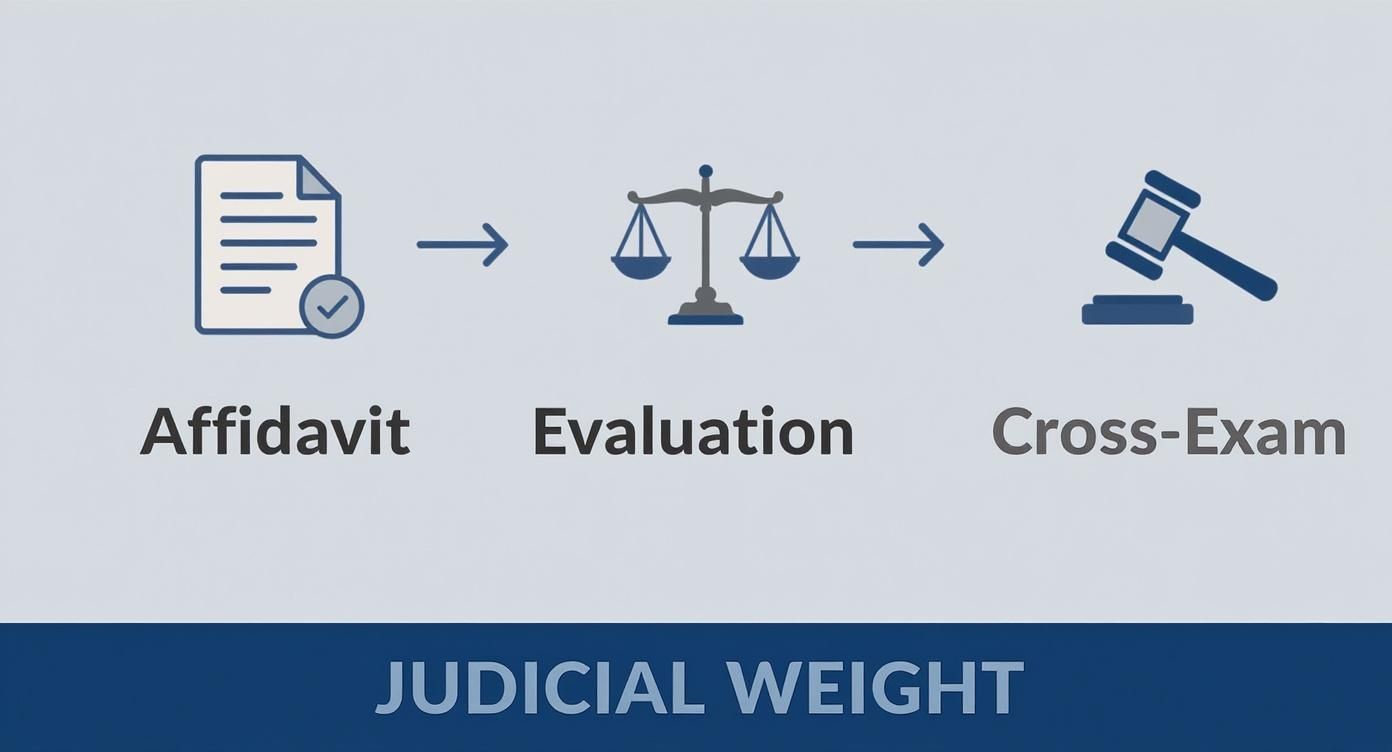
As you can see, an affidavit's journey isn't over once it's filed. Its real test comes when it's evaluated by the court and potentially challenged.
Common Drafting Mistakes vs Best Practices
Even experienced professionals can make small mistakes that have big consequences. Here's a quick look at common pitfalls and how to steer clear of them.
Common Mistake | Best Practice Solution |
|---|---|
Vague or Ambiguous Language | Use precise, clear, and simple language. Avoid jargon and state facts directly. |
Including Arguments or Opinions | Stick strictly to factual statements. Legal arguments belong in pleadings, not affidavits. |
Forgetting to Cite Sources | For facts based on information (not personal knowledge), always state the source of the information. |
Improper Verification Clause | Ensure the verification clearly distinguishes between facts known personally and those based on belief. |
Incorrect Formatting | Follow the court's formatting rules meticulously—title, parties, numbered paragraphs, and signature block. |
Avoiding these common traps ensures your affidavit is not just a document, but a powerful and credible piece of evidence for your case.
Insights on Streamlining the Process with AI
Putting together a perfect affidavit under the CPC can be painstaking work. This is where legal AI tools like Draft Bot Pro can really make a difference. It can generate a compliant template, prompt you for the necessary facts for each section, and make sure all the structural rules are followed. This doesn’t just save a ton of time; it also cuts down the risk of making those small but costly drafting errors that could undermine your case.
For those looking to sharpen their skills even further, be sure to check out our guide on how to improve your legal drafting skills.
Common Questions About Affidavits Under CPC
Once you get the hang of affidavits, you start running into those tricky, practical questions that pop up in the middle of drafting. We've gone through the core rules, but now let's tackle some of the most common queries that lawyers and their teams face day-to-day.
What Is the Difference Between an Affidavit and a Pleading?
This is probably the most frequent point of confusion, but the distinction is actually quite simple.
A pleading—think of a plaint or a written statement—is where you lay out your story. It’s the formal document where you state your claims or your defences and build your legal arguments.
An affidavit, on the other hand, is a sworn statement of fact. Its entire job is to provide the evidence that backs up what you've claimed in your pleading. Put another way: the pleading is the argument, and the affidavit is the proof.
What Are the Legal Consequences of a False Affidavit?
Filing a false affidavit is one of the most serious mistakes you can make. The courts take it incredibly seriously because it’s a direct attack on the integrity of the justice system. This isn't just a simple error; it's seen as a deliberate attempt to deceive the court.
Someone who knowingly swears to false information can be prosecuted for perjury under the Indian Penal Code. The consequences are severe, including potential imprisonment and hefty fines. The court also has the power to initiate contempt of court proceedings against the person who signed it (the deponent).
InsightsYou absolutely cannot overstate how seriously the courts view a false affidavit. They depend on the sworn truth presented in these documents to make decisions. When someone lies, it undermines the entire judicial process and brings down heavy legal consequences on their head.
Can an Affidavit Be Amended After It Is Filed?
As a general rule, no. Once an affidavit has been sworn and filed with the court, you can't just go back and change it. It’s treated as a fixed, unchangeable record of facts as they were stated at that specific moment.
But what if you discover a genuine mistake? In that case, the proper course of action is to file a supplementary affidavit. This new document doesn't alter the original; instead, it corrects the error or adds necessary information. The court will then read and consider both affidavits together. It's vital to be transparent about the correction and clearly explain why the initial error occurred.
How Can Legal AI Help Answer These Nuances?
The maze of civil procedure can be tough to navigate, especially when you need a quick, reliable answer to a very specific question. This is where a legal AI assistant like Draft Bot Pro can be a game-changer.
Instead of losing hours digging through legal texts, you can just ask the AI your question directly. It provides instant, context-aware answers pulled from its vast knowledge base of the CPC and relevant case law. For example, if you’re unsure about the right phrasing for that supplementary affidavit or the procedural steps for filing it, Draft Bot Pro can give you clear guidance and even help generate the exact language you need. It helps you handle these tricky situations with confidence and precision.
Ready to create flawless legal documents without the hassle? Draft Bot Pro offers expert AI-powered drafting and research designed for Indian legal professionals. Trusted by over 46,379 lawyers and students, our platform helps you produce accurate, compliant documents in a fraction of the time. Start your free trial today and see the difference at https://www.draftbotpro.com.
