
Your Practical Guide to Section 104 CPC Appealable Orders

When you're deep in the trenches of a civil suit, it feels like every single order the court makes is a major event. But the law has a different perspective. Section 104 of the Code of Civil Procedure (CPC) is the legal system's way of keeping the main case on track, acting as a strict gatekeeper for which orders can be appealed before a final judgment is even reached.
It's a common misconception that you have a right to appeal every single intermediate decision. In reality, Section 104 exists to prevent exactly that. It's a smart mechanism designed to stop litigation from getting bogged down by endless challenges to minor procedural rulings. This section, which you absolutely must read alongside Order 43, lays out the specific, limited circumstances under which a party can challenge an order while the trial is still ongoing.
Demystifying Section 104 of the Civil Procedure Code
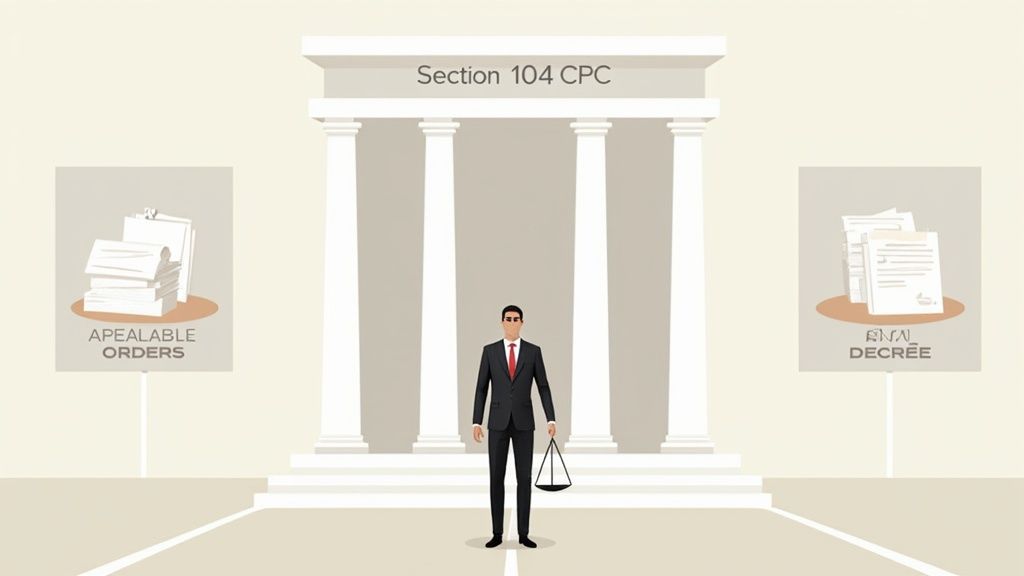
Think of a complex civil trial as a long road trip. The final judgment is your destination. Along the way, the court makes dozens of small decisions—these are the traffic lights, the minor turns, the pit stops. If you could stop and argue about every single one of these through an immediate appeal, you'd never reach your destination. The journey would grind to a halt.
Section 104 CPC is like the highway code that says, "You can't exit the highway to challenge every single traffic light. You can only take an appeal 'exit' for a handful of major decisions that could completely derail your entire trip." This is crucial for preventing the main trial from being endlessly stalled.
The Core Purpose and Function
At its heart, Section 104 is all about balance. On one side, it protects your right to seek justice against a genuinely harmful order that causes serious prejudice to your case. On the other, it protects the court system's efficiency by stopping the main suit from being derailed by constant interruptions.
This is where the idea of appealable orders comes in. Not every direction a judge gives is an 'order' you can appeal. Section 104, working with Order 43, gives you a specific, closed list. If an order isn't on that list, you generally have to wait until the final decree to challenge it.
Insights: The spirit behind Section 104 is simple: interim appeals are the exception, not the rule. The legislature's intent was clear—save your challenges for the final appeal unless an interlocutory order is so damaging that it demands immediate review.
To help you grasp the core concepts before we dive deeper, here's a quick summary of the fundamental principles governing Section 104.
Key Principles of Section 104 CPC at a Glance
Principle | Explanation |
|---|---|
Substantive Right | Section 104 grants the fundamental, substantive right to appeal against certain orders. |
Exhaustive List | The list of appealable orders mentioned in the section is exhaustive and not merely illustrative. |
No Second Appeal | Generally, there is no second appeal from an order passed in an appeal under this section (S. 104(2)). |
Partnership with Order 43 | Section 104 must be read together with Order 43, Rule 1, which provides a detailed list of specific appealable orders. |
Prevention of Delays | The primary goal is to prevent unnecessary delays and piecemeal litigation by limiting interlocutory appeals. |
Understanding these points is the first step to mastering how and when you can file an appeal against an interim order.
Its Crucial Partnership with Order 43
You simply cannot understand Section 104 in a vacuum. It works hand-in-glove with Order 43, Rule 1 of the CPC. Think of them as two parts of the same key. Section 104 gives you the right to appeal, but Order 43 lists many of the specific "doors" (orders) that key can unlock. You need both to open the gate to an appeal.
This structure is what stops the system from being flooded with frivolous appeals that delay justice. For more foundational knowledge on related legal documents, you might find value in checking out our guide to an affidavit under CPC in India. It’s this framework that maintains order in civil proceedings.
How Draft Bot Pro Can Help
Navigating the complexities of the CPC, especially the interplay between Section 104 and Order 43, requires precision. A legal AI like Draft Bot Pro can be instrumental here. When faced with a court order, you can use Draft Bot Pro to quickly verify if it falls under the appealable categories listed in the statute. The AI can cross-reference the specifics of your order against the provisions and relevant case law, providing instant clarity on your next steps and helping you avoid the critical error of appealing a non-appealable order.
The Legislative Intent Behind Section 104
Ever wondered why the Civil Procedure Code doesn’t let you appeal every single court order? The answer isn't about limiting your rights; it's about protecting the very heart of judicial efficiency. This is where Section 104 CPC comes in, drawing a crucial line in the sand between orders that cause real, substantive harm and those that are just minor procedural bumps in the road.
Think of civil litigation like a long road trip. The final decree is your destination. Section 104 essentially creates an express lane for appealing urgent problems that could completely derail the journey. But for smaller issues—like a brief delay or a routine ruling on document submission—you have to wait until you reach the destination. This clever design stops the legal highway from getting jammed with constant, minor challenges.
Without this gatekeeping function, a litigant could theoretically appeal dozens of small orders, paralysing the suit and dragging out justice for years.
Balancing Justice With Efficiency
The core philosophy of Section 104 is all about striking a delicate balance. It respects a litigant's right to appeal an unjust order, but it also prioritises getting cases resolved swiftly. The legislature knew that allowing appeals for every single interlocutory order would just open the floodgates to frivolous litigation, turning the appellate process into a weapon for delay.
This has been a major concern historically. Section 104 is a direct response to the problem of too many appeals clogging up India's civil litigation system. The original 1908 Code was much broader, leading to significant delays. Over the decades, amendments have deliberately narrowed the scope of Section 104 to keep things moving.
The flowchart below gives a great visual of how courts think through this, separating the truly harmful issues from the purely procedural ones.
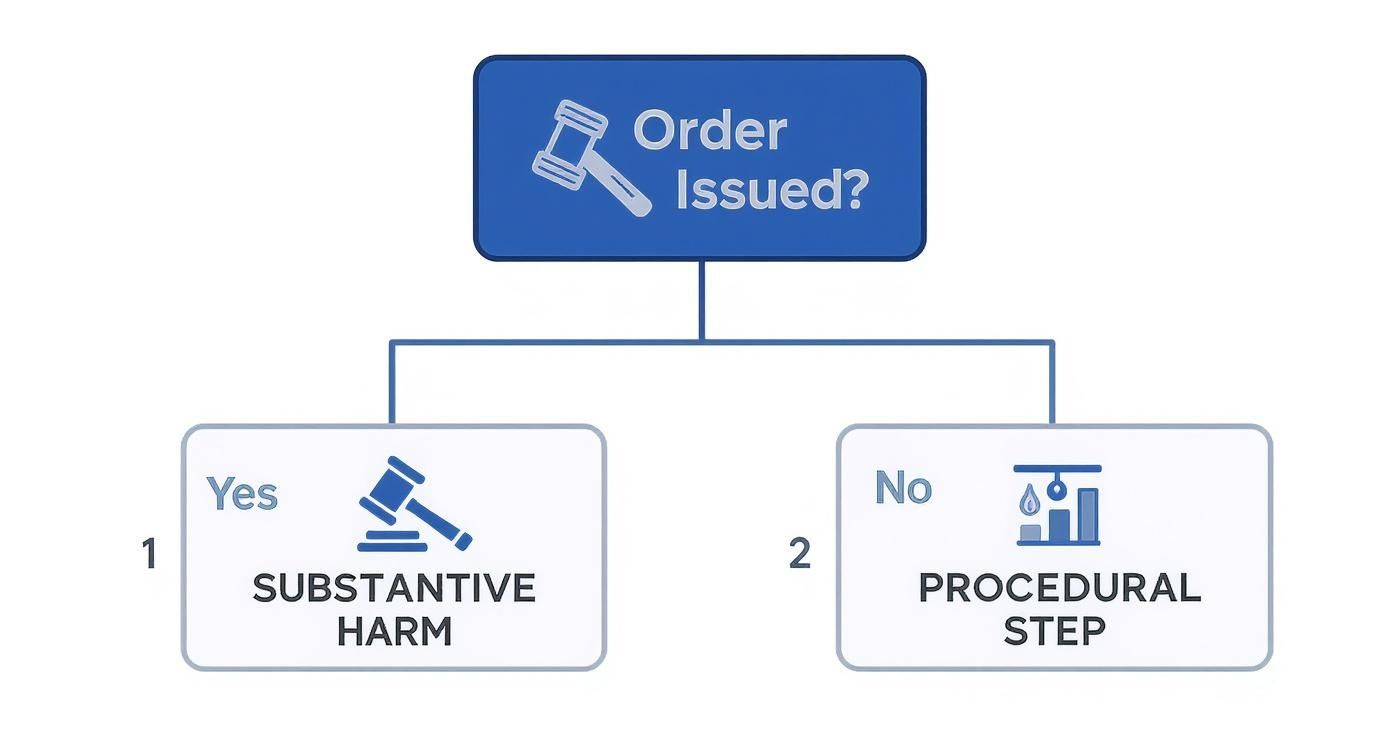
It all boils down to one central question: does the order fundamentally gut a party's rights, or is it just a routine step in the process? The answer decides whether an immediate appeal under Section 104 is on the table.
The Principle of Finality and Preventing Piecemeal Litigation
Another huge principle at play here is the doctrine of finality. The legal system needs to deliver conclusive resolutions. If parties could challenge every little interim step, a single case could shatter into dozens of smaller, simultaneous appeals. This "piecemeal" litigation is exactly what Section 104 is built to prevent.
By limiting appeals to a specific, curated list of orders, the Code makes sure the trial court can actually manage the case all the way to a final judgment. Any gripes about procedural orders that didn't cause irreversible damage can be bundled together and addressed in one big appeal against the final decree. To really get a handle on the legislative thinking here, you need to master effective legal research methods.
Insights: Courts deliberately interpret Section 104 and Order 43 narrowly. This isn't to take away a litigant's rights, but to protect the speed and integrity of the trial itself. It reinforces the idea that interlocutory appeals are the exception, not the rule.
This strict approach is absolutely critical to making the whole system work.
How Draft Bot Pro Can Help
Understanding the theory is one thing, but applying it in a real case can be tricky. This is where a legal AI assistant like Draft Bot Pro is a game-changer. When you're staring at an order and wondering if it's appealable, you can use its AI-powered tools to quickly check the facts of your case against established case law.
For example, you could ask Draft Bot Pro to find judgments that distinguish a procedural order from one affecting substantive rights. In seconds, the tool can pull up summaries of key precedents, helping you build a rock-solid argument for (or against) the appealability of an order under Section 104. It saves you countless hours of digging through books and ensures your strategy is built on solid ground from the start.
A Clause-by-Clause Breakdown of Appealable Orders
This is where the theory behind Section 104 CPC hits the ground running in actual litigation. While Section 104(1) gives you the core right to appeal certain orders, it's Order 43, Rule 1 that spells out the specific menu of what's on offer.
Think of it this way: Section 104 gives you the ticket to the game, but Order 43 tells you which gates are open.
Knowing this list isn't just helpful; it's absolutely non-negotiable for any civil litigator. Filing an appeal against a non-appealable order is a classic rookie mistake, one that gets your appeal dismissed and wastes everyone's time and money. On the flip side, failing to challenge a genuinely damaging—and appealable—order can be a fatal blow to your case.
Orders Relating to Plaints and Pleadings
The opening moves in a lawsuit are full of procedural orders that can shape the entire battle. Thankfully, Order 43, Rule 1 allows appeals against several of these, giving you a chance to fix foundational problems early on.
One of the most frequent is an appeal against an order returning a plaint under Order 7, Rule 10. You file a suit, but the judge decides your court lacks the territorial or pecuniary jurisdiction to hear it. The order isn't a dismissal, but a redirection. If you're convinced the original court was the right one, appealing this order is crucial—otherwise, you're forced to start from scratch somewhere else.
Another critical one is an order rejecting an application to set aside a suit's dismissal for default (under Order 9, Rule 9). Let's say your suit was tossed out because you missed a hearing. You then apply to have it restored, and that application is also rejected. That rejection is appealable. It's a vital safeguard against a single, perhaps excusable, slip-up costing a litigant their entire case.
Orders on Ex-Parte Decrees and Proceedings
Ex-parte matters are a minefield where the right to appeal an order is make-or-break. The textbook example is an order refusing to set aside an ex-parte decree under Order 9, Rule 13.
Imagine a decree is passed against your client because they weren't in court. You move an application to have it set aside, showing there was a good reason for their absence. If the court says no, the ex-parte decree becomes final. Your client loses without ever getting a chance to argue the merits. This refusal is appealable precisely because it strikes at the heart of your client’s right to be heard.
Insights: The appealability of orders tied to ex-parte decrees champions a core principle of natural justice: Audi alteram partem (hear the other side). Section 104, working with Order 43, acts as a crucial safety net when a party is at risk of being condemned without a voice.
This right to appeal ensures that a procedural stumble doesn't snowball into a substantive injustice without at least getting a second look from an appellate court.
Injunctions and Interlocutory Orders
Temporary injunctions are the heavy artillery of civil litigation, and any order touching them can dramatically shift the balance of power. This is why Order 43, Rule 1(r) makes orders granting or refusing an injunction under Order 39, Rules 1 and 2 appealable.
Picture a property dispute where you're trying to stop the other side from starting construction. If the court denies your injunction, the damage could be done long before the final judgment. Conversely, if an injunction is slapped on your opponent, their entire project grinds to a halt, costing them dearly. The stakes are just too high, so the law rightly allows an immediate appeal whether the injunction is granted or refused.
The Role of Legal AI in Navigating These Clauses
Let's be honest, keeping the dozens of clauses in Order 43 straight, especially under pressure, is tough. This is where a legal AI assistant like Draft Bot Pro can be a game-changer.
Imagine the court has just denied your client's plea for a temporary injunction under Order 39, Rule 1. You need to get an appeal memo drafted, and fast. Instead of wrestling with a blank page, you can ask Draft Bot Pro to whip up a preliminary draft. The AI can structure the appeal, pinpoint the right legal grounds based on your facts, and even suggest relevant case law on similar injunction matters. This doesn't just save time; it ensures you're building your appeal on a solid foundation from the very beginning.
To help you get a quick handle on this, the table below summarises some of the most common appealable orders found under Section 104 CPC when read with Order 43.
Common Appealable Orders Under Section 104 and Order 43
Type of Order | Relevant Provision | Brief Description |
|---|---|---|
Returning a Plaint | Order 43, Rule 1(a) | An order under Order 7, Rule 10 returning a plaint to be filed in the proper court. |
Refusing Ex-Parte Rehearing | Order 43, Rule 1(d) | An order under Order 9, Rule 13 rejecting an application to set aside an ex-parte decree. |
Granting or Refusing Injunction | Order 43, Rule 1(r) | An order under Order 39, Rules 1, 2, 2A, 4, or 10 concerning temporary injunctions. |
Appointing or Refusing a Receiver | Order 43, Rule 1(s) | An order under Order 40, Rules 1 or 4 related to the appointment of a receiver. |
This clause-by-clause familiarity is the bedrock of any solid appellate strategy in civil law. Knowing instinctively which orders open the door to an appeal—and, just as importantly, which ones slam it shut—is a skill that truly marks the difference between a novice and a seasoned litigator.
Getting Your Appeal Drafted and Filed

Successfully challenging an order under Section 104 of the CPC isn't just about feeling the lower court got it wrong. It’s a precise procedural dance. One misstep can get an otherwise solid appeal thrown out, wasting your client's time and money.
To get it right, you need to nail three things: picking the right court, hitting your deadlines, and writing a killer memorandum of appeal. A solid grasp of the entire appellate process is non-negotiable. Each step demands careful attention to give your client the best shot at success.
Identifying the Correct Appellate Forum
First things first: where do you file? Before you even think about writing, you have to pinpoint the correct appellate court. This is foundational.
Typically, an appeal against an order from a Civil Judge (either Junior or Senior Division) goes to the District Court. But if the District Judge passed the original order, your appeal heads to the High Court. Filing in the wrong court is an amateur mistake that leads to instant rejection or a painful, time-consuming transfer. Always double-check the court hierarchy and the specific High Court rules to confirm you're in the right place.
Adhering to Strict Limitation Periods
In the world of appeals, the clock is always ticking. The Limitation Act, 1963, lays down strict deadlines that you absolutely cannot ignore. For an appeal to a District Court, you usually have 30 days from the date of the order. For a High Court appeal, the window is wider, generally 90 days.
Missing that deadline can be fatal. Sure, you can file an application for condonation of delay, but winning one is never a sure thing. You have to prove "sufficient cause" for the delay, which is a high bar. To get a better handle on this, check out our guide on mastering the condonation of delay application format. Don't leave it to a chance—track your dates meticulously.
Drafting a Persuasive Memorandum of Appeal
The memorandum of appeal is your opening argument. It's often your best chance to convince the appellate court before you even step into the courtroom. It needs to be sharp, concise, and legally sound. Drop the emotional language and focus on the cold, hard legal errors.
Here's what every strong memo needs:
Clear Grounds of Appeal: List each ground separately. Frame them as mistakes the lower court made, like misapplying a law or ignoring a key piece of evidence.
Statement of Facts: Give a short, neutral summary of the facts that matter for the appeal. This is not the place to introduce new information that wasn't on the record below.
Prayer for Relief: Be crystal clear about what you want. Usually, it's for the appellate court to set aside the lower court’s order.
Insights: A truly effective memorandum does more than just list complaints. It weaves a compelling legal narrative. Each ground should logically connect to the next, building a case that shows why the lower court's decision is legally wrong and has genuinely harmed your client.
A well-crafted memo commands the court's attention and frames the entire case in your favour from the get-go.
How Draft Bot Pro Streamlines the Appeal Workflow
Juggling all the moving parts of a Section 104 appeal is intense. The pressure to get everything perfect is immense, and this is where a legal AI assistant like Draft Bot Pro becomes an invaluable part of your team. It can seriously boost both the speed and quality of your work.
Need to draft that crucial memorandum of appeal? Draft Bot Pro can spin up a structured, comprehensive first draft in minutes. Just feed it the case facts, and the AI helps you articulate the grounds, structure the arguments logically, and tick all the procedural boxes. It can even pull up relevant case law to strengthen your points, saving you hours of research. By handling the grunt work of drafting, Draft Bot Pro lets you focus on the high-level strategy that actually wins appeals.
Landmark Judgments That Shape Section 104
The black-and-white text of Section 104 CPC gives us the framework, but it's the decades of judicial interpretation that paint the full picture. The real-world application of this section has been sculpted by countless court battles, with landmark judgments from the Supreme Court and various High Courts providing the necessary colour and context.
Think of these precedents as the bedrock upon which modern legal arguments are built. They bring much-needed clarity to tricky questions, like the critical difference between an 'order' and a 'decree,' or where exactly we draw the line between a simple procedural ruling and one that genuinely affects a party's substantive rights. For any litigator working in this space, a deep dive into these judicial pronouncements isn't just helpful—it's essential.
Distinguishing Orders from Decrees
One of the most fundamental issues courts have tackled time and again is the distinction between an order and a decree. While a decree provides a final, conclusive determination of the parties' rights in a suit, an order usually just handles procedural matters along the way.
But it's not always that simple. The Supreme Court's decision in Shah Babulal Khimji v. Jayaben D. Kania, (1981) 4 SCC 8, was a game-changer. This seminal judgment dramatically shifted how we interpret appealability. The court held that an order that impacts "vital and valuable rights" and causes "serious injustice" should be treated as a 'judgment' for the purpose of an appeal.
This ruling blew the doors open beyond strict, literal definitions. It introduced a practical test: what is the consequence of the order? It established that if an interlocutory order has the feel and finality of a judgment, it can be appealed. The key takeaway? Just calling something an 'order' isn't enough; its actual effect on the litigants' core rights is what really counts.
Defining the Boundaries of Substantive Rights
Another battleground shaped by case law is figuring out what constitutes an order that affects "substantive rights." Let's be clear: not every inconvenient order is appealable. The judiciary has been careful to uphold the spirit of the law, which is to prevent a flood of appeals on minor procedural hiccups.
Courts have consistently held that for an order to be appealable under Section 104 (read with Order 43), it must directly rule on a party's rights or liabilities in the suit. For example, an order that merely allows an amendment to a pleading? Generally not appealable, as it doesn't finalise anyone's rights. But an order that rejects an application to bring legal heirs on record? That's a different story, as it could effectively kill the lawsuit for the deceased party.
Insights: The judicial trend is clear—the courts are looking for an element of finality or irreversible prejudice. The core question they ask is: if this order is left unchallenged, will it slam the door on a significant legal right or defence for one of the parties?
This thoughtful approach ensures that the appellate process is saved for issues that truly matter to the case's outcome, rather than being used as a tool for delay.
The Role of AI in Leveraging Case Law
Navigating the vast ocean of case law to find that one perfect precedent for your specific situation can feel like searching for a needle in a haystack. This is where a legal AI assistant like Draft Bot Pro gives you a serious edge. Instead of spending hours manually sifting through decades of judgments, you can use its powerful research tools to instantly pinpoint relevant rulings.
Imagine you're arguing that an order refusing to appoint a receiver is causing your client irreparable harm. You can simply ask Draft Bot Pro to find judgments that back up this exact point. The AI can analyse your case facts and pull up the most relevant case summaries, complete with citations and the court's reasoning. You might also want to explore some of the top landmark judgments of the Supreme Court of India to see how foundational cases can shape a winning legal strategy. This lets you build a more persuasive and authoritatively supported appeal memo in a fraction of the time it would normally take.
Your Questions About Section 104, Answered
When you're deep in the weeds of the Civil Procedure Code, it's natural for the same questions to pop up, especially around appealing those tricky interlocutory orders. Let's tackle some of the most common queries legal professionals have about Section 104 CPC.
Think of this as a quick-reference guide to clear up any lingering doubts and make sure the core principles we've talked about really stick.
What's the Real Difference Between an Appeal and a Revision?
This is a great question, and it gets to the heart of appellate procedure. An appeal is a statutory right, a full-blown continuation of the original suit where a higher court can look at the case again, covering both facts and law. It’s a broad re-examination.
A revision, on the other hand, is a different beast entirely. Governed by Section 115 of the CPC, it’s not a right but a discretionary remedy. Here, the higher court isn't re-trying the case; it's just checking if the lower court messed up on jurisdiction. Did it overstep its authority, fail to use the power it had, or act illegally? That's the focus.
So, an appeal under Section 104 challenges the actual substance of an order. A revision is a much narrower supervisory check-up on the lower court's power.
Can I Appeal Any Order a Civil Court Passes?
Not a chance. And that’s the entire reason Section 104 exists. The right to appeal isn't something you can just assume; it has to be specifically given by law. Section 104 CPC, along with Order 43, Rule 1, creates a very exclusive club of appealable orders.
If an order isn't on that list, you can't file an appeal against it. Period. You’ll have to wait until the final decree is passed and then challenge the correctness of that non-appealable order as part of your main appeal.
Insights: This isn't just arbitrary gatekeeping. It's a deliberate policy to stop cases from getting bogged down in endless appeals over every minor procedural ruling. The idea is to keep the main trial moving forward, saving everyone's time and the court's resources for the issues that truly matter.
It's all about pushing the case towards a final resolution.
Is There Such a Thing as a Second Appeal Against a Section 104 Order?
Generally, no. Section 104(2) of the CPC slams the door on that possibility. It’s crystal clear: no further appeal is allowed from any order passed in an appeal under this section.
Let’s break that down. Say you appeal an order, and the first appellate court (like a District Court) hears it and makes a decision. That's the end of the line for that specific issue. You can't then take that appellate decision and file a second appeal to the High Court. This rule is another way the Code prevents litigation from spiralling into never-ending procedural battles.
How Can Legal AI Actually Help with Section 104 Appeals?
Trying to figure out the fine points of Section 104 CPC and digging up the right case law can be a grind, especially when the clock is ticking. This is where a sharp legal AI assistant becomes your secret weapon.
Picture this: you're unsure if a specific order from a trial court is even appealable, or you need to find precedent to back up your argument fast. Instead of spending hours buried in research, you could ask a tool like Draft Bot Pro, "Find Supreme Court judgments that distinguish an appealable order from a simple procedural one under Section 104." In seconds, you get relevant case summaries and citations.
Better yet, when it’s time to draft your memorandum of appeal, Draft Bot Pro can generate a solid first draft that covers all the essential grounds and procedural checkpoints. It helps you build a more compelling appeal by tapping into a massive database of legal knowledge, freeing you up to focus on the winning strategy instead of the grunt work. It’s not just about saving time—it’s about reducing the risk of missing a crucial point that could make or break your case.
Ready to build stronger appeals and streamline your legal research? Draft Bot Pro is the AI-powered legal assistant built by Indian lawyers, for Indian lawyers. Trusted by over 46,379 legal professionals, it helps you draft precise legal documents and find verifiable case law in seconds. Discover how Draft Bot Pro can elevate your practice today.
