
Top 8 Landmark Judgements of Supreme Court of India

The Supreme Court of India, as the final interpreter of the Constitution, has often been a crucible where the nation’s socio-political ideals are tested and forged. It is not merely a court of law but a dynamic institution that has actively shaped the very fabric of Indian democracy. Its pronouncements have extended beyond the confines of courtrooms, profoundly altering the relationship between the state and its citizens, defining the boundaries of fundamental rights, and establishing principles of governance that continue to guide the nation. Understanding these pivotal decisions is crucial for grasping the evolution of Indian constitutional law.
This article delves into eight landmark judgements of the Supreme Court of India that have left an indelible mark on the country's legal and social landscape. We will dissect each case, exploring its historical context, the core legal questions at stake, and the groundbreaking principles the Court established. From safeguarding the Constitution's core structure to expanding the horizons of personal liberty and privacy, these judgements are more than just legal precedents; they are cornerstones of modern India. For legal professionals and students, mastering these cases is not just an academic exercise but a fundamental requirement for navigating the complexities of Indian law.
Insights from Draft Bot Pro
For legal professionals, keeping track of the intricate details, ratios, and subsequent applications of these landmark judgements can be a formidable task. A legal AI tool like Draft Bot Pro can be invaluable. It can help you quickly summarise the core arguments of a case, trace the evolution of a legal doctrine through subsequent rulings, and find specific precedents relevant to your current casework, significantly speeding up research and ensuring comprehensive understanding.
1. Kesavananda Bharati v. State of Kerala (1973): The Unshakeable Foundation
Often hailed as the case that saved Indian democracy, Kesavananda Bharati v. State of Kerala is arguably the most significant of all landmark judgements of the Supreme Court of India. This monumental decision, delivered by a historic 13-judge bench, introduced the revolutionary 'Basic Structure Doctrine', forever altering the balance of power between the Parliament and the judiciary.
The case originated when His Holiness Kesavananda Bharati, head of a religious mutt in Kerala, challenged the state's land reform acts which sought to impose restrictions on the management of his property. This challenge eventually escalated into a broader examination of Parliament's power to amend the Constitution, particularly in light of previous conflicting judgements.
The Judgment and Its Core Principle
The Supreme Court, in a narrow 7-6 majority, held that while Parliament's power to amend the Constitution under Article 368 is wide, it is not unlimited. The court propounded that Parliament cannot amend the Constitution in a way that would alter, abrogate, or destroy its 'basic structure' or fundamental framework. While the court did not provide an exhaustive list of what constitutes the basic structure, it identified several core principles, including:
Supremacy of the Constitution
Republican and democratic form of government
Secular character of the Constitution
Separation of powers
Federal character of the Constitution
Insights
This judgement established a crucial check on the legislative power of the Parliament. It ensures that the core ethos and foundational principles of the Constitution cannot be dismantled by a temporary parliamentary majority, thereby preserving its spirit for future generations.
The Lasting Impact
The Basic Structure Doctrine has become the bedrock of Indian constitutional law. It has been invoked numerous times to strike down constitutional amendments that were deemed to violate this fundamental framework. It acts as a judicial safeguard against potential legislative overreach, ensuring that the Constitution remains a living document whose soul cannot be compromised. This judgement cemented the Supreme Court’s role as the ultimate interpreter and guardian of the Constitution.
For legal professionals, understanding Kesavananda Bharati is non-negotiable as it forms the basis for challenging the constitutional validity of legislative actions and amendments.
How Draft Bot Pro Can Help: Analysing the nuances of the Kesavananda Bharati case and its progeny can be complex. Draft Bot Pro can assist legal teams by generating detailed summaries of subsequent cases that have applied the Basic Structure Doctrine. It can also help draft petitions and legal arguments that rely on this doctrine, providing precedents and identifying the specific 'basic features' relevant to a particular case, thereby enhancing the precision and strength of your legal submissions.
2. Maneka Gandhi v. Union of India (1978): The Dawn of Substantive Due Process
The judgement in Maneka Gandhi v. Union of India represents a watershed moment in Indian constitutional law, fundamentally reshaping the interpretation of fundamental rights. This transformative decision dramatically expanded the scope of Article 21 (Right to Life and Personal Liberty), breathing new life into the Constitution and establishing a robust framework for protecting individual freedoms against arbitrary state action.
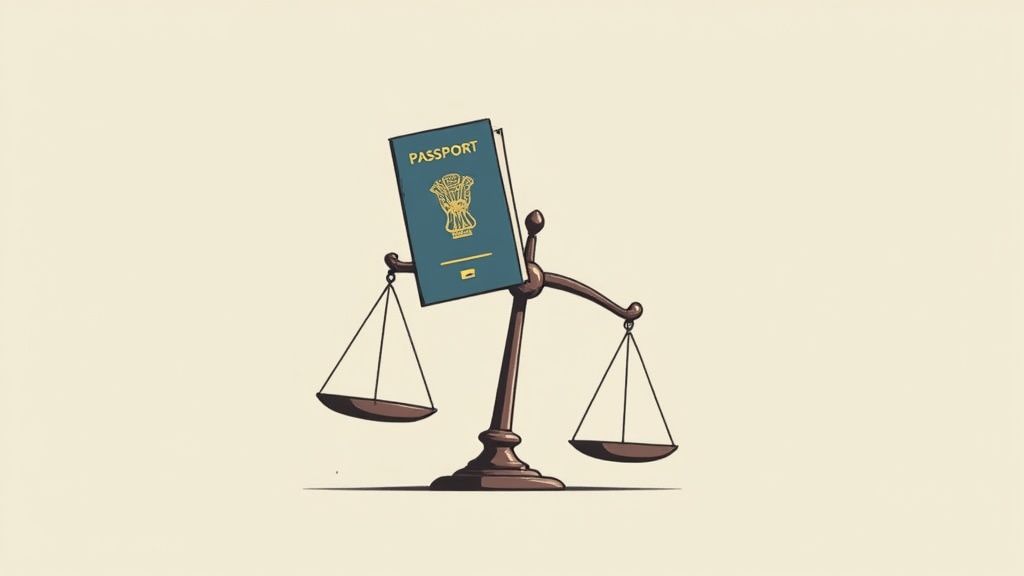
The case arose when the passport of journalist Maneka Gandhi was impounded by the authorities without providing any reason, citing 'public interest'. She challenged this action, arguing it violated her right to personal liberty. This challenge led the Supreme Court to reconsider its previous, more restrictive interpretation of Article 21, particularly from the A.K. Gopalan case.
The Judgment and Its Core Principle
In a landmark decision, the Supreme Court held that the 'procedure established by law' under Article 21 cannot be arbitrary, unfair, or unreasonable. The court introduced the concept of substantive due process, ruling that any procedure depriving a person of their life or personal liberty must be 'right, just and fair'. It established a golden triangle linking Articles 14 (Equality), 19 (Freedoms), and 21, meaning any law must satisfy the requirements of all three to be constitutionally valid. The court also held that the Right to Life is not merely animal existence but includes the right to live with human dignity.
The key principles that emerged were:
The procedure for depriving liberty must be fair, just, and reasonable.
The principles of natural justice, such as the right to be heard (audi alteram partem), are an essential part of this procedure.
Fundamental rights are not isolated silos but must be read together in a harmonious construction.
Insights
This judgement shifted the judicial focus from 'procedure established by law' to 'due process of law'. It ensured that personal liberty can only be curtailed by a law that is not only procedurally sound but also substantively fair and non-arbitrary, significantly enhancing judicial scrutiny over legislative and executive action.
The Lasting Impact
The Maneka Gandhi decision is the foundation upon which the modern jurisprudence of Article 21 is built. It paved the way for the Supreme Court to recognise a vast array of unenumerated rights as part of the Right to Life, including the right to livelihood (Olga Tellis), the right to a clean environment (M.C. Mehta cases), and the right to privacy. It remains one of the most crucial landmark judgements of the Supreme Court of India.
For legal professionals, this judgement is indispensable for any case involving fundamental rights, particularly when challenging the procedural or substantive fairness of state actions that curtail personal liberty or other associated rights.
How Draft Bot Pro Can Help: Crafting arguments that leverage the 'golden triangle' of Articles 14, 19, and 21 requires precision. Draft Bot Pro can instantly access and summarise decades of case law stemming from Maneka Gandhi, helping you build a compelling argument. It can analyse the facts of your case and suggest the most relevant precedents where arbitrary procedures were struck down, providing powerful support for your petitions and oral arguments.
3. Vishaka v. State of Rajasthan (1997): Shielding Dignity at the Workplace
In a pivotal move for gender justice, Vishaka v. State of Rajasthan stands as one of the most crucial landmark judgements of the Supreme Court of India, addressing the pervasive issue of sexual harassment at the workplace. This judgement filled a glaring legislative void, establishing a robust framework to protect the fundamental rights of working women to equality, life, and liberty.
The case was catalysed by the brutal gang-rape of Bhanwari Devi, a social worker in Rajasthan who was targeted for her efforts to prevent child marriage. The acquittal of the accused highlighted the absence of legal mechanisms to address such workplace atrocities, prompting women's rights groups to file a Public Interest Litigation (PIL) before the Supreme Court.
The Judgment and Its Core Principle
In the absence of a specific domestic law, the Supreme Court took an innovative step by drawing upon international conventions, primarily the Convention on the Elimination of All Forms of Discrimination against Women (CEDAW). The Court held that sexual harassment at the workplace is a violation of fundamental rights under Articles 14, 15, 19(1)(g), and 21 of the Constitution. It then laid down a set of mandatory guidelines, famously known as the 'Vishaka Guidelines', to be followed by all employers until Parliament enacted a suitable law. Key directives included:
Defining sexual harassment to include unwelcome sexually determined behaviour.
Mandating the formation of an Internal Complaints Committee (ICC) in every workplace to investigate and redress grievances.
Imposing a duty on employers to prevent harassment and create a safe working environment.
Spreading awareness about the rights of female employees.
Insights
This judgement is a powerful example of judicial activism, where the Supreme Court stepped in to fill a legislative vacuum to protect fundamental rights. It established the principle that international conventions can be used to interpret and enforce domestic law where there are gaps, thereby ensuring that constitutional guarantees of equality and dignity are not just theoretical promises.
The Lasting Impact
The Vishaka Guidelines served as the law of the land for 16 years, fundamentally changing the landscape of workplace safety for women in India. This landmark judgement sensitised organisations and led to the establishment of redressal mechanisms across public and private sectors. Its principles formed the very foundation for the Sexual Harassment of Women at Workplace (Prevention, Prohibition and Redressal) Act, 2013, which eventually codified these protections into formal legislation. The case remains a testament to the judiciary's role in social engineering and protecting the vulnerable.
For legal professionals and HR departments, compliance with the Act, which originated from this judgement, is a critical legal and ethical responsibility.
How Draft Bot Pro Can Help: Ensuring compliance with sexual harassment laws requires meticulous documentation and process management. Draft Bot Pro can generate customised anti-sexual harassment (POSH) policies for organisations, draft notices for the formation of Internal Complaints Committees (ICCs), and create templates for inquiry reports and annual compliance filings. This helps legal teams ensure their clients are fully compliant with the law that originated from the Vishaka judgement.
4. K.S. Puttaswamy v. Union of India (2017): The Right to Privacy as a Fundamental Right
In the digital age, the unanimous verdict in Justice K.S. Puttaswamy (Retd.) v. Union of India stands as a monumental landmark judgement of the Supreme Court of India, cementing a citizen's right to privacy. This historic decision by a 9-judge bench unequivocally declared that the Right to Privacy is a fundamental right, intrinsic to life and personal liberty under Article 21 of the Constitution.
The case emerged from challenges against the government's Aadhaar scheme, which collected biometric data, raising profound questions about individual autonomy and state surveillance. The Court was tasked with resolving conflicting precedents, specifically the older judgements in M.P. Sharma (1954) and Kharak Singh (1962), which had previously held that privacy was not a constitutionally protected right.
The Judgment and Its Core Principle
The Supreme Court delivered a resounding affirmation of individual dignity, holding that privacy is an essential facet of a meaningful life. The judgement overruled the earlier contrary decisions and established that the Right to Privacy is a natural, inalienable right that is fundamental to human existence. It is not an absolute right and can be subject to reasonable restrictions, which must be tested against the principles of legality, legitimate state aim, and proportionality.
The Court elaborated on the multi-faceted nature of privacy, including:
Informational privacy: The right of an individual to control their own personal data.
Decisional autonomy: The right to make personal choices without undue state interference.
Bodily privacy: The right to one's own physical self and integrity.
Insights
This judgement fundamentally shifted the balance between individual liberty and state interests. It established that any intrusion into a citizen's privacy by the state must be just, fair, and reasonable, creating a high constitutional bar against arbitrary surveillance and data collection.
The Lasting Impact
The Puttaswamy judgement has had a transformative effect on Indian law and society. It provided the constitutional foundation for the decriminalisation of homosexuality in Navtej Singh Johar v. Union of India (2018), recognising the right to privacy in matters of sexual orientation. It also influenced subsequent rulings that struck down the mandatory linking of Aadhaar to bank accounts and mobile phones.
This verdict directly prompted the enactment of a dedicated data protection law, culminating in the Digital Personal Data Protection Act, 2023. For legal professionals, it has become a powerful tool to challenge state surveillance, excessive data collection, and any policy that infringes upon personal autonomy, making it indispensable for modern constitutional and digital rights litigation.
How Draft Bot Pro Can Help: The implications of the Puttaswamy judgement are vast and continually evolving, especially in technology law. Draft Bot Pro can help legal professionals by generating arguments grounded in the principles of informational privacy and decisional autonomy. It can identify relevant precedents where the right to privacy has been invoked, from challenging surveillance tech to advocating for consent-based data frameworks, ensuring your legal strategies are both current and constitutionally robust.
5. Navtej Singh Johar v. Union of India (2018): Dignity, Privacy, and Freedom
In a monumental stride for human rights and individual liberty, the judgement in Navtej Singh Johar v. Union of India marked a watershed moment for the LGBTQ+ community in India. This landmark decision by a five-judge Constitution Bench unanimously read down Section 377 of the Indian Penal Code, a 158-year-old colonial-era law that had criminalised consensual homosexual relations between adults.

The case was brought by a group of prominent LGBTQ+ citizens who argued that Section 377, which penalised ‘carnal intercourse against the order of nature,’ was a weapon of harassment and discrimination. It forced a significant section of the population to live in fear, violating their most basic fundamental rights. This judgement corrected a historical wrong, affirming the rights of individuals to love whom they choose.
The Judgment and Its Core Principle
The Supreme Court held that Section 377, in its application to consensual sexual conduct between adults in private, was irrational, arbitrary, and manifestly unconstitutional. The judgement is anchored in the principle that sexual orientation is a natural and immutable aspect of identity, and any discrimination on this basis is a violation of the fundamental rights guaranteed by the Constitution. The core principles upheld were:
Right to Dignity: The court emphasised that dignity is the cornerstone of all fundamental rights.
Right to Privacy: Building upon the Puttaswamy judgement, the court affirmed that the choice of a partner is a fundamental aspect of an individual's private life.
Right to Equality: It held that Section 377 was a direct violation of Article 14 (Equality before Law) and Article 15 (Prohibition of Discrimination).
Right to Freedom of Expression: The court recognised that one's sexual orientation is an essential attribute of self-expression under Article 19.
Insights
This judgement is a powerful affirmation that constitutional morality must trump public or majoritarian morality. It established that the law cannot be used to persecute citizens based on their identity and private, consensual acts, thereby expanding the very definition of freedom and dignity.
The Lasting Impact
The Navtej Singh Johar decision has had a profound and transformative impact on Indian society. It has not only decriminalised homosexuality but has also given legal legitimacy to Pride marches and LGBTQ+ activism, fostering a more inclusive environment. This landmark judgement has paved the way for challenging discrimination in employment, housing, and healthcare, and has sparked crucial conversations around marriage equality and adoption rights for same-sex couples.
For legal professionals, this case is a foundational text for any litigation concerning LGBTQ+ rights and anti-discrimination law. It serves as a powerful precedent for arguing cases related to personal liberty, privacy, and equality, extending far beyond the specific context of Section 377.
How Draft Bot Pro Can Help: The reasoning in the Navtej Singh Johar judgement is multi-layered, drawing from various constitutional principles. Draft Bot Pro can help legal teams quickly extract key arguments and precedents from this voluminous judgement. It can assist in drafting petitions advocating for further LGBTQ+ rights, such as marriage equality, by identifying the core legal principles and applying them to new factual matrices, ensuring your arguments are robust and constitutionally sound. For deeper analysis, explore how AI can be a powerful tool for navigating complex Supreme Court of India judgements.
6. M.C. Mehta v. Union of India (Multiple Environmental Cases): The Green Crusader
The series of cases filed by environmental lawyer M.C. Mehta represents not a single judgement, but a sustained judicial movement that fundamentally shaped India’s environmental jurisprudence. Through numerous Public Interest Litigations (PILs), M.C. Mehta brought critical environmental issues to the forefront, compelling the Supreme Court to act as a guardian of the nation's natural resources and the people's right to a healthy environment under Article 21.
These cases addressed a wide spectrum of environmental crises, from the industrial pollution threatening the Taj Mahal and the contamination of the Ganga river to the hazardous air quality in Delhi. This judicial activism led to the development of a robust framework for environmental law in India, marking a significant chapter in the history of landmark judgements of the Supreme Court of India.
The Judgment and Its Core Principle
Rather than one single ruling, the M.C. Mehta cases established a triad of powerful legal principles. The most groundbreaking was the principle of 'Absolute Liability' from the Oleum Gas Leak case, which holds that an enterprise engaged in a hazardous or inherently dangerous activity has an absolute and non-delegable duty to ensure no harm results. If harm does occur, the enterprise is absolutely liable to compensate, with no exceptions available. Other key principles that were either introduced or strongly reinforced include:
The Polluter Pays Principle: The entity responsible for the pollution must bear the costs of remedying the damage.
The Precautionary Principle: The lack of full scientific certainty shall not be used as a reason for postponing cost-effective measures to prevent environmental degradation.
The Right to a Healthy Environment: Interpreted as an integral part of the Right to Life under Article 21 of the Constitution.
Insights
This series of judgements transformed the Supreme Court into a proactive environmental regulator. By entertaining PILs and issuing continuous monitoring orders (mandamuses), the Court ensured that its directions were not just pronounced but also implemented on the ground, creating a model for judicial oversight in environmental governance.
The Lasting Impact
The impact of the M.C. Mehta cases is visible across India. The mandate for vehicles in Delhi to switch to Compressed Natural Gas (CNG) in the early 2000s, the establishment of the Taj Trapezium Zone to protect the monument from pollution, and ongoing efforts to clean the Ganga river are direct outcomes. These judgements led to the closure of thousands of polluting industries and the progressive strengthening of vehicular emission standards (Bharat Stage norms). They also paved the way for the creation of specialised environmental bodies like the National Green Tribunal (NGT).
For environmental lawyers, these cases are the foundational texts for litigation, providing the legal ammunition to hold polluters accountable and demand state action.
How Draft Bot Pro Can Help: Crafting an effective environmental PIL requires a deep understanding of the principles established in the M.C. Mehta cases. Draft Bot Pro can instantly generate a repository of these judgements, highlighting the specific legal principles articulated in each one. It can assist in drafting petitions by suggesting relevant precedents, framing prayers for relief based on established doctrines like 'Absolute Liability' or the 'Polluter Pays Principle', and citing specific scientific reports and court-appointed committee findings used in past cases, ensuring your submissions are legally and factually robust.
7. Indra Sawhney v. Union of India (1992): The Reservation Framework
Popularly known as the Mandal Commission case, Indra Sawhney v. Union of India is a seminal judgement that shaped the contours of reservation policy in India. This landmark decision by a nine-judge bench addressed complex questions of social justice, equality, and merit, providing a comprehensive legal framework for affirmative action that continues to influence policy and jurisprudence to this day.
The case arose from widespread protests and legal challenges following the V.P. Singh government's decision to implement the recommendations of the Mandal Commission. This commission had recommended a 27% reservation for Other Backward Classes (OBCs) in government jobs and public sector undertakings, sparking a nationwide debate on the very nature of reservation in India.
The Judgment and Its Core Principle
The Supreme Court, while upholding the constitutional validity of providing 27% reservation for OBCs, introduced critical safeguards to balance the objectives of social justice with the need for administrative efficiency and merit. The court's verdict was built on several key principles that created a structured approach to affirmative action:
The 50% Ceiling: The court ruled that total reservations in a given year should not exceed 50%, establishing this as a general rule to maintain a balance with the rights of the general category.
Exclusion of the 'Creamy Layer': It introduced the concept of the 'creamy layer', mandating that the socially and economically advanced members among the OBCs must be excluded from the benefit of reservation.
No Reservation in Promotions: The judgement held that reservations should be confined to initial appointments and not extend to promotions.
Insights
This judgement is a masterclass in constitutional balancing. It affirmed reservation as a vital tool for remedying historical injustices while simultaneously introducing guardrails like the 50% ceiling and the 'creamy layer' principle to ensure that it does not become a tool for reverse discrimination and that its benefits reach the most deserving.
The Lasting Impact
The Indra Sawhney judgement has become the definitive precedent for all matters concerning reservation policy in India. It is the cornerstone upon which subsequent debates, legislative actions, and judicial reviews on affirmative action are built. The principles laid down, especially the 50% ceiling and the creamy layer concept, are constantly invoked in legal challenges to new reservation policies, such as the EWS quota introduced via the 103rd Amendment.
For legal professionals dealing with service law or constitutional challenges, a deep understanding of Indra Sawhney is indispensable as it provides the foundational logic for arguments both for and against specific reservation schemes.
How Draft Bot Pro Can Help: The reservation jurisprudence following Indra Sawhney is complex and has seen numerous constitutional amendments and subsequent judgements. Draft Bot Pro can swiftly analyse the entire timeline of reservation law, generating a precise case brief that highlights how the principles from this landmark judgement have been applied, modified, or distinguished in later cases. This allows legal teams to craft nuanced arguments grounded in a comprehensive understanding of the legal evolution.
8. Shreya Singhal v. Union of India (2015): Champion of Online Free Speech
In the digital age, Shreya Singhal v. Union of India stands as a monumental landmark judgement of the Supreme Court of India, cementing its role as a fierce protector of free speech online. This case decisively struck down the draconian Section 66A of the Information Technology Act, 2000, safeguarding the fundamental right to freedom of speech and expression in the ever-expanding realm of the internet.
The case arose from a series of arrests of individuals for posting allegedly 'offensive' content on social media, including criticism of political figures. Two law students, Shreya Singhal and Aseem Trivedi, filed a petition challenging the constitutional validity of Section 66A, which criminalised sending information of a "grossly offensive" or "menacing character". They argued it was vague, overly broad, and had a chilling effect on legitimate speech.
The Judgment and Its Core Principle
The Supreme Court, in a unanimous and widely acclaimed decision, declared Section 66A unconstitutional and void. The Court found that the provision violated Article 19(1)(a) as its prohibitions were not covered by the reasonable restrictions outlined in Article 19(2). The key flaw identified was its vagueness and overbreadth; terms like "annoyance," "inconvenience," and "grossly offensive" were subjective and not clearly defined, leaving them open to misuse by law enforcement.
Crucially, the judgment made a clear distinction between three forms of speech:
Discussion: The expression of ideas and opinions.
Advocacy: Pleading in favour of a cause or idea.
Incitement: Urging others to commit unlawful acts.
The Court held that only speech that amounts to "incitement" could be restricted, thereby importing the clear and present danger test (similar to the Brandenburg test in the US) into Indian jurisprudence.
Insights
This judgment established that free speech rights apply as robustly online as they do offline. It sent a clear message that the state cannot arbitrarily curb dissent or criticism on the internet using vaguely worded laws, thereby preventing the creation of a 'chilling effect' on public discourse.
The Lasting Impact
The Shreya Singhal judgment is a cornerstone for internet freedom in India. It has served as the primary legal precedent for challenging laws that seek to curtail online speech. Although Section 66A was struck down, its ghost has lingered, with some police forces continuing to use it erroneously. This led the Supreme Court to issue further directives to ensure compliance. The principles from this case have profoundly influenced subsequent debates on digital regulation, including the Information Technology Rules, 2021, and continue to guide the judiciary in balancing security with individual liberty.
For legal professionals dealing with freedom of expression, technology law, or constitutional challenges, this case is an indispensable reference for defending online civil liberties.
How Draft Bot Pro Can Help: Crafting arguments against online speech restrictions requires precision. Draft Bot Pro can instantly access and summarise the core principles of the Shreya Singhal judgment, helping you build a strong legal foundation. It can generate drafts for petitions challenging vague statutory provisions by citing the tests for vagueness and overbreadth laid down in this case, and it can help differentiate between permissible and impermissible restrictions on speech, ensuring your arguments are constitutionally sound.
Landmark Supreme Court Judgements Comparison
Case / Judgment | Implementation Complexity 🔄 | Resource Requirements ⚡ | Expected Outcomes 📊 | Ideal Use Cases 💡 | Key Advantages ⭐ |
|---|---|---|---|---|---|
Kesavananda Bharati v. State of Kerala (1973) | High – 13-judge largest bench, complex doctrine | Moderate – judicial expertise needed | Strong constitutional protection against arbitrary amendments | Protecting constitutional integrity and amendment limits | Establishes unamendable Basic StructureDoctrine; judicial safeguard against overreach |
Maneka Gandhi v. Union of India (1978) | Moderate – 7-judge bench, broad legal principles | Moderate – judiciary and lawyers’ engagement | Expanded fundamental rights, protection of personal liberty | Challenging arbitrary state action and strengthening rights | Broadens Article 21 interpretation; enforces just, fair procedure |
Vishaka v. State of Rajasthan (1997) | Moderate – guidelines-based, adaptable to workplaces | Low to moderate – compliance by organizations | Safer workplaces, legal redressal for harassment | Addressing workplace sexual harassment in absence of legislation | Pioneered sexual harassment laws; empowered women; used international law |
K.S. Puttaswamy v. Union of India (2017) | High – 9-judge bench, nuanced privacy framework | Moderate – judiciary and legal analysis | Recognition of right to privacy, data protection impetus | Challenging surveillance, data misuse, and protecting autonomy | Fundamental recognition of privacy; basis for digital rights and data protection laws |
Navtej Singh Johar v. Union of India (2018) | Moderate – 5-judge bench, targeted decriminalization | Low to moderate – legal advocacy and social adaptation | Decriminalization of homosexuality; affirmation of dignity | LGBTQ+ rights advocacy and anti-discrimination litigation | Decriminalizes consensual acts; affirmed equality and dignity under Constitution |
M.C. Mehta v. Union of India (Multiple Cases) | High – multiple PILs, ongoing judicial monitoring | High – scientific, legal, administrative resources involved | Enforcement of environmental protections, pollution control | Public interest environmental litigation and policy enforcement | Established key environmental principles; empowered citizens; judicial environmental activism |
Indra Sawhney v. Union of India (1992) | High – 9-judge bench, complex affirmative action framework | Moderate – sustained administrative implementation | Affirmative action balanced with meritocracy | Reservation policy formulation and social justice implementation | Framework for reservations with limits; introduced creamy layer principle |
Shreya Singhal v. Union of India (2015) | Moderate – constitutional invalidation of vague law | Moderate – legal reform and judicial enforcement | Strengthened digital free speech; curtailed misuse of laws | Protecting online speech and challenging arbitrary restrictions | Reinforced free speech online; precedent for digital rights |
The Continuing Conversation: The Court's Enduring Legacy
The journey through these eight landmark judgements of the Supreme Court of India is more than a historical review; it is an exploration of the very soul of Indian constitutional democracy. Each case, from the foundational principles laid down in Kesavananda Bharati to the modern affirmation of digital rights in Shreya Singhal, represents a pivotal moment where the judiciary stepped forward to interpret, protect, and expand the rights of every citizen. These are not merely dusty legal precedents; they are the living, breathing architecture of our republic.
What we see is a court that has consistently acted as a guardian of the constitutional ethos. It has defined the unamendable 'basic structure' of our governance, infused 'procedure established by law' with fairness and justice in Maneka Gandhi, and created legally binding guidelines to protect women's dignity in Vishaka. The Court has acted as a progressive force, championing the right to privacy in Puttaswamy, decriminalising consensual relationships in Navtej Singh Johar, and establishing the 'polluter pays' principle through the persistent efforts of M.C. Mehta. It has also navigated the complex socio-political landscape of reservations in Indra Sawhney, striving for a balance between equity and equality.
Key Insights and Actionable Takeaways
For legal professionals, understanding these judgements is not just an academic exercise but a practical necessity. The principles articulated within them are potent tools for advocacy and essential knowledge for offering sound legal counsel.
Embrace the Dynamic Nature of Law: The evolution from Maneka Gandhi to Puttaswamy demonstrates that fundamental rights are not static. Legal professionals must constantly engage with new interpretations to build robust arguments. Use the reasoning in these cases to argue for the expansion of rights in novel contexts.
Leverage Constitutional Principles in Every Case: Even in seemingly routine matters, the principles of natural justice, due process, and fundamental rights can be invoked. The spirit of Kesavananda Bharati reminds us that all state action is subject to constitutional limitations.
Champion Public Interest: The M.C. Mehta cases are a testament to the power of public interest litigation (PIL). Young lawyers can draw inspiration from this to identify and litigate issues of public importance, using judicial precedent as a powerful weapon for social change.
Integrate Technology with Legal Practice: The Shreya Singhal judgement, which grappled with the implications of the digital age, highlights the need for legal professionals to be tech-savvy. As legal practice evolves, so does the need to protect the information that underpins it. Ensuring robust law firm data security is no longer optional; it is a fundamental professional obligation in an era of digital case files and client communications.
The Role of AI in Modern Legal Practice
The sheer volume and complexity of these landmark judgements of the Supreme Court of India can be overwhelming. Drawing connections, tracing the evolution of legal principles, and applying them effectively requires immense effort. This is where modern tools can revolutionise legal practice.
How Draft Bot Pro Can Help: A legal AI like Draft Bot Pro can instantly analyse these seminal cases, extracting key principles and tracing their application in subsequent judgements. It can help a lawyer quickly understand how the 'basic structure' doctrine has been applied post-Kesavananda Bharati or how the privacy test from Puttaswamy has been used in recent High Court rulings. This allows legal professionals to move beyond mere knowledge and towards strategic application, crafting more persuasive and well-supported arguments with unparalleled efficiency.
These judgements are a powerful reminder that the law is a conversation between the past, present, and future. The Supreme Court, through its interpretations, has ensured that our Constitution remains a relevant and transformative document. For every lawyer, law student, and citizen, engaging with these decisions is to participate in the ongoing dialogue that shapes our nation's destiny. They are not the final word, but the foundational pillars upon which future legal progress will be built.
Ready to harness the full power of India's most important legal precedents? Draft Bot Pro is the AI-powered legal assistant designed to help you instantly analyse, summarise, and apply the principles from these landmark judgements in your own work. Visit Draft Bot Pro to see how you can elevate your legal research and drafting today.
