
Guide to disciplinary proceedings against govt. servant: A Practical Overview

When a government servant faces disciplinary proceedings, it's a formal step taken by the employer to look into alleged misconduct or a breach of service rules. This isn't some arbitrary action; it's a process governed by a strict legal framework. The whole point is to strike a balance between administrative needs and the employee's constitutional rights, ensuring everything is handled fairly and justly. Ultimately, this structured inquiry helps maintain public trust and integrity within government services.
Understanding Disciplinary Proceedings for Government Servants
Let's be honest, receiving a notice for disciplinary proceedings can be an incredibly daunting and stressful experience. It’s a formal process that can feel overwhelming, but it's important to understand what it really is: a mechanism for ensuring accountability and discipline within the public sector. Think of it as an internal review, much like in a private company, but with one critical difference—government servants have special constitutional protections.
These protections are in place to guarantee that no action is taken without following the proper procedure. The main goal isn't just to punish; it's to investigate the allegations thoroughly and give the employee a fair and reasonable chance to tell their side of the story.
The Foundation of Disciplinary Action
The entire system for these proceedings is built on a solid foundation of specific rules and regulations. At its core, any action is triggered by some form of employee misconduct, which can be anything from a minor slip-up to a serious violation. The key legal pillars you need to know are:
Article 311 of the Indian Constitution: This is the bedrock of protection for civil servants. It ensures they can’t be dismissed or removed by a subordinate authority and, crucially, must be given a reasonable opportunity to defend themselves.
Central Civil Services (Classification, Control and Appeal) Rules, 1965: Known as the CCS (CCA) Rules, this is the detailed playbook. It lays out the step-by-step procedure for everything from initiating an inquiry to conducting it.
Getting a handle on these rules is the very first step to navigating the process. They cover everything from how a charge sheet must be framed to the precise steps of a departmental enquiry.
Minor vs Major Penalties
One of the first things to grasp is the distinction between minor and major penalties. The seriousness of the alleged misconduct directly influences the potential penalty, which in turn decides the procedural path the inquiry will take.
InsightsThe procedural hoops to jump through for imposing a major penalty (like dismissal or removal from service) are far more rigorous and detailed than for a minor penalty (like a censure or withholding increments). This is to ensure the highest standards of natural justice are upheld when someone's career and livelihood are on the line.
This distinction is absolutely crucial because it shapes the entire course of the disciplinary proceedings against govt. servant. For example, a formal departmental enquiry complete with witness examinations is mandatory for major penalties but might be skipped for minor ones.
How Legal AI Can Help from Day One
The moment you receive a notice or charge sheet, the dense legal language can be overwhelming. This is where a Legal AI tool like Draft Bot Pro can become an indispensable ally. Right from the get-go, it can help you break down complex legal terminology, understand the specific charges levelled against you, and provide clear summaries of the relevant service rules. By gaining this clarity from the outset, you can prepare a much more structured and effective response, ensuring you start your defence on the strongest possible footing.
The Constitutional and Legal Framework Explained
Every disciplinary proceeding against a government servant isn't just a random affair; it's a carefully structured process, grounded in a solid legal framework designed for fairness. Think of it as the official rulebook for a very serious game. Without these rules, actions could be arbitrary. With them, every single move is governed by established principles.
Right at the top of this legal structure is the Constitution of India itself. It provides the ultimate shield for government employees, making sure they're treated fairly and equitably. This constitutional guarantee is what really separates a government job from one in the private sector, where such robust protections might not exist.
Flowing from the Constitution are specific statutes and rules that lay out the nitty-gritty details. These are the nuts and bolts of the system, spelling out everything from how to issue a charge sheet to what penalties can be imposed. Getting a handle on this two-tiered structure is the first step to making sense of the whole process.
Article 311: The Ultimate Constitutional Safeguard
If you're looking for the heart of a government servant's protection, you'll find it in Article 311 of the Indian Constitution. This isn't just another legal clause; it's a fundamental safeguard against any arbitrary dismissal, removal, or demotion. It sets out two golden rules that every disciplinary authority must follow, no exceptions.
These two pillars of protection are:
No Subordinate Dismissal: A government employee can't be dismissed or removed by an authority that is subordinate to the one who appointed them. This simple rule ensures a certain level of seniority and objectivity in the final decision.
Right to a Fair Hearing: No major penalty can be handed down without a proper inquiry. The employee must be clearly informed of the charges against them and given a reasonable chance to mount a defence. This is the very essence of natural justice.
This all works within the "doctrine of pleasure," a principle stating that a civil servant holds their office at the pleasure of the President or the Governor. But Article 311 puts crucial limits on this doctrine. It means this "pleasure" isn't absolute or based on a whim—it must be exercised strictly according to the law. While you can learn more about the structure of public service commissions, which also fall under constitutional mandates, understanding Article 311 is crucial. For more details on related constitutional roles, you can explore our guide on Article 316 of the Indian Constitution and its key functions.
The CCS (CCA) Rules, 1965: In Detail
If Article 311 is the foundation, then the Central Civil Services (Classification, Control and Appeal) Rules, 1965 are the detailed architectural blueprints. These rules provide the granular, step-by-step procedures for conducting disciplinary proceedings against central government employees.
They meticulously define what counts as misconduct, classify the different types of penalties (minor and major), and lay out the exact procedure for imposing each one. For example, the rules specify how a suspension should be handled, what a charge sheet must look like, and the rights an employee has during a departmental enquiry. For both the disciplinary authority and the accused employee, these rules are the go-to manual.
InsightsLandmark Supreme Court rulings have constantly shaped how these rules are interpreted. In the famous case of A.K. Kraipak vs. Union of India, the court famously held that even administrative actions must follow the principles of natural justice. This ruling blurred the line between quasi-judicial and administrative functions, establishing that fairness is a non-negotiable part of any disciplinary action and reinforcing the spirit of Article 311.
How Draft Bot Pro Simplifies Legal Complexities
Let's be honest, wading through the dense text of the Constitution and the CCS (CCA) Rules can be a huge task. This is where a Legal AI tool like Draft Bot Pro gives you a real edge. It can instantly break down and provide clear, easy-to-understand summaries of complicated legal provisions and landmark cases.
Instead of spending hours trying to translate legal jargon, you can get a concise explanation of your rights under Article 311 or the specific procedural steps laid out in Rule 14 of the CCS (CCA) Rules. For a government servant facing proceedings, Draft Bot Pro acts like a powerful research assistant, helping to level the playing field by making the complex legal landscape accessible and manageable.
The journey through a disciplinary proceeding is often filled with procedural traps. Agencies like the Central Vigilance Commission (CVC) and the Department of Personnel and Training (DoPT) oversee these inquiries. However, the CVC usually only gets involved in cases where there's a question of lack of integrity. To fight delays, the CVC has pushed for inquiries to be finished within six months. But even with these guidelines, procedural mistakes are common, often leading tribunals to throw out entire proceedings. This just goes to show how critical it is to follow the rules to the letter.
Navigating the Departmental Enquiry Step by Step
A departmental enquiry for a major penalty isn't some chaotic, unpredictable ordeal. It's a highly structured, formal process that unfolds in a clear sequence. Think of it as a procedural roadmap, where each stage builds on the last, moving from the initial allegation to a final, evidence-based conclusion.
Understanding this flow is absolutely critical for any government servant facing an inquiry. When you know what to expect at each turn, you can prepare effectively, assert your rights, and build a much stronger defence. The journey kicks off with a formal charge sheet and ends when the inquiry report lands on the disciplinary authority's desk.
This legal framework is built on a clear hierarchy, starting from the highest law of the land.
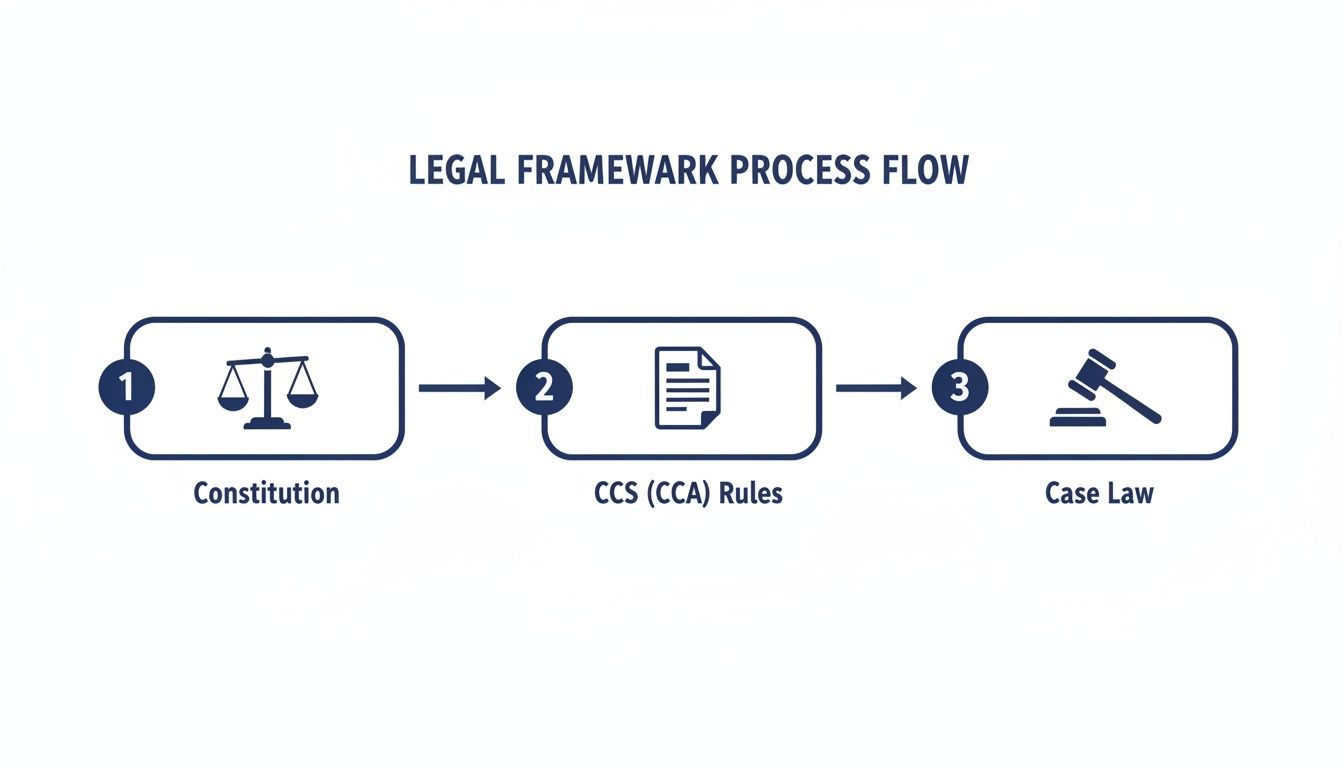
As you can see, the Constitution provides the bedrock principles. Specific service rules, like the CCS (CCA) Rules, add the detailed procedures, and everything is constantly shaped and clarified by court judgments.
The Initial Stages: From Charge Sheet to Written Defence
The entire process is officially set in motion with the issuance of a charge sheet. This isn't just a simple notice; it's a critical legal document that spells out the specific allegations of misconduct against you. It has to be crystal clear, precise, and must come with a list of all documents and witnesses the department plans to use to prove its case.
Once that charge sheet is in your hands, the ball is in your court. You'll be given a set amount of time, usually 10 to 15 days, to submit your written statement of defence. This is your first real chance to tell your side of the story, either admitting the charges or refuting them with your own narrative and evidence.
Appointment of Officers and the Enquiry Proceedings
If you deny the charges in your written statement, the disciplinary authority will then appoint two key officials to move things forward:
Inquiry Officer (IO): An impartial official tasked with conducting the proceedings. Their job is to hear both sides, record all the evidence, and then write up a report based only on those findings.
Presenting Officer (PO): This officer's role is to present the department's case against you, much like a prosecutor in a trial.
The real heart of the enquiry is the examination of witnesses. First, the Presenting Officer calls the department's witnesses to the stand. You (or your Defence Assistant) get the crucial right to cross-examine every single one of them. After the department's case is presented, it's your turn to call your own defence witnesses, who will, in turn, be cross-examined by the PO.
InsightsProcedural mistakes are the Achilles' heel of many disciplinary actions. I've seen countless cases fall apart because of simple errors—failing to properly serve a notice, denying access to a crucial document, or not giving a fair chance to cross-examine a key witness. These are exactly the kinds of details that courts and tribunals zoom in on.
The Inquiry Report and Concluding the Process
After all the witness testimonies have been heard and arguments made, the Inquiry Officer gets to work on a detailed report. This isn't about personal opinion; it's a careful analysis of the evidence presented for each charge. The IO will record a finding on whether each charge has been proved, not proved, or only partially proved. That report is then sent up to the disciplinary authority, who decides on the next course of action.
It's worth noting that the mechanics of a departmental enquiry are quite specific to service law. For a look at how similar processes work in a different context, you can read our complete guide to a domestic enquiry in labour law.
Unfortunately, delays are a massive problem in these proceedings. One government report found that a shocking 69% of delays happen at the administrative level before the inquiry even begins, with another 17% caused by how the inquiry officer handles evidence. These hold-ups don't just violate principles of justice; they create unbelievable stress. You can dig deeper into these systemic issues in the full Hota Committee Report.
How Draft Bot Pro Can Be Your Procedural Ally
Walking through these steps demands meticulous preparation and a solid grasp of the rules. This is where a tool like Draft Bot Pro can be a game-changer.
First, it can help you put together a clear, structured, and persuasive written statement of defence. The AI can analyze the charge sheet and help you formulate strong responses to each specific allegation. More critically, it assists in preparing sharp, relevant questions for cross-examining the department's witnesses. By spotting weaknesses and inconsistencies in their statements, you can effectively dismantle the case against you.
In any formal proceeding, understanding the importance of audit logs for accountability highlights why every procedural step matters. With Draft Bot Pro, your defence becomes more than just a simple denial—it becomes a robust, well-reasoned, and legally sound counter-argument.
Knowing Your Rights and Building Your Defence

Facing disciplinary proceedings can feel like you've been dropped into a dense fog without a map. But you aren't alone. The principles of natural justice and the service rules are your compass, giving you fundamental rights to ensure the entire process is fair and above board.
Knowing these rights isn't just about feeling empowered; it's the absolute first step in building a defence that can stand up to scrutiny. These rights are not polite suggestions—they are legally enforceable. If the department violates any of them, it can be grounds to challenge the entire proceeding. Let's break down exactly what you're entitled to.
Your Fundamental Rights During an Enquiry
Every government servant facing a charge of misconduct is protected by a shield of rights. These are built into the system to level the playing field, making sure you have a real chance to tell your side of the story and respond to the allegations.
Here's what you're guaranteed:
The Right to Be Clearly Informed: You must be given a charge sheet that is specific and crystal clear. Vague accusations just won't cut it. How can you defend yourself against a charge you don't even fully understand?
The Right to Inspect Documents: The department has to hand over copies of all documents and a list of witnesses they plan to use against you. You have an absolute right to inspect this evidence to prepare your response.
The Right to Present Your Evidence: You are entitled to submit your own written statement, bring forward your own documents, and even call witnesses to back up your case.
The Right to a Defence Assistant: You can have another government servant (or sometimes a retired one) act as your Defence Assistant. Think of them as your guide—they help you navigate the process, cross-examine the department's witnesses, and argue on your behalf.
InsightsThe phrase "reasonable opportunity" is the heart of Article 311 and the courts have looked at it very closely. It’s not just some fuzzy concept; it means a real, substantial opportunity. This includes the right to cross-examine witnesses and the right for the disciplinary authority to provide clear reasons for its decision. If they just hand down a verdict with no explanation, that's a direct violation of natural justice.
Common and Powerful Defence Strategies
Beyond simply knowing your rights, a strong defence often targets procedural mistakes or holes in the department's case. A successful outcome can often hinge on finding these cracks in the foundation of the disciplinary proceedings against a govt. servant.
Some of the most effective lines of attack include:
Procedural Flaws: Go through the CCS (CCA) Rules with a fine-tooth comb. Was every single step followed correctly? Was the charge sheet served properly? Was the Inquiry Officer truly impartial? Were deadlines met? A major procedural slip-up can be enough to get the entire proceeding thrown out.
Violation of Natural Justice: This is a classic and powerful defence. Were you denied the chance to see a critical document? Blocked from cross-examining a key witness? Did the Inquiry Officer show obvious bias? Any of these can be argued as a violation of the principles of natural justice.
Mala Fide Intent: This one is tougher to prove, but it's a knockout blow if you can. If you can show that the whole thing was started with malicious intent—to settle a personal score or for reasons that have nothing to do with genuine administration—the action can be challenged as mala fide (in bad faith).
How Draft Bot Pro Fortifies Your Defence
Building a legally sound and coherent defence takes serious organisation and sharp arguments. This is exactly where a legal AI assistant like Draft Bot Pro gives you a massive advantage. The tool helps you systematically pull together all your evidence, documents, and witness statements into a structured case file.
More importantly, Draft Bot Pro can check the actions taken by the disciplinary authority against the specific rule book—the CCS (CCA) Rules. By doing this, it helps you spot potential procedural errors or violations of natural justice that are easy to miss. It then helps you shape compelling written arguments, structure your defence statement, and even prepare for cross-examination by pointing out inconsistencies in the department's evidence. With Draft Bot Pro, your defence becomes more than just a simple reply; it becomes a comprehensive and strategic counter-narrative.
The Final Order and Your Appeal Options
The moment the Inquiry Officer submits their report, the process moves into its nail-biting final stage. But it's vital to remember that this report isn't the final word. Think of it as a set of findings based on the evidence presented, which the Disciplinary Authority must now weigh up before making any decision.
This is a make-or-break point in any disciplinary proceedings against a govt. servant. The Disciplinary Authority will go through the entire case file—the charge sheet, your defence statement, all the evidence, and the inquiry report—to arrive at a well-reasoned conclusion. You will almost always be given a copy of the report and one last chance to make a representation before any penalty is decided.
Understanding the Range of Possible Penalties
If the charges stick, the Disciplinary Authority will issue a final order spelling out the penalty. These aren't just pulled out of a hat; they are clearly laid out in the service rules and fall into two main categories, each with a very different impact on your career.
Minor Penalties:
Censure: A formal slap on the wrist that goes on your official record.
Withholding of Promotion: Your promotion gets put on hold for a specific period.
Recovery of Loss: If you caused a financial loss to the government, they can recover some or all of it from your pay.
Withholding of Increments: Your annual salary hikes are paused for a set time.
Major Penalties:
Reduction to a Lower Stage: Your pay is knocked down a few notches within your current pay scale.
Reduction to a Lower Post: A demotion to a lower grade or position.
Compulsory Retirement: You're forced to retire, though you usually get to keep your pension benefits.
Removal from Service: A serious step that also bars you from future government employment.
Dismissal from Service: The most severe punishment possible, which also disqualifies you from any future government jobs.
Your Avenues for Recourse and Appeal
Getting hit with a tough final order doesn't mean the fight is over. The system is built with multiple channels for you to challenge the decision and fight for a just outcome. Your first and most immediate option is a departmental appeal.
You have the right to file an appeal with the designated Appellate Authority, who is usually a higher-ranking official than the person who penalised you. This isn't just a simple letter; it needs to be a solid, well-argued document that clearly lays out why you're challenging the order. Are there procedural mistakes? Were the findings flawed? Or was the penalty just way too harsh? To get a deeper understanding of these options, check out our guide on navigating India’s Conduct, Discipline, and Appeal rules.
If the first appeal doesn't work, you can also file a review petition. Once you've exhausted all departmental options, the next stop is the courts. You can take your case to the Central Administrative Tribunal (CAT), a special court designed to handle service matters for government employees. From there, CAT's decisions can be challenged in the High Court and, as a last resort, the Supreme Court.
InsightsOne of the strongest arguments you can make when challenging a final order is disproportionate punishment. The courts have said time and again that the penalty must fit the crime. If a minor slip-up leads to dismissal, for example, a court is very likely to call the order "shockingly disproportionate" and send it back to the authority to impose a more reasonable punishment.
How Draft Bot Pro Assists in Crafting a Powerful Appeal
Putting together a convincing appeal is a specialised skill. It's about blending hard facts with sharp legal arguments, and this is where Draft Bot Pro can be a game-changer. Our AI assistant helps you structure your appeal memo so it’s both logical and persuasive.
By going through your case papers and the final order, Draft Bot Pro helps you zero in on the strongest points for your appeal—whether it’s a violation of natural justice or a penalty that’s completely over the top. It helps you phrase your arguments clearly, pulling up relevant legal precedents and service rules to back you up. This makes sure your appeal is not just an emotional plea but a robust, legally sound document built to give you the best possible shot at success.
Frequently Asked Questions About Disciplinary Proceedings
When you're facing disciplinary action, the big picture can be overwhelming, but it's often the small, specific questions that cause the most stress. While the overall process has a set rhythm, every individual's situation throws up its own unique worries. Here, we'll tackle some of the most common questions that pop up during disciplinary proceedings against a government servant.
Think of this as your quick-reference guide. Getting straight answers can cut through the anxiety and help you make smarter decisions as you navigate the road ahead.
Can I Be Suspended Indefinitely?
Absolutely not. A government servant cannot be left hanging in suspension forever. The rules, particularly Rule 10 of the CCS (CCA) Rules, 1965, are designed with built-in checks to prevent this exact scenario.
An initial suspension order is only good for 90 days. Before that clock runs out, a review committee has to meet and decide if there's a real need to extend it. If they miss that deadline, the suspension order simply dissolves, and the employee is considered back on duty.
Even if they do extend it, those extensions have their own time limits—usually 180 days at a time—and each one demands a formal review. This system ensures that suspension is used as a temporary measure, not as a back-door punishment without a proper hearing.
InsightsThe Supreme Court has made its stance clear time and again: keeping someone on suspension for a prolonged period without concluding the inquiry is simply not fair. If you find your suspension is dragging on without a good reason, you can challenge it at the Central Administrative Tribunal (CAT). It can be argued as an arbitrary action that violates your right to a speedy resolution.
What Is the Role of the Central Vigilance Commission?
The Central Vigilance Commission (CVC) is the top watchdog for integrity in the central government, but it doesn't poke its nose into every single disciplinary case. Its involvement is reserved for matters that have a "vigilance angle"—think allegations of corruption, dishonesty, or anything that questions your integrity.
You'll typically see the CVC step in at two key moments:
First Stage Advice: This happens after a preliminary look into the allegations but before a charge sheet is issued. The department might ask the CVC if the evidence is strong enough to start major penalty proceedings.
Second Stage Advice: Once the inquiry is over and the report is in, the department consults the CVC again. This time, they're seeking advice on what kind of punishment, if any, fits the findings.
Now, the CVC’s advice isn't a legally binding order. However, departments are expected to take it very seriously. If they decide to go against the CVC's recommendation, they need to have very solid reasons to justify it.
What Happens to My Retirement Benefits if Proceedings Are Pending?
This is a major concern for many. If you're set to retire while a disciplinary case is still active against you, your benefits will be impacted. The rules allow for your pension and gratuity to be put on hold until the whole affair is concluded.
You won't be left with nothing, though. You'll be sanctioned a provisional pension to tide you over. The final decision on your full pension and the release of your gratuity hinges entirely on the outcome of the inquiry. If you're cleared of all charges, everything that was withheld will be released to you. But if a penalty is imposed, the President has the authority to withhold or even withdraw your pension, or recover losses from it.
Can Criminal and Departmental Proceedings Run Simultaneously?
Yes, they can, and it's a perfectly legal and common practice. This might sound like "double jeopardy," but the courts have established that it's not. The reason is simple: the two proceedings are fundamentally different beasts.
A departmental inquiry is about your fitness to continue in your job. The standard of proof is the "preponderance of probability"—basically, is it more likely than not that you committed the misconduct? A criminal trial, on the other hand, is about proving a crime "beyond a reasonable doubt," a much higher bar.
This is why getting acquitted in a criminal case doesn't automatically get you off the hook in a departmental inquiry. If the acquittal was due to a technicality (like a witness not showing up) and not because you were proven innocent, the departmental proceedings can still continue and find you liable.
How Draft Bot Pro Can Clarify Your Doubts
Trying to make sense of all these rules can feel like you're lost in a maze. This is where a legal AI tool like Draft Bot Pro can be a game-changer. You can upload the specific service rules or circulars that apply to your case and ask it direct questions. Get instant, clear answers about suspension timelines, the CVC's exact role, or how retirement benefit rules work in your situation. Having that kind of accurate information on demand gives you a firm footing and helps you understand exactly where you stand.
Navigating the choppy waters of disciplinary proceedings demands clarity and a solid strategy. Draft Bot Pro gives you the AI-powered edge you need to dissect charge sheets, build powerful legal arguments, and make sense of complex service rules. Fortify your defence with cutting-edge legal tech that thousands across India already trust. Visit https://www.draftbotpro.com to see how we can help.
