
article 316 of indian constitution: Key Facts and Roles

Article 316 of the Indian Constitution is the blueprint for appointing members to the Public Service Commissions. It’s the rulebook that dictates how the gatekeepers of India's vast civil services are chosen, ensuring both the Union Public Service Commission (UPSC) and the State Public Service Commissions (SPSCs) are led by qualified, impartial individuals. For legal professionals and students, understanding this article is crucial, and a Legal AI like Draft Bot Pro can significantly streamline the research process by providing instant summaries and analysis of its clauses.
What Is the Purpose of Article 316?
Imagine India’s civil service as a world-class orchestra. For it to perform perfectly, you need a panel of expert judges to audition and select the absolute best musicians. Article 316 is essentially the set of rules for forming this crucial selection committee. It makes sure the judges themselves are seasoned, unbiased, and have a sharp eye for talent.
This provision lays down the entire framework for the appointment, qualifications, and tenure of the members of these powerful commissions. At its heart, the goal is simple: to shield the merit-based recruitment system from political pressure and keep the playing field level for everyone.
To get a better sense of how this works, here's a quick breakdown of its key components.
Quick Overview of Article 316 Provisions
This table summarises the core mechanics of Article 316, giving you a quick reference for who appoints whom.
Provision | Appointing Authority | Applicable Body |
|---|---|---|
Clause (1) | President of India | Union Public Service Commission (UPSC) |
Clause (1) | Governor of the State | State Public Service Commission (SPSC) |
Clause (1A) | President of India | Joint Commission (for two or more states) |
Clause (2) | President or Governor | Acting Chairman appointment |
As you can see, the appointing authority is clearly defined, which is a fundamental aspect of maintaining the federal structure while ensuring accountability.
The Core Principles of Appointment
The article is crystal clear about who holds the power to make these critical appointments. For the UPSC, that authority rests with the President of India. When it comes to the SPSCs, the respective State Governor is in charge. This division of power is a classic feature of India's federal system, establishing a direct line of command.
But it’s not just about who appoints them; it's also about who can be appointed. A crucial rule is that at least half of the members of any commission must be people who have held a government office for at least ten years, either under the Government of India or a state government. This is a brilliant stroke of constitutional wisdom, as it guarantees a healthy mix of deep administrative experience and fresh perspectives on the commission.
Ensuring Independence and Impartiality
Article 316 isn't just a hiring manual; it’s a shield protecting the commissions' autonomy. Members are given a fixed tenure of six years or until they hit a specific age limit, which insulates them from the threat of arbitrary removal. This job security is what allows them to do their work without fear or favour, upholding the very integrity of the civil service recruitment process.
Insights: The fixed tenure is more than just a job perk; it's a critical constitutional safeguard. It empowers commission members to make impartial decisions, even if those decisions are politically inconvenient, thereby preserving the merit-based foundation of the Indian bureaucracy.
To get the full picture of what these commissions are tasked with, it's worth exploring our detailed guide on Article 320 of the Indian Constitution. For any law student or legal professional, understanding how these articles connect and interact is absolutely key.
This is where a Legal AI like Draft Bot Pro can be a game-changer. Instead of spending hours manually cross-referencing constitutional articles, you can simply ask the AI to summarise the appointment criteria under Article 316 or compare it with the functions laid out in Article 320. You get instant, accurate answers, all backed by verified sources.
How Commission Members Are Appointed
So, how do individuals actually get appointed to these powerful Public Service Commissions? It's not a free-for-all. The entire process is carefully laid out in Article 316 of the Indian Constitution, ensuring it’s structured and deliberate.
Think of it like putting together an expert committee for a mission-critical national project. You need a clear leader to make the final call, and you need non-negotiable criteria to ensure you’re getting the right people for the job. Article 316 provides precisely that blueprint.
The appointing authority is split cleanly, reflecting India's federal system. For the Union Public Service Commission (UPSC), the body that handles recruitment for all-India services, the President of India has the sole power to appoint the Chairman and its members.
When it comes to the State Public Service Commissions (SPSCs), which manage recruitment for state-level jobs, that power rests with the Governor of that specific state. This clear division of power ensures that both the central and state governments have independent bodies to manage their administrative needs without stepping on each other's toes.
This visual shows the journey of a member, from their appointment right through their term, all anchored by the constitutional goal of impartiality.As the infographic shows, the entire lifecycle of a commission member is designed to shield the institution's integrity and independence.
The Crucial Qualification Criteria
The Constitution doesn't just stop at naming who does the appointing. It also lays down a vital rule about who can be appointed. This is where the "expert committee" idea really clicks. You wouldn't want a panel of judges who've never seen the inside of a courtroom, right?
In the same vein, Article 316 makes sure that the commissions are packed with real-world administrative experience.
Article 316 (1) states: "...as nearly as may be one-half of the members of every Public Service Commission shall be persons who at the dates of their respective appointments have held office for at least ten years either under the Government of India or under the Government of a State..."
This single clause is the bedrock of the commission's competence. It mandates that at least 50% of the members must have spent a minimum of ten years in government service. This is a deliberate move to create a balanced team of:
Seasoned Administrators: People who have a deep, hands-on understanding of how the government machinery actually works, its quirks, and its real-world challenges.
Diverse Experts: The other half can be drawn from different walks of life—academics, lawyers, scientists, and more—bringing in fresh thinking and specialised knowledge.
This blend is no accident. It’s designed to create a body that is both grounded in reality and forward-looking, capable of picking civil servants who are not just book-smart but also equipped for the practical demands of public service.
Making Sense of Complex Appointments
For law students and legal professionals, digging into these appointment rules, their history, and the case law surrounding them can be quite a slog. This is where modern tools can genuinely help.
You can use a Legal AI like Draft Bot Pro to instantly break down the complexities of these appointment procedures. For instance, you could ask it to contrast the appointment powers of the President and a Governor under Article 316 or to pull up a summary of key cases related to a member's qualifications. It delivers precise, source-backed answers, freeing you up to focus on analysis instead of getting bogged down in manual research. This makes getting to grips with article 316 of the Indian constitution much faster and far more effective.
Understanding Tenure, Resignation, and Removal
When we talk about Public Service Commissions, two words should immediately spring to mind: stability and independence. These aren't just buzzwords; they're the very pillars holding up the integrity of these institutions. To make sure they can operate free from outside influence, Article 316 of the Indian Constitution lays down the law on everything from how long members serve to how they can resign or be removed.
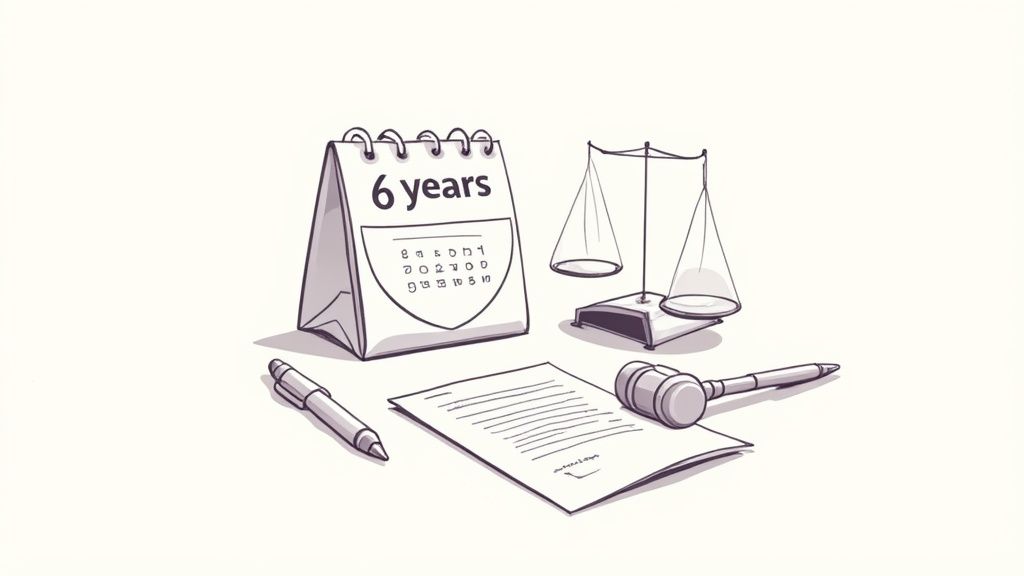
Think of this security of tenure as a protective shield. It’s not some minor procedural point—it's what guards against political meddling. By giving members a fixed term, the Constitution empowers them to make impartial, merit-based decisions, rather than ones that bend to political winds.
The Fixed Term of Office
So, how long do they serve? Article 316(2) sets a clear timeline: a member of a Public Service Commission holds their position for a term of six years right from the day they start. But it’s not just about the years; there’s an age cap, and it’s different for the Union and State commissions.
UPSC Members: They're in for six years or until they hit 65 years of age, whichever comes first.
SPSC Members: Their term is also six years, but the age limit is a bit lower at 62 years, again, whichever is earlier.
This fixed-term structure is crucial. It creates a predictable and stable environment, which is essential for long-term planning and applying recruitment standards consistently. It's a deliberate design to stop the kind of frequent member turnover that could easily disrupt the commission's work and leave it vulnerable to outside pressure.
The Resignation Process
What if a member wants to leave voluntarily? While the tenure is fixed, it's not a prison sentence. Article 316(2)(a) outlines a formal, straightforward process for stepping down.
A member of the UPSC who wishes to resign simply needs to submit a written notice to the President of India. For a member of an SPSC, the process is the same, but the notice goes to the Governor of their state. This ensures that a member's departure is as constitutionally sound and officially recorded as their appointment, maintaining the integrity of the institution from beginning to end.
Insights: The security of tenure granted by Article 316 is the bedrock of the commissions' autonomy. By protecting members from arbitrary dismissal, the Constitution empowers them to act as true guardians of the merit principle, ensuring a fair and transparent selection process for India's civil services.
Grounds for Removal
Now, this is where the shield really shows its strength. A member can't just be fired on a whim. The process for removal is incredibly stringent and ties directly into Article 317 of the Constitution, which covers the removal and suspension of a Public Service Commission member.
Removal can only be ordered by the President, and only on the ground of "misbehaviour." Even then, it’s not an executive decision alone. The Supreme Court must first conduct a formal inquiry and confirm the charge.
This strict procedure is another vital safeguard. It means members can carry out their duties without constantly looking over their shoulders, reinforcing their independence and the credibility of the commission itself.
For legal professionals, getting a grip on the interplay between Articles 316 and 317 is absolutely critical. This is where a Legal AI like Draft Bot Pro can be a game-changer. You could ask it to quickly generate a comparative analysis of the resignation and removal clauses or dig up key case law related to what constitutes "misbehaviour" for a commission member. It delivers accurate, source-verified information in an instant, helping you build a much stronger, practical understanding of these constitutional safeguards.
The Evolution of Public Service Commissions in India
To really get to the heart of Article 316 of the Indian Constitution, you have to look back at where the idea came from. The concept of an independent body for hiring civil servants wasn't just invented in 1950; its roots go deep into the British colonial era. This was a time when the need for a structured, merit-based administration was becoming painfully obvious.
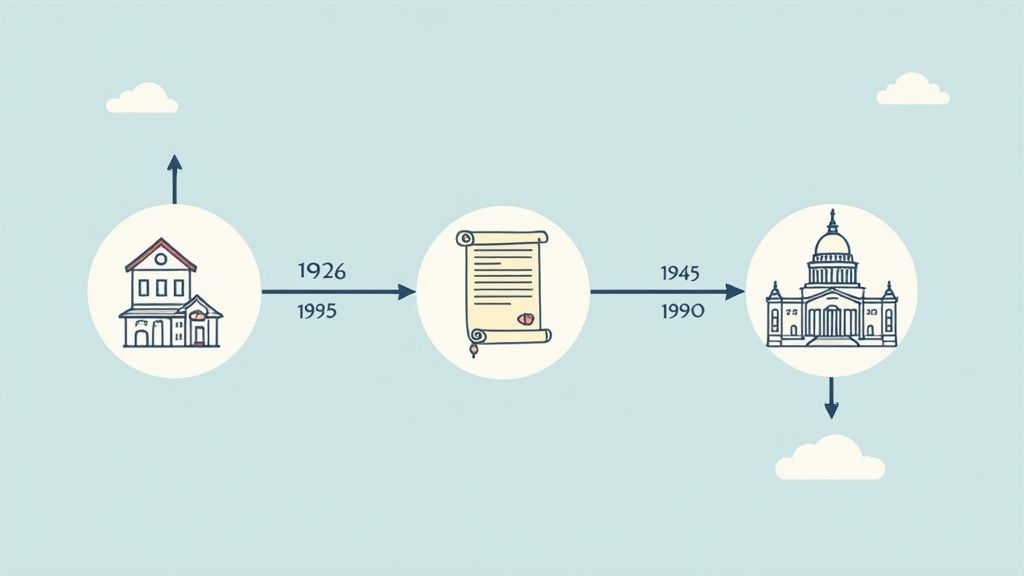
The journey officially kicked off on 1st October 1926, with the creation of the first Public Service Commission, led by Sir Ross Barker. Back then, its role was quite limited and entirely advisory. Still, this was a crucial first step, setting the stage for a more powerful and independent recruitment body down the line.
The real game-changer was the Government of India Act, 1935. This landmark law transformed the advisory body into a Federal Public Service Commission, giving it far more autonomy and a wider scope of work. This shift showed a growing understanding that good governance depended on an impartial commission, one that was free from the strings of political favouritism.
From Federal Commission to Constitutional Body
When India's Constituent Assembly sat down to write the new Constitution, they didn't have to start from scratch. They had decades of experience—and mistakes—to learn from. They knew all too well the problems of the past: nepotism, political meddling, and wildly inconsistent hiring standards. It was clear that the solution had to be powerful and protected by the Constitution itself.
This historical context is everything. The framers didn't just create the Public Service Commissions out of thin air; they took an existing idea and gave it constitutional armour. By embedding the rules for appointments and tenure directly into Article 316, they made sure these commissions would be stable, permanent, and shielded from the whims of those in power. Turning it from a statutory body into a constitutional one was a deliberate move to protect the integrity of India's civil services for good.
Insights: The constitutional status given to the UPSC and SPSCs was a direct answer to the challenges of history. The framers wanted to build a wall against patronage, making sure that a career in public service was open to talent, not just connections.
Why This History Matters Today
Understanding this backstory makes it clear why Article 316 is so detailed. It’s not just a list of procedures; it’s the result of decades of administrative trial and error. Every provision—on appointments, tenure, and qualifications—is designed to uphold that merit-based ideal that began back in 1926. This legacy still guides the commissions and the courts today. You’ll often see this history referenced in legal judgments, and for a better grasp, you might find our article on [8 landmark cases in India that transformed the Constitution](https://www.draftbotpro.com/post/8-landmark-cases-in-india-that-transformed-the-constitution) insightful.
For legal professionals and students trying to unpack Article 316 of the Indian constitution, tracing this legislative history can be a real headache. This is exactly where a Legal AI like Draft Bot Pro can be a lifesaver. You can ask it to summarise the key changes from the 1935 Act to the final constitutional text. In an instant, you'll get a clear picture of the framers' intent, giving you a solid foundation for your research.
How Legal AI Can Help With Constitutional Research
Wading through the dense text of the Indian Constitution can feel like a monumental task, even for those of us who live and breathe the law. When you need to get to the bottom of a specific provision like Article 316 of the Indian Constitution, the old-school approach means hours buried in commentaries, legislative debates, and sprawling case law databases. It's thorough, but it's slow.
This is where technology is stepping in to give us a real edge. A Legal AI like Draft Bot Pro is completely changing the game for legal research, making it faster and far more precise than ever before.
Think about it. An AI-powered legal assistant can turn a mountain of work into a molehill. Instead of manually piecing together the relationship between the appointment process in Article 316 and the removal process in Article 317, you can just ask. The AI will pull it all together, giving you a concise, source-backed summary in a matter of seconds.
Practical Applications for Legal Professionals
For practising advocates and law students, the benefits are immediate and incredibly powerful. Let’s say you’re prepping a memo on the eligibility criteria for SPSC members. You could ask a Legal AI like Draft Bot Pro to generate detailed research notes, pulling up landmark judgments related to member appointments under Article 316. Just like that, you have a solid foundation to build on.
Insights: The real magic of Legal AI is its ability to do the heavy lifting. It automates the tedious search for relevant case law and legislative history, freeing you up to focus on what really matters: strategic analysis and building a killer argument.
These tools are also brilliant at comparative analysis. Need to know the key differences between the appointment criteria for UPSC and SPSC members? You can get a side-by-side comparison highlighting the constitutional justifications, a task that would have taken a significant chunk of your day. To see exactly how these platforms operate, you can explore this AI legal research tool in India.
To better understand the technology that powers these tools, you might find this article on Building Fastest AI Audio Transcription an interesting read. It helps turn what was once tedious constitutional analysis into a streamlined and highly accurate workflow.
Draft Bot Pro Features for Constitutional Law
Here’s a quick look at how a specialised tool like Draft Bot Pro transforms the often-daunting task of constitutional research.
Research Task | Traditional Method | Advantage with Draft Bot Pro |
|---|---|---|
Finding Case Law | Manually searching through databases like SCC Online or Manupatra with keywords. | Instantly pulls up the most relevant and cited judgments related to Article 316 and its clauses. |
Comparative Analysis | Opening multiple books or tabs to compare appointment processes of UPSC vs. SPSC. | Generates a side-by-side comparison table or summary highlighting key distinctions in seconds. |
Understanding Provisions | Reading through dense commentaries and scholarly articles to grasp the full meaning. | Provides clear, plain-language explanations of complex constitutional articles, backed by sources. |
Building Arguments | Spending hours piecing together points from various sources to form a coherent legal argument. | Suggests potential arguments and counter-arguments based on existing case law and interpretations. |
Using a Legal AI built specifically for legal work means you're not just getting information faster; you're getting smarter, more relevant insights that directly support your case or study.
Got Questions About Article 316? Let's Break It Down.
When you start digging into the nuts and bolts of Article 316 of the Indian Constitution, a few practical questions always pop up. It's one thing to read the text, but another to understand how it plays out in the real world. Let's tackle some of the most common queries that stump students, legal pros, and civil service aspirants alike.
Can a PSC Member Be Reappointed to the Same Job?
This is probably the most frequent question, and the answer is a straightforward no.
Once a member of a Public Service Commission finishes their term, they cannot be reappointed to that exact same position. This isn't just a procedural rule; it's a powerful safeguard built into the Constitution. The entire point is to maintain absolute impartiality and prevent anyone from developing vested interests. By making it a one-time gig, the framework ensures a member's decisions aren't coloured by the hope of getting another term. It reinforces the integrity of the commission from the ground up.
What Happens if the Chairman's Post is Empty?
Life happens. A Chairman might be on leave, or the position could suddenly become vacant for other reasons. Does everything grind to a halt? Not at all.
The Constitution has a solid backup plan laid out in Article 316(1A). If the Chairman's office is temporarily empty, the President (for the UPSC) or the state Governor (for an SPSC) can appoint an existing member of the commission to step in as the Acting Chairman. This simple provision ensures the commission's work carries on seamlessly until a permanent replacement is found or the original Chairman returns.
Insights: These rules for an Acting Chairman and the ban on reappointment aren't just administrative fine print. Think of them as constitutional fail-safes. They're designed to guarantee two things: continuity of work and the unquestionable impartiality of the Public Service Commissions, preventing any one person from wielding influence for too long.
How Do Joint Commissions Work?
Here's a slightly more complex scenario. What if two or more states decide to team up and use a single commission for their recruitment needs? This is what's known as a Joint Public Service Commission (JPSC).
For this to happen, the legislatures of the states involved must first pass a resolution asking for one. Once they do, Parliament can step in and create a JPSC by law. The really interesting twist here is who makes the appointments. For a JPSC, the Chairman and its members are appointed by the President of India, not the individual state Governors. This makes perfect sense—you need a neutral appointing authority to oversee a body that serves multiple states.
Keeping these distinctions straight, especially the different appointment procedures for a JPSC versus a regular SPSC, is a classic challenge for anyone studying constitutional law. This is exactly where a Legal AI like Draft Bot Pro can make a world of difference. For instance, it can instantly clarify these nuances under Article 316, giving you verified answers in seconds and saving you from hours of sifting through dense texts.
For expert legal research and drafting powered by AI, explore Draft Bot Pro. Visit us at https://www.draftbotpro.com to see how thousands of legal professionals are working faster and smarter.
