
Your Guide to Navigating Section 207 MV Act

Picture this: a client calls in a panic. Their truck has been stopped and the police are threatening to detain it. The reason? A missing permit. This is where Section 207 of the Motor Vehicles Act, 1988, stops being a dry legal provision and becomes a real-world problem you need to solve, fast.
Section 207 gives police officers and other authorised officials the power to detain a vehicle if it's being driven without a valid Registration Certificate (RC) or permit. It’s one of the most direct and potent enforcement tools in the entire Act, designed to get non-compliant and untraceable vehicles off our roads.
Why This One Section Can Make or Break a Case
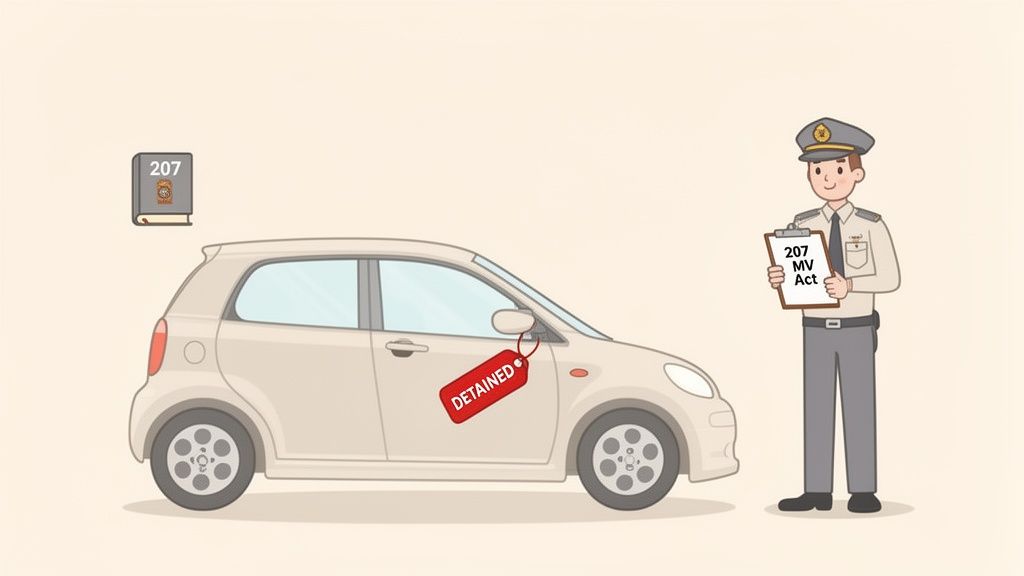
For any lawyer or law student in India, getting a handle on the 207 MV Act is non-negotiable. This is where administrative law smacks right into a citizen's right to property. When a client’s vehicle gets seized, they don't care about legal theory; they want to know if the detention was legal, how quickly they can get their vehicle back, and if they can challenge the officer's action. A solid grasp of Section 207 isn't just academic—it's your practical playbook.
The Motor Vehicles Act, 1988, is the bedrock of road safety law in India, and the stakes couldn't be higher. With official reports showing that 153,972 people were killed in road accidents in just one year, the need for strict compliance is painfully clear. As these numbers continue to climb, a lawyer’s expertise in MV Act enforcement becomes more critical than ever. You can find more on this from the Ministry of Road Transport and Highways.
What Makes Section 207 a Big Deal?
This isn't just about paying a fine. Section 207 authorises the physical removal of a vehicle from the road. It’s a powerful deterrent, and knowing its ins and outs is vital for:
On-the-Spot Advice: Giving your client clear, correct advice during a tense roadside stop or after their vehicle has been impounded.
Fighting Unfair Seizures: Spotting procedural mistakes or unlawful detentions to build a strong challenge, whether through a legal notice or a court application.
Getting the Vehicle Back: Expertly navigating the Superdari process (the legal term for releasing property to a custodian) to get your client's vehicle back with minimal delay and disruption.
Sharpening Your Defence: Using the specific language and limitations of Section 207 to strengthen your arguments in related traffic offence cases.
The Modern Lawyer's Secret Weapon
Mastering the nuances of the 207 MV Act isn’t just about reading the statute; it’s about knowing the relevant case law and procedural technicalities inside-out. And let's be honest, that takes time. This is where having the right tools gives you a serious advantage. Legal AI like Draft Bot Pro can provide instant insights, research relevant precedents, and help draft necessary legal documents, turning hours of work into minutes.
To give you a quick reference, here are the core reasons a vehicle can be detained under this section.
Key Grounds for Vehicle Detention Under Section 207
This table breaks down the main violations that trigger Section 207 and identifies who has the authority to act.
Grounds for Detention | Empowered Authority | Governing Section |
|---|---|---|
Driving without a valid Registration Certificate (RC). | Any police officer or other authorised person. | Section 207(1) |
Using a vehicle in contravention of permit conditions. | Any police officer or other authorised person. | Section 207(1) |
Using a vehicle without a valid permit. | Any police officer or other authorised person. | Section 207(1) |
Understanding these grounds is the first step, but applying them effectively under pressure is what sets a great lawyer apart.
InsightsLegal AI assistants like Draft Bot Pro are built for exactly this kind of situation. They're designed to help legal professionals cut through the grunt work of research and drafting. Imagine, instead of spending hours digging for the right High Court judgment or structuring a release application from scratch, you could generate a precise, court-ready document in minutes. Just upload the facts of the case, and Draft Bot Pro can produce a detailed legal memo or a formal notice. It's an indispensable tool for turning around vehicle detention cases efficiently, letting you focus on strategy and advocacy for your client.
The Legislative Intent Behind Vehicle Seizure
To really get to grips with the power packed into Section 207 of the MV Act, you have to look past the black-and-white text and dig into its core purpose. This isn't just another penalty provision; it’s a crucial public safety tool, deliberately crafted by the legislature to tackle very real dangers on Indian roads.
At its heart, Section 207 is designed to be a powerful deterrent. It targets vehicles that are operating completely outside the legal framework—the ones that are unregistered, untraceable, and often, uninsured. These vehicles are a massive threat, existing in a legal grey area that makes it nearly impossible to assign blame after an accident, hunt down stolen property, or even ensure basic tax compliance. Section 207 was created to stop this dead in its tracks, giving authorities the power to physically remove these risks from our streets.
A Gatekeeper for Road Legality
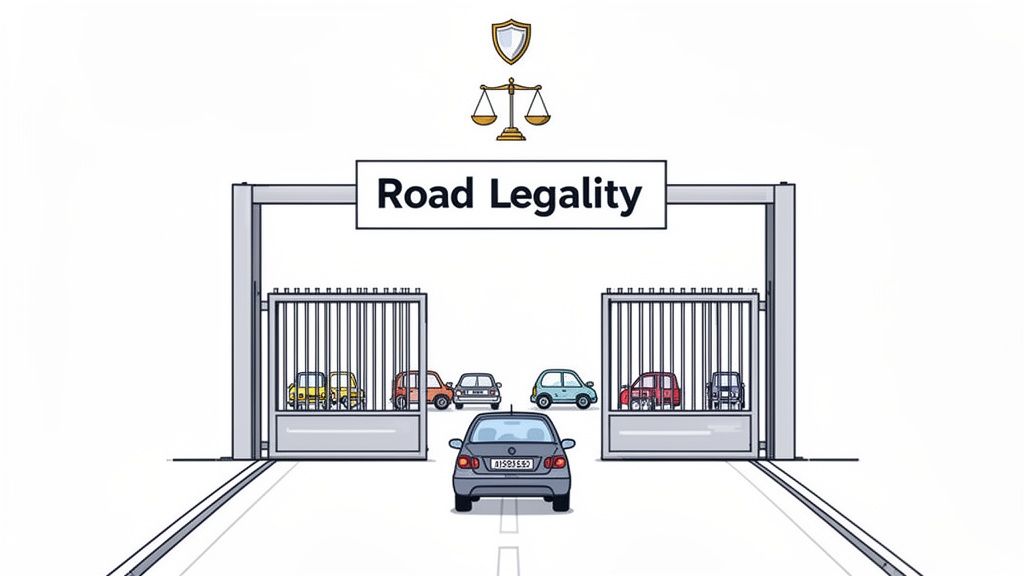
Think of Section 207 as a 'gatekeeper' for our roads. For any vehicle to be legally on the road, it has to pass through several gates: registration, permits, and valid insurance. These aren't just bureaucratic hoops to jump through. They are essential checkpoints confirming a vehicle’s identity, its roadworthiness, and its owner's accountability.
When a vehicle is missing this crucial paperwork, it has essentially snuck past these safety gates. The power to detain under the 207 MV Act is what allows an officer to halt that vehicle and hold it until its legal status is sorted out. This single action supports several bigger public policy goals:
Protecting Accident Victims: An unregistered or uninsured vehicle leaves victims high and dry, with almost no way to get compensation after a crash. Seizure gets these vehicles off the road before they can cause that harm.
Deterring Vehicle Theft: If you have to produce registration documents at any time, it becomes much harder to use a stolen vehicle freely. This directly disrupts criminal networks.
Ensuring Tax Compliance: Vehicle registration is tied directly to paying road tax. By enforcing registration, the provision ensures that state governments get the funds they need to maintain our roads.
Maintaining Accurate Records: A reliable national vehicle registry is vital for law enforcement. Section 207 helps protect the integrity of this database by penalising non-compliance.
InsightsFor legal professionals, framing an argument around legislative intent can be incredibly persuasive in court. Whether you're challenging a wrongful seizure or defending a necessary one, showing you understand Section 207's role as a public safety tool—not just a punitive clause—adds serious weight and context to your reasoning. Legal AI tools like Draft Bot Pro can assist by rapidly sourcing parliamentary debates or committee reports related to the MV Act, providing the historical context needed to build a compelling narrative about the law's purpose.
How Draft Bot Pro Clarifies Legislative Intent
Understanding the 'why' behind a law is just as important as knowing the 'what'. When you're building a case around the 207 MV Act, you need to quickly find materials that shed light on its purpose.
This is exactly where a tool like Draft Bot Pro becomes a game-changer. Using its AI-powered research features, you can simply ask it to find and summarise government reports, legislative assembly debates, or Law Commission reports related to the Motor Vehicles Act. This lets you weave a compelling story about why Section 207 exists, beefing up your arguments with authoritative context that goes way beyond the statutory text alone. It’s this deeper understanding that provides the crucial context needed to argue the purpose and scope of the law effectively.
Breaking Down The Elements Of Section 207
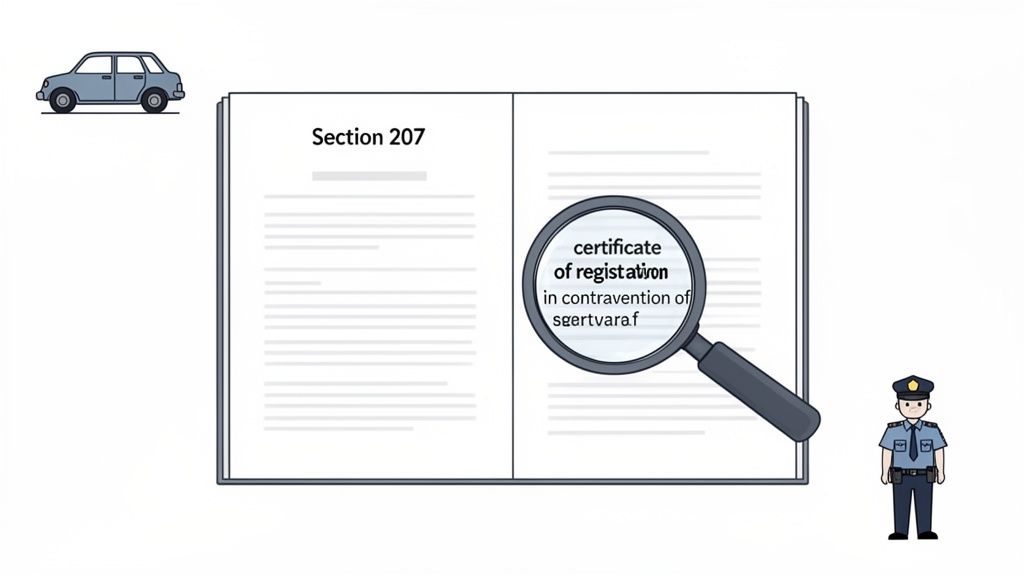
To stand your ground in court, whether you're challenging a vehicle's detention or defending it, you have to go deeper than a quick read of the 207 MV Act. The power to seize a vehicle isn't a blank cheque for law enforcement; it's a specific authority triggered by very particular circumstances. A solid legal argument is built by taking the section apart, piece by piece.
Let's dissect the statutory language of Section 207 to get a crystal-clear picture of what exactly gives an officer the right to detain a vehicle and where their authority ends. When you understand these nuts and bolts, you can advise a client with confidence at a roadside stop or dismantle an unlawful seizure in court. Every word carries legal weight, and knowing how to interpret them is everything.
The Triggering Action: "In Contravention Of"
The entire machinery of Section 207 kicks into gear with one simple phrase: a vehicle being used "in contravention of" the law. This is the legal tripwire. It's not some vague, catch-all term; it points to a handful of specific, verifiable violations concerning the vehicle's core documentation.
The violations that pull this trigger are:
No valid Certificate of Registration (RC): The vehicle is on the road without proof that it's legally registered.
Missing a required permit: This is key for commercial vehicles. Think goods carriers or buses that need special permits to operate.
Breaking permit conditions: Maybe the vehicle has a permit, but it's being used improperly—like a truck carrying unauthorised goods or a taxi operating outside its designated zone.
This means an officer can't just detain a vehicle under Section 207 for any old traffic offence. Speeding, for example, is illegal, but it's a violation of traffic rules, not the registration or permit conditions outlined here. If you're interested in speeding violations, our guide to Section 112 of the Motor Vehicle Act is a great resource.
The Critical Documents: Certificate of Registration and Permit
The law is laser-focused on two specific documents: the Certificate of Registration and the permit. The RC is the vehicle's birth certificate, proving its identity and legal status in the national registry. A permit, on the other hand, is the legal permission slip for a vehicle to be used for a specific commercial purpose.
The law is clear: these documents must be produced when asked for.
Statutory Text Highlight"...any police officer or other person authorised in this behalf... may if the vehicle is not covered by a permit, seize and detain the vehicle... and for this purpose take or cause to be taken any steps he may consider proper for the temporary safe custody of the vehicle..."
This language gives the officer the undeniable right to demand these papers. If the driver can't produce them, either in physical form or through approved digital means like DigiLocker or mParivahan, the officer has a legal basis to detain the vehicle. It's the absence of these documents that hands them the power to act.
The Empowered Authority: "Any Other Person Authorised"
Section 207 doesn't just give this power to the police. Pay close attention to the phrase "any other person authorised in this behalf by the State Government." This is a game-changer. It extends the power to detain to officials from the Regional Transport Office (RTO) or other state agencies.
For any lawyer, this makes the first question in a detention case simple: was the person who seized the vehicle actually authorised to do so? An official needs a specific notification from the State Government empowering them to use the 207 MV Act. If they don't have that specific authority, the entire seizure is invalid from the get-go and can be challenged on that ground alone.
Insights Using Legal AI for Clause Analysis
Pulling apart legal clauses and finding the right case law to back up your interpretation is where lawyers earn their stripes, but it's also incredibly time-consuming. This is where modern legal tech can give you a serious leg up.
With an AI assistant like Draft Bot Pro, you can analyse the different elements of Section 207 in minutes. Just feed it the facts of your case—why the vehicle was stopped, who detained it—and ask for a detailed legal memo. The AI will break down each crucial phrase, like "in contravention of," and instantly pull up relevant judgments from the High Courts and the Supreme Court. You'll not only save hours of grunt work but also build your arguments on a rock-solid foundation of legal precedent, giving you a decisive edge.
Key Judgements Shaping Section 207 Interpretation
The text of the 207 MV Act gives you the skeleton, but it’s the body of case law that adds the flesh and blood. For any lawyer or law student, understanding these key judgements isn't just an academic exercise—it's the practical toolkit you need to build strong arguments in court. Landmark rulings have painstakingly defined the scope, limits, and procedural fairness required when authorities use their power to detain vehicles.
These judgements give much-needed clarity on real-world situations. They answer the tricky questions the Act itself leaves open, like what's a "reasonable" time for detention, or how do you protect the rights of a bank that financed the vehicle? By really digging into these precedents, you move from just knowing the law to strategically applying it.
The Constitutional Test of Reasonableness
The courts have been crystal clear on this: the power under Section 207 is significant, but it isn't absolute. It must be used in a way that’s fair, non-arbitrary, and reasonable. A core principle established through countless rulings is that detention cannot go on forever or be used to punish someone. Its only job is to make sure the necessary documents are produced and checked.
The very moment a vehicle owner presents the required Registration Certificate or permit, the legal justification for holding the vehicle evaporates. Any delay after that can be seen as an arbitrary use of power, which could even be a violation of Article 14 of the Constitution. This is the cornerstone of any legal challenge against a long-drawn-out seizure.
InsightsFor practising lawyers, this means documenting every single interaction with the authorities is absolutely critical. Note the date and time you tried to show them the documents. This record becomes powerful evidence in a court application, proving that any further detention was unreasonable and, therefore, unlawful. Draft Bot Pro can help create a structured affidavit from your notes, ensuring this crucial evidence is presented formally and effectively.
Defining Procedural Fairness and Limitations
Judicial decisions have also put up firm procedural guardrails around how the 207 MV Act is enforced. The courts have closely examined the actions of officers to make sure they stick to the spirit of the law, not just the letter.
Several High Courts have laid down specific limits:
No Seizures for Other Offences: The power to detain under Section 207 is tied only to the absence of an RC or permit. Courts have repeatedly ruled that this section can’t be used to detain a vehicle for other traffic violations like speeding or not wearing a seatbelt.
Rights of Financiers: When a financed vehicle is involved, judgements have consistently recognised the legitimate financial interest of banks and NBFCs. Courts often grant interim custody (Superdari) of the seized vehicle to the financier. This prevents the vehicle’s value from plummeting while the legal case against the owner is sorted out.
The Concept of a 'Public Place': The Act kicks in when a vehicle is used in a "public place." Case law has helped define this term broadly to include any place the public has a right to access. This can even mean privately owned property, like a private road that leads to a public park.
How Draft Bot Pro Accelerates Case Law Research
Keeping up with the ever-changing landscape of judicial precedents is a huge challenge. Manually sifting through databases for the most relevant and powerful judgements on Section 207 can eat up hours of your day. This is exactly where a legal AI assistant like Draft Bot Pro gives you a massive advantage.
With Draft Bot Pro, you get instant access to a curated library of case law. Just type in a query like "landmark judgements on wrongful detention under 207 MV Act," and the AI finds and summarises the most critical rulings for you. It can pinpoint the ratio decidendi of each case and explain what it means in practice, saving you hours of grind and making sure your arguments are backed by the strongest possible authorities.
To give you a clearer picture, the table below highlights some influential court decisions and their real-world impact.
Landmark Precedents on Section 207 Application
This table provides a comparative overview of influential court rulings and their practical impact on how Section 207 is enforced and challenged.
Case Citation | Court | Key Finding or Principle Established | Practical Implication for Lawyers |
|---|---|---|---|
M.C. Mehta v. Union of India | Supreme Court | Emphasised the overarching importance of enforcing vehicle regulations for public safety and environment. | Reinforces the public policy argument for strict compliance, useful when defending necessary detentions. |
Sandeep Kumar v. State of U.P. | Allahabad HC | Detention becomes illegal if authorities refuse to release the vehicle after valid documents are produced. | Establishes a clear ground for challenging prolonged detention and claiming damages for wrongful seizure. |
Fullerton India Credit Co. Ltd. v. State | Various HCs | Recognised the superior right of a financier to claim interim custody of a seized, financed vehicle. | Provides a strong precedent for financiers to file for Superdari and protect their financial asset from depreciation. |
State of Maharashtra v. Nanded-Parbhani Z.L.B.M.V. Operator Sangh | Supreme Court | The term 'permit' must be interpreted strictly; any deviation from permit conditions justifies detention. | Supports the detaining authority's action when a commercial vehicle is used outside its permitted scope or route. |
Understanding these precedents is non-negotiable for anyone dealing with a Section 207 matter. They provide the nuances and arguments that can make the difference between winning and losing a case.
Practical Drafting Insights Using Draft Bot Pro
This is where theory hits the road. When a client’s vehicle gets detained under the 207 MV Act, they aren't looking for a seminar on statutory interpretation. They need action—fast. That means you need to be able to draft sharp, effective legal documents, often with the clock ticking.
The two workhorses in these situations are the legal notice challenging the detention and the application for vehicle release, which we all know as Superdari. Nailing these documents is a make-or-break skill for anyone handling MV Act matters. A well-worded notice can sometimes get the vehicle released without ever seeing a courtroom, while a solid Superdari application is your direct path to getting your client’s property back.
But let's be honest, drafting these from scratch is a grind, especially for junior advocates. It's time-consuming and dangerously easy to make a small mistake that costs your client big.
Drafting a Legal Notice for Wrongful Detention
Your first move is often a legal notice. Think of it as a formal shot across the bow. It has to be crisp, legally sound, and put the detaining officer on notice that they may have overstepped. The entire point is to make them rethink the seizure by pointing out procedural mistakes or a flat-out lack of legal grounds under Section 207.
This is where having an AI legal assistant in your corner changes the game. Instead of digging through old files for a template, you can use Draft Bot Pro. Just feed it the facts—the seizure memo, your client's story, and any papers they have. The AI gets to work and produces a tailored notice that includes:
A Solid Factual Matrix: A clean, chronological account of what happened.
The Legal Hook: Pinpointing the exact provisions of the 207 MV Act and pulling in relevant case law to build the argument that the detention is illegal.
A Clear Demand: A formal request for immediate release of the vehicle, usually with a firm deadline to show you mean business.
A task that could easily burn a few hours is done in minutes. The result is a professional, powerful notice ready to go.
Crafting the Superdari Application for Vehicle Release
If the notice doesn't do the trick, or if the situation calls for it, your next step is filing a Superdari application before the jurisdictional Magistrate. This is the formal plea to the court to grant interim custody of the vehicle back to its owner while the case proceeds. A weak application can get bogged down in objections, so you have to get it right.
InsightsThe power of a Superdari application lies in its clarity. You must convince the court that your client is the rightful owner and that letting the vehicle rot in a police lot serves no purpose, creating nothing but hardship and financial loss.
Once again, Draft Bot Pro cuts through the complexity. Give it the case details, and it generates a court-ready application that nails the jurisdiction, clearly lays out the grounds for release, and formats the necessary affidavits and annexures. This seriously reduces the risk of those small drafting errors that can get an application thrown out on a technicality.
Avoiding Common Drafting Pitfalls
Even seasoned lawyers can trip up when drafting under pressure. For the 207 MV Act, we see the same mistakes pop up time and again:
Wrong Court: Filing the Superdari application before the wrong Magistrate.
Weak Grounds: Being too vague about why the detention is illegal or why the vehicle must be released.
Missing Paperwork: Forgetting to attach essentials like the RC, insurance, or the seizure memo itself.
No Legal Backing: Failing to cite key High Court or Supreme Court judgments that strengthen your argument.
These slip-ups cause delays that your client simply can't afford. A tool like Draft Bot Pro helps you sidestep these traps by ensuring your documents are properly structured and legally robust from the get-go. If you're new to this, it's worth understanding how AI can draft legal documents to see the potential.
The need for this kind of efficiency is only growing. Enforcement of road safety rules is inconsistent, but the consequences of violations are severe. For example, a recent analysis in Gujarat found that overloaded vehicles were involved in 366 road accident fatalities. This data from the ICCT's findings shows just how high the stakes are, and it highlights why your legal documents must be flawless when you're challenging these enforcement actions in court.
Common Questions About Section 207 MV Act
When a client's vehicle gets detained, the questions come thick and fast. They're stressed, confused, and looking to you for quick, clear answers. As a lawyer, having a solid grasp of the common pain points around Section 207 is non-negotiable.
Let's break down some of the most frequent questions that land on a lawyer's desk. Think of this as your go-to guide for those initial, crucial conversations.
What's the Process for Getting a Detained Vehicle Back?
The first and most direct route is to present the necessary documents—usually the Registration Certificate (RC), permit, and insurance—to the police or RTO. If everything is in order, the vehicle is typically released once any outstanding fines are paid. Simple enough.
But we all know it's not always that straightforward. If you hit a wall with delays or disputes, your next move is filing a vehicle release application, what we call a Superdari, in the local Magistrate's court. This is your formal legal recourse to compel the authorities to release the vehicle.
Insights: An AI Pro TipDrafting a perfect Superdari application under pressure is tough. This is where an AI tool like Draft Bot Pro really shines. You can just upload the seizure memo and vehicle details, and it spits out a court-ready application in minutes. It's a massive time-saver and helps avoid those small drafting errors that can cause big delays.
Can My Vehicle Be Seized Just for a Missing Driving Licence?
In short, no—not under Section 207, anyway. This section is very specific: it gives authorities the power to detain a vehicle for the absence of a Registration Certificate or a permit.
Driving without a licence is a separate offence under Section 181 of the MV Act, but it isn't a valid reason for seizing the vehicle under Section 207. And remember, digital documents on platforms like DigiLocker or mParivahan are legally valid. If your client shows a digital RC and permit, the vehicle should not be detained.
How Long Can They Legally Keep My Vehicle?
This is a grey area because the Act doesn't set a hard deadline. However, the courts have been very clear on this: detention cannot be indefinite. It must be for a reasonable period, just long enough for the authorities to verify the documents.
Any unreasonable or arbitrary delay is an abuse of power and can be challenged in court. This is why it’s so important to advise your client to keep a detailed record of every interaction and every attempt made to produce the documents. A solid paper trail is your best weapon against wrongful detention. For complex cases like this, understanding the intricacies of court procedures is key, which is why resources on subjects like mastering the bail application format can provide useful procedural context.
What Happens if a Financed Vehicle Is Seized? What Are the Financier's Rights?
When a vehicle on a loan is seized, the financier—be it a bank or an NBFC—has a clear and recognised legal stake in it. After all, it's their asset.
Courts almost always recognise this interest. They often grant interim custody of the vehicle to the financier to prevent its value from plummeting while the case against the owner plays out. If you're representing a financier, their claim to the vehicle is strong.
Lawyers for financiers can use Draft Bot Pro’s research features to pull up relevant case law supporting a financier’s right to custody. It's a quick way to find the exact judgments you need to build an unshakeable application.
Navigating the procedural maze of the 207 MV Act demands speed, accuracy, and solid legal knowledge. Draft Bot Pro is the AI legal assistant built by Indian lawyers, for Indian lawyers, to deliver just that. From generating error-free Superdari applications in minutes to finding the exact case law you need to win your argument, our platform is trusted by over 46,379 legal professionals. Stop wasting hours on manual drafting and research. Discover a more efficient way to practise law at https://www.draftbotpro.com.
