
A Guide to Section 112 of Motor Vehicle Act

At its core, Section 112 of the Motor Vehicle Act is the backbone of India's framework for managing vehicle speeds and keeping our roads safe. This isn't some rigid, one-size-fits-all rule. Instead, it’s a crucial piece of law that gives authorities the power to set sensible speed limits based on the type of road, the kind of vehicle, and local conditions. For any driver in India, getting to grips with this section is non-negotiable.
Decoding Section 112 of the Motor Vehicle Act
Think of our road network as a complex ecosystem. You've got heavy trucks, zippy motorcycles, and family cars all sharing the same space, each moving differently and posing unique risks. Section 112 acts like the traffic conductor, setting the tempo to make sure everything flows safely. Its main job is simple: prevent accidents by keeping speed in check.
The law is built to be flexible. It provides a solid foundation for both central and state governments to establish speed limits that actually make sense for a given area. This adaptability is what makes it so effective, allowing for tailored rules that account for everything from a winding mountain road to a busy city highway.
The Core Purpose of Speed Regulation
Let’s be clear: enforcing speed limits is a life-or-death matter. Over-speeding is consistently one of the biggest killers on our roads. Through Section 112, the Motor Vehicles Act, 1988, takes this head-on.
The numbers are stark. In 2022 alone, over-speeding was responsible for a staggering 119,904 fatalities, making up about 71% of all road accident deaths that year.
This statistic really drives home why following Section 112 isn't just about dodging a fine. It’s about protecting yourself, your passengers, and everyone else on the road by creating a more predictable and controlled driving environment.
We've created a simple table to break down exactly what Section 112 aims to achieve.
Table: Key Objectives of Section 112
Objective | Description |
|---|---|
Prevent Accidents | The primary goal is to reduce crashes, injuries, and deaths caused by excessive speed. |
Empower Authorities | It gives government bodies the legal power to set and enforce context-specific speed limits. |
Enhance Public Safety | By managing traffic flow, it creates a safer environment for all road users, including pedestrians. |
Promote Driver Discipline | The law encourages responsible driving habits and discourages reckless behaviour behind the wheel. |
Ultimately, these objectives work together to make our roads fundamentally safer for everyone involved.
Navigating Legal Complexities with AI
Let's face it, legal statutes can be a headache to read. The language is often dense and confusing for anyone who isn't a lawyer. This is where modern tools are changing the game.
InsightsLegal AI platforms can cut through the complex jargon and translate it into plain, simple English. If you’re dealing with a speeding ticket or just want to understand your rights, this is a massive help. You get clear, straight answers instead of having to guess.
A specialised legal AI tool like Draft Bot Pro can demystify the text of Section 112 for you. It analyses the statute and explains your specific duties as a driver and the potential fallout if you slip up. This kind of technology puts knowledge in your hands, making sure you're fully aware of the rules of the road.
Working with legal texts demands precision. For legal pros and students looking to get better at this, learning how to do legal research faster is a must. Tools like Draft Bot Pro don't just spit out answers; they help you build the research skills you need to tackle any legal challenge with confidence.
How Speed Limits Are Applied Across India
Ever wondered why you can cruise at 80 km/h on a highway but have to slow down to 40 km/h in a bustling city? The answer isn't arbitrary. It’s all rooted in the practical and dynamic application of Section 112 of the Motor Vehicle Act. This law doesn’t just pluck numbers from thin air; it provides a logical framework for authorities to set safe, sensible speed limits for different environments. Think of it as a responsive system, not a rigid one.
Setting a speed limit involves far more than just hammering a sign into the ground. It's a careful process of assessing a whole host of factors that affect road safety. Authorities, from the central government down to local municipalities, conduct detailed evaluations of road conditions, typical traffic flow, and the surrounding environment. This ensures every speed limit is a deliberate decision aimed at keeping people safe.
The Logic Behind Varying Speed Limits
Picture a road as its own unique ecosystem. A wide, multi-lane expressway is built for higher speeds, offering clear lines of sight and few interruptions. On the flip side, a narrow city street is a minefield of potential hazards—pedestrians stepping out, cars pulling out, and constant intersections.
To account for these stark differences, authorities weigh several key factors:
Road Engineering and Design: Is the road wide or narrow? Is the surface smooth or riddled with potholes? Are there sharp curves or blind corners? A well-designed highway can handle faster travel much more safely than a poorly lit local road.
Traffic Density: The sheer volume and type of vehicles on the road are critical. A route clogged with heavy trucks, which need a lot more room to brake, will almost always have a lower speed limit than a road used mainly by passenger cars.
Geographic Location: What's happening around the road is just as important. Speed limits drop significantly near schools, hospitals, markets, and residential areas where you expect to see a lot of people on foot.
Vehicle Type: Section 112 is smart enough to allow different speed limits for different vehicles on the same road. A heavy commercial truck might be capped at a lower speed than a motorcycle or a car simply because of its size and stopping distance.
This nuanced approach means you can even see different speed limits on the same stretch of road, perhaps changing by time of day or even by lane, all in the name of safety.
Visualising Speed Limits in Action
To really see how this works, let's look at a simple comparison of typical speed limits across different zones in India.
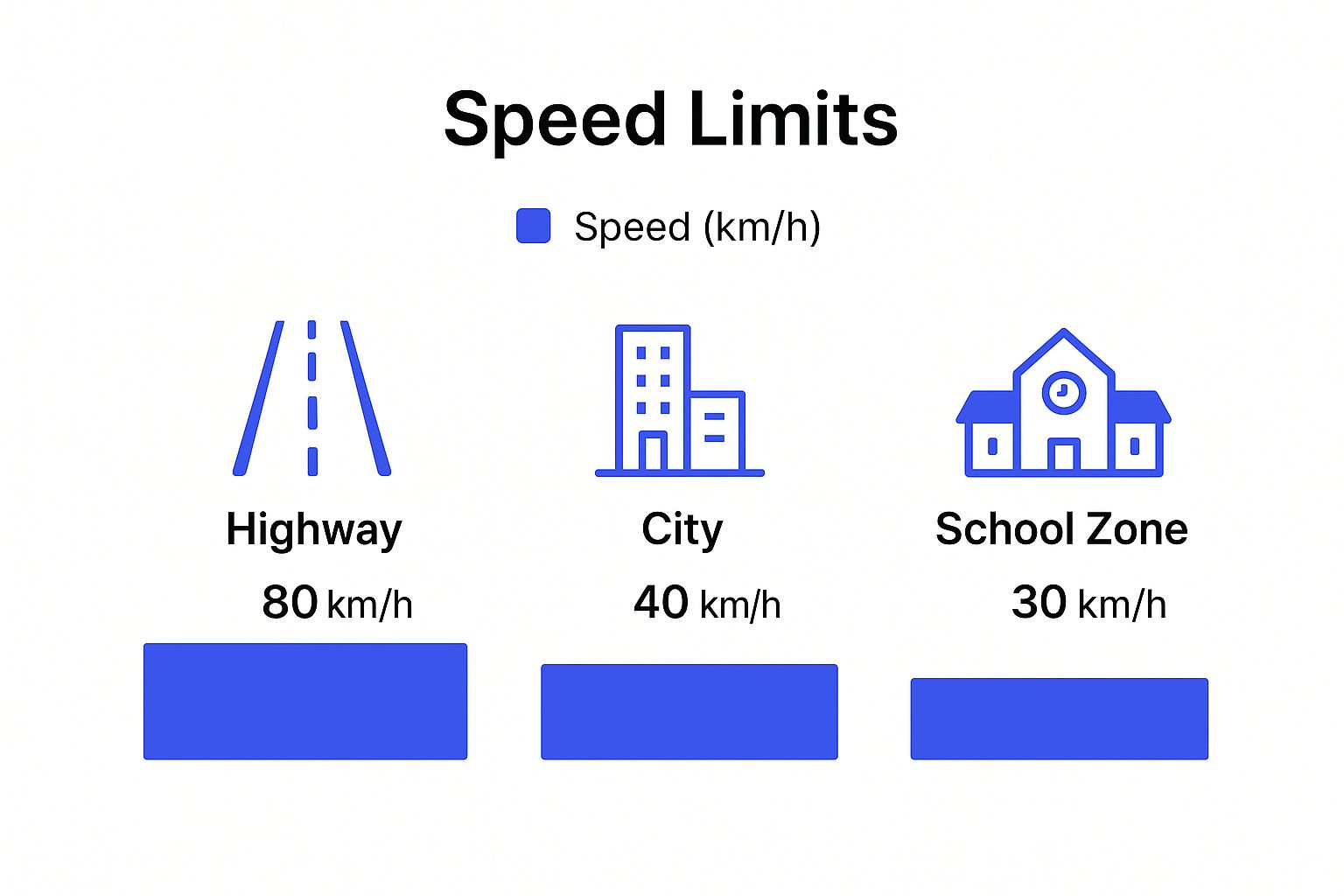
This visual breakdown makes it crystal clear: as the risk and potential for interacting with pedestrians goes up, the legal speed limit comes way down.
Central and State Roles in Enforcement
The power to set these limits isn't held by just one body; it's shared. While the central government might set national maximums for roads like national highways, state governments and local authorities have the final say within their own jurisdictions. This decentralised model is crucial because it allows for local knowledge to shape local rules.
For instance, a state might lower the speed limit on a particular highway that cuts through several small towns, even if a similar national highway elsewhere has a higher limit. This flexibility is what makes Section 112 so effective in practice.
InsightsUnderstanding who sets the speed limit can be a game-changer if you ever need to contest a speeding ticket. If a local municipality has set a limit that seems ridiculously low or is badly signposted, you might actually have grounds for a challenge. This is where digging into the specific notification or order that established the limit becomes so important.
Navigating these layers of jurisdiction can feel a bit overwhelming. If you're ever stuck wondering about the legal basis for a specific speed limit, a legal AI tool can cut through the noise. A tool like Draft Bot Pro can help you pinpoint the exact state or central government notifications that apply to a particular road, giving you the clarity you need to understand your legal standing. It makes the law more accessible and transparent for everyone.
Understanding the Penalties for Speeding Violations
Getting caught speeding under Section 112 of the Motor Vehicle Act is a lot more than just a minor inconvenience. It's a serious violation, and the consequences—both legal and financial—can be pretty steep. These penalties aren't just about punishment; they're designed to be a powerful deterrent, hammering home the life-or-death importance of sticking to speed limits.
The fallout from a speeding ticket can go way beyond just paying a fine. While that's the most common outcome, the law has a tiered system for repeat offenders or for situations where speeding creates an even bigger danger. This approach ensures the punishment fits the crime, from a one-off mistake to a pattern of reckless behaviour.
A Breakdown of Fines and Penalties
The penalties for breaking speed limits aren't one-size-fits-all. They change depending on the type of vehicle you're driving and whether it's your first offence or if you've been caught before. This structure is designed to be fair but also to send a very clear message: the law will not tolerate repeat offenders.
For instance, if you're driving a light motor vehicle (LMV) and get caught speeding for the first time, you're looking at a fine somewhere between ₹1,000 to ₹2,000. Get caught again, though, and the penalty jumps significantly. For heavier vehicles, like medium or heavy passenger or goods vehicles, the fines start higher, typically from ₹2,000 up to ₹4,000 for a first offence.
The financial hit is just the starting point. The goal is simple: make drivers think twice before putting the pedal to the metal.
Let's break down how these penalties differ across vehicle types in a bit more detail.
Speeding Penalties Under the Motor Vehicle Act
Vehicle Type | First Offence Fine (₹) | Subsequent Offence Fine (₹) | Other Potential Penalties |
|---|---|---|---|
Light Motor Vehicle (LMV) | ₹1,000 - ₹2,000 | Increased fines, potential licence suspension | Community service, driving school |
Medium/Heavy Passenger Vehicle | ₹2,000 - ₹4,000 | Increased fines, potential licence suspension | Impounding of vehicle, driver retraining |
Medium/Heavy Goods Vehicle | ₹2,000 - ₹4,000 | Increased fines, potential licence suspension | Impounding of vehicle, permit suspension |
Two-Wheeler | ₹1,000 - ₹2,000 | Increased fines, potential licence suspension | Helmet safety awareness programmes |
As you can see, the consequences get progressively more serious, especially for those who don't learn their lesson the first time.
Expert TipIf you get a challan (ticket), your first move should be to read it carefully. It will spell out the specific offence, the fine amount, and the section of the law you've been charged under. If something doesn't seem right or you think there's been a mistake, this is your chance to gather the facts for a potential challenge.
Understanding these details is critical. If the legal jargon on the challan is confusing, a legal AI tool can be a game-changer. A platform like Draft Bot Pro can analyse the document for you, translating the complex legal terms into plain English so you know exactly what you're up against and what your options are.
When Consequences Escalate
While fines are standard, some situations can trigger far more severe penalties. These are typically reserved for cases where speeding creates an extreme public safety risk or when a driver repeatedly ignores traffic laws.
Licence Suspension: For repeat offenders, the authorities have the power to suspend or even cancel your driving licence. It's a drastic step, but it gets dangerous drivers off the road.
Imprisonment: In the worst-case scenarios, especially if speeding causes a fatal accident, the driver could face jail time. This underscores just how seriously the law treats such negligence.
Impounding of Vehicle: The authorities can also seize the vehicle involved in the offence.
The real-world impact of Section 112 becomes crystal clear when you look at India's road accident statistics. In 2022 alone, India saw a staggering 461,312 accidents, which led to 168,491 deaths and left 443,366 people injured. Speeding is consistently one of the main culprits. Back in 2015, speeding and dangerous driving were linked to 75% of road crash deaths, with over 60,969 fatalities attributed to speeding alone. If you want to dig deeper, you can discover more insights about the status of road accidents in India.
The Process After Being Caught
So, what happens after you're flagged down or a speed camera gets you? The process usually kicks off with a challan. You can pay the fine online or at a designated office, which is essentially an admission of the offence.
But what if you feel the challan was issued unfairly? Maybe the speed limit sign was hidden, or you suspect the speed gun was faulty. You have the right to contest it in court. This means appearing before a magistrate to present your side of the story. To do this effectively, you need a solid legal argument. This is where legal AI like Draft Bot Pro can be a massive help, assisting you in structuring your defence and identifying the key legal points to argue. It empowers you to navigate the legal maze with much more confidence.
How Technology Is Enforcing Speed Limits
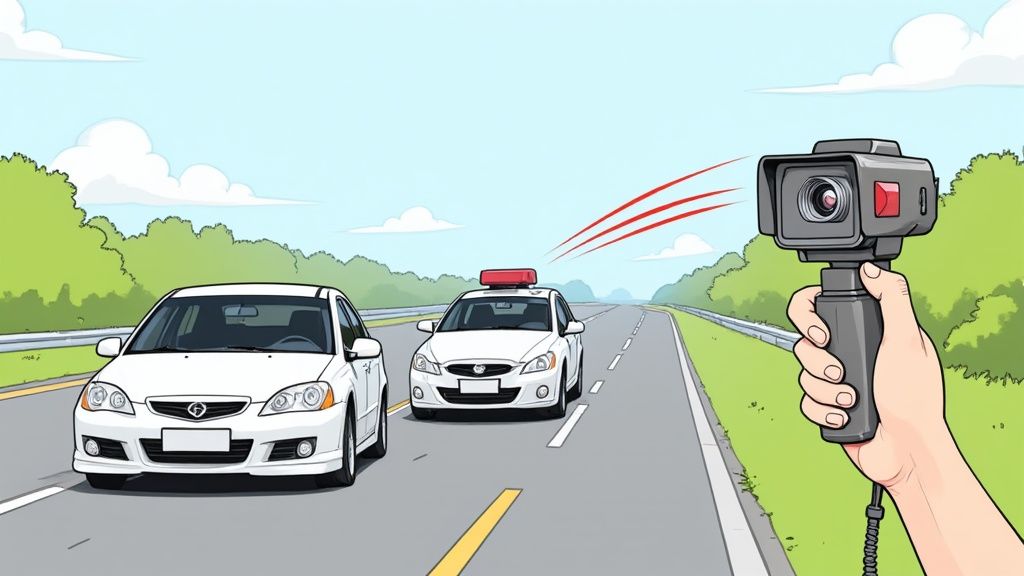
The days of relying solely on a traffic cop hiding behind a corner are fading fast. We've entered a new era for enforcing Section 112 of the Motor Vehicle Act, one powered by an impressive arsenal of technology. Catching speeders is now more efficient, precise, and widespread than ever before.
This isn't just about handing out more challans. It's about creating a constant, reliable presence that encourages safer driving habits around the clock. The whole game has shifted from sporadic checks to a systematic, tech-driven approach. These tools can watch over huge stretches of road all at once, ensuring speed limits are respected even when no police car is in sight.
The Modern Toolkit for Speed Enforcement
Today’s traffic authorities have a whole range of sophisticated gadgets to keep speeds under control. Each has its own job, and they often work together to build a tight enforcement network.
Speed Cameras (ANPR): These are the most familiar eyes on the road. Automatic Number Plate Recognition (ANPR) cameras are cleverly placed to snap pictures of any vehicle that flies past the speed limit. They automatically log the number plate, date, time, and exact location of the violation.
Radar Guns: Often wielded by patrol officers, these handheld or car-mounted devices use Doppler radar to get an instant speed reading. They’re perfect for mobile enforcement and for targeting specific high-risk zones.
Interceptor Vehicles: Think of these as the high-performance pursuit cars of the police force. They're kitted out with advanced speed detection gear and communication systems, built to chase down and stop vehicles travelling at dangerously high speeds on our highways.
The evidence these devices collect—whether it's a crystal-clear photo or a radar reading—is increasingly being accepted in court. For it to hold up, however, the authorities have to prove the equipment was properly calibrated and working perfectly.
Legal Standing of Tech-Based Evidence
So, does a photo from a speed camera carry the same legal weight as an officer's testimony? The answer is a solid yes, but with a few important conditions. The evidence has to be clear, untampered with, and backed by records proving the device was accurate.
InsightsWhen a machine-generated challan lands on your doorstep, you have every right to question the evidence. Was the camera's calibration certificate up to date? Was the device working correctly at that exact moment? A successful challenge often comes down to these technicalities, not just claiming you weren't speeding.
This is where a good grasp of the law is crucial. If you think there's a problem with the evidence, you need a structured legal argument. Legal AI tools like Draft Bot Pro can analyse the challan and the evidence, helping you spot potential holes in the prosecution's case. For anyone interested in diving deeper, our guide on AI for Evidence Act analysis in India explains more about how technology is changing legal practice.
The Future of Enforcement: Autonomous and AI-Driven
The evolution of speed enforcement is nowhere near finished. The next big step involves artificial intelligence and autonomous systems that could one day make manual checks almost redundant.
Section 112 of the Motor Vehicles Act is also central to the rise of new tech like autonomous vehicles. The potential for self-driving cars to practically eliminate speeding violations is huge. These AI-driven vehicles can be programmed to stick rigidly to posted speed limits, taking human error and the temptation to speed completely out of the equation. As this technology goes mainstream, our laws will have to keep pace.
Imagine smart traffic systems that adjust speed limits in real-time based on weather and traffic, beaming these updates directly into your car. It’s a glimpse into a future where technology doesn't just catch you speeding—it actively stops it from happening in the first place. That’s a massive shift in how we think about road safety.
Using Legal AI to Handle Traffic Violations
Getting a challan for breaking Section 112 of the Motor Vehicle Act can be a jarring experience. The official language on the ticket is often dense and confusing, leaving you unsure of what you've actually done wrong or what to do next. This is exactly where legal tech can step in as your first line of defence, turning a stressful moment into a manageable problem.
Instead of panicking or just paying a fine you feel isn't fair, you can use a legal AI tool to get some clarity. These platforms are built to make sense of the charges against you, translating the complex jargon into simple, plain English. It's like having an initial legal consultation right on your phone, available 24/7.
Demystifying Your Challan with Draft Bot Pro
When that speeding ticket lands in your hand, the first step is to understand what you're being accused of. A legal AI assistant like Draft Bot Pro can look at your challan and give you a straightforward breakdown. It will pinpoint the specific violation under Section 112, explain the fines involved, and lay out what could happen if you’re a repeat offender.
This initial analysis is absolutely crucial. It gives you the knowledge to make a smart decision: do you pay up, or do you have a solid reason to fight it? The AI helps you get past the initial confusion and start thinking strategically, all without the immediate, and often high, cost of hiring a lawyer.
Building a Strong Defence Strategy
If you decide to contest the ticket, your next challenge is putting together a legally sound defence. This is where legal AI really starts to shine. It goes beyond just explaining things and becomes an active partner in building your response.
Draft Bot Pro can help you find potential arguments based on the specifics of your situation. For instance, you can type in the details of the incident, and the AI will help you identify possible lines of defence, such as:
Improper or Hidden Signage: Was the speed limit sign blocked by a tree or just not clearly visible?
Faulty Equipment: Do you have a reason to believe the speed gun wasn't calibrated correctly?
Incorrect Details on the Challan: Are there mistakes in the date, time, location, or even your vehicle's details?
Once you've found a potential defence, the AI can help you draft a coherent and properly structured response to send to the authorities. It turns a complicated legal task into a clear, step-by-step process.
InsightsThe strongest legal challenges are always built on facts and procedure. An AI tool helps you zero in on these objective points instead of getting lost in emotional arguments. By looking at precedents and legal requirements, it makes sure your response is grounded in solid reasoning, which can seriously improve your chances of a good outcome.
This kind of support is invaluable. It helps level the playing field, letting you assert your rights with confidence, even if you have no legal background. For a deeper look, check out our guide on whether you can use AI to draft legal documents, which gets into the capabilities and limits of these tools.
To see more on how legal AI systems are being used for traffic violations and other legal issues, you might want to explore resources like Buddypro's legal AI blog. These kinds of platforms offer great practical insights into this evolving world. By using tools like Draft Bot Pro, you're not just fighting a ticket; you're taking an active and informed role in the legal process.
Common Questions About Section 112
Getting your head around traffic laws can be tricky, especially when it comes to something as common as speeding. When you’re faced with the legal side of Section 112 of the Motor Vehicle Act, it’s easy to feel unsure about your rights and what to do next. Let's tackle some of the most common questions with clear, no-nonsense answers.
Our goal here is to arm you with the essential info you need to handle real-life situations. Whether it's figuring out how to respond to a challan or understanding the ripple effects of a speeding violation, these answers will help you make smarter decisions and stay on the right side of the law.
What Should I Do If I Receive a Speeding Challan?
Getting a speeding challan is stressful, but the first thing to do is take a breath and carefully read the document. Go over every single detail: the date, time, location, your vehicle info, and the speed they clocked you at. You’d be surprised how often a small error could be grounds to challenge it.
After you've checked it, you really have two paths: pay the fine or contest it in court. If you pay up, you're essentially admitting you did it. But if you genuinely believe the challan was issued in error—maybe the speed limit sign was hidden behind a tree or missing altogether—you have every right to fight it. This is where collecting your own evidence, like photos of the scene, becomes absolutely critical.
InsightsContesting a challan isn't just about saying "I didn't do it." You need to build a proper legal argument, a clear, fact-based case for the court. This is where legal tech can be a massive help, guiding you in organising your points and drafting a formal, professional response.
A tool like Draft Bot Pro can be a game-changer here. It can break down the details of your challan, help you pinpoint the specific legal angles of Section 112 that apply to your case, and assist in putting together a solid written response for the court. It gives you the power to go through the process with a lot more clarity and confidence.
Can I Challenge the Accuracy of a Speed Camera?
Yes, you absolutely can. The reliability of a speed camera or radar gun isn’t just taken for granted in court. The legal responsibility—what we call the burden of proof—is on the traffic authorities to prove their equipment was properly calibrated and working correctly when it clocked you.
To build a strong challenge, you or your lawyer can formally request the device's maintenance and calibration records. These are the official documents that certify the equipment has been tested and meets the required accuracy standards. If the authorities can't produce these records, or if the documents show the device was due for a check-up, a court might just throw the evidence out and dismiss the challan. It’s a technical defence, but a very effective one.
Are Emergency Vehicles Exempt from Speed Limits?
For the most part, yes. Emergency vehicles like ambulances, fire engines, and police cars are generally allowed to exceed the speed limits set under Section 112. But this isn't a free-for-all; it only applies when they are in the middle of responding to a genuine emergency.
To let other drivers know what’s happening, they have to use their sirens and flashing lights. This is the signal for everyone else on the road to yield and let them pass safely and quickly. It’s important to remember this exemption is only for them. Claiming you had a "personal emergency" is almost never a valid legal defence for speeding.
How Do Speeding Violations Affect My Licence and Insurance?
A speeding ticket hits you in more ways than just the initial fine. The impact on your driving record and insurance premiums can be serious and stick around for years. Every violation gets logged, creating a history that can come back to bite you.
Driving Licence: One violation might not be the end of the world, but if you keep getting caught for offences under Section 112 of the Motor Vehicle Act, you could face suspension or even permanent cancellation of your licence. The authorities don't take repeat offenders lightly.
Motor Insurance: Insurance companies are all about assessing risk, and a driving record full of speeding tickets screams "high-risk driver." As a result, you can bet on a hefty hike in your annual insurance premiums, which will end up costing you a lot more than the original fine over time.
At the end of the day, sticking to the speed limit isn't just about avoiding a ticket. It's about keeping yourself safe, holding onto your driving privileges, and protecting your wallet.
Ready to take control of your legal work? Draft Bot Pro is the most affordable and verifiable Legal AI, built by lawyers for lawyers in India. Create precise legal documents and conduct accurate research backed by real sources. Join over 46,379 legal professionals and see how our AI-powered assistant can transform your practice. Visit us at https://www.draftbotpro.com to get started.
