
Understanding Article 330 of Indian Constitution
- Rare Labs
- Oct 27, 2025
- 14 min read

Article 330 of the Indian Constitution is a cornerstone of our democracy. It's the provision that reserves seats in the Lok Sabha (the lower house of Parliament) for members of the Scheduled Castes (SCs) and Scheduled Tribes (STs). The core mission here is simple but profound: to guarantee political representation for communities that have been historically pushed to the margins, ensuring their voices are heard right at the centre of national lawmaking.
Decoding Article 330 And Its Purpose
At its heart, Article 330 is an instrument of social justice. It’s designed to forge a more inclusive and truly representative democracy. Think of it like this: if democracy is a highway, Article 330 creates dedicated lanes to ensure smoother, more equitable access for those who have historically faced endless roadblocks. It’s a direct constitutional answer to centuries of social exclusion, securing a place for SC and ST communities at the highest legislative table.
This safeguard isn't just a token gesture; it's rooted in demographic reality. The number of seats reserved in any state or union territory is directly proportional to the population of SCs and STs living there. This formula ensures that the representation is fair and actually reflects the presence of these communities across the country.
The Principle of Proportional Representation
The entire mechanism behind Article 330 is built on one clear principle: political power should mirror the population.
Here’s how it works in practice:
If a state has a 15% Scheduled Caste population, then roughly 15% of its Lok Sabha seats will be reserved for SC candidates.
Likewise, if 10% of a state's population belongs to Scheduled Tribes, around 10% of its seats are set aside for ST candidates.
This mathematical approach isn't just about numbers; it’s about preventing the systemic underrepresentation of communities that might otherwise be drowned out in a general election. It turns the abstract ideal of equality into a concrete, measurable outcome within our political system.
For a clearer picture, let's break down the key components of Article 330.
Key Provisions of Article 330 at a Glance
Provision | Explanation |
|---|---|
Reservation for SCs/STs | Seats shall be reserved in the Lok Sabha for Scheduled Castes and Scheduled Tribes. |
Proportional Representation | The number of reserved seats is proportional to the SC/ST population in a state or union territory. |
State-Specific Application | The calculation and allocation of reserved seats are done on a state-by-state basis. |
Separate ST Reservation in Autonomous Districts | Special provisions exist for reserving seats for STs in the autonomous districts of Assam. |
This table provides a quick summary, but as you can see, the article is quite layered. It's part of a much larger constitutional framework of affirmative action.
How Draft Bot Pro Can Help
Getting to grips with the nuances of constitutional law—the precise wording, the historical debates, the landmark judgments—can feel like a monumental task. This is exactly where a legal AI assistant like Draft Bot Pro changes the game. It can instantly summarise the article, pull up related case law, and cross-reference it with other relevant constitutional provisions. For law students, advocates, and researchers, this means cutting down hours of manual work. You can spend less time digging for information and more time on sharp analysis and interpretation, making even the most complex legal topics far more approachable.
The Historical Context of Article 330
To really get to grips with Article 330 of the Indian Constitution, you have to travel back in time to the fiery, foundational debates of the Constituent Assembly. This wasn't some last-minute administrative detail. It was a carefully forged response to centuries of systemic social injustice, championed by visionaries like Dr. B.R. Ambedkar as a critical piece of nation-building.
The framers knew exactly what they were up against. They understood that political independence from the British wouldn't magically erase the deep-seated inequalities plaguing Indian society. For communities like the Scheduled Castes and Scheduled Tribes, who had been systematically shut out of opportunities and denied a voice for generations, real democracy needed a direct, forceful intervention.
Political reservation was designed as that intervention—a deliberate, corrective measure to dismantle historical walls of exclusion and pull marginalised communities into the very heart of national governance.
The Debate Over the Sunset Clause
One of the hottest topics in the Assembly was how long these reservations should last. The original text included a "sunset clause", setting a ten-year lifespan for the provision. This wasn't a random number; it was a reflection of the framers' incredible optimism. They genuinely hoped that a decade would be enough to level the playing field, paving the way for a society where such safeguards would no longer be needed.
That initial ten-year limit was more than a policy; it was a statement of faith in the new nation's ability to heal its historical wounds quickly. But as it turned out, the reality of deep-rooted social prejudice was far more stubborn than anyone had anticipated.
InsightsThe persistence of social and economic disparities has forced Parliament to extend this reservation period again and again through constitutional amendments. What started as a temporary fix has become an enduring feature of Indian democracy, highlighting the long and difficult road toward true social justice.
From Temporary Measure to Enduring Policy
So why the repeated extensions? It's complicated. Successive governments have had to acknowledge that while things have improved for SC and ST communities, they haven't yet reached a point of parity with the rest of the population. The early dream of rapid social change had to make way for a more pragmatic reality: you can't undo centuries of discrimination overnight. It's a long-term project.
This evolution from a temporary provision to a long-standing policy captures a core tension in Indian politics: the dream of a casteless society clashing with the hard reality of persistent inequality. Understanding this history is absolutely crucial to grasping why Article 330 of the Indian Constitution is still so vital today.
For anyone trying to trace this constitutional journey, keeping track of all the amendments and their timelines can be a nightmare. This is where a tool like Draft Bot Pro can be a game-changer. It lets you trace the amendment history of any article, instantly pulling up the relevant acts and explaining their impact. For legal pros and students, this provides a crystal-clear, chronological map of how provisions like Article 330 have evolved, cutting out hours of tedious manual research.
A Clause-by-Clause Analysis of Article 330
To really get to grips with Article 330 of the Indian Constitution, you have to look past the big picture and get into the nitty-gritty. The constitutional text itself is precise, but let's be honest, it can feel a bit dense. So, let's break it down into smaller, more manageable pieces to see how it actually turns population figures into real-world political representation.
At its heart, the article runs on a pretty straightforward mathematical idea. It says that the number of seats reserved for Scheduled Castes (SCs) or Scheduled Tribes (STs) in the Lok Sabha for any state has to be in direct proportion to their population in that state.
This concept map really brings home the journey from historical injustice to a constitutional fix, which is the whole basis for political reservation.
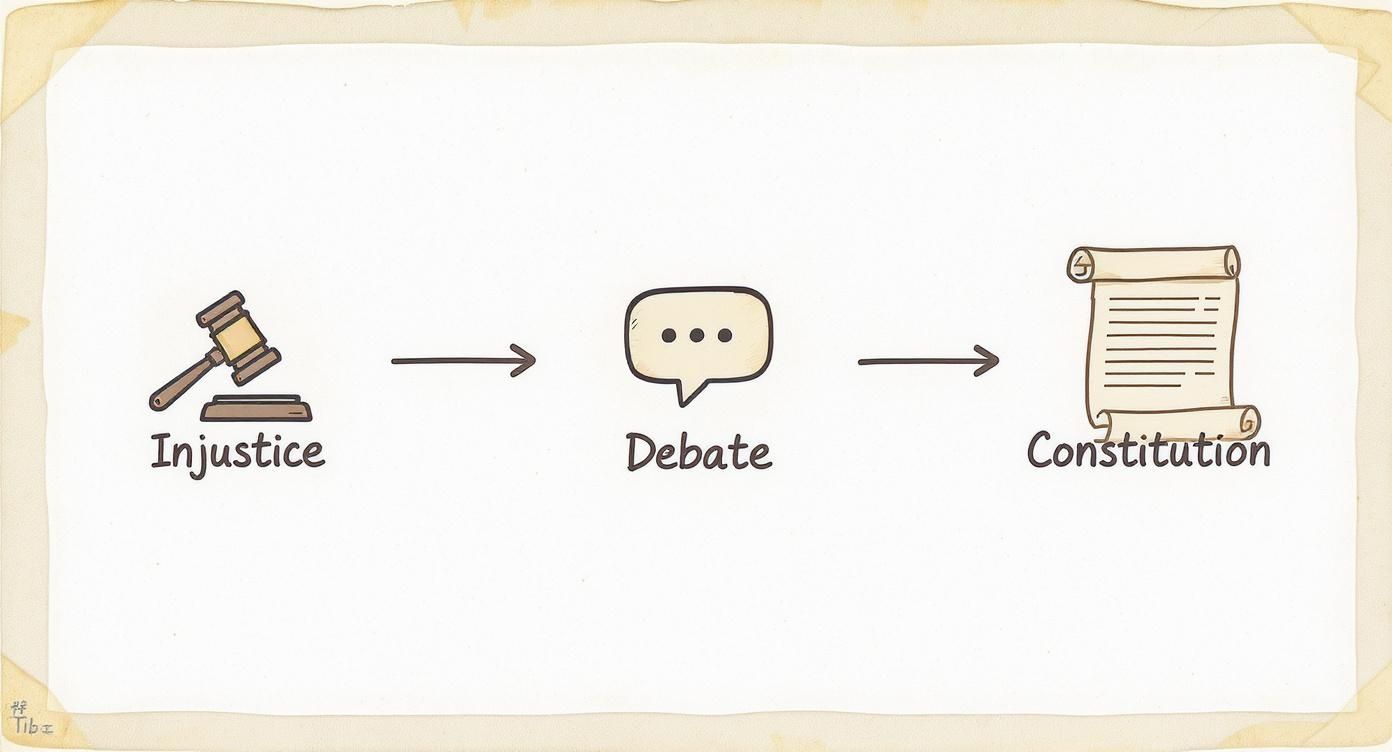
You can see the flow from injustice, through intense debate, and finally to constitutional action. It highlights how provisions like Article 330 weren't just afterthoughts; they were carefully designed solutions to problems that were centuries in the making.
The Reservation Formula Explained
Let's cook up a hypothetical state to see this in action. We'll call it "Aryavarta." Imagine it has a total population of 50 million people and gets 25 seats in the Lok Sabha.
Here’s a quick look at Aryavarta's demographics:
Scheduled Caste (SC) Population: 10 million (that's 20% of the total)
Scheduled Tribe (ST) Population: 5 million (that's 10% of the total)
Now, applying Article 330's formula, here’s how the reserved seats would be worked out:
SC Reserved Seats: 20% of the 25 Lok Sabha seats = 5 seats.
ST Reserved Seats: 10% of the 25 Lok Sabha seats = 2.5 seats. Since you can't have half a seat, this gets rounded to the nearest whole number, giving us 3 seats.
This simple bit of maths ensures that the representation of SCs and STs in Parliament is a direct reflection of their demographic presence in the state. It makes sure their political voice is proportional to their numbers. Simple as that.
Special Provisions for Assam
But Article 330 isn't just a one-size-fits-all rule. It has a special clause carved out just for the autonomous districts of Assam. In this case, the reservation for Scheduled Tribes isn't based on the ST population of the entire state.
Instead, the number of seats reserved for STs in these autonomous districts is calculated based on the proportion of the ST population within those districts alone. It's a subtle but crucial difference. This nuance shows a real understanding of the unique demographic and administrative setup of these regions, making sure the tribal communities there get representation that truly reflects their local concentration.
InsightsThis clause-by-clause structure reveals a meticulously designed legal framework. It balances a general, state-wide formula with specific, tailored exceptions for regions with distinct historical and demographic contexts, showing the Constitution's adaptability.
Understanding these mechanics is crucial. Article 330 was put in place to secure political representation for SCs and STs by reserving Lok Sabha seats in proportion to their population. Originally adopted on 24 August 1949, it sets a clear formula where the number of reserved seats matches the ratio of SC and ST populations to the total population. This kind of structured affirmative action is one of the most significant of its kind in any democracy, directly taking on the challenge of historical marginalisation. You can find more insights about this constitutional framework on Hinsoli.com.
Of course, navigating these detailed clauses, especially when you start cross-referencing with census data and delimitation reports, can get complicated. This is where an AI legal assistant like **Draft Bot Pro** can be a game-changer. It can instantly break down constitutional text, explain what specific clauses mean, and give you the context you need, turning dense legal jargon into clear, usable knowledge for both students and seasoned professionals.
The Real-World Impact of Article 330
Let's be honest, the true test of any constitutional provision isn't just the elegance of its wording. It’s about the impact it has on the ground, in the real world. When we talk about Article 330 of the Indian Constitution, we're not just discussing a piece of text; we're talking about a powerful mechanism that directly shapes the political landscape of the entire country.
It’s the engine that converts demographic numbers into actual seats in the Lok Sabha, ensuring our government reflects the nation's true social diversity. This one article has a massive ripple effect on everything from election strategies and political debates to the very faces we see representing us in Parliament.
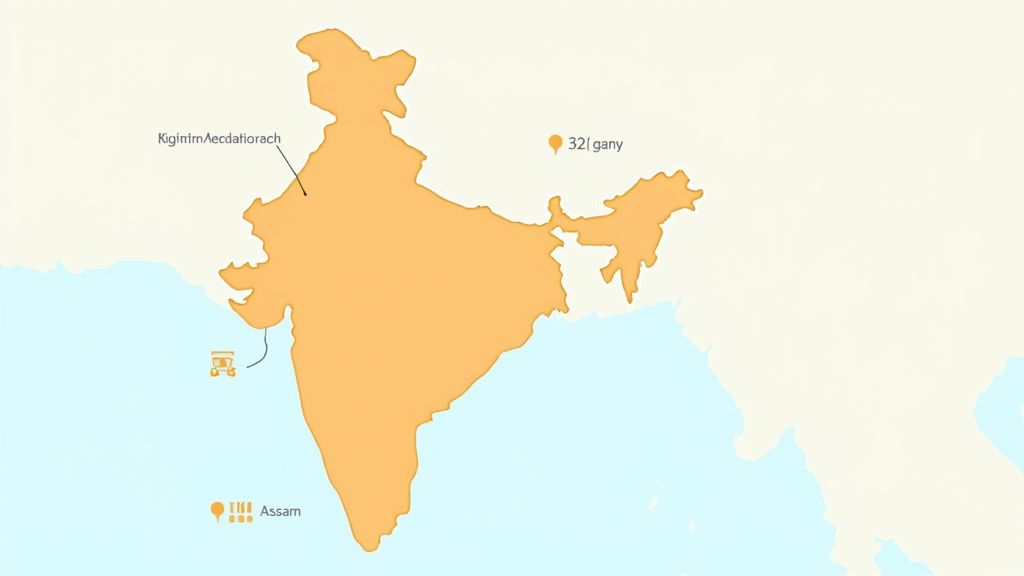
At its heart, Article 330 is about proportional representation. It forges a direct link between the population of Scheduled Castes (SCs) and Scheduled Tribes (STs) and their power in Delhi. This ensures their voices are not just an afterthought but a fundamental part of making laws.
From Census Data to Seats in Parliament
So, how does this actually work? It’s all about the numbers. The Census of India tells us how many SC and ST citizens there are, and Article 330 translates that into a specific number of reserved seats.
Take the 2011 Census, for example. It showed that Scheduled Castes make up about 16.6% of India’s population, and Scheduled Tribes account for another 8.6%. Fast forward to the 2019 general elections, and those percentages were directly reflected in the Lok Sabha: 84 seats were reserved for SC candidates and 47 seats for ST candidates, out of the 543 total. It's a clear, mathematical formula for representation. If you want to dig into the specifics, there are some great insights on GKToday.in that break down the data.
How It Plays Out in Key States
The real drama of Article 330 unfolds at the state level, especially in places with large SC and ST populations.
Uttar Pradesh: This is a big one. With one of the country's highest SC populations (around 21%), UP has a huge number of reserved seats. The SC vote isn't just important here; it's often the deciding factor in who wins and loses.
Madhya Pradesh: Similarly, the state's substantial ST population (over 21%) means no party can afford to ignore tribal communities. They have to field candidates who understand tribal issues and develop campaigns that speak directly to their needs.
This forces political parties to think differently. They can't just rely on broad, generic promises. They have to find candidates who genuinely connect with these communities and are prepared to champion their specific concerns on the national stage.
InsightsThe representation guaranteed by Article 330 ensures that unique socio-economic issues—like land rights for tribal communities or access to education for Dalit children—are brought to the forefront. These aren't just abstract policy points; they're brought into the national debate by elected members who have lived these experiences.
Making Sense of the Data with Draft Bot Pro
Trying to connect the dots between constitutional law, census figures, and election results can be a massive headache. For political analysts, law students, or researchers, sifting through all that data is an overwhelming task.
This is where a specialised tool like Draft Bot Pro comes in. Instead of spending hours digging through archives, you can use it to quickly find out how demographic data from a specific state translates into reserved seats. You can even find legislative records showing how representatives from these constituencies have fought for their communities. It gives you a much deeper, data-driven understanding of how constitutional provisions actually shape our democracy day-to-day.
How Draft Bot Pro Cuts Through the Legal Research Maze
Let's be honest, untangling a complex constitutional provision like Article 330 of the Indian Constitution can be a real grind. For any lawyer, law student, or researcher, it’s not just about reading the text. You have to dig into its history, track down every amendment, and make sense of landmark judgments that have shaped its meaning over decades. It's a mountain of work, and this is exactly where the right technology can change the game.
Legal AI assistants like Draft Bot Pro are built to slice through this kind of complexity. Picture this: you need the complete story of Article 330, and you need it now. Instead of losing hours sifting through dusty books and clunky online databases, you get a clear, concise breakdown in seconds.
Turning Hours of Research into Minutes
But this goes way beyond a simple summary. Draft Bot Pro can instantly map out the entire amendment history of an article, showing you exactly how it has changed over time. For example, it can pinpoint every single legislative act that extended the reservation period under Article 330, giving you a crystal-clear timeline of its journey from what was once a temporary measure to the long-standing policy it is today.
InsightsThis kind of instant, curated information completely flips the script on legal research. It shifts your focus from the grunt work of finding information to the high-value task of analysing it. You get to spend your time interpreting the law, not just hunting for it.
These tools are also brilliant at connecting the dots. If you're looking at Article 330 for the Lok Sabha, the AI can immediately point you to Article 332, which covers reservations in State Legislative Assemblies. It builds that web of understanding for you. To get a broader sense of how technology is shaking up the legal world, it's worth exploring how today's Legal Research AI tools are becoming indispensable.
The Draft Bot Pro Advantage
For anyone working specifically with Indian law, a specialised tool is even more powerful. Think about what you could do with these capabilities at your fingertips:
Instant Case Law Access: Get a handpicked list of the most important Supreme Court judgments on Article 330, each with a neat summary of its core findings.
Cross-Referencing Power: See in a flash how Article 330 interacts with other parts of the Constitution or related laws.
Plain English, Instantly: Cut through the dense legalese. The tool can translate convoluted text into simple, straightforward explanations, making complex ideas much easier to grasp.
This is precisely what Draft Bot Pro was built for. By using a dedicated **AI legal research tool for India**, you can slash the time you spend on research. It delivers accurate, verifiable answers that are always tied back to the original sources, giving you a serious competitive edge in your legal work and studies.
Evolution Through Amendments and Court Rulings
Like the Constitution itself, Article 330 of the Indian Constitution isn't some dusty relic sitting on a shelf. Think of it as a living, breathing part of our democracy. It has been constantly tweaked and refined over the decades, shaped by both Parliament's amendments and the Supreme Court's landmark rulings to meet India's changing social and political needs.
What started out as a temporary, ten-year measure has been extended again and again. Each time Parliament votes to extend the reservation for SCs and STs, it's a powerful statement: a consensus that the deep-seated inequalities that made these safeguards necessary in the first place still haven't gone away. This journey shows how a short-term fix has become a cornerstone of our electoral system.
The Landmark 104th Amendment Act
The most recent major change came with the 104th Amendment Act of 2019. This was a big one, and it did two key things.
First, it hit the "extend" button again, pushing the reservation of seats for SCs and STs in the Lok Sabha and State Assemblies forward for another ten years, up to 25 January 2030.
Second, it marked a significant policy shift by getting rid of the reserved seats for the Anglo-Indian community. The reasoning was that the community had progressed to a point where it no longer needed this special representation, a clear example of how the Constitution is designed to adapt to the times.
InsightsThe cycle of extending these reservations shines a light on a fundamental tension in India—the gap between the constitutional dream of a society free from caste discrimination and the hard reality that historical disadvantages are still very much with us, demanding continued action.
The Courts Have Their Say
The judiciary, especially the Supreme Court, has been just as important in shaping how Article 330 works in practice.
Through a series of critical judgments, the courts have stepped in to clear up the grey areas. They’ve tackled thorny questions like how reserved constituencies should be drawn up (a process called delimitation) and whether these reserved seats should be rotated. These rulings act as a crucial check, making sure the provision is applied fairly and stays true to the Constitution's core principles. If you're keen to understand just how much the judiciary shapes our laws, digging into **8 landmark cases in India that transformed the Constitution** is a great place to start.
Keeping Up with a Changing Law
For any legal professional or law student, trying to keep track of every amendment and landmark judgment is a massive headache. This is where a legal AI tool like Draft Bot Pro can be a game-changer. Instead of spending hours buried in research, you can use it to instantly trace the entire legislative history of Article 330, get clear summaries of key court rulings, and understand exactly what they mean on the ground. It turns a mountain of complex information into straightforward, usable insights in minutes.
A Few Common Questions About Article 330
When you dig into the specifics of Article 330 of the Indian Constitution, a few questions almost always pop up. Let's tackle some of the most common ones to clear up how it works in the real world.
Why Do We Keep Extending Reservation Under Article 330?
The original idea was to have this reservation policy for just ten years. This was rooted in a hopeful vision: that a decade would be enough to start levelling the playing field for SC and ST communities, who have faced centuries of social and economic exclusion.
But as time went on, parliament after parliament recognised that these deep-seated disadvantages don't just vanish overnight. The extensions, brought in through constitutional amendments, are a pragmatic acknowledgement that the job isn't done. They are seen as essential to ensure these communities have a voice in our democracy and to keep working towards the constitutional promise of social justice. The most recent extension has pushed the timeline to 2030.
InsightsThe repeated extensions aren't a sign of failure, but rather a reflection of a hard truth: undoing centuries of systemic inequality is a marathon, not a sprint. It shows the Constitution is a living document, adapting to the social realities on the ground.
Who Can Actually Run for Election in a Reserved Seat?
It's pretty straightforward: only a person who belongs to a Scheduled Caste (SC) can contest from a seat reserved for SCs. The same applies to Scheduled Tribes (ST) in ST-reserved constituencies. If you want to file a nomination for an SC-reserved seat, for instance, you must have an official SC certificate.
But here’s the crucial part: every single registered voter in that constituency gets to vote, no matter their caste or tribe. This system, known as a joint electorate, cleverly balances targeted representation for marginalised groups with the fundamental democratic principle of a universal right to vote.
How Are Reserved Constituencies Decided?
This isn't a random process. The job falls to the Delimitation Commission, an independent body set up specifically for this task. The Commission dives into the latest census data to pinpoint which constituencies have the highest concentration of SC or ST populations.
The logic is simple: this method makes it far more likely that the elected representative will have a genuine connection to the community and understand its unique challenges. To keep things fair and prevent any one area from being permanently reserved, these seats are often rotated during subsequent delimitation exercises.
Trying to make sense of constitutional law, from its core articles to the tangled web of amendments, requires precision and speed. Draft Bot Pro is an AI legal assistant built for Indian law professionals and students. It helps you instantly break down articles, track their history, and pull up relevant case law. Stop wading through endless text and get to the heart of your legal research faster. See how Draft Bot Pro can help your practice today.
