
8 Landmark Cases in India That Transformed the Constitution

The Indian Constitution is not merely a static text; it is a dynamic, living document continuously shaped and redefined by the Supreme Court's interpretations. Certain pivotal judgements have transcended their specific legal contexts to fundamentally alter the course of Indian law, governance, and the very fabric of individual rights. These decisions serve as the bedrock of modern Indian jurisprudence, influencing every facet of legal practice from constitutional challenges to everyday civil liberties.
This article delves into eight of the most significant landmark cases in India, providing a comprehensive yet digestible roundup for legal professionals and students. We will move beyond mere summaries to dissect the core legal principles, the factual matrix of each case, and the enduring legacy that continues to impact judicial reasoning today. For each case, we will offer practical insights, highlighting its relevance in contemporary legal scenarios and its application in drafting, argumentation, and legal strategy.
Understanding these cases is non-negotiable for anyone in the legal field. They are not just historical precedents; they are active principles that shape arguments and outcomes in courtrooms across the nation. We will also explore how advanced Legal AI tools can streamline this process.
Insights from Draft Bot Pro
Leveraging a tool like Draft Bot Pro can transform how you interact with these complex judgements. Instead of manually sifting through hundreds of pages, you can instantly extract the ratio decidendi, identify relevant judicial commentary, and find subsequent cases that have cited these landmark decisions. This allows you to build stronger, more informed legal arguments by connecting historical precedent directly to your current casework, saving invaluable time and enhancing the precision of your legal analysis.
1. Kesavananda Bharati v. State of Kerala (1973)
Often hailed as the case that saved Indian democracy, Kesavananda Bharati v. State of Kerala is arguably the most significant of all landmark cases in India. This seminal judgment by the Supreme Court introduced the revolutionary ‘Basic Structure Doctrine’, a judicial innovation that permanently altered the balance of power between the Parliament and the judiciary.
The case originated when His Holiness Kesavananda Bharati, the head of a Hindu monastery in Kerala, challenged the Kerala Land Reforms Act, 1963. The challenge expanded to include the 24th, 25th, and 29th Constitutional Amendments, questioning the Parliament's absolute power to amend the Constitution, particularly in ways that abridged Fundamental Rights.
The Basic Structure Doctrine Explained
The core question before the largest-ever constituted 13-judge bench was deceptively simple: is Parliament's power to amend the Constitution unlimited? By a razor-thin 7-6 majority, the Court held that while Parliament has the power to amend any part of the Constitution, it cannot alter its "basic structure" or framework.
This doctrine acts as a crucial check on the legislative authority, ensuring that the foundational principles of the Constitution-such as democracy, federalism, secularism, and the rule of law-remain sacrosanct. It prevents any single government from overhauling the Constitution to suit its political agenda, thereby preserving its soul.
The following infographic provides a quick reference to the monumental scale of this case.
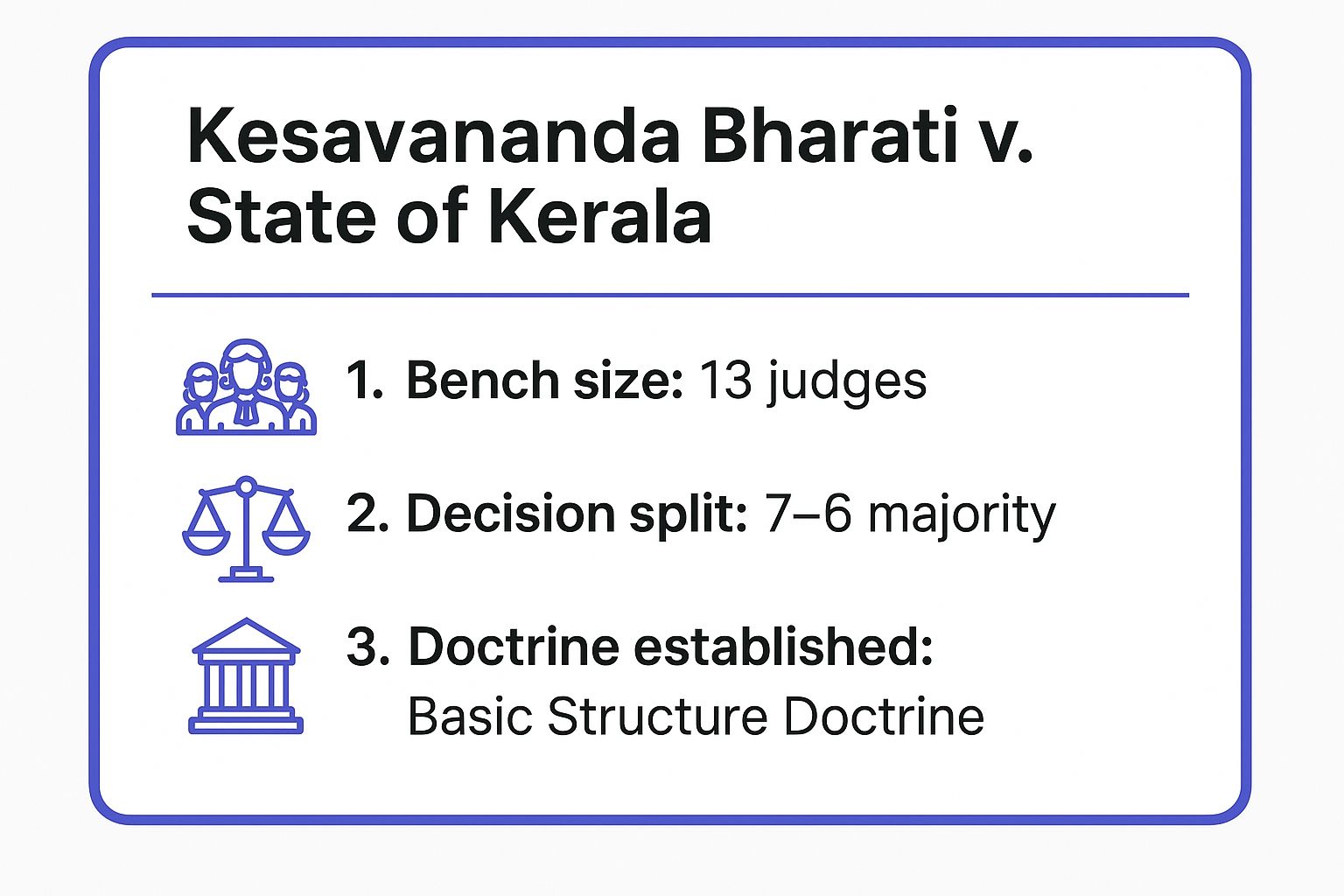
The 7-6 split decision highlights the profound constitutional dilemma the Court faced, with Justice H.R. Khanna's swing vote ultimately shaping modern Indian constitutional law.
Practical Implications and Insights
The doctrine's impact is profound and enduring. It was instrumental in striking down the 39th Amendment in Indira Nehru Gandhi v. Raj Narain and parts of the 42nd Amendment in Minerva Mills v. Union of India, which had sought to grant Parliament unlimited amending power.
Actionable Tips for Legal Professionals:
Constitutional Litigators: When challenging a constitutional amendment, frame your arguments around which specific elements of the basic structure are being violated. Identifying the precise feature-be it judicial review, federalism, or secularism-is critical.
Legislators and Policymakers: Before drafting a constitutional amendment bill, a "basic structure compliance check" should be an integral part of the process to ensure its long-term legal validity.
Law Students: Focus on the evolution of what constitutes the 'basic structure', as the list is not exhaustive and has been expanded by the judiciary over decades.
Insights:Understanding the nuanced arguments presented by Nani Palkhivala for the petitioner and H.M. Seervai for the state is essential for grasping the doctrine's intellectual foundations. Modern tools like Legal AI can help analyse these complex arguments. For instance, Draft Bot Pro can quickly summarise the dissenting opinions and compare them with the majority judgment, providing a deeper understanding of this landmark case. Explore how AI can assist in legal research for complex constitutional matters.
2. Maneka Gandhi v. Union of India (1978)
A watershed moment in Indian human rights jurisprudence, Maneka Gandhi v. Union of India dramatically expanded the scope of Article 21 (Right to Life and Personal Liberty). This case transformed the understanding of fundamental rights, establishing that they are not isolated silos but are interconnected, forming a golden triangle of protection for citizens. It stands as one of the most vital landmark cases in India for its liberal interpretation of personal liberty.
The case arose when the passport of Maneka Gandhi, a journalist and politician, was impounded by the Regional Passport Officer without providing any reason, citing "public interest". She challenged this arbitrary action, arguing that it violated her fundamental rights under Articles 14 (Right to Equality), 19 (Right to Freedom of Speech and Expression, which includes the right to travel abroad), and 21.
The Golden Triangle of Rights Explained
The core legal question was whether the "procedure established by law" under Article 21 could be any procedure, however arbitrary or unfair. The Supreme Court, in a groundbreaking verdict, overruled its earlier stance in A.K. Gopalan v. State of Madras and held that the procedure must be "right, just and fair," not arbitrary, fanciful, or oppressive.
This judgment established that Articles 14, 19, and 21 are deeply intertwined. Any law depriving a person of their personal liberty must not only satisfy the requirements of Article 21 but also stand the test of reasonableness under Article 19 and non-arbitrariness under Article 14. This interlinking is famously known as the "golden triangle," ensuring a robust check on executive and legislative action. The Court also held that the 'Right to Life' under Article 21 means more than mere animal existence; it includes the right to live with human dignity.
Practical Implications and Insights
The impact of this judgment has been monumental, serving as the fountainhead for a plethora of unenumerated rights. The Right to a Speedy Trial, the Right to Legal Aid, the Right to Privacy, and various environmental rights have all been derived from this expanded interpretation of Article 21.
Actionable Tips for Legal Professionals:
Human Rights Litigators: When advocating for a new dimension of human rights, anchor your argument in the expansive 'Right to Dignity' established under Article 21. This provides a powerful constitutional basis for recognising unenumerated rights.
Public Law Practitioners: In challenging any executive action or law that curtails personal liberty, always test it against the combined might of Articles 14, 19, and 21. Argue that the procedure is not just procedurally flawed but also arbitrary and unreasonable.
Law Students: Study the opinions of Justice P.N. Bhagwati and Justice V.R. Krishna Iyer to understand the shift from a positivist to a natural law interpretation of fundamental rights in the Indian context.
Insights:The Maneka Gandhi case demonstrates a profound judicial shift towards protecting individual liberty against state encroachment. Understanding this evolution is key to modern constitutional practice. Modern tools like Legal AI can be invaluable here. For instance, using Draft Bot Pro, you can trace the judicial evolution of Article 21 by summarising and comparing pre and post-Maneka Gandhi judgments, providing a clear map of its expanded scope. Explore how AI can assist in legal research to analyse such transformative legal precedents.
3. Shah Bano Begum v. Mohammed Ahmed Khan (1985)
A deeply divisive and politically charged judgment, Shah Bano Begum v. Mohammed Ahmed Khan stands as one of the most controversial landmark cases in India. This case brought the inherent conflict between secular law and religious personal law to the forefront of national debate, particularly concerning the rights of Muslim women. It highlighted the judiciary's role in interpreting personal laws through the lens of fundamental rights and social justice.
The case began when a 62-year-old woman, Shah Bano Begum, was divorced by her husband and subsequently denied regular maintenance. She filed a plea under Section 125 of the Code of Criminal Procedure (CrPC), a secular provision that obligates a husband to maintain his wife. The core legal battle was whether this secular law could override the principles of Muslim personal law, which limited a husband's liability to the 'iddat' period.
Secular Law versus Personal Law
The Supreme Court, led by Chief Justice Y.V. Chandrachud, delivered a unanimous verdict that sparked nationwide upheaval. The Court ruled in favour of Shah Bano, holding that Section 125 CrPC was secular in nature and applied to all citizens irrespective of their religion. It affirmed that a husband's obligation to provide maintenance to his divorced wife was a matter of social welfare and not contingent upon personal law.
This judgment was seen as a progressive step towards a Uniform Civil Code, which the Court also recommended the government pursue. However, it triggered a severe backlash from orthodox Muslim groups, who viewed it as an infringement on their religious freedom. This intense political pressure led the government to pass the Muslim Women (Protection of Rights on Divorce) Act, 1986, which effectively overturned the Supreme Court's ruling for Muslim women.
Practical Implications and Insights
The legacy of the Shah Bano case is complex. While the immediate legislative outcome diluted the judgment's effect, the case permanently elevated the discourse on gender justice, secularism, and the need for a Uniform Civil Code. It remains a critical reference point in debates on women's rights within religious communities, including the recent Triple Talaq cases.
Actionable Tips for Legal Professionals:
Family Law Practitioners: Develop a thorough understanding of the interplay between Section 125 CrPC and the Muslim Women Act, 1986. Knowing which statute to invoke based on the client's specific circumstances is crucial for securing effective relief.
Human Rights Advocates: Use the precedent of Shah Bano to frame arguments that champion social welfare and gender equality as constitutional imperatives that can inform the interpretation of personal laws.
Law Students: Study the political and social context surrounding the case. Analyse how public and political pressure can influence legislative responses to judicial pronouncements, a key aspect of India's legal-political landscape.
Insights:The Shah Bano judgment demonstrates the judiciary's commitment to constitutional values over religious dogma in matters of basic human dignity. For legal professionals dealing with intricate family law disputes, Legal AI tools can be invaluable. Draft Bot Pro can quickly trace the legislative and judicial history following this case, helping you build a stronger, historically-informed argument. Explore how AI can enhance your practice in Indian family law to manage such complex matters effectively.
4. Vishaka v. State of Rajasthan (1997)
A monumental judgment in the realm of gender justice, Vishaka v. State of Rajasthan is one of the most critical landmark cases in India for its role in addressing the pervasive issue of sexual harassment at the workplace. In the absence of specific domestic legislation, the Supreme Court, led by Justice J.S. Verma, stepped in to fill a legislative vacuum, demonstrating powerful judicial activism to protect the fundamental rights of working women.
The case was initiated through a Public Interest Litigation (PIL) filed by women's rights groups, including 'Vishaka', following the brutal gang-rape of Bhanwari Devi, a social worker in rural Rajasthan. She was targeted for her efforts to prevent child marriage as part of a government-sponsored campaign. The case highlighted the urgent need for a legal framework to ensure women's safety in their professional environments.
The Vishaka Guidelines Explained
The core issue before the Court was the enforcement of fundamental rights under Articles 14, 19, and 21 of the Constitution in the context of workplace safety. The Court held that sexual harassment is a clear violation of these rights, specifically the right to equality, freedom to practise any profession, and the right to life and liberty.
Drawing upon international conventions like the Convention on the Elimination of All Forms of Discrimination against Women (CEDAW), the Court formulated a comprehensive set of binding guidelines. These "Vishaka Guidelines" mandated all employers to establish a robust mechanism for the prevention and redressal of sexual harassment complaints, including the formation of an Internal Complaints Committee (ICC).
These guidelines remained the law of the land for over 15 years until the formal enactment of the Sexual Harassment of Women at Workplace (Prevention, Prohibition and Redressal) Act in 2013, which is largely based on this foundational judgment.
Practical Implications and Insights
The judgment's impact has been transformative, compelling organisations across India to formalise their internal policies against sexual harassment. It laid the groundwork for creating safer and more equitable workplaces, making employers accountable for the safety and dignity of their female employees.
Actionable Tips for Legal Professionals:
Corporate Advisors: Ensure client organisations not only have a PoSH (Prevention of Sexual Harassment) policy but that it is actively implemented. This includes regular awareness sessions, proper constitution of the ICC, and timely handling of complaints.
Litigators: When representing a complainant, meticulously document all instances of harassment and the procedural lapses by the employer in following the Vishaka Guidelines or the subsequent PoSH Act.
HR Professionals: Maintain a clear, confidential, and impartial investigation process. Document every step, from complaint receipt to the final report, to ensure legal defensibility and fairness.
Insights:The Vishaka judgment is a prime example of judicial creativity in protecting fundamental rights. Understanding how the Court invoked international law to interpret domestic constitutional provisions is crucial. Legal AI tools can be invaluable here. For instance, you can use Draft Bot Pro to analyse the judgment's reliance on CEDAW and other international instruments, providing a comparative perspective that enriches your understanding of how international law can shape domestic jurisprudence.
5. I.R. Coelho v. State of Tamil Nadu (2007)
Often described as the definitive postscript to Kesavananda Bharati, the case of I.R. Coelho v. State of Tamil Nadu is a crucial entry among the landmark cases in India for reinforcing judicial supremacy and the rule of law. This judgment by a nine-judge Constitution Bench settled the long-standing debate over the immunity of laws placed in the Ninth Schedule of the Constitution from judicial review.
The core issue stemmed from Parliament's practice of placing controversial laws in the Ninth Schedule to shield them from being challenged in court for violating Fundamental Rights. The Ninth Schedule was originally intended to protect agrarian reforms, but its scope was expanded over time. This case questioned whether this legislative power could be used to create a constitutional black hole, immune from judicial scrutiny, thereby undermining the Basic Structure Doctrine itself.
The Ninth Schedule Test Explained
The Supreme Court, in a unanimous verdict, established a clear and powerful principle: no law can be completely immune from judicial review. The Court held that any law placed in the Ninth Schedule after April 24, 1973-the date of the Kesavananda Bharati judgment-is open to challenge if it violates the basic structure of the Constitution.
This ruling effectively created a "twin test". First, a law must be examined for its impact on Fundamental Rights. Second, if the law damages or destroys the essence of a Fundamental Right which is part of the basic structure, it can be struck down. This judgment ensured that the Ninth Schedule could not be misused to subvert constitutional principles like equality, liberty, and the right to judicial review.
Practical Implications and Insights
The I.R. Coelho judgment is a powerful affirmation that constitutionalism and the rule of law are paramount. It ensures that no branch of government can operate beyond the Constitution's fundamental framework. For instance, laws related to land acquisition, reservation policies, and labour regulations, even if placed in the Ninth Schedule, are now scrutinised for their adherence to the basic structure.
Actionable Tips for Legal Professionals:
Constitutional Litigators: When challenging a post-1973 law in the Ninth Schedule, focus on demonstrating how it violates the "golden triangle" of Articles 14, 19, and 21, which form a core part of the basic structure.
Government and Policymakers: Understand that the Ninth Schedule is no longer an absolute shield. Any new legislation considered for inclusion must be rigorously vetted for basic structure compliance to avoid being struck down by the courts.
Law Students: Trace the evolution of judicial review from A.K. Gopalan to Maneka Gandhi and finally to I.R. Coelho to appreciate how the judiciary has expanded its role in protecting fundamental rights.
Insights:This case cements the idea that judicial review is itself a fundamental aspect of the basic structure. Legal tech tools can be invaluable here. For example, using Draft Bot Pro, you can quickly cross-reference a Ninth Schedule law with a database of precedents on basic structure violations, helping to build a stronger case. This application of AI for Indian law streamlines the complex task of identifying potential constitutional infringements.
6. Indra Sawhney v. Union of India (1992) - Mandal Case
Known as the Mandal Case, Indra Sawhney v. Union of India is a pivotal judgment that fundamentally shaped the landscape of reservation policy in India. This case is a cornerstone among landmark cases in India for its intricate balancing of social justice with principles of equality and administrative efficiency. It addressed the explosive political and social issue arising from the implementation of the Mandal Commission's recommendations for Other Backward Classes (OBC) reservations.
The case emerged from widespread protests and numerous petitions challenging the government's decision to implement the Mandal Commission's report, which recommended a 27% reservation for OBCs in government jobs. The primary legal question was whether reservations could be based solely on caste and to what extent such affirmative action was constitutionally permissible.
The 50% Ceiling and Creamy Layer Concept
A nine-judge Constitutional Bench of the Supreme Court, in a 6-3 majority decision, upheld the constitutionality of providing 27% reservation for OBCs. However, to prevent "reverse discrimination" and maintain meritocracy, the Court introduced two crucial safeguards: the 50% ceiling and the exclusion of the "creamy layer".
The Court ruled that total reservations, including for SCs, STs, and OBCs, should not exceed 50%, except in extraordinary situations. It also directed the government to identify and exclude the socially and economically advanced members of the OBCs, the "creamy layer," from the benefits of reservation. This ensures that the policy reaches the most deserving individuals within backward communities.
Practical Implications and Insights
The judgment's directives continue to govern India's affirmative action framework. It led to the establishment of the National Commission for Backward Classes and the systematic identification of OBCs and the creamy layer. States across India have since created their own OBC lists and criteria for the creamy layer, such as income thresholds, which are periodically revised.
Actionable Tips for Legal Professionals:
Administrative Lawyers: When advising on reservation policies, ensure that any new framework adheres strictly to the 50% ceiling. Any breach requires justification based on extraordinary circumstances and quantifiable data.
Policymakers: The regular review and rationalisation of the 'creamy layer' criteria are essential for the policy's effective and equitable implementation. This review must be based on current socio-economic data.
Law Students: Study the distinction made by the Court between reservations in initial appointments and reservations in promotions. The judgment initially barred reservations in promotions, a stance that has since been modified through constitutional amendments.
Insights:The brilliance of the Indra Sawhney judgment lies in its nuanced approach, which validated the principle of affirmative action while instituting checks to prevent its misuse. Analysing the various concurring and dissenting opinions reveals the deep ideological and constitutional tensions involved. Legal AI tools like Draft Bot Pro can be invaluable here. Use it to create a comparative analysis of Justice B.P. Jeevan Reddy's majority opinion against the dissenting views, providing a comprehensive understanding of the legal reasoning that sculpted modern reservation law.
7. Minerva Mills v. Union of India (1980)
Building directly on the precedent set by Kesavananda Bharati, the case of Minerva Mills v. Union of India served as a critical bulwark against parliamentary overreach. This is one of the most vital landmark cases in India as it decisively curtailed Parliament's attempt to grant itself unlimited power to amend the Constitution, thereby reinforcing the supremacy of the Basic Structure Doctrine.
The case challenged the constitutional validity of Sections 4 and 55 of the 42nd Amendment Act, 1976, enacted during the Emergency. These clauses sought to place constitutional amendments beyond judicial review and grant Parliament absolute, unchecked power to alter the Constitution, effectively dismantling the checks and balances established by Kesavananda Bharati. The petitioners, a textile company nationalised under the Sick Textile Undertakings (Nationalisation) Act, 1974, argued these amendments destroyed the Constitution's fundamental identity.
Reinforcing Judicial Review and Limited Government
The central issue was whether Parliament could, through an amendment, remove all limitations on its amending power and strip the judiciary of its power of judicial review over constitutional amendments. The Supreme Court, in a 4-1 majority judgment, struck down these provisions, delivering a powerful defence of constitutionalism.
The Court held that Parliament's power to amend is not absolute and cannot be used to destroy the Constitution's basic features. It famously declared that the power of judicial review and the "limited amending power" of Parliament are themselves integral parts of the basic structure. The judgment beautifully articulated that the Constitution is supreme, and Parliament is a creature of it, not its master. It restored the delicate balance between Fundamental Rights and Directive Principles of State Policy, which the 42nd Amendment had disturbed.
Practical Implications and Insights
This case is a cornerstone for understanding the separation of powers in India. It cemented the judiciary's role as the ultimate interpreter and guardian of the Constitution, preventing the legislative branch from establishing its own supremacy. Its principles continue to guide the scrutiny of constitutional amendments today.
Actionable Tips for Legal Professionals:
Constitutional Litigators: When arguing against a law that ousts judicial review, cite Minerva Mills to establish that judicial review is a non-negotiable basic feature of the Constitution.
Legislative Drafters: Any provision in a bill, especially a constitutional amendment, that limits or excludes judicial oversight must be carefully scrutinised for compliance with the Minerva Mills precedent to avoid being struck down.
Law Students: Focus on the "golden triangle" relationship between Articles 14, 19, and 21, and how this case protected it by maintaining the balance with Directive Principles.
Insights:The judgment's distinction between "amending power" and "destructive power" is a crucial conceptual tool for any constitutional law argument. Legal AI tools can be invaluable here. For instance, you could use Draft Bot Pro to trace the evolution of the Basic Structure Doctrine from Kesavananda Bharati to Minerva Mills and subsequent cases like I.R. Coelho, mapping how the judiciary has fortified these foundational principles over time.
8. Justice K.S. Puttaswamy v. Union of India (2017) - Privacy Case
In the digital age, Justice K.S. Puttaswamy v. Union of India stands as a monumental guardian of individual liberty, solidifying its place among the most critical landmark cases in India. This unanimous decision by a nine-judge bench of the Supreme Court unequivocally declared the Right to Privacy as a fundamental right, intrinsic to life and personal liberty under Article 21 and as a part of the freedoms guaranteed by Part III of the Constitution.
The case arose from challenges against the Government of India's Aadhaar scheme, which collected and stored citizens' biometric and demographic data. The core legal question was whether the Constitution of India guarantees a fundamental right to privacy. The Court overruled previous judgments in M.P. Sharma (1954) and Kharak Singh (1962) that had held privacy was not a constitutionally protected right, thus reshaping Indian constitutional jurisprudence for the modern era.

Privacy as a Fundamental Right Explained
The Supreme Court held that privacy is a natural, inalienable right with multiple dimensions, including personal autonomy, bodily integrity, and the right to protect one's personal information. The Court clarified that this right is not absolute and can be subject to reasonable restrictions, which must be based on a law, serve a legitimate state aim, and be proportional to the objective pursued.
This judgment provides a robust constitutional framework to scrutinise state actions that infringe upon an individual's personal sphere. It has had far-reaching consequences, influencing subsequent rulings on issues ranging from data protection and surveillance to LGBTQ+ rights, most notably in the Navtej Singh Johar case which decriminalised homosexuality.
Practical Implications and Insights
The Puttaswamy judgment created a new legal landscape, especially for technology, governance, and civil liberties. Its principles now form the bedrock of India's data protection laws and serve as a benchmark for evaluating the constitutionality of state surveillance programmes.
Actionable Tips for Legal Professionals:
Technology Lawyers: When advising clients on data handling practices or new technologies, you must ensure compliance with the privacy principles laid down in Puttaswamy. Conduct a privacy impact assessment as a standard part of your due diligence.
Government and Public Sector Undertakings: Any programme involving citizen data must incorporate "privacy by design". The legal justification for any intrusion must meet the three-part test: legality, legitimate aim, and proportionality.
Human Rights Advocates: Leverage this judgment to challenge state-sponsored surveillance and advocate for stronger data protection legislation that empowers individuals with control over their personal information.
Insights:The brilliance of this judgment lies in its forward-looking nature, particularly in the concurring opinions of Justice D.Y. Chandrachud and Justice S.K. Kaul, which elaborate on privacy in the context of technological advancements. Analysing these separate opinions is crucial. Using a tool like Draft Bot Pro, you can efficiently summarise and compare the nuances of all six opinions delivered in this case, gaining a comprehensive view of the Court's reasoning. Discover how to use AI for an in-depth analysis of Supreme Court of India judgments to better understand this complex and vital ruling.
Key Aspects Comparison of 8 Landmark Cases in India
Case Title | Implementation Complexity (🔄) | Resource Requirements (⚡) | Expected Outcomes (📊⭐) | Ideal Use Cases (💡) | Key Advantages (⭐) |
|---|---|---|---|---|---|
Kesavananda Bharati v. State of Kerala (1973) | High – Complex constitutional bench ruling | Moderate – Legal expertise, judiciary | Preserves Constitution’s basic structure; limits amendments | Challenging unconstitutional amendments; constitutional defense | Judicial review of amendments; protects fundamental rights |
Maneka Gandhi v. Union of India (1978) | Moderate – Expands rights interpretation | Moderate – Requires strong legal arguments | Expanded fundamental rights scope; substantive due process | Human rights cases focusing on life and liberty | Enhanced protection of personal liberty; fair procedure |
Shah Bano Begum v. Mohammed Ahmed Khan (1985) | Moderate – Intersection of personal & secular law | Moderate – Legal and socio-political resources | Advanced women’s maintenance rights; secular law supremacy | Family law cases involving personal vs secular law conflicts | Strengthened gender equality & social justice |
Vishaka v. State of Rajasthan (1997) | Moderate – Judicial activism, policy creation | Low to moderate – Organizational compliance needed | Workplace sexual harassment guidelines; legal redress system | Workplace harassment prevention and complaint handling | Immediate legal protection; employer accountability |
I.R. Coelho v. State of Tamil Nadu (2007) | High – Constitutional bench; judicial review | Moderate – Expert constitutional counsel | Limits immunity of 9th Schedule laws; strengthens judicial review | Challenging protected but unconstitutional laws | Protects fundamental rights from legislative bypass |
Indra Sawhney v. Union of India (1992) | Moderate – Complex social policy ruling | Moderate – Administrative enforcement | Affirmative action framework; 50% reservation ceiling | Reservation policy design and implementation | Balanced social justice with efficiency |
Minerva Mills v. Union of India (1980) | High – Constitutional amendment scrutiny | Moderate – Judiciary and legislature engagement | Reinforces basic structure; balances legislature and judiciary | Defense against arbitrary legislative supremacy | Maintains rule of law; judicial review safeguarded |
Justice K.S. Puttaswamy v. Union of India (2017) | High – Landmark 9-judge decision | Moderate – Tech and legal expertise | Privacy as fundamental right; digital rights framework | Privacy, data protection, digital rights advocacy | Strong personal autonomy protection; modern technology law |
Applying Legal History to Modern Practice with AI
The journey through India's legal landscape, as charted by the landmark cases in India discussed in this article, reveals a dynamic and ever-evolving constitutional philosophy. From the foundational principles established in Kesavananda Bharati to the modern privacy rights cemented in Puttaswamy, each judgement represents a critical pillar supporting the edifice of Indian democracy and individual liberties. These cases are not merely historical artefacts; they are potent, active precedents that continue to shape judicial reasoning, legislative action, and the everyday practice of law across the nation.
Mastering these cases is indispensable for any legal professional. Understanding the Basic Structure Doctrine from Kesavananda Bharati and Minerva Mills is crucial for constitutional challenges. Grasping the expanded definition of "procedure established by law" in Maneka Gandhi is essential for any argument involving personal liberty. Similarly, the principles from Vishaka and Shah Bano inform arguments in workplace safety and personal law, while Indra Sawhney remains the definitive authority on reservation policies. These are the tools of the trade for an Indian lawyer.
Bridging Precedent and Practice with AI
The true challenge for practitioners and students lies not just in knowing these cases, but in applying their complex doctrines to contemporary legal problems. Manually tracing the precedential lineage of a specific legal point through decades of case law is a time-consuming and arduous task, prone to oversight. This is where technology becomes a transformative ally.
AI-powered legal tools are revolutionising this process. Imagine preparing a writ petition challenging a new surveillance law. Instead of spending days manually searching for citations that build upon the Puttaswamy judgement, a sophisticated AI can do it in seconds.
Insights from Draft Bot Pro:A tool like Draft Bot Pro can instantly analyse your legal query and provide a structured overview of how the principles from these landmark cases in India have been interpreted and applied in subsequent High Court and Supreme Court rulings. It can identify the most relevant paragraphs, highlight conflicting interpretations, and suggest arguments grounded in the most current jurisprudence.
For instance, when dealing with an issue of judicial review over a constitutional amendment, Draft Bot Pro can:
Instantly recall the principles from I.R. Coelho, explaining how it fortified the Basic Structure Doctrine.
Cross-reference this with relevant sections from Minerva Mills to build a multi-layered argument.
Provide a list of recent cases where the Ninth Schedule was challenged, complete with verifiable citations.
This integration of AI allows you to move beyond simple knowledge recall to a state of deep, contextual understanding. It empowers you to build stronger, more persuasive arguments by connecting the foundational wisdom of these landmark judgements with the specific facts of your case. By leveraging such technology, you transform legal history from a static subject of study into a dynamic and powerful tool for modern legal practice, ensuring your work is not only efficient but also precise and authoritatively supported.
Ready to bridge the gap between historical precedent and modern legal challenges? Draft Bot Pro harnesses the power of AI to analyse the landmark cases in India and connect them to your current work, providing source-backed insights and accelerating your legal research. Visit Draft Bot Pro to see how you can transform your legal practice today.
