
A Practical Guide to Order 21 Rule 66 CPC Execution Proceedings

Order 21 Rule 66 of the Civil Procedure Code (CPC) is where the rubber meets the road in execution proceedings. It's the bedrock rule that governs the proclamation of sale—the official public notice that kicks off the auction of a judgment-debtor's property. This isn't just a simple announcement; it's a meticulously detailed document designed to make the entire process transparent and fair for everyone involved.
The Role of Order 21 Rule 66 in Fair Execution
Let's break it down. Imagine you've won a case and the court has granted you a monetary decree. Now comes the hard part: actually getting the money. The person who owes you the money (the judgment-debtor) isn't paying up, so you've moved the court to sell their property. This is a critical moment.
Order 21 Rule 66 steps in here as a crucial safeguard. It's all about striking a balance. On one hand, you (the decree-holder) have a right to see your decree satisfied. On the other hand, the judgment-debtor has a right to get a fair price for their property, not have it sold off for a pittance in a rushed, poorly advertised auction.
The rule forces a pause and demands detail. It ensures that any potential buyer knows exactly what they're bidding on, which naturally helps the property fetch its true market value.
A Foundation for Transparency
At its heart, Order 21 Rule 66 is a transparency mandate. To be legally sound, the proclamation of sale must spell out several key details:
Time and Place of Sale: Exactly when and where the auction will happen. No ambiguity allowed.
Property Details: A description of the property that is clear and thorough enough for anyone to identify it.
Encumbrances: Any known liabilities tied to the property, like a mortgage or a lien. Buyers need to know what they're taking on.
Revenue Payable: Any government dues, like property taxes, that are outstanding.
Valuation: The court's assessment of the property's value. This often includes estimates provided by both the decree-holder and the judgment-debtor.
InsightsThink of the proclamation under Rule 66 as the property's official biography presented to the public. If this biography is misleading or incomplete, it not only harms the judgment-debtor by potentially depressing the sale price but also exposes the entire auction to being legally challenged and set aside.
Getting this right is fundamental to the entire recovery process. For a wider view on turning a judgment into cash, understanding the tactics for effective post-judgment collections is incredibly useful.
The Role of Legal AI
Navigating the nitty-gritty of drafting a compliant proclamation can be a minefield. One small slip-up, and the whole sale could be invalidated later.
This is where specialized legal AI tools like Draft Bot Pro come into play. It acts like an expert paralegal, ensuring every requirement of Order 21 Rule 66 is ticked off. By analysing your case files and property documents, it can generate a draft proclamation that includes all the mandatory particulars, double-checking them against the statutory checklist. This helps you start the execution process on a rock-solid, compliant foundation, saving immense time and preventing headaches down the line.
To learn more about the entire process from start to finish, you can check out our comprehensive guide on the execution of decrees.
Navigating the Proclamation of Sale Procedure
Kicking off a sale under Order 21 Rule 66 CPC isn’t just a simple administrative step; it's a carefully structured, court-led process. It all begins when the decree-holder, having won their case, files an application to execute the decree by selling the judgment-debtor's immovable property. This very application is what sets the wheels of Rule 66 in motion.
Once that application lands, the court's role shifts from passive observer to active judicial authority. Its first, and most critical, task is to issue a notice to the judgment-debtor. This isn't just a courtesy call. It's a cornerstone of natural justice, giving the person whose property is on the line a real chance to have their say before it goes under the hammer.
This notice is vital. It’s the judgment-debtor’s opportunity to contest the sale, present their own valuation of the property, and flag any mistakes in the details the decree-holder has provided. Think of it as a crucial crossroad where the final terms of the auction are thrashed out and decided.
The Court's Duty to Settle Terms
After hearing from both sides, the executing court has a non-negotiable duty: it must "settle the terms of the proclamation." This means the judge has to actively apply their mind, weigh the evidence and arguments, and finalise the specific details that will be advertised to the public. The goal is to make sure the proclamation is fair, accurate, and leaves no room for ambiguity.
The whole procedure is designed to create a fair balance, flowing from the decree-holder's right to recover their dues to a court-managed proclamation that safeguards the judgment-debtor's right to a fair sale.
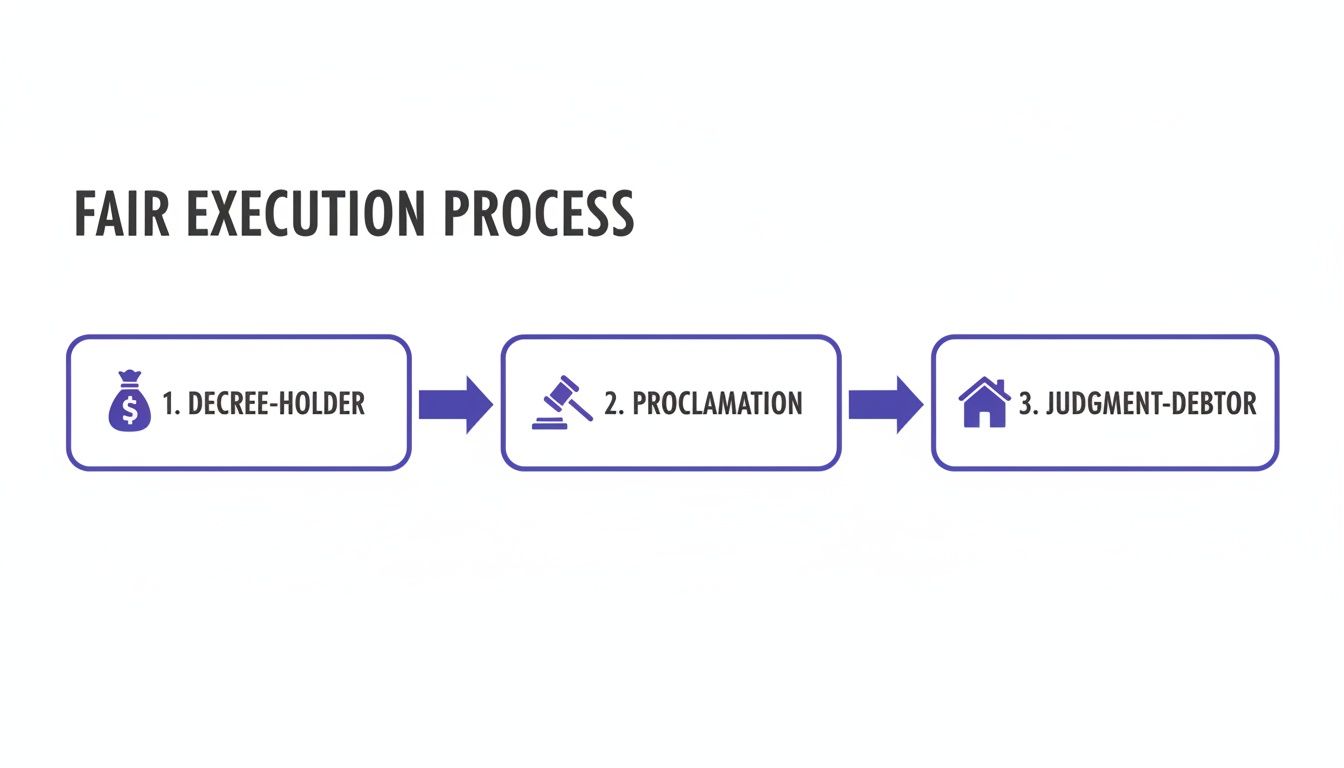
This visual shows how the proclamation acts as the central pillar, balancing the creditor’s need for recovery against the debtor’s right to get a fair price for their assets.
The final document must strictly follow the blueprint laid out in the Civil Procedure Code, specifically Form No. 29 of Appendix E. This isn't a mere guideline; it's the mandatory format for a legally sound proclamation.
The non-negotiable details include:
The exact time and place of the auction.
A full and proper description of the property being sold.
Any government revenue assessed on the property, if applicable.
A list of any encumbrances (like a mortgage) the property is subject to.
The total amount the sale is intended to recover.
Critically, the value of the property as stated by both the decree-holder and the judgment-debtor.
InsightsAny deviation from Form No. 29 or leaving out these crucial details can be labelled a 'material irregularity.' This kind of mistake gives the judgment-debtor powerful ammunition to challenge and potentially get the entire sale cancelled later on, under Order 21 Rule 90.
AI Assistance in Procedural Compliance
Keeping track of every single procedural checkbox can be a real headache. This is where legal AI assistants like Draft Bot Pro can be a game-changer. A lawyer can simply upload the decree-holder's application and the judgment-debtor's objections into the platform.
The AI can then instantly cross-check these documents against the strict requirements of Order 21 Rule 66 and Form No. 29. It can generate a draft of the settled terms or even an objection memo, flagging any missing information or compliance risks. This helps build a bulletproof proclamation that’s far less likely to be challenged later, making the execution process smoother and more secure for everyone involved. Procedural precision, after all, is the key to a successful auction.
Contested Issues of Valuation and Property Description
When a dispute under Order 21 Rule 66 CPC blows up, you can bet that two issues are almost always at the centre of the fire: the property's valuation and its description. These aren't just minor details on a form; they are the very heart of the matter, determining whether an auction is fair or a complete injustice. If the court gets these wrong, the whole execution proceeding can fall apart.
Think about it from a practical standpoint. A potential buyer shows up at a public auction, holding the official sale proclamation. Their entire bidding strategy—how much they're willing to pay, or if they're even interested at all—hinges on the information in that single piece of paper. If the proclamation lowballs the property's value or gets the description wrong, serious bidders will just walk away. This inevitably leads to a depressed sale price, causing what the law calls 'substantial injury' to the judgment-debtor.
This is exactly why the law puts such a heavy responsibility on the executing court. The judge can't just take the decree-holder's word for it. They have a judicial duty to dig in, examine the facts, and carefully settle the terms of the proclamation. The goal is to ensure both the value and description are as accurate as humanly possible to fetch the best price at auction.
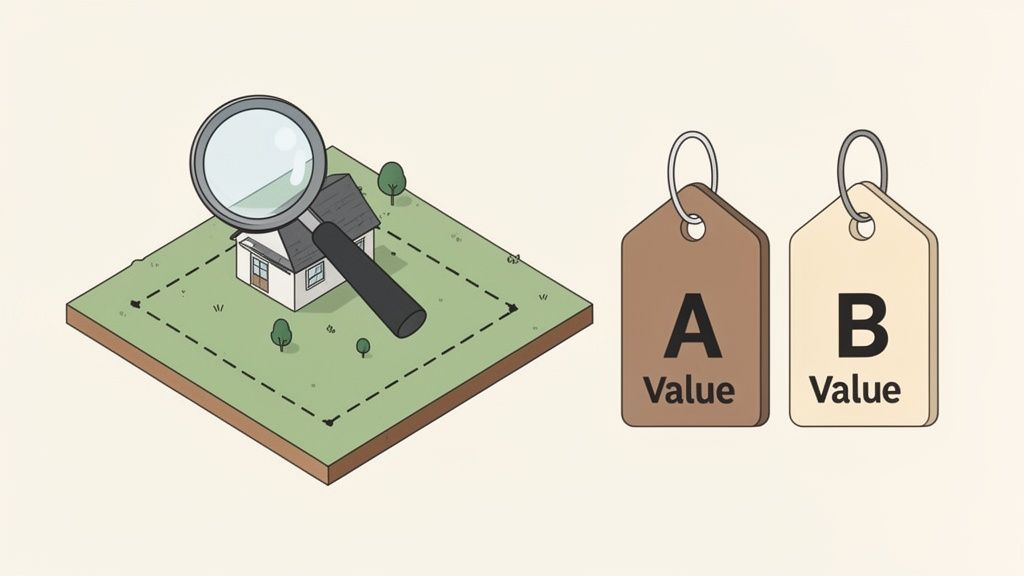
The Battleground of Property Valuation
Valuation is, without a doubt, the most fiercely contested part of this process. It’s a classic tug-of-war. The decree-holder often pushes for a lower value, hoping for a quick sale to recover their money. On the other side, the judgment-debtor will naturally argue for the highest possible valuation to satisfy the decree while minimising their own loss. The CPC anticipates this conflict and steps in to mediate.
Thanks to modern amendments and court rulings, the proclamation must now state the value of the property as estimated by both parties. But the court isn't just a passive referee; it isn't bound by either figure. The judge must apply their own judicial mind to arrive at a fair estimation, which is then clearly stated in the sale notice. This gives bidders a transparent look at the valuation spectrum, letting them make a truly informed decision.
A key part of this is understanding fair market value and its pivotal role in the proclamation of sale.
InsightsThe court's role in setting the valuation isn't a mere rubber-stamping exercise. It's an active, judicial function. The judge is expected to weigh all the evidence—market trends, property location and condition, and expert reports from both sides—before settling on the value. Skipping this step is a material irregularity, plain and simple.
Why an Accurate Property Description is Non-Negotiable
Just as critical as the price tag is the description of what's being sold. A sloppy or incomplete description can be just as damaging as a flawed valuation. Let me give you a real-world example: imagine a proclamation advertises the sale of a plot of land but conveniently forgets to mention the two-storey commercial building standing on it.
This isn't a small mistake; it's a catastrophic one. Bidders, relying on the official notice, would base their offers on the value of empty land. The final price would be a fraction of what it should be. This is a textbook 'material irregularity' that directly causes 'substantial injury' to the judgment-debtor, giving them rock-solid grounds to have the sale set aside under Order 21 Rule 90.
Common errors that can torpedo a sale include:
Incorrect Boundaries: Getting the property's physical limits wrong.
Omission of Structures: Failing to list existing buildings, wells, or other improvements.
Zoning Misinformation: Incorrectly stating if the land is residential, commercial, or agricultural.
Failure to Mention Encumbrances: Not disclosing existing mortgages, liens, or other claims against the property.
These mistakes don't just mislead buyers; they actively suppress the auction price. In one notable case from Karnataka, a sale was challenged because the proclamation ignored a state-specific amendment to Rule 66(2)(e). It left out crucial details like revenue assessments and the parties' own valuations. The result? A property valued at Rs. 3.85 crores was sold for just Rs. 2.5 crores—a mere 65% of its market price. That's a textbook case of substantial injury flowing directly from a defective notice.
How Legal AI Ensures Precision
This is where meticulous attention to detail becomes your best defence, and a tool like Draft Bot Pro can be a game-changer. A lawyer can simply upload the property records, valuation reports, and pleadings from both sides. The AI then analyses this mountain of data to generate a draft proclamation that is both complete and accurate. It cross-references every detail, flagging inconsistencies and ensuring the property description is precise and all valuations are correctly stated. This dramatically reduces the risk of human error and helps forge a legally sound proclamation, shielding the sale from future challenges. For a deeper dive, check out our article on using AI for property valuation.
Judicial Insights on Order 21 Rule 66
The black and white text of Order 21 Rule 66 CPC gives us the skeleton, but it's the courts that put flesh on the bones. Landmark rulings from the Supreme Court and various High Courts have elevated this rule from a mere procedural checklist to a set of hard-and-fast principles. These judgments are absolutely critical, as they shape our understanding of what really counts as a ‘material irregularity’ or ‘substantial injury’ in the eyes of the law.
If there's one central theme that runs through decades of case law, it's this: the executing court's job isn't mechanical. A judge can't just take the decree-holder's paperwork, rubber-stamp it, and issue a sale proclamation. Far from it. The court is required to apply its judicial mind, listen to the judgment-debtor's side of the story, and settle the terms of the sale in a way that’s fair to everyone involved.
This active role is the bedrock of the entire process. It’s what ensures the proclamation is more than just a piece of paper—it's a fair and accurate advertisement for the property. Dropping the ball on this duty can have disastrous consequences, often leading to the whole sale being thrown out.
The Court's Active Duty, Not a Passive Formality
The courts have been crystal clear on this point time and time again: settling the terms under Rule 66 is a quasi-judicial function. It demands a careful, considered look at all the facts and documents on the table. When a court fails to do this, it’s not just a minor slip-up; it’s a failure of its judicial duty.
Take a common scenario: a court sets aside a sale because the proclamation was drawn up without properly notifying the judgment-debtor. It makes perfect sense. Without that notice, the judgment-debtor never gets a chance to argue their case about the property's real value, its correct boundaries, or any loans attached to it. This isn't just a procedural hiccup; it's a denial of natural justice, and it's a fatal flaw.
Similarly, imagine a judgment-debtor comes prepared. They file detailed objections, complete with a valuation report from a certified professional or official records proving the property's correct details. The court must engage with this evidence. Simply brushing it aside and going with whatever the decree-holder said is a classic example of a material irregularity that can get the auction invalidated.
InsightsAt its core, judicial interpretation sees the court as a guardian of fairness. Its main job is to make sure the judgment-debtor's property sells for the best possible price. That can only happen if the sale proclamation is accurate, complete, and totally transparent.
Case Scenarios That Define "Material Irregularity"
So, what kind of mistakes are big enough to get a sale overturned? Looking at real-world examples from court rulings is the best way to understand this. These are the kinds of errors that judges take very seriously.
Gross Undervaluation: The proclamation lists the property's value at a tiny fraction of its market price, completely ignoring the judgment-debtor's evidence of a higher valuation.
Inaccurate Property Description: Advertising a plot as empty land when it actually has buildings or other valuable structures on it.
Omission of Key Details: Forgetting to mention a critical access road, a water source, or existing tenants, all of which heavily impact the property's value.
Ignoring Objections: Pushing ahead with the proclamation without even holding a proper hearing to consider the judgment-debtor's objections.
The landmark case of Ludhiana Improvement Trust v. Ujjagar Singh (2016) is a perfect illustration of these principles in action. The Punjab and Haryana High Court went through the case with a fine-tooth comb, showing exactly how procedural sloppiness can wreck an execution proceeding. The court found that the executing court simply didn't apply its mind, especially by ignoring clear objections that the land wasn't vacant but had buildings on it. This mistake led directly to a flawed proclamation, proving just how vital the court's active role under Order 21 Rule 66 is. You can read the court's full reasoning in the Ludhiana Improvement Trust judgment.
How Legal AI Can Leverage Judicial Precedents
Building a knockout argument, whether you're representing the decree-holder or the judgment-debtor, means having solid case law on your side. This is where legal AI tools like Draft Bot Pro can give you a serious edge. You can upload your case file and the draft proclamation, and then ask the AI to scan the document for potential weaknesses based on what the courts have said in the past.
For a judgment-debtor's lawyer, Draft Bot Pro can cross-reference the proclamation against a massive library of judgments, flagging similar cases where sales were cancelled due to material irregularities. It can help you draft a water-tight objection, armed with the right case law to back up your points on undervaluation or wrong descriptions. This isn't just about quoting the rule; it's about tapping into the deep well of judicial wisdom that truly defines it.
Strategic Drafting and AI-Powered Objections
Knowing the law behind Order 21 Rule 66 CPC is one thing. Putting it into practice is a whole different ball game. This is where strategy kicks in, whether you're the decree-holder trying to push the sale through or the judgment-debtor fighting for a fair shake. Success almost always boils down to sharp drafting and a keen eye for weaknesses in the other side's paperwork.
For the decree-holder, the mission is simple: draft an application and proclamation that are legally airtight. A single mistake can give the other side an opening to file objections, leading to frustrating delays that tie up your recovery. On the flip side, if you're the judgment-debtor, your job is to comb through that notice with a fine-tooth comb, hunting for any procedural misstep, dodgy valuation, or missing property detail that can form the basis of a solid objection.
This meticulous, often painstaking work is exactly where modern legal tools can give you an edge. Assistants that can scan documents and flag legal issues in seconds are completely changing how lawyers approach drafting and objections.

Drafting a Bulletproof Proclamation for Decree-Holders
As the decree-holder, the onus is on you to give the court the full, unvarnished truth. A half-baked or rushed application is practically an invitation for trouble. Your draft proclamation needs to be so thorough that there’s simply no room for misinterpretation.
Here’s what you absolutely must nail down:
Property Identification: Be precise. Your description should include exact boundaries, survey numbers, and any permanent structures on the land.
Encumbrance Disclosure: Come clean about everything. List all known mortgages, liens, or any other claims on the property. Being transparent now prevents nasty surprises later.
Valuation Justification: Don’t just pull a number out of thin air. You need to back it up with solid proof, like a professional valuer’s report or recent sale deeds for similar properties nearby.
Statutory Compliance: Go through the checklist. Double and triple-check that you've met every single requirement laid out in Order 21 Rule 66 and any relevant state amendments.
Taking this proactive approach does more than just fortify your position—it also shows the court you're acting in good faith, which can help speed things along.
Scrutinising the Notice for Judgment-Debtors
If you’re the judgment-debtor, that notice under Rule 66 is your call to action. Your goal is to dissect the decree-holder’s submissions and find any inaccuracy that could cause you ‘substantial injury’.
Zero in on these common weak spots:
Valuation Discrepancies: Does the decree-holder's valuation seem suspiciously low compared to the actual market rate?
Incomplete Descriptions: Have they conveniently forgotten to mention a valuable building, a well, or standing crops that are part of the property?
Procedural Errors: Was the notice served correctly? Does the draft proclamation itself follow the proper legal format?
Catching these flaws early lets you file a detailed, evidence-backed objection. This forces the court to fix the proclamation before it ever gets advertised for sale.
InsightsThe battle under Order 21 Rule 66 is often won or lost on the quality of documentation. For the decree-holder, precision is your shield against delays. For the judgment-debtor, any imprecision in the decree-holder’s draft is your sword.
To make this practical, here's a checklist outlining how each party should approach the draft proclamation.
Drafting Checklist Decree-Holder vs. Judgment-Debtor
Checklist Item | Decree-Holder's Focus | Judgment-Debtor's Focus |
|---|---|---|
Property Description | Ensure it is complete and accurate to avoid ambiguity. Include all assets. | Check for omissions (e.g., buildings, crops) that reduce the property's value. |
Valuation | Provide a fair market value supported by a valuer's report or comparable sales. | Scrutinise for undervaluation. Is the price significantly below market reality? |
Encumbrances | Disclose all known claims, mortgages, and liens transparently. | Verify the listed encumbrances. Are there any that are overstated or non-existent? |
Revenue Details | Accurately state the revenue assessed upon the land. | Cross-check the stated revenue with official records. Any discrepancy is an error. |
Procedural Steps | Confirm every step in Rule 66 has been followed to the letter. | Look for any procedural lapses—improper service, incorrect format, missed deadlines. |
This side-by-side view highlights the competing interests at play. While the decree-holder aims for flawless execution, the judgment-debtor's role is to act as a crucial check on the process, ensuring fairness prevails.
The Draft Bot Pro Advantage
This is where a legal AI like Draft Bot Pro becomes a game-changer. Instead of burning hours manually drafting paperwork or trying to spot errors, you can just upload your case files, property records, and valuation reports. The AI takes it from there.
For a decree-holder, it can generate a solid draft application and proclamation that checks all the statutory boxes. It automatically cross-references your details against the requirements of Order 21 Rule 66, making sure nothing slips through the cracks.
For a judgment-debtor, Draft Bot Pro can analyse the decree-holder's notice and whip up a detailed objection memo. It's incredibly good at spotting inconsistencies, comparing the property description against official records, and flagging potential undervaluation. By running your case facts against its massive database of statutes and case law, it can unearth procedural flaws you might have missed, helping you build a much stronger case. To see how this works, you can learn more about how to use AI to draft legal documents. It’s a huge time-saver that arms you with a data-driven strategy.
Understanding Pre-Sale and Post-Sale Challenges
One of the biggest strategic mistakes you can make in execution proceedings is getting the timing of your objection wrong. There's a hard line drawn in the sand between challenging the sale proclamation before the auction and trying to fight it after the hammer has fallen. Get this wrong, and your application could be dead on arrival, dismissed on purely procedural grounds.
The law has created specific moments for specific complaints. Order 21 Rule 66 CPC is your one and only chance to raise pre-sale issues. If you, as the judgment-debtor, spot a problem in the draft proclamation—maybe the property description is off, the valuation is suspiciously low, or an existing charge on the property hasn't been mentioned—this is the time to shout about it. The court's job is to iron out these details before any public auction notice is even printed.
The Doctrine of Waiver and Its Consequences
Here's the kicker: staying quiet at this stage is a huge gamble. If you receive the notice under Rule 66 but don't file any objections, the law assumes you're okay with the terms. This is a classic case of waiver or acquiescence.
By not speaking up, you effectively sign away your right to complain about those specific issues later. You can't, for instance, see a rock-bottom valuation in the proclamation, do nothing, and then use that same low value as a reason to set aside the sale after it's done. The court's logic is simple and brutal: you had your chance to fix the script, and you let it go.
InsightsThe Rule 66 hearing is your only opportunity to edit the script before the play begins. Once the auction (the play) is over, you can only complain about how the actors performed (the conduct of the sale itself), not about the script (the proclamation) that everyone already agreed on.
The Limited Scope of Post-Sale Objections
This brings us to the post-sale battleground: Order 21 Rule 90. This rule is not a do-over or a second chance to point out flaws in the proclamation. Its purpose is much narrower, limited strictly to "material irregularity or fraud" in how the auction was published or conducted.
What does that actually mean? Here are a few examples of valid Rule 90 objections:
The auction was held at a completely different time or place than what was advertised.
There's clear evidence of fraud or collusion by the auctioneer.
The sale notice wasn't published correctly, which kept potential bidders from even knowing about it.
What you cannot do is use Rule 90 to rehash arguments that belonged in the Rule 66 hearing. A recent Supreme Court ruling in the Selvaraj case hammered this point home. The judgment-debtor saw an alleged undervaluation in the Rule 66 notice but chose to stay silent. Only after the sale was completed did they try to challenge it under Rule 90. The court shut it down, calling it a clear case of acquiescence. The apex court has made it crystal clear: all complaints about the terms of the proclamation must be raised before the sale, not after. You can dive deeper into this landmark clarification of CPC rules on post-auction challenges.
How Draft Bot Pro Helps Formulate Timely Objections
Trying to keep these procedural timelines straight is exactly where a tool like Draft Bot Pro gives you a serious edge. When you, as the judgment-debtor's counsel, get a notice, you can simply upload it along with the property documents. The AI will quickly scan the draft proclamation for red flags—undervaluation, incomplete descriptions, procedural missteps—and help you whip up a sharp, well-structured objection memo specifically for the Rule 66 hearing. This ensures you're making the right arguments at the right time, building a case that won't get thrown out on a technicality.
Got Questions? We've Got Answers
Execution proceedings can feel like navigating a maze. Let's clear up some of the most common questions that pop up around Order 21 Rule 66 CPC, building on what we've already covered.
What's the Real Point of Order 21 Rule 66?
At its heart, this rule is all about fairness. Its main job is to make sure that when a judgment-debtor's property is sold at a public auction, it's done transparently and fetches the best possible price.
This is achieved by insisting on a detailed 'proclamation of sale' – basically, an official announcement that gives potential buyers the full picture of the property, including its value and any existing claims or liabilities (encumbrances).
Can You Fight a Sale if the Property Value is Wrong?
Absolutely. A dodgy valuation is one of the most common reasons to object under this rule. But here's the catch: you have to act fast.
The judgment-debtor must raise the alarm about an incorrect valuation after they get the notice under Rule 66 but before the court gives the final stamp of approval on the proclamation. If you miss this window, you’ve likely lost your chance to object on those grounds.
InsightsTiming is everything in litigation, and it's especially true here. Courts often see a failure to object to the valuation at this early stage as a silent agreement. Trying to bring it up later is an uphill battle you'll probably lose.
What If the Judgment-Debtor Just Ignores the Notice?
Ignoring the notice is a terrible idea. Seriously. If the judgment-debtor doesn't show up or respond, the court will simply move forward using only the information the decree-holder has provided.
This means the judgment-debtor gives up their only real shot to challenge the terms of the sale. The end result? A property potentially sold for far less than it's worth, leading to a massive financial hit.
How Can Legal AI Help with All This?
Let's be practical – managing the procedural checklist for this rule can be a headache. This is where modern tools can make a real difference. For example, a legal AI can scan a draft proclamation and instantly highlight things you might have missed or gotten wrong.
You can just upload your case documents and get quick support. A tool like Draft Bot Pro can analyse what the decree-holder has filed and help you put together a solid objection memo, making sure every point of challenge is raised correctly and at the right time.
Tired of the drafting grind? Simplify your legal work with Draft Bot Pro. Our AI-powered legal assistant helps Indian lawyers and law students whip up precise legal documents and nail their research in a fraction of the time. Join over 46,000 legal professionals who already trust us. See what you're missing at https://www.draftbotpro.com.
