
Master the Contempt Petition Format in India
- Rare Labs
- Nov 13, 2025
- 14 min read

Filing a contempt petition is how we, as legal professionals, make sure court orders are more than just words on paper. When you draft one correctly, you’re not just filling out a form; you’re creating the essential tool to hold someone accountable for wilfully disobeying a judge's directive. It's about enforcing justice, plain and simple.
So, Why Does a Contempt Petition Really Matter?
When a court issues an order, compliance isn't optional. But what happens when a party simply ignores it? This act of defiance doesn't just affect the case at hand—it strikes at the very authority of the judiciary. That’s where a contempt petition comes in. It's your formal way of telling the court, "Your order is being ignored," and asking for its power to be enforced. This isn't just about procedure; it's about upholding the rule of law.

The stakes are incredibly high, so getting the details right is crucial. Indian law splits contempt into two main categories, and the path your petition takes depends entirely on which one fits your situation.
Civil Contempt: This is the one you'll encounter most often. It boils down to the wilful disobedience of any court judgment, decree, order, or other directive. A classic real-world example? A government body that drags its feet and fails to pay court-ordered compensation to a landowner.
Criminal Contempt: This is far more serious. It involves actions that outright scandalise the court, interfere with a fair trial, or obstruct the administration of justice. Think of it as an attack on the integrity of the court itself.
A Quick Look at the Two Types
To make it clearer, here’s a straightforward comparison of the two. Understanding these distinctions is the first step in framing your petition effectively.
Civil vs Criminal Contempt at a Glance
Attribute | Civil Contempt | Criminal Contempt |
|---|---|---|
Nature of Act | Wilful disobedience of a court order, judgment, or decree. | Scandalising the court, prejudicing a fair trial, or obstructing justice. |
Intent | To compel the party to comply with the court's order. | To punish the offender for undermining the court's authority. |
Primary Goal | Remedial – to provide relief to the aggrieved party. | Punitive – to uphold the dignity and authority of the judiciary. |
Example | A spouse failing to pay court-ordered maintenance. | Publishing an article that unfairly maligns a sitting judge. |
Knowing which type you're dealing with dictates the tone, evidence, and legal arguments you'll need to present.
The Challenge of a Backlogged System
Let's be realistic—our courts are swamped. According to the National Judicial Data Grid, there are over 1.45 lakh (145,000) contempt cases pending across the Supreme Court and various High Courts. A huge chunk of these are filed against government departments for non-compliance.
This backlog is precisely why your drafting has to be flawless. A petition with technical errors is an easy target for dismissal, getting lost in the pile before a judge even considers its merits.
Insights: I've seen countless petitions get rejected at the registry level for simple formatting mistakes or missing information. A well-structured petition does more than just look professional; it makes the judge’s job easier. It allows them to quickly grasp the core issue: that a court order was wilfully disobeyed.
Getting the Format Right from Day One
Mastering the contempt petition format isn't just about ticking boxes. It’s about building a clear, logical, and persuasive narrative from the very first page. Every section, from the cause title to the prayer, has a job to do in convincing the court that its authority has been challenged.
For anyone tackling this complex task, a specialised legal AI tool like Draft Bot Pro can be a game-changer. It helps you generate a structurally sound first draft based on the facts of your case, ensuring you meet all the procedural requirements. This legal AI can free you up to focus on what really matters—crafting the powerful substantive arguments that will win your case. You can dive deeper into what’s at stake in our detailed guide on the punishment for contempt of court in India.
The Anatomy of a Perfect Contempt Petition
Let's move past the theory. A contempt petition that actually gets a judge's attention has a very specific and logical flow. Think of it as building a case brick by brick, where each section proves your point and makes the act of disobedience undeniable.
A messy, jumbled petition just confuses the issue. But get the structure right, and you guide the court straight to the heart of the matter. Getting this anatomy right isn’t just about ticking boxes; it's about making your argument impossible to ignore from the moment it lands on the clerk's desk.
The Foundational Components of Your Petition
Every solid legal document is built on a strong foundation. For a contempt petition, that means getting the preliminary sections absolutely perfect. These parts frame your entire argument.
Cause Title: This is the formal heading. It has to clearly state the court's name, the petition number, and the full details of everyone involved—the Petitioner (that’s you) versus the Contemnor/Respondent (the one violating the order).
Index: A clean, organised index is non-negotiable. It lists every single document you're filing, from the main petition and affidavit to all the annexures (your evidence), with their page numbers. It’s the roadmap for the judge and their team.
Synopsis and List of Dates: Think of this as the executive summary. The synopsis gives a quick overview of the case. The List of Dates, however, is your secret weapon. It lays out a timeline of every key event, from the day the original order was passed to each specific instance of non-compliance.
Insights: Never, ever underestimate the power of a well-drafted List of Dates. A clear, chronological timeline can paint a powerful picture of deliberate defiance, often making your case for you before the judge even dives into the detailed arguments.
The Core Argument: Averments of Contempt
This is where the real action is. It's the heart of your petition where you lay out, in excruciating detail, how the court's order was violated. Precision is everything here.
Vague accusations will get you nowhere. You need to connect the dots for the court with cold, hard facts. State exactly which part of the court's order was ignored. Then, you link that specific directive to the contemnor's actions—or their deliberate inaction.
For instance, don't just say, "The respondent didn't follow the order."
Instead, be specific: "Paragraph 5 of the Honourable Court's order dated 1st January 2024 explicitly directed the Respondent to remove the illegal construction within 30 days. As of 15th March 2024, the Respondent has failed to take any action whatsoever, which constitutes wilful disobedience."
The basic structure needs the case title, party names, the date and details of the original order, a crystal-clear description of the disobedience, and the relief you’re asking for. This format is pretty standard across most courts. The Supreme Court, however, has some extra requirements for petitions filed under Article 129 of the Constitution, which you can read more about in official records on the Sansad.in website.
The Concluding Sections: The Prayer and Verification
After you’ve laid out the contempt, you have to tell the court what you want it to do about it.
The Prayer Clause is your formal request for action. Typically, you'll ask the court to initiate contempt proceedings against the contemnor and punish them according to the Contempt of Courts Act, 1971.
Finally, every single contempt petition must be backed by a Verification Affidavit. This is your sworn statement, affirming that everything in the petition is true to the best of your knowledge. It’s what gives your claims legal weight. For a deeper dive into this crucial document, check out our guide on crafting an affidavit under the CPC in India.
Piecing all these elements together correctly is absolutely critical. This is where a legal AI assistant like Draft Bot Pro can be a game-changer. It generates a compliant, properly structured draft, ensuring all the foundational parts like the cause title, index, and affidavit format are spot-on. This legal AI helps you focus on what really matters: articulating the powerful facts of your case.
Drafting Your Petition with Practical Examples
Knowing the theory is one thing, but putting it into practice is where it really counts. Let's walk through a common scenario to see how the contempt petition format works in the real world.
Imagine a High Court has ordered a municipal corporation to tear down an illegal commercial building in a residential zone, but they're just... not doing it. This is a classic case of wilful ignorance, and your job is to translate this inaction into a powerful legal story for the court.
Your tone needs to be firm and assertive, but always respectful. Every single sentence should be a precise, factual statement that points directly to the act of disobedience. It's a delicate balance, but getting it right is what makes a petition command attention.
Crafting the List of Dates and Events
Think of the 'List of Dates and Events' as the backbone of your petition. It’s your chance to lay out the story chronologically, creating a clear, undeniable picture of deliberate delay and inaction. You don't need long, winding paragraphs here; each entry should be a short, sharp, factual jab that guides the judge through the timeline of contempt.
Let’s use our municipal corporation example:
10.01.2024: The Hon'ble High Court delivers its final judgment in W.P. (C) No. 123/2023. The order is clear: the Respondent Municipal Corporation must demolish the illegal structure within 60 days.
15.01.2024: We serve a certified copy of the judgment on the Commissioner of the Respondent Corporation. They are now officially on notice.
11.03.2024: The 60-day compliance period officially expires. The Respondent has done nothing.
20.03.2024: The Petitioner sends a legal notice to the Respondent, reminding them of the court's order and warning that contempt proceedings are the next step.
05.04.2024: Despite the notice, the illegal structure is still standing. Total silence from the Respondent's end.
See how that simple timeline builds a case of wilful disobedience? It’s all facts, no fluff.
This visual gives you a bird's-eye view of how the petition should be structured.
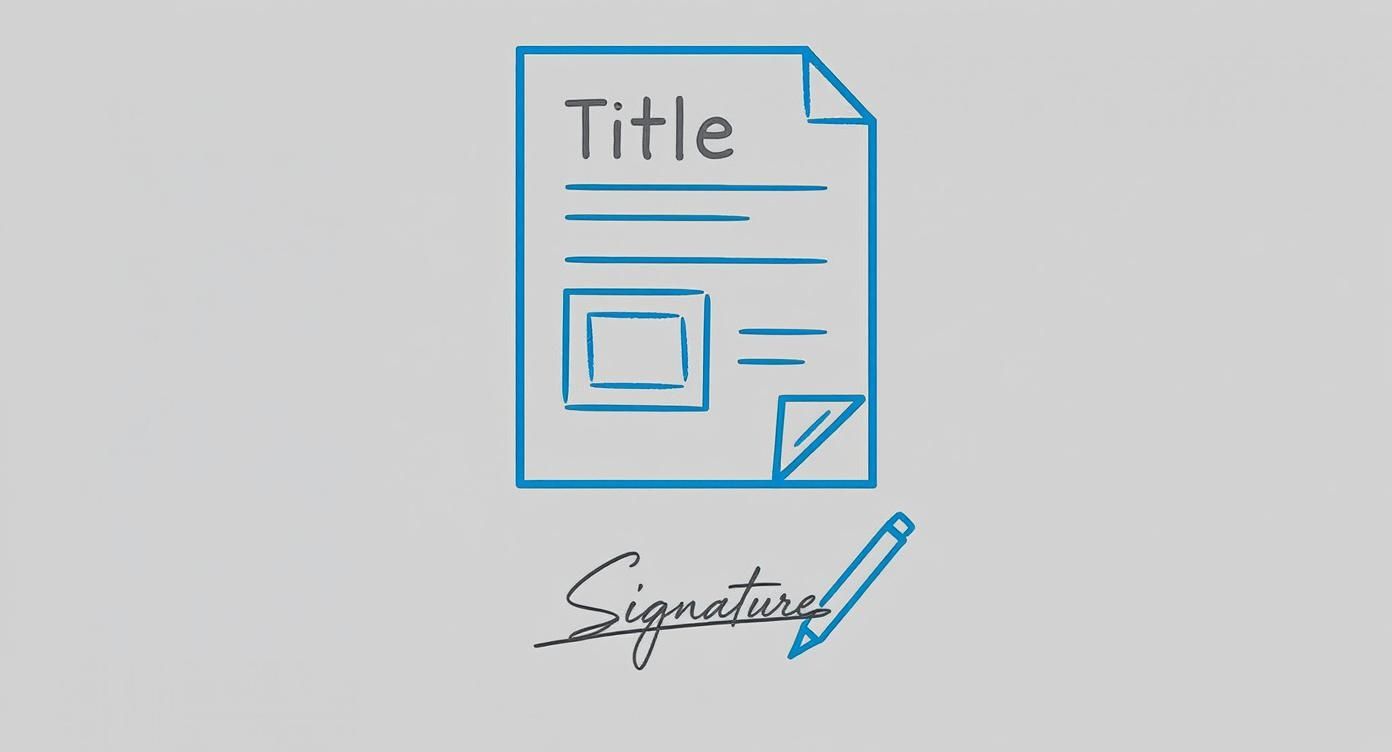
Following this structure ensures that every part of your petition, from the heading to the final verification, builds a logical and legally watertight argument.
Formulating a Powerful Prayer Clause
The 'Prayer' is where you bring it all home. It’s the closing argument where you tell the court exactly what you want it to do. The language has to be formal and direct, leaving zero room for interpretation. You're not making a suggestion; you're making a formal request for the court to wield its authority.
For our municipal corporation scenario, a well-drafted prayer would look something like this:
In light of the facts and circumstances mentioned above, it is most respectfully prayed that this Hon’ble Court may be pleased to:a) Initiate contempt proceedings against the Respondent for their wilful and deliberate disobedience of the judgment dated 10.01.2024 passed in W.P. (C) No. 123/2023.b) Punish the Respondent in accordance with the provisions of the Contempt of Courts Act, 1971.c) Pass any such further order or orders as this Hon'ble Court may deem fit and proper in the interest of justice.
Notice how each point is a crystal-clear, actionable request. It guides the court directly to the outcome you’re fighting for.
Using Legal AI to Draft with Precision
Let’s be honest, drafting these sections with the required legal precision is tedious and time-consuming. It's easy to make a small mistake that could get your petition thrown out on a technicality. This is where a good legal AI tool becomes your best friend.
A legal AI tool like Draft Bot Pro can be a game-changer here. You feed it the core facts—the judgment date, who the parties are, the nature of the non-compliance—and it generates a structured first draft for you. The AI handles the foundational contempt petition format, making sure all the correct legal terms and clauses are in place from the get-go.
This legal AI frees you up to focus on what you do best: refining the narrative and strengthening the factual arguments. Think of it as a safety net that catches formatting errors while you perfect the substance. For lawyers and law students, this means clawing back hours of grunt work and drastically reducing the risk of a petition getting rejected.
Building Your Case with Strong Evidence
A contempt petition is only as strong as the evidence you bring to the table. Once you've laid out the core arguments in your draft, the next make-or-break task is to assemble a file that leaves zero doubt about the other party's deliberate non-compliance. Think of it this way: a powerful story without proof is just that—a story. Solid evidence is what turns your narrative into a compelling legal argument the court can't ignore.
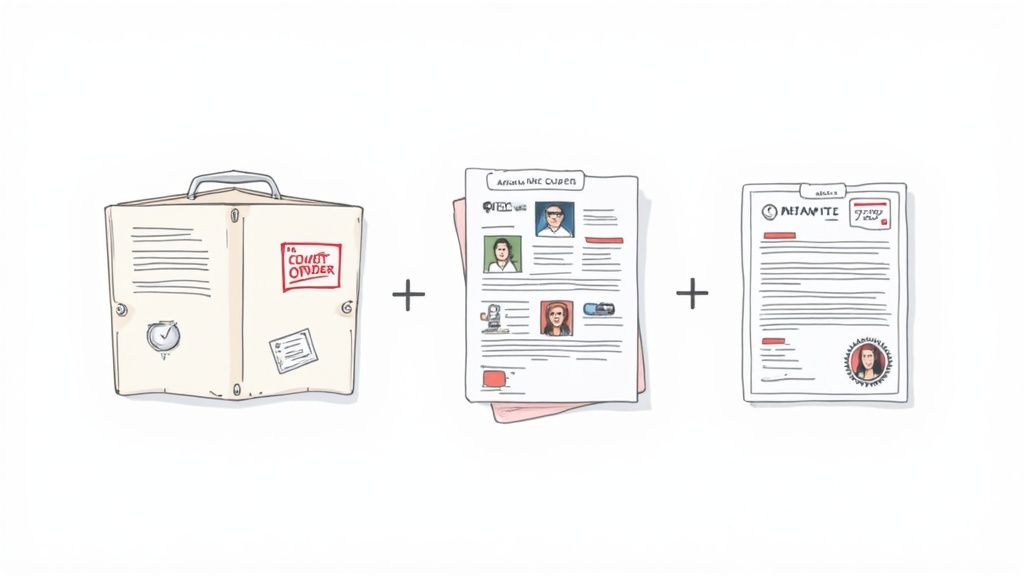
This isn't just about attaching a few documents and calling it a day. You need to be methodical. Your goal is to show a clear, undeniable chain of events: the court issued an order, the other party knew about it, and they consciously chose to defy it. Every single piece of evidence you include is a brick in the foundation of your case.
Assembling Your Non-Negotiable Documents
Let's start with the basics. Some documents are absolutely essential. Without them, your petition will likely get shot down at the filing stage itself. Start by gathering these must-haves:
A certified copy of the court order: This is the bedrock of your petition. It’s the official document that proves the court’s directive actually exists.
Proof of service: You have to prove the other party received the order. This could be anything from a postal receipt or a courier slip to an affidavit from the person who physically delivered it.
Evidence of non-compliance: This is where you prove the contempt. It could be dated photographs showing an illegal construction is still standing, official letters where they refuse to act, or bank statements proving maintenance payments were never made.
The established format for contempt petitions requires these supporting documents. It’s a procedural safeguard to ensure the court has everything it needs to properly assess your claim. You can read more about the procedural necessities for court petitions on SCObserver.in.
The Mandatory Affidavit and Smart Organisation
Every single contempt petition needs to be backed by a sworn affidavit. This is the legal document where you formally declare that all the facts in your petition and the contents of your annexures are true and correct to the best of your knowledge. Don't forget, this affidavit has to be properly prepared and notarised.
Insights: A well-organised, neatly indexed set of annexures does more than just tick a procedural box. It signals professionalism and makes it incredibly easy for the court to grasp your case at a glance. It's a simple step, but it can genuinely influence how your petition is perceived.
Getting all this evidence in order can be a real headache, especially when you're juggling multiple documents. This is where a legal AI assistant like Draft Bot Pro can be a huge help. The tool can assist in structuring your document list and ensuring your affidavit follows the correct court standards. This legal AI helps you avoid those small clerical mistakes that can stall your case.
Sometimes, a strong file isn't enough, and you might need to call witnesses to testify. You can learn more about that process in our guide on issuing a summons to a witness in Indian law. At the end of the day, a rock-solid evidence file, organised properly, gives your petition the credibility it needs to succeed.
Common Mistakes That Can Sink Your Petition
Filing a contempt petition feels like the final step, but it's also where things can go spectacularly wrong. Even with a watertight case, a simple, avoidable error in your draft can get it thrown out on a technicality before a judge even looks at the merits.
Think of this as your pre-flight checklist. So many petitions fail not because the contempt didn't happen, but because the petition itself wasn't drafted with enough precision.
One of the most common pitfalls I see is using vague, wishy-washy language. Simply stating that the respondent "failed to comply" or "ignored the order" is nowhere near enough. You need to get specific. Spell out exactly how and when they defied the court's directions, linking their specific actions—or inactions—back to the precise clauses of the order.
Another rookie mistake? Getting the party details wrong. This sounds basic, but you’d be surprised how often it happens. Meticulously double-check and triple-check the names, official titles, and addresses of every single respondent. A petition filed against the wrong person or a non-existent legal entity is dead on arrival.
The Critical Elements: Proof and Procedure
The heart of any contempt case is proving the disobedience was wilful. The burden is entirely on you to show that the contemnor not only knew about the court's order but made a conscious, deliberate choice to defy it. If you can't establish this element of intent, your petition is doomed to fail.
Just as critical is the ticking clock. Under Section 20 of the Contempt of Courts Act, 1971, you have exactly one year from the date of the contempt to file your petition. Miss that deadline by even a day, and it's an absolute bar to your case, no matter how blatant the disobedience was.
Insights: A well-drafted petition tells a clear, chronological story. It should read like this: the court passed an order, the order was served and understood, and then the other party intentionally disregarded it. Every detail you include should reinforce that single narrative of wilful disobedience, leaving no room for doubt.
This is where catching errors before you file becomes paramount. To help with this, I've put together a quick checklist of Do's and Don'ts to run through before you finalise your draft.
Petition Drafting Checklist Do's and Don'ts
This table is a handy reference to make sure you've covered your bases and avoided the common traps that can get a petition dismissed.
Action | Do | Don't |
|---|---|---|
Language & Specificity | Clearly state the specific actions (or inactions) that constitute contempt. | Use vague terms like "disobeyed" or "failed to comply" without details. |
Party Details | Triple-check the full legal names, designations, and addresses of all respondents. | Guess or use outdated information for the parties involved. |
Proving Wilful Intent | Attach evidence showing the respondent knew about the order (e.g., service proof). | Assume the court will know the respondent was aware of the order. |
Timelines | Calculate the one-year limitation period from the date of contempt carefully. | Delay filing, risking the petition becoming time-barred. |
Annexures & Evidence | Neatly annex a certified copy of the original court order being violated. | Forget to attach the foundational court order or provide a blurry photocopy. |
Prayer Clause | Clearly state the relief you are seeking from the court. | Be ambiguous about what action you want the court to take against the contemnor. |
Running through this checklist can be a real lifesaver. It forces you to look at your petition with a critical eye and ensures it's procedurally sound before it even lands in the court registry.
This is also where a specialised legal AI tool like Draft Bot Pro can act as an essential safety net. Its pre-structured templates are already designed to meet specific court formatting rules, guiding you away from these simple but costly mistakes. This legal AI can flag missing sections or formatting errors, giving you peace of mind that your petition is solid. That simple check can genuinely be the difference between your case being heard or being dismissed at the filing counter.
Common Questions Answered
When you're dealing with a contempt petition, a lot of questions can pop up. It's a tricky area of law. Let's walk through some of the most common queries I hear from clients and junior advocates.
How Long Do I Have to File a Contempt Petition?
This is a critical one, and the clock is always ticking. Under Section 20 of the Contempt of Courts Act, 1971, you have exactly one year to file your petition from the date the contempt happened.
Don't treat this lightly. It's a hard deadline. I've seen perfectly good cases get thrown out before they even start, simply because they were filed a day late. The court has no discretion here; miss the deadline, and your case is dead on arrival.
Can I File This Myself, Without a Lawyer?
Legally, yes, you can appear as a "party-in-person." But should you? I'd strongly advise against it. The process is a minefield of procedural rules and technicalities that can trip up even seasoned professionals.
Insights: The court registry is notoriously strict about the contempt petition format. They will scrutinize every detail, from the margins to the way paragraphs are numbered. An experienced advocate knows the unwritten rules and what the clerks look for, ensuring your petition doesn't get bounced back for a simple formatting mistake before a judge ever sees it. A legal AI like Draft Bot Pro can also help ensure these formatting requirements are met from the very first draft.
What Happens if They Comply After I've Filed?
It’s a common scenario. You file the petition, and suddenly, the other side decides to follow the court's order. When this happens, the court will definitely take notice. The person in contempt (the contemnor) will likely offer an unconditional apology, and the court might just accept it and close the case.
However, that doesn't mean you're left empty-handed. The court can still order them to pay your costs for the legal action you were forced to take because of their delay. This is where a well-drafted initial filing really pays off.
Is a Simple "I'm Sorry" Always Enough?
Not at all. While offering an unconditional apology is a huge step in the right direction, the court doesn't have to accept it automatically. A judge is going to look at the whole picture.
They’ll assess how genuine the apology seems, the seriousness of the contempt, and the person’s overall conduct throughout the matter. Based on that, they'll decide whether to let them off with a warning or still impose a penalty. The apology is a major factor, but it's not a get-out-of-jail-free card.
Tired of battling with procedural nitty-gritty? Draft Bot Pro is an AI legal assistant designed by Indian lawyers specifically for the challenges we face. It helps you get your documents right the first time, meeting the exact standards of our courts so you can focus on the substance of your case. See how it can simplify your drafting and research by visiting https://www.draftbotpro.com today.