
Punishment for Contempt of Court in India Explained

When a court delivers a judgment, that's supposed to be the final word. But what happens when someone wilfully ignores it or openly defies the court's authority? That’s where the concept of contempt of court comes in.
The punishment for contempt of court in India can be serious: simple imprisonment for up to six months, a fine of up to ₹2,000, or both. These penalties aren't just about punishment; they're about upholding the very dignity and authority of our judicial system.
What Constitutes Contempt of Court in India
Think of a court order as the final word in a legal dispute. When that final word is ignored, it’s not just a minor infraction—it threatens the entire foundation of justice. Contempt of court isn't just dry legal jargon; it’s the crucial principle that protects the courts' authority and ensures the rule of law means something.
Without these laws, court decisions would be nothing more than suggestions.
It’s a bit like a referee's call in a football match. If players could just ignore the whistle, the game would descend into chaos. In the same way, contempt laws exist to maintain order and fairness in the legal process. Disrespecting a court's authority undermines public confidence that justice isn't just declared, but is actually delivered.
The Two Pillars of Contempt
To really get a handle on this, you need to understand the two main categories. Each one deals with a different kind of interference with the justice system.
Civil Contempt: This is pretty straightforward. It happens when someone wilfully disobeys any judgment, decree, direction, or order from a court. Basically, it's a direct failure to follow the court's instructions.
Criminal Contempt: This is a much broader category. It includes any act that "scandalises" or lowers the authority of a court, or anything that prejudices or interferes with a judicial proceeding.
The distinction is critical. Civil contempt is about a personal failure to obey an order, while criminal contempt involves an attack on the integrity of the judicial system itself.
Key Principles of Contempt of Court
Here’s a quick table to break down the fundamental ideas behind contempt laws in India.
Concept | Primary Purpose | Governing Law | Key Consequence |
|---|---|---|---|
Civil Contempt | To compel an individual to obey a specific court order or judgment. | Section 2(b) | Corrective (ensuring compliance) |
Criminal Contempt | To punish acts that undermine the court's authority or obstruct justice. | Section 2(c) | Punitive (punishing interference) |
Judicial Dignity | To maintain public respect and confidence in the judicial system. | Contempt of Courts Act, 1971 | Upholding the rule of law |
Fair Proceedings | To ensure legal proceedings are conducted without prejudice or external influence. | Inherent judicial power | Protecting the integrity of justice |
This framework helps clarify why these laws are so vital for a functioning legal system.
At its core, civil contempt is corrective—it aims to get someone to comply with an order. Criminal contempt, on the other hand, is punitive. It’s designed to punish behaviour that actively obstructs justice or tears down the court's authority.
Navigating these definitions can be tricky, as it often involves a deep dive into legal precedents. This is where modern tools can make a difference. Legal AI platforms like Draft Bot Pro can be a massive help for legal professionals, allowing them to quickly scan case law and see how similar actions have been classified in the past. This gives them invaluable context when building a case or a defence.
To really get a handle on the punishment for contempt of court, you first need to know that not all contempt is created equal. The law slices it into two main categories: civil and criminal. While they both serve to protect the court's authority, they come from very different places and have entirely different goals.
Think of it this way: civil contempt is like you knowingly refusing to pay a bill you've been ordered to pay. Criminal contempt, on the other hand, is like publicly declaring that the entire banking system is corrupt and telling everyone to ignore it. One is a specific act of defiance; the other is a broadside attack on the institution itself.
H3: Civil Contempt: A Failure to Comply
Civil contempt is pretty straightforward. It’s all about a person wilfully disobeying a court's specific judgment, order, or direction. That word, "wilful," is the key. This isn't about an honest mistake or being physically unable to follow an order; it's a conscious choice to ignore what the court has mandated.
A classic example is when a court orders someone to hand over property in a dispute, and they just... don't. The court's aim here isn't purely to punish them for the sake of it. The goal is to compel them to act—to finally follow the original order.
H3: Criminal Contempt: An Attack on Justice
Criminal contempt is a much more serious affair because it strikes at the very heart of the judicial system. This covers any act that "scandalises" the court, interferes with ongoing legal proceedings, or otherwise obstructs the administration of justice. It's about protecting the public's faith in the courts.
For instance, publishing a baseless, inflammatory article accusing a judge of taking a bribe, or organising a protest to intimidate witnesses outside a courtroom—that’s criminal contempt. The court’s response here is punitive. It’s about punishing the individual to send a clear message that undermining the justice system won't be tolerated.
The line often boils down to intent. Civil contempt is about forcing someone to do what they were told for the benefit of another party. Criminal contempt is about punishing someone to vindicate the court's authority and maintain public trust.
To lay it out clearly, let's compare the two side-by-side.
H3: Comparing Civil and Criminal Contempt
Basis of Comparison | Civil Contempt | Criminal Contempt |
|---|---|---|
Nature | Remedial. It's about enforcing a court order for a party's benefit. | Punitive. It's about punishing an act that harms the court's authority. |
Act | Wilful disobedience of a specific court judgment, decree, direction, or order. | Acts that scandalise the court, prejudice proceedings, or obstruct justice. |
Intent | The focus is on compelling compliance with the original order. | The goal is to punish the offender and deter others from similar acts. |
Purpose | To provide relief to the aggrieved party. | To uphold the dignity and authority of the judicial system. |
This table shows how, while both are serious, their underlying purpose and the actions they address are fundamentally different.
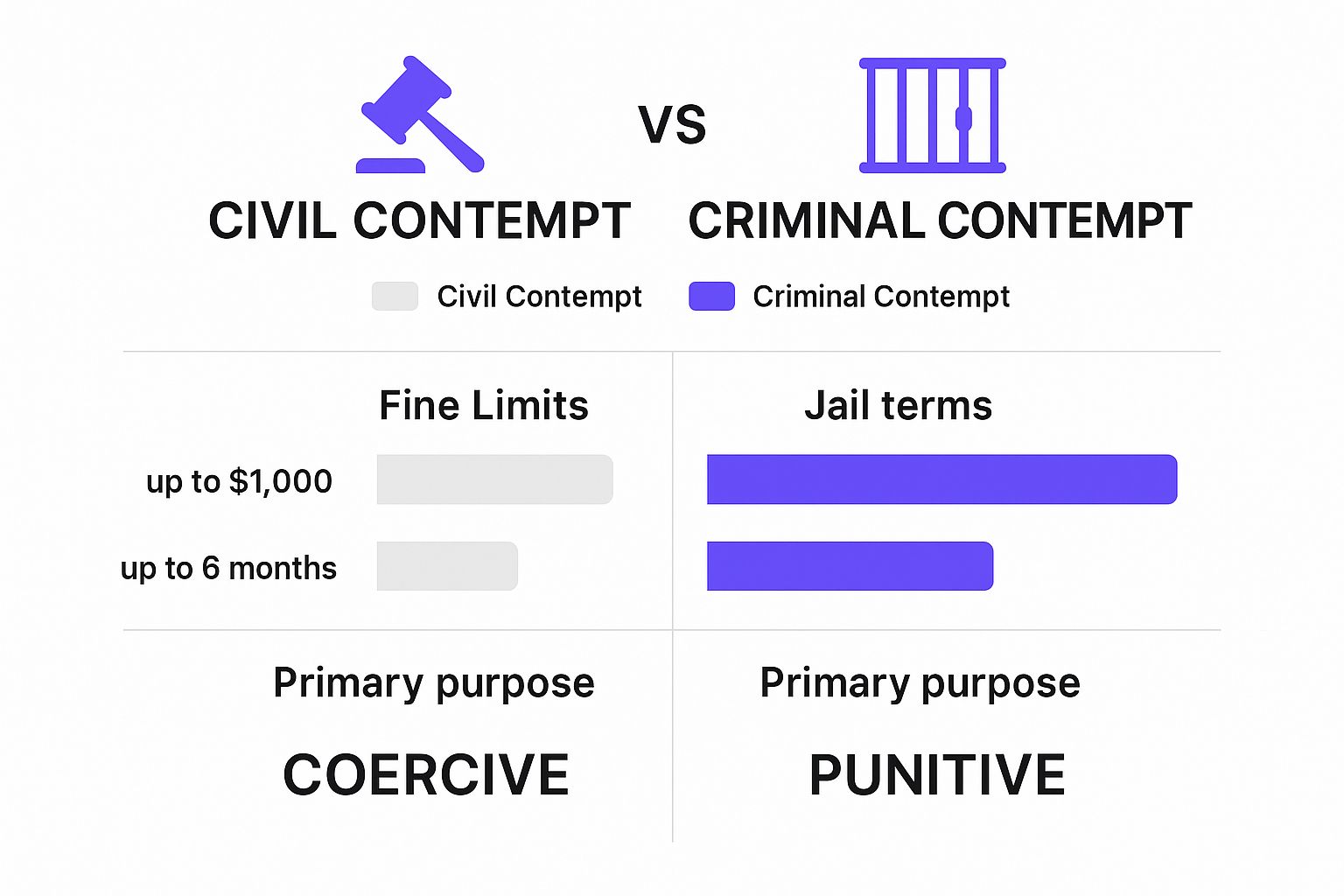
As the infographic highlights, the consequences reflect the nature of the offence. Criminal contempt often attracts a harsher, more punitive response because it’s seen as a direct challenge to the rule of law. The Contempt of Courts Act, 1971, is the primary legislation that gives courts the teeth to deal with both types of contempt.
Figuring out which category an act falls into can be tricky, often turning on a fine-grained analysis of the act, the context, and the person's intent. This is where modern legal tech is becoming a massive help. For lawyers, a tool like Draft Bot Pro can cut through the complexity. Its AI can quickly sift through case facts and cross-reference them with thousands of precedents, helping to classify an act as civil or criminal with much greater speed and accuracy.
If you're interested in how this technology is changing legal practice, you might want to check out our guide on how AI assists with the Civil Procedure Code in India-india).
The Contempt of Courts Act, 1971: A Closer Look

To really get to grips with how courts protect their authority, we need to pop the bonnet and look at the legal engine that drives the whole process. That engine is The Contempt of Courts Act, 1971.
This is the primary rulebook. It lays out the rules of engagement for both civil and criminal contempt, giving courts a clear, structured way to deal with actions that undermine their dignity or get in the way of justice. It’s not just a dusty old statute; it's the foundation for the entire system of contempt proceedings in India. You can find a deeper dive into its provisions on Bhatt & Joshi Associates.
Without this Act, the power to punish for contempt would be far less defined.
Key Provisions You Need to Know
While the entire Act is important, a few key sections do the heavy lifting. Section 2 is where it all starts, officially laying out the definitions for the two types of contempt we've discussed:
Section 2(b) tackles civil contempt. Think of this as the wilful disobedience of any court judgment, decree, direction, order, or other formal process. It’s about someone deliberately ignoring a direct command from the court.
Section 2(c) defines criminal contempt much more broadly. This covers anything published or any act that scandalises the court, prejudices a fair trial, or otherwise interferes with the administration of justice.
But the real teeth of the Act? That’s found in Section 12.
Section 12: The Power to PunishThis section is the heart of the Act's enforcement power. It clearly states that a person found guilty of contempt can face simple imprisonment for up to six months, a fine of up to ₹2,000, or both.
This gives the court the leverage it needs to ensure its orders aren't just suggestions. The punishment for contempt of court is meant to be both a penalty and a powerful deterrent.
The Apology Proviso and Constitutional Muscle
Interestingly, the Act also has a built-in off-ramp. It allows the court to waive the punishment if the person in contempt offers a genuine, unconditional apology that satisfies the court. This shows the law's main goal isn't just to punish people but to restore respect for the judicial process.
It’s also critical to understand where this power truly comes from. The Act is bolstered by the Constitution of India itself, giving it an unshakeable foundation.
Here’s the inside track:
The power of the higher courts to punish for contempt isn't just a gift from the 1971 Act; it's an inherent power baked right into the Constitution. Article 129 gives the Supreme Court this power as a "court of record," and Article 215 does the exact same for the High Courts. This constitutional backing means their authority to maintain order and enforce their will is fundamental to their very existence.
For legal professionals, navigating these sections requires absolute precision. This is where a tool like Draft Bot Pro can be a game-changer. It can instantly pull up the relevant sections of the Act, cross-reference them with landmark judgments, and help you build arguments based on how courts have interpreted these very provisions in thousands of past cases. This kind of AI-powered backup ensures your legal strategy is built on solid, well-researched ground.
Decoding the Punishment for Contempt of Court
When someone defies a court's authority, the consequences have to be firm. The punishment for contempt of court isn't just about slapping a penalty on an individual; it’s about sending a clear message: court orders must be followed, and the judicial process demands respect. The law lays out specific penalties to act as both a punishment and a warning to others.
Under Section 12 of The Contempt of Courts Act, 1971, the court’s powers are clearly defined. If found guilty, a person can be sentenced to simple imprisonment for up to six months, a fine of up to ₹2,000, or both. This gives the courts a straightforward framework, preventing punishments from being random or excessive.
But those headline numbers—six months and ₹2,000—don't paint the full picture. A court's decision is never a knee-jerk reaction. It carefully weighs several factors before handing down a sentence.
Factors That Influence Sentencing
A judge doesn’t just look at the rulebook; they look at the entire situation. The court takes a hard look at the context surrounding the contempt to make sure the punishment fits the crime and serves the interests of justice.
Here’s what they typically consider:
Severity and Nature of the Act: Was it a simple mistake, an unintentional slip-up? Or was it a deliberate, public act of defiance meant to undermine the court? Scandalising the court, for example, is almost always treated more seriously than a minor delay in following an order.
Conduct of the Contemnor: Is the person sorry for what they did? Did they try to make things right, or did they just dig their heels in? A genuine show of remorse and a cooperative attitude can go a long way in reducing the penalty.
The Impact on Justice: Did the person’s actions actually derail a case or just create a small procedural hiccup? The more an act interferes with the administration of justice, the harsher the punishment is likely to be.
The court’s aim is to uphold its authority, not to be vengeful. That’s why the story behind the contempt is so critical in deciding the final outcome.
InsightsA sincere, unconditional apology can be a game-changer. Section 12 gives the court the power to let the contemnor off or reduce the punishment if it's satisfied with the apology. But be warned: a half-hearted, tactical apology is easy to spot and will likely be dismissed.
The Strategic Role of Legal AI
To give a client solid advice, a lawyer needs to know more than just the law; they need to understand how judges think. Predicting a sentence means looking at past cases to see how courts have handled similar situations. This is where AI becomes a powerful ally.
A legal AI tool like Draft Bot Pro can sift through thousands of past contempt cases in moments. It analyses sentencing patterns, showing lawyers how different High Courts or the Supreme Court have dealt with various types of contempt. This data-driven insight helps legal teams give their clients a realistic idea of what to expect and build a defence strategy based on hard precedent, not just a hunch.
How a Contempt Case Unfolds

So, how does a contempt action actually get started? It really comes down to two paths: either the court takes notice of the issue on its own initiative (suo motu) or an aggrieved party files a petition. This initial step is critical because it shapes the entire proceeding, influencing everything from timelines to the types of defences available.
Think of it this way: when a court acts suo motu, the judge themselves issues a show-cause notice. There's no external complaint. The notice spells out the alleged contempt and demands an explanation. For lawyers on the receiving end, the clock starts ticking immediately to get the facts straight and pull up the relevant orders.
Key Stages
Once initiated, the case moves through a series of well-defined stages. It’s a procedural journey with clear signposts:
The court issues a formal notice.
The alleged contemnor files a reply.
Specific charges are framed by the court.
The matter proceeds to a final hearing.
Each of these steps is governed by strict timelines laid out in the Contempt of Courts Act, 1971, and missing them is not an option.
The reply stage is where the real legal strategy begins. This is the first opportunity to build a defence. Are you arguing it was an unintentional mistake (civil contempt)? Or are you asserting the right to fair criticism (criminal contempt)? The arguments you make here will define the entire case and heavily influence the final outcome.
InsightsA well-drafted, respectful response to a show-cause notice can genuinely sway a judge's perspective. It shows you're taking the matter seriously.
But be warned, the deadlines are unforgiving. Courts expect a swift response to maintain their authority, often giving just days to reply. Blow past a deadline, and you risk an adverse order being passed against you almost automatically, leading to immediate punishment for contempt of court.
This is where Draft Bot Pro becomes a lifesaver. It can instantly find relevant case law and statutes specifically on show-cause defences, cutting down research that would normally take hours into just a few minutes. This allows legal teams to focus on crafting a precise and powerful written reply.
Building A Defence
The final hearing is where your defence is put to the ultimate test. It’s all about presenting evidence—whether through witness testimony or documents—to prove your intent, or lack thereof. The core question is always: was the action wilful, and did it truly undermine the judicial process?
This is also the stage for arguing mitigating factors. Under Section 12, a sincere, unconditional apology can dramatically change the court's view and soften the sentence. Knowing how to frame that apology, and understanding past sentencing trends, becomes absolutely crucial.
To build a solid defence, you'll need to:
Compile all evidence related to your intent and the actual impact of your actions.
Research similar cases to see what kind of penalties were handed down.
Prepare a written apology if it’s a viable strategy.
Structure your arguments for the hearing in a logical, persuasive flow.
Draft Bot Pro uses AI to make this analysis predictive. It scans thousands of past contempt cases, identifying patterns in how different courts weigh factors like the severity of the defiance or the public impact. This data-driven insight helps lawyers give their clients a much more accurate picture of potential outcomes, taking a lot of the guesswork out of the equation.
If you’re interested in how AI is changing legal work, you might want to learn how it supports analysis under the Indian Evidence Act. Check out our guide on AI for Evidence Act Analysis in India.
Ultimately, a timely reply and a well-reasoned defence don't just help your case—they reinforce the respect that the entire judicial process relies on.
Draft Bot Pro helps.
The Challenge of Pending Contempt Cases
We’ve all heard the phrase "justice delayed is justice denied," and nowhere does it ring truer than with contempt of court cases. When someone defies a court order, the consequences should be swift. If they aren't, the court's authority starts to look less like a firm command and more like a gentle suggestion. This is the heart of the problem with the massive backlog of contempt cases clogging up the Indian judiciary.
The sheer scale of this backlog is mind-boggling. As of March 2025, government data showed over 1,800 contempt cases sitting with the Supreme Court. The situation is even worse in the High Courts, which are drowning in more than 143,000 pending cases. That’s a total of nearly 145,000 instances where the court's authority has been questioned, and a final answer is still awaited. You can dig into these findings on pending court cases to see the full picture.
This staggering number isn't just a statistic; it's a critical flaw in our justice system and a central piece of the larger conversation around judicial reform in India.
Can We Speed Up Justice?
Fixing this problem isn't just about hiring more people or building more courtrooms. We need to work smarter, not just harder. This is where legal technology is starting to offer some real, practical solutions.
InsightsThink about it: if punishments for contempt are delayed, it sends a dangerous signal that non-compliance has no immediate consequences. For the rule of law to mean anything, the court's authority needs to be both respected and enforced without delay.
For legal professionals buried under mountains of paperwork, tools like Draft Bot Pro can be a game-changer. Imagine using AI to instantly break down a case file, pinpoint the most relevant case laws, and get a first draft of your response ready in minutes. This isn't science fiction; it's how lawyers can start managing their caseloads more effectively.
By responding to court notices faster, lawyers can help clear these backlogs one case at a time. It ensures that contempt proceedings actually do what they're supposed to do: uphold the dignity of justice, without making it wait.
Common Questions About Contempt of Court
When you get into the nitty-gritty of punishment for contempt of court, a lot of practical questions pop up. Let's clear up some of the most common ones to give you a better feel for how these laws work in the real world.
Can a Company Be Held in Contempt of Court?
Absolutely. A company is its own legal entity, and it can definitely be held liable for contempt. If a business deliberately ignores a court's order, it’s the directors or officers running the show who will face the music—including potential fines and even jail time—on behalf of the company.
Is Criticising a Court Judgment Always Contempt?
Not at all. Fair, well-reasoned criticism of a judicial decision is a healthy part of free speech. The law, however, draws a very clear line in the sand. Contempt comes into play when criticism turns malicious, baselessly accuses a judge of having ulterior motives, or is clearly intended to tear down the court's authority. That’s when you cross over into criminal contempt.
What if I Genuinely Cannot Comply With an Order?
This is a classic defence in civil contempt cases. The key word here is 'wilful' disobedience. If you can prove to the court that you didn't comply because it was simply impossible—due to circumstances completely out of your control—then you likely won't be held in contempt. It's about intent; an honest inability to follow an order isn't the same as thumbing your nose at the court.
InsightsThe principles of natural justice are the bedrock of this process. You can't be punished for contempt without a fair chance to defend yourself. This means you must receive a formal notice detailing the charges, and you'll have your day in court to present your side of the story before any penalty is imposed.
Getting these details right is crucial, whether you're a litigant or a legal professional. For a closer look at the professional duties and protections that lawyers have, our guide on the rights of advocates in India is a great next step.
This is where legal AI can be a game-changer. When advising a client, you need to know if a defence like "inability to comply" has legs. Tools like Draft Bot Pro can sift through thousands of past cases in seconds to see how courts have ruled in similar situations, giving you solid, data-backed confidence in your legal strategy.
Handling contempt proceedings demands sharp legal insight and zero room for error. Draft Bot Pro is the trusted AI co-pilot for over 46,379 Indian legal professionals, delivering expert-level legal drafting and research backed by verifiable sources. It was built by lawyers, for lawyers, to help you build winning cases faster. See how at https://www.draftbotpro.com.
