
A Guide to Article 200 of Indian Constitution
- Rare Labs
- Nov 22, 2025
- 18 min read

When a state legislature passes a bill, it's not quite a law just yet. Think of it like a final quality control check before a product hits the shelves. Article 200 of the Indian Constitution sets up the Governor as that final inspector.
This step is far more than a rubber stamp. It's a cornerstone of India's federal system, creating a crucial balance between the state's power to make its own laws and the Union's need for constitutional oversight. The Governor acts as a vital link, and their decision can either breathe life into a new law or send it straight back to the drawing board.
Decoding the Governor's Four Constitutional Paths
So, when a bill lands on the Governor's desk, what happens next? It’s not a simple yes-or-no situation. Article 200 gives the Governor four distinct options, each with its own significant ripple effects.
Grant Assent: This is the most common and straightforward path. The Governor signs the bill, and just like that, it becomes an official Act.
Withhold Assent: Here, the Governor effectively vetoes the bill. It's a powerful move that stops the legislation in its tracks, preventing it from ever becoming law.
Return for Reconsideration: The Governor can also act as an editor, sending the bill back to the legislature with specific notes or suggestions for changes. The only exception here is for Money Bills, which can't be returned this way.
Reserve for the President: If a bill seems to clash with central laws, constitutional principles, or affects the powers of the High Court, the Governor can kick it upstairs for the President's final say.
This framework was carefully put together to make sure state laws don't stray from the nation's broader constitutional vision. Ever since its adoption on 1 August 1949, Article 200 has been a key player in the delicate dance between state and central governments. You can dive deeper into the historical debates and adoption of Article 200 on the official Constitution of India website.
InsightsUnderstanding these four options is the first step to grasping the delicate constitutional balance. The choice a Governor makes isn't arbitrary; it's guided by constitutional propriety and, as the Supreme Court has often reiterated, must be exercised within a reasonable timeframe. A legal AI like Draft Bot Pro can help legal professionals quickly access judicial precedents that define what constitutes "reasonable," providing crucial context for any legislative challenge.
This is a good moment to introduce a clear summary of the Governor's options.
The Governor's Four Options Under Article 200 At a Glance
The table below breaks down the procedural choices a Governor has when presented with a bill from the state legislature.
Option | Description | Key Implication |
|---|---|---|
Grant Assent | The Governor signs the bill into law. | The bill becomes an Act and is officially enforceable. |
Withhold Assent | The Governor refuses to sign the bill. | The bill is effectively rejected and does not become law. |
Return for Reconsideration | The bill is sent back to the legislature with suggestions (not applicable to Money Bills). | The legislature can either accept the suggestions or pass the bill again in its original form. |
Reserve for the President | The bill is sent to the President of India for the final decision. | The fate of the bill now rests with the Union executive, not the state. |
Each path has profound consequences, not just for the specific piece of legislation, but for the entire dynamic of Centre-State relations.
Navigating This Complex Terrain
For lawyers and law students, tracking the nuances of Article 200 and its web of judicial interpretations can be a real headache. This is where a specialised legal AI assistant like Draft Bot Pro can be a game-changer.
Imagine needing to quickly find precedents on gubernatorial assent or analyse a draft bill for potential conflicts that might trigger a reservation for the President. Draft Bot Pro can do that heavy lifting, digging up sourced answers to tough constitutional questions in minutes. It's like having a paralegal on call, ensuring you're always prepared to tackle these issues head-on.
Navigating the Governor's Assent Process
When a bill passes the state legislature and lands on the Governor's desk, it’s not quite over the finish line. This is the crucial final stage where a legislative proposal either becomes law or gets sent back to the drawing board. Think of the Governor's role as the final, critical checkpoint in the law-making process.
Under Article 200 of the Indian Constitution, the Governor isn't just a rubber stamp. They have a constitutional duty to scrutinise the bill, and their decision has real, tangible consequences. This is where a bill's journey can take one of four distinct turns.
The Four Paths a Bill Can Take
The bill's fate now rests entirely with the Governor. What happens next? Article 200 lays out a clear decision tree with four possible outcomes.
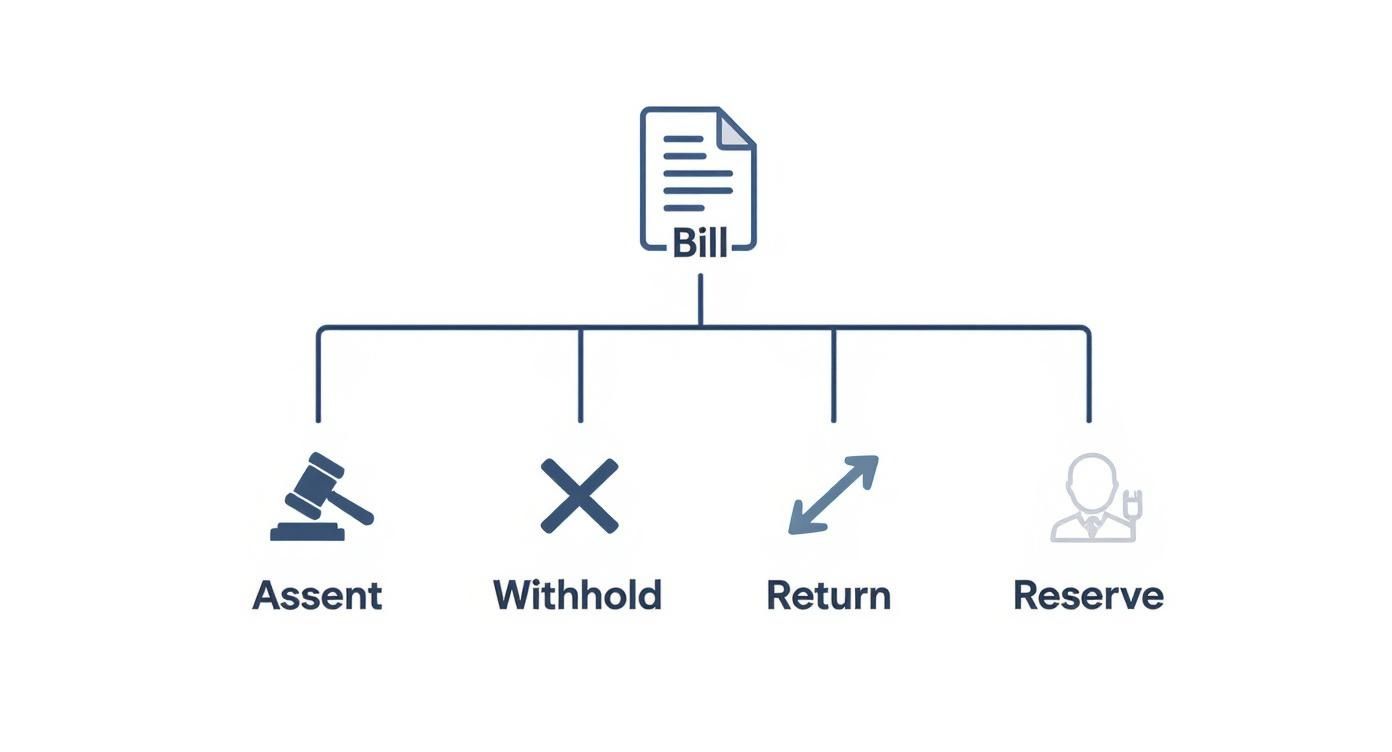
As you can see, giving assent is the most straightforward path, but it's far from the only one. The Governor can hit the brakes, ask for a do-over, or even escalate the matter to a higher authority.
Let’s unpack what each of these four options really means in practice.
1. Granting Assent: This is the green light. The Governor signs the bill, and just like that, it graduates from being a 'Bill' to an 'Act'. It's now officially the law of the land in that state.
2. Withholding Assent: This is a firm 'no'. The Governor refuses to sign, and the bill is dead in the water. It’s important to remember this isn't an absolute veto to be used on a whim; the Supreme Court has made it clear that this power must be used with good reason and not just to stall legislation.
3. Returning for Reconsideration: Think of this as the Governor playing the role of a constitutional editor. They send the bill back to the legislature, usually with a message outlining specific concerns or suggesting changes. But here’s the catch: if the House passes the bill again (with or without the suggested changes), the Governor must give their assent. There's no second chance to say no.
4. Reserving for the President: This move kicks the bill upstairs to the national level. The Governor decides the bill requires the President of India's consideration. This is a vital mechanism within Article 200, typically used for bills that might clash with central laws, challenge national policy, or touch upon matters of grave national importance.
Mandatory Reservation: When the Governor Has No Choice
Sometimes, the Governor’s decision isn't a choice at all—it's a constitutional obligation. The most critical instance of this is when a bill could potentially weaken the authority of the state's High Court.
If a bill passed by the legislature would, in its operation, "derogate from the powers of the High Court so as to endanger the position which that Court is by this Constitution designed to fill," the Governor is left with no discretion. They must reserve it for the President’s consideration.
This provision is a powerful constitutional safeguard. It ensures that a state legislature cannot unilaterally undermine the independence or authority of the judiciary, protecting a core pillar of our democratic structure from political overreach.
For any lawyer or law student, navigating these procedural forks in the road and their ever-evolving judicial interpretations is a constant challenge. This is precisely where modern tools like Draft Bot Pro come into their own. An AI-powered assistant can scan a draft bill and flag clauses that might trigger a return for reconsideration or, crucially, a mandatory reservation for the President. It helps you spot the constitutional red flags before they become a problem, allowing you to draft smarter, more resilient legislation. It’s about making sure your draft isn't just legally sound, but strategically savvy.
Landmark Supreme Court Judgments and Insights
Article 200 isn't just a static clause in a book; it's a living, breathing provision that has been tested, argued over, and ultimately shaped by the Supreme Court of India. Over the years, the Court has had to step in repeatedly to draw the lines, transforming Article 200 from a simple procedural instruction into a crucial check on constitutional power.
The real questions—the ones that get to the heart of India's federal structure—have been settled in the courtroom. Can a Governor just sit on a bill forever? Is their power to say 'no' absolute and unchecked? The judiciary's answer has been loud and clear: the Governor is a constitutional head, not a political roadblock.
These judicial interventions are what prevent legislative gridlock and ensure the democratic will of a state legislature is actually respected.
Setting Timelines and Defining Limits
One of the biggest grey areas the Court had to tackle was delay. For decades, it was unclear if a Governor could just leave a bill on their desk indefinitely, creating a sort of de facto "pocket veto." The Supreme Court has now put that ambiguity to rest, decisively.
Through a series of critical rulings, the Court introduced the concept of "constitutional reasonableness." What does that mean? It means that even though Article 200 doesn't give a hard deadline in days or weeks, a Governor is constitutionally required to act on a bill within a reasonable amount of time. Sitting on it forever is simply not an option.
InsightsThe Supreme Court's message is unmistakable: when a Governor fails to make a decision on a bill in a timely manner, they are failing to perform their constitutional duty. This principle is a powerful safeguard, ensuring the entire legislative process can't be held hostage by one person's inaction. Legal professionals can leverage a tool like Draft Bot Pro to instantly access key judgments that have established this "reasonable time" doctrine, strengthening their legal arguments.
This oversight from the judiciary is absolutely vital for maintaining the separation of powers. It stops the Governor's office from being used as a tool to undermine an elected state government, reinforcing the idea that laws are made by debate and votes, not procedural stalls.
The Tamil Nadu Governor Case: A Watershed Moment
The judiciary's firm hand in shaping article 200 of the Indian Constitution really came to the fore in recent times. Between 1950 and 2025, the Supreme Court took up 27 cases touching directly on this article. Of those, 15 resulted in landmark rulings that clarified the Governor’s powers.
The most game-changing of these was the 2025 judgment in the State of Tamil Nadu v. Governor of Tamil Nadu. This ruling was huge. It mandated that Governors must act on bills within six months. The impact was immediate, leading to a 50% reduction in the backlog of pending bills in Tamil Nadu and other states. Just as importantly, the judgment hammered home the point that Governors can't just withhold assent on a whim; they need a solid constitutional reason. You can dive deeper into the history of this issue and the TN Governor judgment on constitutionofindia.net.
Key Takeaways from Landmark Rulings
If you pull back and look at the body of case law around Article 200, a few foundational principles have emerged that every legal professional needs to have at their fingertips.
No Unfettered Discretion: The power to withhold assent or reserve a bill for the President is not a blank cheque. It must be exercised for constitutional reasons, not because of personal feelings or political pressure.
Reconsideration is Binding: This is a big one. If a Governor sends a bill back and the legislature passes it again (with or without changes), the Governor must give their assent. They can't then decide to reserve it for the President. The Tamil Nadu case made this crystal clear.
Reasons Must Be Communicated: While the text of Article 200 doesn't explicitly say this, judicial interpretation has strongly indicated that Governors should communicate why they are withholding assent or returning a bill. Transparency is key.
For lawyers and law students, staying on top of this evolving legal landscape is non-negotiable. This is where a legal AI assistant can be a massive help. A tool like Draft Bot Pro can instantly cross-reference a legislative issue against a constantly updated database of case law. It provides sourced answers on how the Supreme Court has interpreted specific facets of Article 200, allowing you to build arguments that are grounded in the absolute latest precedents. For a wider perspective, check out our guide on the top 8 landmark judgments of the Supreme Court of India.
The President's Check: Decoding the Reservation Power
Of the four paths a Governor can take under Article 200, one stands out for its sheer constitutional weight: the power to reserve a bill for the President’s consideration. This isn't just a procedural step; it's a vital safeguard, giving the Union government a moment to review state laws before they hit the statute books. It's a core feature of India's quasi-federal system, designed to ensure state laws don’t inadvertently trip over national policies or constitutional red lines.
Think of it as a constitutional second opinion. When a Governor feels a bill's implications ripple beyond state borders or wade into sensitive legal territory, they can "escalate" it to the President. This isn't an everyday occurrence. It's a tool for specific, high-stakes situations where a national perspective is needed to keep the country's legal framework coherent.

This power truly highlights the delicate balancing act at the heart of article 200 of the Indian constitution. It’s where state and central authority meet, and sometimes, where they clash.
When Does a Governor Hit the 'Reserve' Button?
Sometimes, the Governor has to reserve a bill—for instance, if it weakens the position of the High Court. But most of the time, it's a judgement call. Governors tend to use this power when a bill raises certain red flags, acting as a crucial check on legislative overreach.
Here are the usual suspects that get a bill sent upstairs to the President:
Conflicts with Central Laws: If a state bill is on a collision course with a law passed by Parliament on a topic in the Concurrent List, it gets flagged to prevent legal chaos.
Opposes Directive Principles: Legislation that seems to run contrary to the Directive Principles of State Policy—the guiding soul of our governance—is often sent for a second look.
Touches National Interest: Any bill dealing with matters of national importance, from security to key economic policies, is a prime candidate for reservation.
Is Potentially Unconstitutional: If the Governor believes a bill is fundamentally unconstitutional on its face, it’s almost certain to be reserved.
This isn't just a theoretical power gathering dust. Data from the Ministry of Home Affairs shows that between 1950 and 2020, a total of 1,243 state bills were reserved for the President. The practice peaked in 2018 with 147 bills reserved in a single year. Interestingly, states like Tamil Nadu, West Bengal, and Kerala have consistently been the source of over 40% of all reserved bills, pointing to the underlying political and constitutional debates in these regions. For a deeper dive into these frameworks, you can explore the full text and related documents on India's constitution.
What Happens After a Bill Is Reserved?
Once the Governor reserves a bill, it's out of their hands. The legislation travels from the state capital to the desks of the Union executive. The President, guided by the Union Council of Ministers, then takes charge with three options under Article 201:
Give Assent: The President signs off, and the bill officially becomes a state law.
Withhold Assent: The President can refuse to sign, which is effectively a veto. The bill dies.
Return for Reconsideration: The President can send the bill back to the state legislature via the Governor, usually with a message suggesting changes.
InsightsHere’s a crucial distinction: if the state legislature re-passes the returned bill (with or without changes), the President is under no constitutional obligation to give assent. This is a massive departure from the Governor's position, who must give assent if a bill is returned and passed a second time. This nuance is critical for legal strategy, and a tool like Draft Bot Pro can help by flagging these specific procedural differences and providing access to related case law, ensuring legal advice is precise and accurate.
This entire sequence shows just how complex our federal dynamics can be. For lawyers drafting legislation, anticipating these moves is a bit like playing chess. This is where a specialised legal AI tool like Draft Bot Pro can be a game-changer. It can scan draft legislation for clauses that have historically triggered presidential reservations, flagging potential conflicts before they become a problem. This forward-thinking approach helps ensure a bill is not just built to pass the state assembly, but also to survive scrutiny from the Centre.
Right, let's move from the textbook theory of Article 200 of the Indian Constitution to what it actually means on the ground for practicing lawyers, policy wonks, and law students. Knowing the Governor's four options is one thing, but figuring out why a bill goes down one path and not another? That's the real game.
This isn't just about academic debate. It's about a proactive, almost defensive, approach to drafting. You have to stress-test your legislation against every potential constitutional snag before it even gets a whiff of the Governor's office. Often, the only difference between a bill that sails through and one that's dead on arrival is foresight. It all comes down to meticulous preparation.
Your Tactical Playbook for Article 200
To make this practical, you need a system. Think of this as a pre-flight checklist for your draft bills. It's a structured way to spot the red flags and give your clients a realistic take on what’s likely to happen next. It’s all about mapping the bill’s journey and being ready for any detours.
Here's a straightforward checklist to help you dissect a state bill and anticipate potential Article 200 hurdles.
Legislative Drafting Checklist for Article 200 Compliance
Checklist Item | Potential Issue | Mitigation Strategy |
|---|---|---|
High Court Powers | Does the bill mess with the High Court's powers or its jurisdiction in any way? | This is an absolute deal-breaker. A provision like this triggers a mandatory reservation for the President's review. The only fix is to redraft the clause entirely, ensuring the High Court's constitutional authority is left completely intact. |
Conflict with Central Law | Is your bill stepping on the toes of an existing Parliament-enacted law on a Concurrent List subject? | A direct clash is a classic reason for a bill to be reserved. The best defence is solid research. Find any conflicting central laws and either draft your bill to align with them or carefully carve out a separate, non-conflicting space for it to operate. |
National Interest | Could the bill be spun as impacting national security, foreign policy, or major economic matters? | Vague language is your enemy here; it's an open invitation for scrutiny. You need to define the bill's scope with surgical precision. Make it crystal clear that you're tackling a specific state issue, not wading into national territory. |
Constitutional Validity | Does any part of the bill look like it might violate fundamental rights or other bedrock constitutional principles? | This is a huge trigger for a Governor to either withhold assent or reserve the bill. Every single clause needs to be bulletproof, backed by precedent and solid legal reasoning. |
Common Drafting Traps That Sink Bills
Beyond those big-ticket items, a few rookie drafting mistakes can create massive headaches. In the high-stakes world of legislative advocacy, even a small ambiguity can be enough for a Governor to hit the brakes with a veto or send the bill back for another look.
The bottom line:The most resilient laws aren't just well-argued; they're impeccably drafted. Clarity and precision are your best weapons against procedural hold-ups. An unambiguous, constitutionally sound bill leaves a Governor with very little wiggle room to delay or deny assent on legitimate grounds.
Keep an eye out for these classic pitfalls:
Vague Definitions: If your key terms are wishy-washy, you’re practically begging the Governor to return the bill for clarification. Define everything tightly.
Overly Broad Powers: Handing the executive branch a blank cheque of discretionary power without clear rules is a red flag for violating the separation of powers.
Retrospective Application: Applying laws backwards, especially when it comes to crime or taxes, is a constitutional minefield. It’s a fast track to getting your bill reserved.
Getting a Strategic Edge with Legal AI
In this legal labyrinth, being one step ahead is everything. This is where specialised legal AI assistants are becoming a game-changer. A tool like Draft Bot Pro is built from the ground up to tackle these very challenges faced by legal professionals in India.
Think about it: you upload a draft bill, and the AI scans it against a massive, up-to-the-minute database of Supreme Court precedents on Article 200. It can flag a clause that sounds dangerously similar to something the courts have already struck down. It can also spot potential conflicts with central laws that a human reviewer, even a careful one, might miss. For anyone looking to up their game, diving into a practical guide to fast legal research can give you the foundational skills that AI then supercharges.
This flips your entire workflow on its head. You move from being reactive to being proactive. Instead of crossing your fingers and waiting for a constitutional challenge, you anticipate it and draft tougher, more resilient legislation from day one. For lawyers and law students in India, using a tool like this is no longer about just being efficient; it’s about gaining a serious strategic advantage in the craft of making law.
The Evolving Role of Article 200 in Indian Federalism
As we've seen, Article 200 of the Indian Constitution is far more than just a procedural footnote. It's actually a critical mechanism sitting right at the heart of India's federal structure, carefully balancing the legislative freedom of states with the need to uphold the nation's constitutional principles. Its role has been anything but static.
The journey of Article 200, from the early Constituent Assembly debates to modern Supreme Court rulings, shows just how dynamic and often contentious it can be. The text of the article hasn't changed, but its real-world application has been completely reshaped by shifting political tides and, most importantly, by a judiciary that has stepped in to reinforce its original purpose.
From Procedure to Constitutional Principle
What was first seen as a simple checkpoint has now become a major battleground for defining Centre-State relations. The Governor's powers—to give assent, withhold it, return a bill for reconsideration, or reserve it for the President—are not just administrative choices. They are powerful constitutional tools. When they're used improperly, they can cause legislative gridlock and completely undermine the democratic will of a state's elected government.
Time and again, the Supreme Court has clarified that these powers aren't absolute or to be used at a Governor's political whim. Landmark judgments have hammered home the point that Governors must act within a reasonable timeframe. This has turned an unwritten rule into a solid, court-enforceable expectation, ensuring the legislative process can't be held hostage by a pocket veto.
InsightsThe true test of Article 200 is how it reflects the health of our cooperative federalism. When it works smoothly, it shows a healthy dialogue between the Centre and the states. But when there's constant friction, it often signals deeper political and constitutional tensions that need to be addressed. Understanding this dynamic is key for legal professionals, and a legal AI like Draft Bot Pro can provide crucial data-driven insights by analyzing legislative trends and judicial responses across different states.
Navigating the Future with Modern Tools
For any legal professional, keeping up with these complexities is non-negotiable. This is where modern tools can give you a real edge. An AI-powered legal assistant like Draft Bot Pro helps you tackle Article 200 proactively, not reactively. By running draft legislation against its massive database of precedents and historical data, it can flag clauses that are likely to attract the Governor's scrutiny or even lead to a bill being reserved.
This approach lets you draft more robust and constitutionally solid legislation right from the get-go. As the conversation around federalism evolves, a deep understanding of every part of the legislative process is crucial. That includes getting to grips with related constitutional provisions, and you can dive deeper by checking out our guide on understanding Article 247 of the Indian Constitution.
Ultimately, a thorough knowledge of these articles, combined with precise tools like Draft Bot Pro, is indispensable for anyone navigating India’s complex legal framework.
A Few Common Questions on Article 200
When you dig into the details of constitutional law, a few key questions always seem to pop up. Let's tackle some of the most common ones about Article 200 of the Indian Constitution to clear up the Governor's role, the rules of the game, and how court rulings play out in the real world.
Can a Governor Just Sit on a Bill Forever?
In a word, no. While the Constitution doesn't slap a hard deadline on the Governor, the Supreme Court has made it crystal clear that they can't just delay a decision indefinitely. The Court has repeatedly stressed that Governors need to act within a reasonable timeframe.
In several landmark judgments, the Court has clarified that withholding assent isn't some absolute power to be used on a whim. The decision has to be rooted in solid constitutional reasoning, not political convenience. And when a Governor does take such a big step, they're expected to explain why.
What Happens If a Governor Sends a Bill Back, but the Legislature Passes It Again?
This is where the power of the elected legislature really shows. If a Governor returns a bill (as long as it’s not a Money Bill) for another look, the state legislature gets to debate it all over again.
If they decide to pass it a second time—with or without changes—and send it back to the Governor, the Governor’s hands are tied. At this point, they are constitutionally bound to give their assent. They lose the option to withhold it again or to reserve it for the President. It’s a fundamental check that ensures the will of the elected body prevails.
How Can an AI Tool Like Draft Bot Pro Actually Help with Article 200 Issues?
This is where things get practical. Legal AI assistants like Draft Bot Pro give lawyers and policymakers a serious edge when dealing with Article 200. Imagine you're drafting a new bill. The tool can scan your draft and flag specific clauses that might clash with central laws or step on the judiciary's toes—which are exactly the kinds of red flags that might make a Governor reserve a bill.
InsightsBy comparing your draft against a massive database of case law and legislative history, an AI tool can give you critical insights into how similar provisions have been handled before. This lets you build tougher, more resilient legislation from the start and see potential constitutional roadblocks long before they become a problem. It's about saving time and avoiding legislative dead ends.
Is Reserving a Bill for the President Something That Happens Often?
It’s a significant move, not an everyday event. But it’s not exactly rare, either. The data shows that well over a thousand bills have been reserved for the President since 1950, so it's a constitutional tool that gets used with some regularity.
You tend to see it happen more often in states where the ruling party is different from the one at the Centre. It’s also common for bills that touch on subjects in the Concurrent List, issues of national security, or anything that might affect the powers of the High Court. That said, recent interventions from the courts are pushing to ensure this power is used as a true constitutional safeguard, not just a political tactic to stall legislation.
Getting the procedural dance of Article 200 right demands precision and a deep well of legal knowledge. Draft Bot Pro is the support you need, with AI-powered legal research and drafting tools that can analyse bills, check for constitutional conflicts, and pull up relevant case law in an instant. Build your legislative work on a solid foundation. Visit the Draft Bot Pro website to see how it works.
