
Navigating India's Criminal Rules of Practice

The criminal rules of practice are the very DNA of India's criminal justice system. Primarily laid out in the Code of Criminal Procedure (CrPC), these rules are the playbook that dictates every single move, from the moment a crime is first reported to the final bang of the gavel and any appeals that might follow. Getting a firm grip on these rules isn't just academic—it's essential for ensuring fairness and order in every case.
Decoding the Blueprint of Criminal Justice
Imagine trying to build a skyscraper without a blueprint. The result? Pure chaos. India's criminal rules of practice act as that indispensable blueprint for our justice system. They provide a predictable, structured framework that guides every action taken by the police, lawyers, and judges.
These rules are what stand between order and arbitrariness. They map out exactly how an investigation should be run, how evidence is to be presented in court, and what rights belong to every person involved—whether they're the accused, the victim, or a witness. This procedural framework is the bedrock of a fair trial.
Why This Rulebook is Absolutely Non-Negotiable
Just look at the numbers. The sheer volume of cases flooding the Indian legal system makes a clear set of rules a necessity. In 2023 alone, India’s National Crime Records Bureau (NCRB) logged a mind-boggling 6,241,569 cognizable crimes. This figure covers everything from the Indian Penal Code (IPC) to Special and Local Laws (SLL), shining a spotlight on the immense pressure our courts and police face every single day.
Without a strict rulebook, a caseload of this magnitude could easily lead to shortcuts, mistakes, and ultimately, a miscarriage of justice. The criminal rules of practice are the essential checks and balances that prevent this from happening.
Insights: Many high-profile cases have been won or lost not on the facts, but on procedure. A seemingly small slip-up—an improperly recorded confession, a missed deadline—can get crucial evidence thrown out or even derail an entire prosecution. It just goes to show that mastering procedure is every bit as important as mastering the facts of the case.
The Four Pillars of Indian Criminal Procedure
To make sense of it all, you can break down the entire procedural journey into four fundamental pillars. Each one serves a distinct purpose, but they all work together, guiding a case from accusation to final verdict.
We can see how this all fits together in the table below.
The Four Pillars of Indian Criminal Procedure
Pillar | Governing Principle | Key Objective |
|---|---|---|
Investigation | Evidence Collection & Rights Protection | To gather facts and evidence lawfully while respecting the rights of suspects. |
Trial | Adjudication & Due Process | To ensure both prosecution and defence can present their cases fairly in court. |
Judgement & Sentencing | Verdict & Proportionality | To deliver a legally sound verdict and, upon conviction, impose a just punishment. |
Appeal & Revision | Review & Rectification | To provide a mechanism for higher courts to correct any errors made in the lower court. |
Each pillar builds on the last, creating a structured path that is designed to uphold the principles of justice from start to finish.
How Legal Tech is Changing the Game
Navigating these detailed procedures requires painstaking precision. In the real world, this means leveraging every tool at your disposal. Modern lawyers are increasingly turning to technologies like legal dictation software to quickly and accurately capture notes, arguments, and client instructions on the fly.
This is also where specialised legal AI tools like Draft Bot Pro come into their own. A lawyer can use it to instantly whip up a technically perfect bail application or a petition to quash an FIR, ensuring every procedural box is ticked. By automating the nuts and bolts of document creation, these tools free up legal professionals to focus on what really matters: strategy, analysis, and winning their case. They turn the intricate rulebook from a potential minefield into a powerful advantage.
The Critical First Steps: From FIR to Investigation
Every criminal case in India kicks off with a single, foundational document: the First Information Report, or FIR. Think of the FIR as the official starting pistol for the entire criminal justice race. It's the first formal record of a cognisable offence, and its registration legally compels the police to start their investigation, turning a simple complaint into a registered case.
This initial step isn't just a formality; it's strictly governed by the criminal rules of practice laid out in Section 154 of the Code of Criminal Procedure (CrPC). Once an FIR is on the books, a whole sequence of duties is triggered for the police. They are now legally bound to investigate the allegations. This isn't just paperwork; it’s the gateway to justice.
The Investigation Unfolds
With the FIR filed, the police investigation begins in earnest. This is the fact-finding stage, where officers are empowered to get to the bottom of the matter. Their powers are considerable, but they aren't unlimited—they are carefully regulated by procedural law to prevent any misuse.
The core of the investigation usually involves a few key activities:
Visiting the Scene: Police will almost always head to the location of the alleged crime. Their first job is to secure the area and start looking for any immediate evidence.
Collecting Evidence: This is a broad task that can involve gathering physical objects, taking forensic samples, seizing documents, or pulling digital data that might be relevant.
Questioning Witnesses: Officers will identify and record statements from anyone who might have seen something, heard something, or knows anything about the offence.
Arrest and Interrogation: If there's credible information or a reasonable suspicion pointing to a specific person, the police have the power to arrest and question them.
Throughout this entire process, the police must meticulously document every single step in a case diary. This diary is a crucial running record that the courts can later scrutinise to ensure the investigation was conducted fairly and thoroughly.
Rights of the Accused During Investigation
While the police have broad powers to investigate, the criminal rules of practice provide a strong shield of rights for the accused. These safeguards are there to create a balance of power and are absolutely fundamental to preventing coercion and protecting individual liberty.
Insights: A surprisingly common procedural slip-up that can torpedo a prosecution is the failure to follow arrest procedures to the letter. Not telling the accused why they're being arrested or denying them a quick call to their lawyer can have serious consequences. These kinds of violations can get evidence thrown out and sometimes even form the basis for getting the entire case quashed.
Here are some of the key rights an accused person has:
The Right to Silence: An accused person cannot be bullied or forced into a confession. They have the right to not incriminate themselves.
The Right to Legal Counsel: An individual has the right to meet with a lawyer of their choice, even during interrogation.
Medical Examination: The accused can insist on a medical examination to document any injuries and ensure their well-being while in custody.
Presentation Before a Magistrate: This one is critical. Any arrested person must be produced before a magistrate within 24 hours. It’s a vital check on police power.
Protecting these rights is paramount. When the threat of arrest is real, you need to act fast. This is where tools like Draft Bot Pro can be an invaluable ally for legal professionals. The AI assistant can help generate a precise and procedurally sound template for an anticipatory bail petition in minutes, ensuring no precious time is wasted. For those looking for support, you can learn more about how AI assists in drafting bail applications in India.
Ultimately, the investigation stage comes to a close when the police file a final report with the court. This document, often called a challan or charge sheet, summarises all the evidence they've collected and states whether they believe there's enough of a case to proceed against the accused. It's this report that sets the stage for the next phase: the court trial.
How a Criminal Trial Unfolds in Court
Once the police have wrapped up their investigation and filed their report, the action moves from the streets to the courtroom. This is where the real drama of the criminal justice process begins, playing out according to a very specific sequence laid out in the criminal rules of practice. A trial isn’t just one big event; it’s a structured journey designed to give both the prosecution and the defence a fair shot at presenting their case.
The whole process kicks off when a magistrate takes cognizance of the offence. This is a formal step where the court acknowledges the case, looks at the initial material, and decides there's enough substance to move forward. It's the green light that confirms the case has cleared the first hurdle and is officially on the trial track.
This visual below breaks down the initial stages leading up to the trial itself, from the moment a complaint is filed to the police investigation.
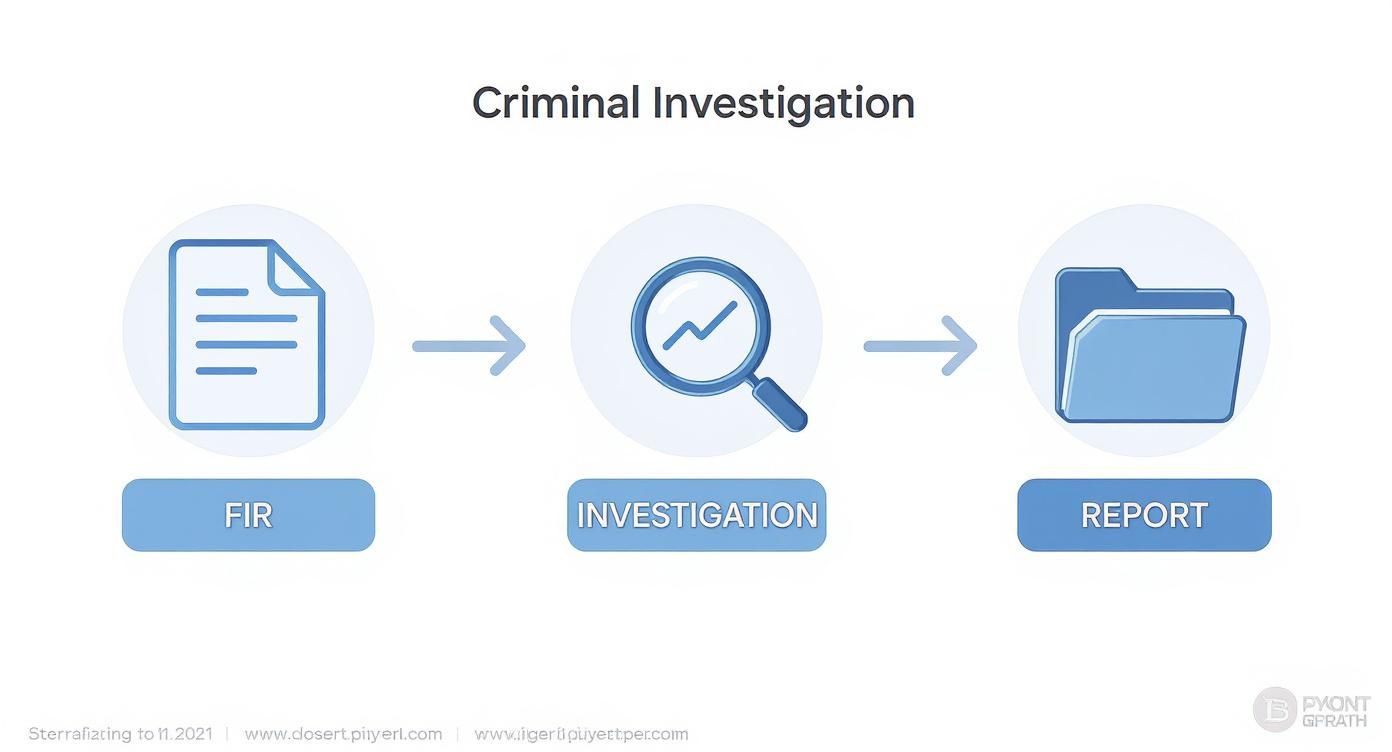
As you can see, a formal complaint (like an FIR) sets a mandatory police investigation in motion. That investigation ends with a final report, which is what the court uses to decide if a full-blown trial is even necessary.
Framing the Charges
Next up is one of the most crucial stages: the framing of charges. You can think of this as the formal accusation being read out in court. The judge carefully goes through the police report and all the evidence gathered to see if, on the face of it, there’s a real case against the accused.
If the judge finds enough material to raise a strong suspicion, specific charges are framed. This is a make-or-break moment because it sets the battleground for the entire trial, defining the exact allegations the accused must now defend against. On the other hand, if the judge feels the evidence is flimsy, the accused can be discharged right then and there, walking free.
The Heart of the Trial: The Evidence Phase
With the charges set, the trial moves into its most active and important phase—presenting evidence. The prosecution gets the first turn, and their goal is to prove the charges “beyond a reasonable doubt.” They do this mainly by calling witnesses to the stand.
The questioning of each witness follows a strict three-part rhythm:
Examination-in-Chief: The prosecution’s lawyer calls their witnesses and asks them questions to build their side of the story, fact by fact.
Cross-Examination: Now, the defence lawyer gets their turn to question the same witness. This is where they try to find holes in the testimony, point out inconsistencies, and challenge the witness's credibility.
Re-examination: The prosecution gets one last go, but they can only ask questions to clear up any confusion or ambiguity that came up during the cross-examination.
Expert witnesses are often a game-changer during this phase. Understanding the vital role a forensic expert witness plays in legal cases is key, as their testimony on complex scientific evidence can easily sway a verdict. Once the prosecution has presented all its evidence, the defence gets its chance to call its own witnesses, who go through the same three-step examination process.
Insights: The cross-examination is often where a case is won or lost. A sharp defence lawyer doesn't just ask random questions; they come in with a clear strategy to dismantle the prosecution's narrative piece by piece. This is where meticulous preparation really pays off. A legal AI tool like Draft Bot Pro can help lawyers prepare by identifying potential inconsistencies in witness statements, suggesting lines of questioning, and researching case law related to evidence admissibility, giving them a significant strategic advantage.
To give you a clearer picture, here’s a simplified breakdown of the entire trial journey.
Stages of a Criminal Trial in India
This table offers a bird's-eye view of the procedural path a criminal case takes, right from the moment charges are framed until the final judgment is delivered.
Stage Number | Procedure | Key Purpose |
|---|---|---|
1 | Framing of Charges | The court formally outlines the specific allegations the accused must answer to. |
2 | Plea of Guilty | The accused is asked if they plead guilty or not guilty. |
3 | Prosecution Evidence | The prosecution presents its witnesses and evidence to prove the charges. |
4 | Statement of the Accused (S. 313 CrPC) | The accused is given a chance to personally explain the evidence against them. |
5 | Defence Evidence | The defence presents its own witnesses and evidence to counter the prosecution's case. |
6 | Final Arguments | Both sides summarise their case and make their final persuasive arguments to the judge. |
7 | Judgment | The court delivers the final verdict of acquittal or conviction. |
Each stage is a critical building block, ensuring the process is thorough and fair to both sides before a final decision is made.
The Accused's Statement and Final Arguments
After all the witnesses have been heard and evidence from both sides is on the record, the court turns to the accused. Under Section 313 of the CrPC, the accused is given a direct opportunity to explain any circumstances or evidence that have appeared against them. This isn't testimony under oath, but it's a fundamental part of natural justice, ensuring their voice is heard.
If you’re interested in the nitty-gritty of getting witnesses to court, you can learn more from our guide on the summons to witness process in Indian law.
Finally, the trial wraps up with final arguments. Here, the lawyers for both the prosecution and the defence take centre stage one last time. They summarise all the evidence, weave together their arguments, and make a final, compelling pitch to the judge. Once these arguments are over, the judge "reserves" the case for judgment, and the wait for the verdict begins.
Essential Rights and Safeguards for the Accused

The complex maze of India's criminal rules of practice isn't just a set of dry procedures. Think of it as a protective shield woven around every single person accused of a crime. These rules act as the guardians of liberty, ensuring the immense power of the state is kept in check by a series of rights that simply cannot be ignored.
At the very heart of this system lies a principle that is the bedrock of any fair society: the presumption of innocence.
Put simply, you are innocent until proven guilty. This isn't just a nice idea; it's a strict command that shapes every part of the legal journey. The entire burden of proving guilt, beyond any reasonable doubt, falls squarely on the shoulders of the prosecution.
The Right to Bail: A Gateway to Liberty
For anyone facing an accusation, perhaps the most urgent safeguard is the right to bail. It’s a mechanism that allows a person to be released from custody while their case is ongoing, usually by providing some form of security or bond. This is critical—it ensures people don't spend months, or even years, in jail before a court has even decided their case.
The Code of Criminal Procedure (CrPC) splits offences into two key categories, which determines how bail works:
Bailable Offences: These are the less serious crimes. For these, getting bail is a matter of right. As long as the accused can provide the necessary surety, the police or court have no choice but to grant it.
Non-Bailable Offences: These cover the more serious crimes. Here, bail isn’t automatic. It's granted at the discretion of the court. A judge will weigh several factors—the gravity of the alleged crime, the strength of the evidence, and whether the accused is a flight risk or might tamper with witnesses.
The Shield of Free Legal Aid
Justice can't have a price tag. Recognising this fundamental truth, Article 39-A of the Constitution and Section 304 of the CrPC guarantee the right to free legal aid for any accused person who can't afford a lawyer. It’s about levelling the playing field.
From the very moment of arrest, the state is obligated to inform the accused of this right. This ensures that a person's financial situation never becomes a barrier to mounting a proper defence with the help of a competent lawyer.
Landmark Judgments Reinforcing Rights
The Supreme Court of India has been a powerful force in strengthening these protections, turning legal principles into real-world safeguards. Its judgments have had a massive impact on how the criminal rules of practice are applied day-to-day.
In the landmark case of D.K. Basu v. State of West Bengal, the Supreme Court laid down 11 mandatory guidelines for the police to follow during an arrest. These directives, which include things like informing a friend or relative of the arrest and letting the accused meet their lawyer, completely changed arrest procedures nationwide.
This ruling is a prime example of how the judiciary steps in to protect citizens and ensure procedural fairness is more than just a concept on paper.
Insights: While these rights look great in the law books, getting them enforced on the ground can be a real battle. Delays, a simple lack of awareness, and bureaucratic hurdles often stand in the way. This is where sharp, strategic legal action makes all the difference. For lawyers fighting to uphold these rights, every second counts. This is where a legal AI assistant like Draft Bot Pro can be a game-changer. It helps advocates rapidly put together solid bail applications, perfectly structured and backed by the right case law. If fundamental rights are being ignored, it can help prepare powerful writ petitions, pulling in strong legal precedents to force action and protect a client's freedom. By handling the heavy lifting, it frees up lawyers to focus on what they do best: building the strongest possible case.
The Final Stages: Judgment, Sentencing, and Appeals
Once the final arguments have been heard and the courtroom falls silent, the case moves into its most critical phase. This is where everything comes together under the strict procedures of the criminal rules of practice, leading to the court's final decision: the judgment.
This isn't just a simple verdict. The judgment is a detailed, carefully written document where the judge systematically unpacks all the evidence and arguments from both sides. It has to lay out the specific points for determination, the court's decision on each one, and the reasoning behind it all.
Ultimately, it all boils down to one of two outcomes. An acquittal, where the accused is found not guilty and walks free, or a conviction, where the court finds them guilty as charged.
The Process of Sentencing
A conviction doesn't end the matter. The very next step is sentencing, a separate and incredibly important hearing to decide the right punishment. This isn't a snap decision. The judge is required to hear arguments from both the prosecution and the defence on what an appropriate sentence would be.
Several factors come into play as the judge weighs their decision:
Nature of the Crime: How severe and brutal was the offence? This is a primary consideration.
Character of the Offender: The court looks at the accused's age, background, and whether this is their first offence.
Mitigating Circumstances: Are there factors that might justify a lighter sentence? Maybe the offender showed genuine remorse or was forced into the situation.
Aggravating Circumstances: On the flip side, were there factors that make the crime worse, like it being pre-planned or committed against a defenceless person?
The goal is to make the punishment fit the crime, and the judge must provide clear reasons for the sentence they hand down. If you're curious about how punishments are determined for specific offences, our explainer on Section 325 IPC punishment in India is a great resource.
Navigating the Appeals System
A conviction from the trial court isn't always the final word. India's legal system has a robust, multi-layered appellate structure, giving people a chance to challenge verdicts in higher courts. It’s important to remember an appeal is not a brand-new trial. Instead, it’s a review to see if the lower court made a serious mistake in law or procedure.
The right to appeal is defined by law, which sets out the grounds and the correct court to approach. The prosecution can appeal an acquittal if they believe the trial court got it wrong, while a convicted person can, of course, appeal their conviction and the sentence.
The entire system, from the first investigation to the final appeal, is often slowed by deep-rooted challenges. For instance, India’s police infrastructure has long been understaffed. Against a sanctioned strength of 22.4 lakh police personnel, the actual force stood at only 17.3 lakh as of December 2013, leaving a massive 22.8% of posts vacant. This shortfall directly impacts the quality of initial investigations, which can have ripple effects throughout the entire judicial process. You can read more about these policing capacity challenges and crime statistics.
Insights: A successful appeal isn't about re-arguing the entire case. It hinges on pinpointing specific errors in the trial court's judgment. Common grounds for appeal include the court wrongly admitting or excluding key evidence, misapplying the law, or simply ignoring crucial facts. The foundation of any strong appeal is a well-drafted Memorandum of Appeal that clearly and persuasively lays out these errors. This is where every detail matters. Tools like Draft Bot Pro are becoming indispensable for legal teams navigating this complex stage. The AI assistant can quickly summarise massive trial records, helping lawyers find those potential errors in a judgment that could be grounds for an appeal. It also assists in drafting a powerful, procedurally sound Memorandum of Appeal, making sure the strongest possible case is presented to the higher court.
Your Questions, Answered
Getting to grips with India's legal system can feel like learning a new language. It's only natural to have questions. Here, we'll tackle some of the most common queries about the criminal rules of practice, breaking them down into simple, clear answers to help you see the path forward.
What’s the Difference Between a Cognisable and a Non-Cognisable Offence?
Think of it as the difference between a fire alarm and a polite knock on the door. A cognisable offence is the fire alarm—a serious crime like murder, theft, or kidnapping. When one of these happens, the police can spring into action immediately and make an arrest without needing a judge's permission (a warrant). This distinction is critical because it defines how much power the police have right from the get-go.
A non-cognisable offence, on the other hand, is less severe. We're talking about things like a simple assault or creating a public nuisance. For these, the police can't just make an arrest. They first need to go to a magistrate and get a warrant, which means they have to present their case before they can take someone into custody.
What Can I Do If the Police Refuse to File an FIR?
This is a frustratingly common scenario, but you absolutely have options. If the police won't register a First Information Report (FIR) for a cognisable offence, don't just walk away. Your first move should be to escalate. Draft a written complaint and send it, preferably by registered post, straight to the Superintendent of Police (SP) or another senior officer.
If that doesn't get the wheels turning, the criminal rules of practice give you a powerful next step. You can file what’s known as a private complaint directly with a Magistrate under Section 156(3) of the CrPC. The Magistrate has the authority to order the police to do their job—register the FIR and start an investigation.
Insights: The ability to get an FIR registered is the very first step toward justice. Don't be discouraged if you hit a roadblock. Knowing the proper channels and being persistent is often what it takes to get the law enforced and an investigation underway. For legal professionals, using a tool like Draft Bot Pro can streamline the process by quickly generating a well-structured Section 156(3) application, ensuring all procedural requirements are met to compel police action.
Is a Speedy Trial a Fundamental Right in India?
Yes, it absolutely is. This isn't just a hopeful guideline; it's a core principle. The Supreme Court of India has made it crystal clear, time and again, that the right to a speedy trial is baked into Article 21 of the Constitution—the article that protects our right to life and personal liberty.
What does this mean in practice? It means that if a trial drags on for an unreasonable amount of time without a good reason, it can be seen as a violation of a person's fundamental rights. In these situations, the accused can go to a higher court and ask for the case to be fast-tracked or, in really extreme cases of delay, even be thrown out completely.
How Does Draft Bot Pro Help People Who Aren’t Lawyers?
While Draft Bot Pro was built with legal professionals in mind, it can be a really useful tool for anyone trying to understand the system. For instance, it can show you the standard structure and language used in crucial legal documents, like a bail application or a petition. This can give you a much clearer picture of what these documents are supposed to look like.
But, and this is important, think of it as a very smart dictionary, not a lawyer. It’s a tool for understanding and assistance. When it comes to your own legal situation, nothing can replace the guidance of a qualified lawyer who can look at the specifics of your case and advise you properly.
Ready to make your legal work more efficient? Draft Bot Pro helps over 46,000 legal professionals in India draft precise documents and conduct accurate research in minutes. Discover how at https://www.draftbotpro.com.
