
A Practical Guide to Section 379 B IPC on Snatching

When you hear the term "snatching," you probably picture a thief on a motorcycle grabbing a purse or a phone from an unsuspecting pedestrian. It’s a classic, frightening scenario, and it's exactly what Section 379 B of the Indian Penal Code (IPC) was created to address.
This law specifically targets theft that involves a sudden, forceful taking of property directly from a person. It was introduced to fill a critical gap in our legal framework, recognising that snatching is a far more aggressive and dangerous crime than simple theft.
Why Snatching Needed Its Own Law: Understanding 379 B IPC
Before Section 379 B, the law often struggled to deal with the unique violence of snatching. Sure, Section 379 covers general theft, but it doesn't quite capture the terror and physical risk of having something ripped from your hands. A pickpocket is a thief, no doubt. But someone who violently yanks a gold chain from your neck? That’s a different beast altogether.
This distinction is what lies at the heart of 379 B. The act of snatching isn't just about losing your valuables; it’s a direct physical confrontation that leaves victims shaken and, too often, injured. It creates a palpable sense of fear in public spaces. The legislature recognised this and carved out a specific offence with tougher penalties to match the severity of the crime.
Getting to Grips with Snatching as a Property Crime
For any lawyer or law student, understanding the nuts and bolts of snatching is the first step to handling these cases effectively. This guide is here to build that foundation, breaking down exactly what you need to know about 379 B IPC. We'll walk through:
The key legal ingredients that make an act "snatching."
How it stands apart from similar offences like theft and robbery.
The procedural roadmap and the serious punishments involved.
Insights: A Modern Lawyer's Edge In today's practice, getting these details right from the start is much easier with specialised AI. Imagine you receive an FIR for a snatching incident. A tool like Draft Bot Pro can scan it, instantly flag the essential elements needed to prove a case under Section 379 B, and even help you draft a bail application that cites the most relevant case law. It's about building a rock-solid case from day one.
We'll take this one step at a time, moving from the basics to more advanced applications. If you want to explore related offences, our detailed article on assault and theft laws in India is a great place to start. Getting this foundational knowledge right is your key to confidently navigating any case involving snatching.
The Core Elements That Define a Snatching Offence
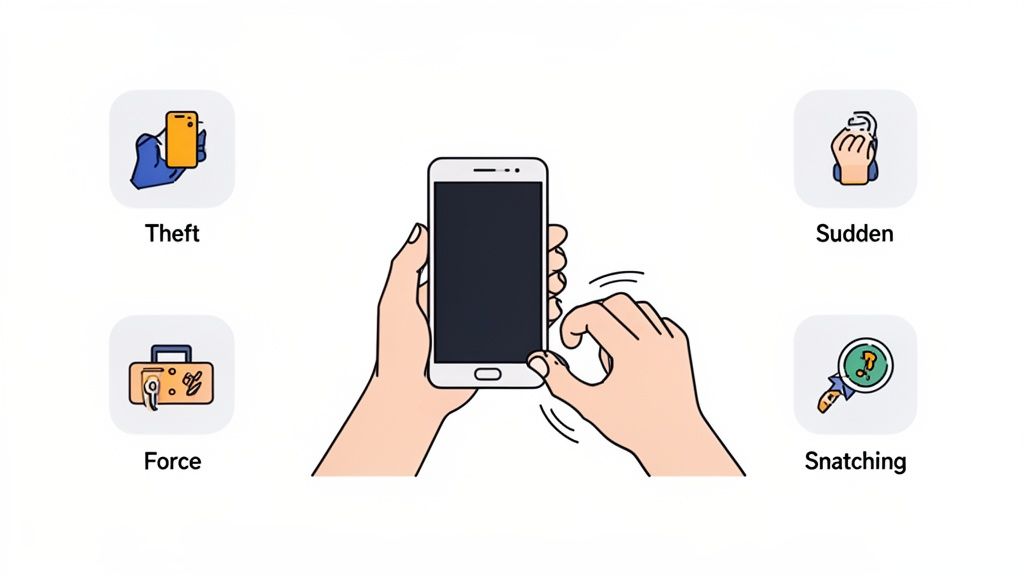
To get a real grip on a snatching offence under Section 379B IPC, you have to break it down into its essential legal parts. It's a bit like a recipe; if you leave out a key ingredient, you don't get the dish you intended. For snatching, the prosecution has to prove several distinct elements, and they have to prove them beyond a reasonable doubt.
Each element is a building block, creating a very specific legal definition that separates this crime from others. Let's walk through the four essential pillars that make up this offence so you can spot them and argue them effectively.
The Foundation: Theft
Every snatching case starts with one thing: theft, as defined under Section 378 of the IPC. This is the bedrock of the entire offence. Without theft, there can be no snatching.
This means the prosecution's first job is to establish a dishonest intention to take movable property out of someone's possession without their consent. For instance, if a person grabs a phone off a table genuinely thinking it's their own, that crucial "dishonest intention" is missing. The act wouldn't even qualify as theft, let alone snatching.
The Method: Sudden or Quick Action
The second vital ingredient is how the theft happens. Section 379B IPC is very clear that the act must be "sudden or quick." This element gets to the heart of what makes snatching so jarring—the surprise and immediacy of the crime.
Think about it. A pickpocket who stealthily lifts a wallet from a purse is committing simple theft. But now, picture someone on a bike speeding past and yanking that same purse off a person's shoulder in a split second. That instantaneous, blink-and-you-miss-it action is what the law is targeting here. The abruptness leaves the victim with no time to react or protect their belongings.
This quickness is a major differentiator that sets the stage for the more aggressive parts of the offence.
The Aggravating Factor: Force or Fear of Force
This is where a simple theft gets upgraded to the much more serious crime of snatching. The law demands that the offender uses "force or fear of force" to pull off the theft. This doesn't always mean extreme violence or causing a serious injury.
Legally speaking, the threshold for "force" can be lower than you might think. Just consider these common scenarios:
Breaking a Grip: The minimal force needed to pry a mobile phone from someone's hand is enough. The victim's resistance, no matter how slight, is overcome by the snatcher's force.
Pulling a Chain: The act of yanking a gold chain hard enough to snap it from the victim's neck is a textbook example of using force.
Yanking a Bag: Violently pulling a handbag off a person's shoulder, causing them to stumble or lose their balance, clearly involves force.
And "fear of force" is just as potent. An offender might not even touch the victim. A menacing gesture or a verbal threat that makes the victim surrender their property out of fear is legally the same as using actual physical force in the eyes of Section 379B IPC.
Deciphering Actus Reus and Mens Rea
In any criminal case, the court is looking for two things: the guilty act (actus reus) and the guilty mind (mens rea).
Insights from Legal Practice For a snatching charge, the actus reus is the physical act of suddenly and forcefully taking property. The mens rea is the dishonest intention to permanently deprive the owner of that property. You must prove both for a conviction under Section 379B.
A sharp lawyer needs to meticulously connect the evidence to both of these components. For example, CCTV footage showing the quick, forceful grab proves the actus reus. The offender's actions afterwards, like running away or trying to sell the stolen item, help prove the dishonest intention—the mens rea.
This is an area where legal AI tools can be a massive help. For instance, a tool like Draft Bot Pro can scan an FIR or witness statement and help you structure your arguments by flagging phrases and facts that directly support each element—the dishonest intent, the suddenness, and the force. This ensures your legal drafts are razor-sharp and hit every necessary point, building a much stronger case whether you're for the prosecution or the defence.
How Snatching Differs from Theft and Robbery
In the world of criminal law, details matter. A lot. While snatching, theft, and robbery might seem similar—they all involve someone taking your property—the Indian Penal Code draws very clear lines between them. Getting these distinctions right is absolutely critical for any lawyer building a case, as one small misstep can completely alter its trajectory.
Think of property crimes as a spectrum. At one end, you have simple theft, which is all about stealth and avoiding confrontation. At the other extreme is robbery, which involves direct violence or the threat of serious harm. Section 379 B IPC (Snatching) carves out its own space right in the middle.
The Line Between Snatching and Simple Theft
The most common mix-up is between snatching (Section 379 B) and simple theft (Section 379). The single most important difference? Force.
Simple theft is defined by its quietness. Picture a pickpocket skillfully lifting a wallet from a pocket without the victim feeling a thing. The entire act is built on the absence of any confrontation.
Snatching, on the other hand, is confrontational by its very nature. It’s all about the sudden and forceful taking of property directly from a person. Even a small amount of force—like yanking a phone from someone's hand or ripping the strap of a handbag—is enough to elevate the crime from simple theft to snatching. This distinction is crucial because the law acknowledges the immediate physical risk and emotional shock that comes with being a victim of snatching.
The numbers tell a story, too. In 2022, India saw a massive 1,82,490 cases of theft filed under IPC Section 379. This highlights just how common non-violent property crime is. Snatching, however, is treated far more seriously because of its aggressive element.
The Threshold Separating Snatching from Robbery
The line dividing snatching from robbery (Section 390) comes down to the degree of violence or threat involved. Robbery is basically theft taken to the next level, aggravated by an immediate threat of wrongful restraint, injury, or even death. The offender’s goal isn't just to take something; it's to completely overpower the victim's will to resist.
Let’s break it down with a few scenarios:
Theft: A thief grabs a purse from a shopping cart while the owner is looking away.
Snatching (379 B IPC): A person on a bike speeds past and yanks that same purse off the owner's shoulder.
Robbery: An attacker pulls out a knife, threatens the owner, and demands the purse.
The key question is always this: was the force used just enough to commit the theft (snatching), or was it used to create fear of instant harm and crush any resistance (robbery)? As soon as a weapon is shown or the victim is physically assaulted to take their property, you've crossed the line from snatching into the far more serious offence of robbery.
To get the comparison crystal clear, here’s a table breaking down the key differences between these three sections.
Comparison of IPC Sections 379, 379 B, and 390
Feature | Section 379 (Theft) | Section 379 B (Snatching) | Section 390 (Robbery) |
|---|---|---|---|
Core Act | Dishonestly taking movable property without consent. | Suddenly or forcefully seizing or securing property from a person. | Theft accompanied by causing or attempting to cause death, hurt, or wrongful restraint. |
Use of Force | No force is used against the person. The act is stealthy. | Sudden force is used to take the property from the person's possession. | Violence or threat of instant violence is used to commit the theft or carry away the property. |
Victim's State | Often unaware at the moment of the crime. | Aware and taken by surprise; the act is sudden and confrontational. | Put in fear of instant death, hurt, or wrongful restraint. |
Punishment | Up to 3 years imprisonment, or fine, or both. | Rigorous imprisonment for a term not less than 3 years, and a fine. | Rigorous imprisonment for up to 10 years, and a fine. Can extend to 14 years in certain cases. |
Example | Pickpocketing a wallet from a crowded bus. | A biker yanking a chain from a pedestrian's neck. | Threatening someone with a knife to make them hand over their phone. |
As you can see, the legal consequences escalate significantly based on the level of force and threat involved.
Insights on Legal Precision Getting the charge right is everything. Charging an act of robbery under Section 379 B weakens the prosecution's case. On the flip side, mislabeling a snatching incident as simple theft completely ignores the violence and trauma the victim experienced. Legal precision isn't just about technicalities; it's about ensuring justice is served correctly. This is where a Legal AI like Draft Bot Pro can provide valuable assistance by analyzing case facts and suggesting the most appropriate sections of the law.
For anyone looking to dive deeper into other property-related offences, our guide on criminal misappropriation under Section 403 of the IPC is a great next step.
Navigating Penalties and Procedures for 379B Cases
Once an act gets flagged as snatching under Section 379B IPC, the legal machinery whirs to life. Understanding what comes next—the consequences and the procedural maze—is absolutely critical for any lawyer in the fray, whether you're prosecuting or defending.
The penalties are deliberately harsh, and the procedural classifications have huge real-world consequences right from the moment of arrest.
The Stiff Penalties for Snatching
A conviction under Section 379B carries serious weight, reflecting just how violent and terrifying the crime is. The law lays down a punishment far tougher than what you’d see for simple theft.
An individual found guilty of snatching faces rigorous imprisonment for a term that cannot be less than three years. This isn't a suggestion; it's a mandatory minimum. The court must impose at least three years of hard labour, though it can certainly go higher depending on the case's specifics. On top of that, the convicted person is also liable to pay a fine.
This tough stance serves a dual purpose:
Deterrence: The severe penalty is there to send a clear message. It’s designed to make potential offenders think twice, making the risk far greater than any reward.
Justice for Victims: It also acknowledges the sheer terror and physical risk that victims of snatching go through. This is about more than just a lost phone or wallet; it’s about the trauma of a violent encounter.
This simple flowchart nails the fundamental difference that triggers these severe penalties—the use of force.
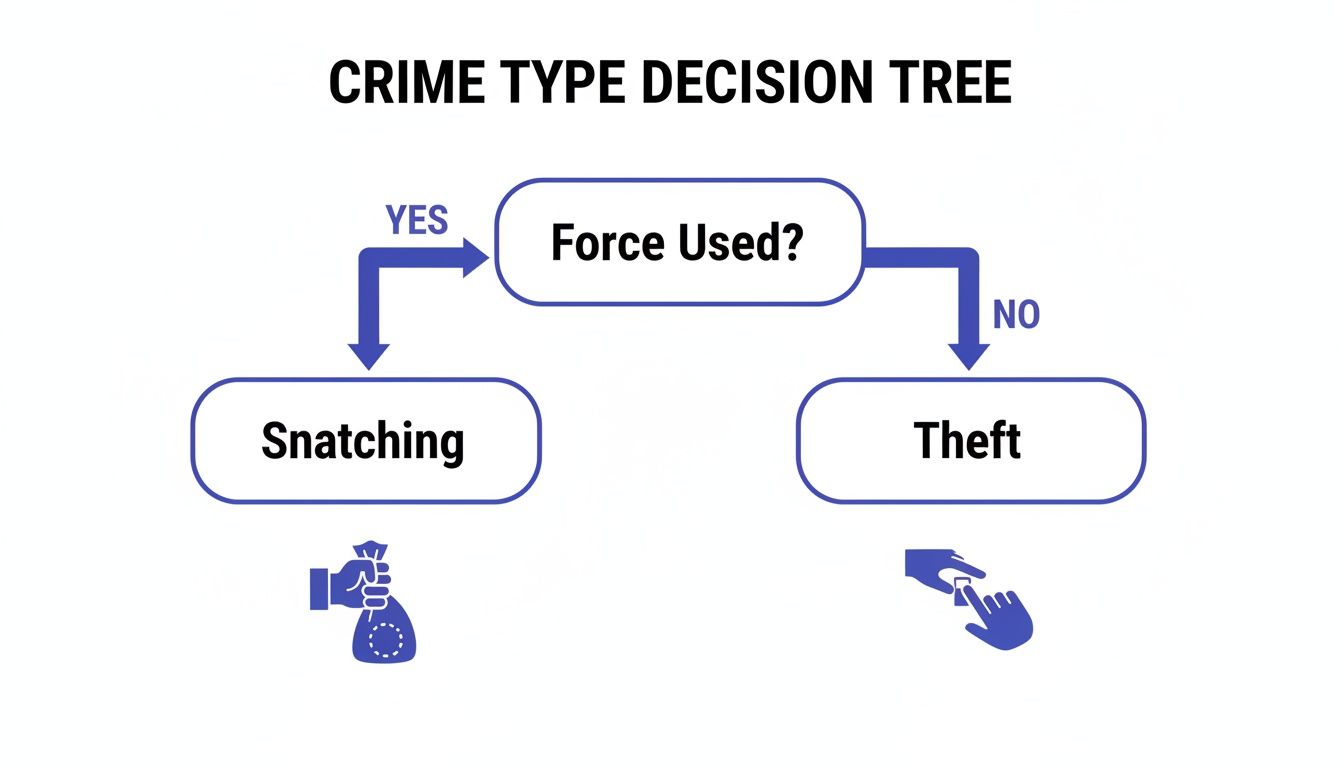
As you can see, it's a critical fork in the road. Was force used to commit the theft? If yes, you're on the path to snatching. If not, it stays in the realm of simple theft.
Key Procedural Classifications
Beyond the punishment, the procedural nuts and bolts of a 379B IPC case define its journey through the justice system. Three classifications are especially important to grasp: cognizable, non-bailable, and the court of trial.
Cognizable Offence: This gives the police the power to arrest a suspect without a warrant. For a crime like snatching, where offenders are often gone in a flash, this authority allows law enforcement to act immediately.
Non-Bailable Offence: This is a game-changer for the accused. It means bail isn’t a right. The accused can't just post a bond to get out. Instead, they must apply to the court, and a judge will weigh the facts and circumstances before deciding whether to grant bail.
Triable by Magistrate: Cases under Section 379B are handled by a Magistrate of the First Class. This tells you exactly which court has the jurisdiction to hear the evidence, run the trial, and deliver a final judgment.
Insights on Legal Drafting The non-bailable nature of snatching makes the bail application one of the most vital documents you'll draft. Putting together a compelling argument for liberty demands precision and a solid grasp of precedent. A Legal AI tool like Draft Bot Pro can streamline this by generating a structured first draft, incorporating relevant case law, and ensuring all procedural requirements are met, saving you critical time.
Judicial Insights from Landmark Snatching Cases
The black-and-white text of a statute gives us the rules, but it’s the court judgments that really add colour and show us how those rules play out in the real world. For a crime like snatching under Section 379 B IPC, judicial precedents are absolutely invaluable. Landmark cases from the Supreme Court and various High Courts have carefully carved out our understanding of this offence.
These rulings aren't just academic exercises; they're practical guides that define the very edges of the crime. They teach us what truly counts as ‘force,’ how ‘sudden’ an act needs to be, and what standard of evidence the prosecution has to meet to get a conviction. Digging into these cases gives you a crucial window into the judicial thinking that leads to a 379 B IPC conviction.
Defining the Nuances of Force and Suddenness
One of the most fought-over elements in a snatching case is often the amount of force used. The courts have been very clear: significant violence or injury isn't a requirement. The only force needed is whatever is enough to overcome the victim's hold or resistance, no matter how small.
Think about someone just holding their phone. If a snatcher yanks it hard enough to break the person's grip, that action meets the ‘force’ requirement. The courts focus on the offender's act of overpowering the victim's possession, not on whether they caused any physical harm.
In the same way, 'suddenness' has been interpreted to mean an act that is quick and completely unexpected, leaving the victim no real time to react. This is the very thing that separates snatching from robbery, where the confrontation might last longer.
Key Precedents and Their Impact
A number of High Court judgments have brought critical clarity to how 379 B IPC is applied. While every case is different, a few common threads have emerged that every lawyer should know.
Proving Intent: The courts are always looking for evidence of dishonest intention. For example, the act of running away from the scene right after the snatch is often pointed to as strong circumstantial evidence of a guilty mind (mens rea).
Corroborating Evidence: A victim's testimony is powerful, but courts love to see it backed up. Evidence like CCTV footage, finding the stolen item on the accused, or having an eyewitness can be what seals the deal for a conviction.
The Line Between Snatching and Theft: Judgments constantly highlight that the active use of force against a person is the clear dividing line. If something is taken without any resistance or confrontation, the charge will almost certainly be simple theft under Section 379, not snatching.
Insights on Legal Research Manually digging through decades of case law to find that one perfect precedent is a soul-crushing task. This is where legal AI offers a massive advantage. A tool like Draft Bot Pro completely changes the game. Instead of burning hours in legal databases, you can find the most relevant and recent judgments on snatching in just a few minutes.
How Draft Bot Pro Speeds Up Case Law Research
Let's say you need to argue that the force used in your case is enough to meet the legal threshold for snatching. With a platform like Draft Bot Pro, your research becomes laser-focused and incredibly fast. You can just type in a query like "precedents defining force in Section 379 B IPC cases."
The AI will instantly scan its massive database of judgments and give you a curated list of the most authoritative cases. It can even generate quick case briefs, summing up the facts, issues, and the court's final decision. This kind of power ensures your legal arguments aren't just persuasive—they're built on a solid foundation of established judicial wisdom, making your case that much stronger.
Applying AI for Effective Legal Strategy in 379 B Cases
It’s one thing to understand the theory, but putting it into practice is where cases are won or lost. In today's world, technology gives us a serious edge when handling cases under 379 B IPC. Artificial intelligence, especially tools built for lawyers, can dramatically sharpen your strategy and make you far more efficient, whether you're arguing for the prosecution or the defence.
Think of a legal AI assistant like Draft Bot Pro as your personal paralegal, built to handle the heavy lifting of legal drafting and research. It helps you build stronger arguments by zeroing in on the critical elements of snatching—the suddenness, the force, the dishonest intent—with a speed and precision that was once impossible. This is where AI stops being a buzzword and becomes a real, practical partner in your daily work.
Streamlining Document Drafting
We all know that drafting crucial documents like anticipatory bail applications or charge-sheet arguments is a grind. It eats up hours. With an AI tool like Draft Bot Pro, you can get a solid first draft hammered out in minutes, making sure all your key legal points are covered right from the start.
For instance, you could give it a prompt like this for a bail application:
"Draft an anticipatory bail application under Section 438 CrPC for an accused in an FIR under Section 379 B IPC. Argue that no force was used and the incident is a simple monetary dispute, not snatching."
This kind of targeted instruction helps the AI craft a narrative that directly attacks the prosecution's main claims. For more ideas on how AI can bolster legal strategies in cases like 379 B IPC, you might want to check out Parakeet AI.
Insights Unlocked with 'Chat with PDF' One of the most useful features of Legal AI like Draft Bot Pro is the ability to 'talk' to your case documents. You can upload an FIR or a witness statement as a PDF and ask it direct questions like, "Summarise the inconsistencies in the victim's statement," or "Pull out all facts that contradict the element of 'force'." This is an incredibly fast way to spot the weak points in the other side's case.
Building a Stronger Case with AI
By letting AI handle the foundational drafting and research, you get to free up your own time to focus on high-level strategy. That means more time to refine your arguments, prep for court, and ultimately, build a much more powerful case for your client. For a deeper dive into this, have a look at our guide on using AI in criminal law practice. It’s not just about working faster; it’s about working smarter and being more thorough.
Got Questions About Section 379 B IPC? Let's Clear Things Up.
Diving into the nitty-gritty of criminal law can get confusing fast. So, let's tackle some of the most common, practical questions that pop up around snatching cases under Section 379 B of the IPC.
How Is Snatching Different From Regular Theft?
This is probably the most frequent point of confusion. What separates a simple theft from the more serious charge of snatching? It all boils down to one thing: sudden force.
Theft, covered by Section 379, is about dishonestly taking someone's property without their permission. But snatching adds a dramatic and aggressive element to the mix. The offender doesn't just quietly take something; they use sudden force, or the threat of it, to rip the item away directly from a person. It's that act of aggression that elevates the crime.
What's the Deal with Bail in Snatching Cases?
Understanding whether an offence is bailable or not is huge for the accused. So, can someone charged under 379 B IPC get bail easily?
In short, no. This is a non-bailable offence. That doesn't mean bail is impossible, but it does mean the accused has no automatic right to it. A judge has to hear the arguments from both sides and then decide whether to grant bail based on the specific facts and circumstances of that particular case.
Insights on Strategy Because snatching is non-bailable, that first bail hearing becomes a make-or-break moment. This is where your arguments need to be razor-sharp. Using a Legal AI like Draft Bot Pro to quickly research precedents where bail was granted in similar circumstances can give you the edge you need to structure a compelling application.
Does the Victim Have to Be Injured?
Another common question is whether the victim needs to have been physically hurt for the act to count as snatching.
The law is clear on this: physical injury is not a requirement. The key word is 'force', but that doesn't always mean causing bodily harm. The effort it takes to overcome a person's resistance—like yanking a phone out of their hand or breaking their grip on a handbag—is more than enough to meet the legal definition of force under Section 379 B.
What Kind of Evidence Actually Sticks in Court?
To secure a conviction for snatching, the prosecution needs to prove its case beyond a reasonable doubt. While every situation is different, a few types of evidence consistently carry the most weight.
Here’s what often makes or breaks a case:
The Victim’s Testimony: A clear, confident account from the victim explaining the suddenness of the attack and the force used is fundamental.
Eyewitness Accounts: If someone else saw it happen, their testimony can provide powerful, independent corroboration.
CCTV Footage: In today's world, video doesn't lie. A clear recording of the incident is often the most compelling piece of evidence.
Recovery of the Stolen Property: Finding the snatched item on the accused is a direct and powerful link to the crime.
Managing all this evidence can be a headache. This is where a tool like Draft Bot Pro comes in handy. It can analyse an FIR or a witness statement, instantly highlighting the key facts that line up with the essential elements of 379 B IPC. It helps you build a tighter, more organised case file from day one.
Ready to build stronger legal arguments with less effort? Draft Bot Pro offers expert AI-powered drafting and research tools designed for Indian legal professionals. From bail applications to case analysis, discover how our platform can help you achieve better outcomes. Explore the future of legal tech at https://www.draftbotpro.com.
