
A Practical Guide to Order 32 Rule 3 CPC for Indian Lawyers
- Rare Labs
- Dec 14, 2025
- 17 min read

When you're dealing with a lawsuit and discover one of the defendants is a minor, the whole game changes. You can't just proceed as if they're another adult on the other side of the table. This is where a crucial piece of procedural law, Order 32 Rule 3 of the Code of Civil Procedure (CPC), comes into play.
This rule isn't just a technicality; it's a fundamental safeguard. Think of it as a legal stop sign. It ensures that a minor, who lacks the legal standing to defend themselves, is properly represented by an adult guardian. This person is formally known as a guardian ad litem, or a "guardian for the suit."
The Protective Shield for Minor Defendants
Let's paint a picture. Imagine a heated property dispute where your client is suing a family, and one of the named defendants is just 15 years old. Can this teenager be expected to grasp the complexities of a written statement, hire a lawyer, or even understand what's at stake? The law gives a firm "no."
This is precisely the gap that Order 32 Rule 3 CPC is designed to fill. It acts as a mandatory protective shield, ensuring that the minor's interests are fiercely and fairly defended in court.
The entire principle rests on a simple, yet powerful, idea: a minor doesn't have the legal capacity to fight a lawsuit alone. Because of this, the court must step in and appoint a guardian to act on their behalf. If this step is missed, any judgment or decree passed against that minor could be declared completely invalid down the line. It’s a cornerstone of a fair trial.
Why Is This Rule So Important?
The whole point of this rule is to stop vulnerable people from being taken advantage of in the legal system. It breathes life into the age-old principle of audi alteram partem—let the other side be heard. It gives a voice to someone who, in the eyes of the law, doesn't have one.
This becomes critically important in civil cases that often involve minors, such as:
Inheritance battles and succession claims
Family property partitions
Contractual disputes where a minor was somehow made a party
So, who's a 'minor'? The rule pulls its definition from Section 3 of the Indian Majority Act, 1875. Generally, it's anyone under 18 years old. This age gets bumped up to 21 if a guardian has already been appointed for the minor by a court. This simple standard has been the bedrock of countless civil suits for over a century, making sure no young person is left undefended. If you want to dig deeper, it's always worth reviewing landmark judgments and the statutory text itself.
Practical Implications for Lawyers
For any lawyer on their feet in court, sticking to Order 32 Rule 3 CPC is non-negotiable. If you're representing the plaintiff, the onus is on you to inform the court that one of the defendants is a minor. You then need to file an application to get a suitable guardian appointed.
Dropping the ball here can have disastrous consequences. You could win the case, get a decree in your favour, only to have it declared null and void against the minor later on. All that hard work, gone.
Insights: The court's primary duty is to protect the interests of a minor. Appointing a guardian ad litem isn't just checking a box; it's a vital step to ensure justice is served and the minor's rights aren't trampled during the fight.
The rule essentially builds a legal firewall around the minor. Even if the minor has a natural guardian, like a parent, that person can't just jump in and start representing them. They must be formally appointed by the court for that specific suit. This process confirms they're a fit and proper person for the job and, crucially, that they don't have any personal interests that conflict with the minor's.
How Draft Bot Pro Can Help
To get this right, you need to file the necessary applications and affidavits correctly. Legal AI like Draft Bot Pro can be a lifesaver, helping you generate the paperwork accurately and ensuring you’ve covered all your procedural bases from the get-go. By automating the creation of these routine but critical documents, you minimize the risk of procedural errors that could jeopardize your case.
Navigating the Guardian Appointment Procedure
Knowing the 'why' behind Order 32 Rule 3 is one thing. Actually executing the 'how' is where the real courtroom battle begins. The process for appointing a guardian ad litem isn't just administrative paperwork; it's a critical procedural sequence. If you get it wrong, a final decree could be unravelled years down the line. Precision here is everything.
The ball starts in the plaintiff's court. Once you've filed a suit against a minor, it’s your duty to immediately file an application to get a guardian appointed. Taking this step shows the court you're on top of procedure and sets the stage for a fair fight.
Initiating the Application
The whole process hinges on a formal application filed under Order 32 Rule 3. This document doesn't need to be complicated, but it must be precise. You need to clearly state that a defendant is a minor, name the person you're proposing as the guardian, and ask the court to formally appoint them.
But the application doesn't stand alone. It must be backed by a crucial affidavit—a sworn statement that needs to cover a few key points:
Proposed Guardian's Details: Full name, age, and address. No ambiguity.
Relationship to the Minor: How do they know the minor? Parent, grandparent, older sibling? Spell it out.
Absence of Adverse Interest: A crystal-clear declaration that the proposed guardian's interests don't clash with the minor's in this specific lawsuit.
Fitness to Act: Confirmation that the proposed guardian is an adult, of sound mind, and generally fit to represent the minor's best interests.
This flowchart breaks down the simple but mandatory three-step process for shielding a minor defendant's interests right from the start of a lawsuit.
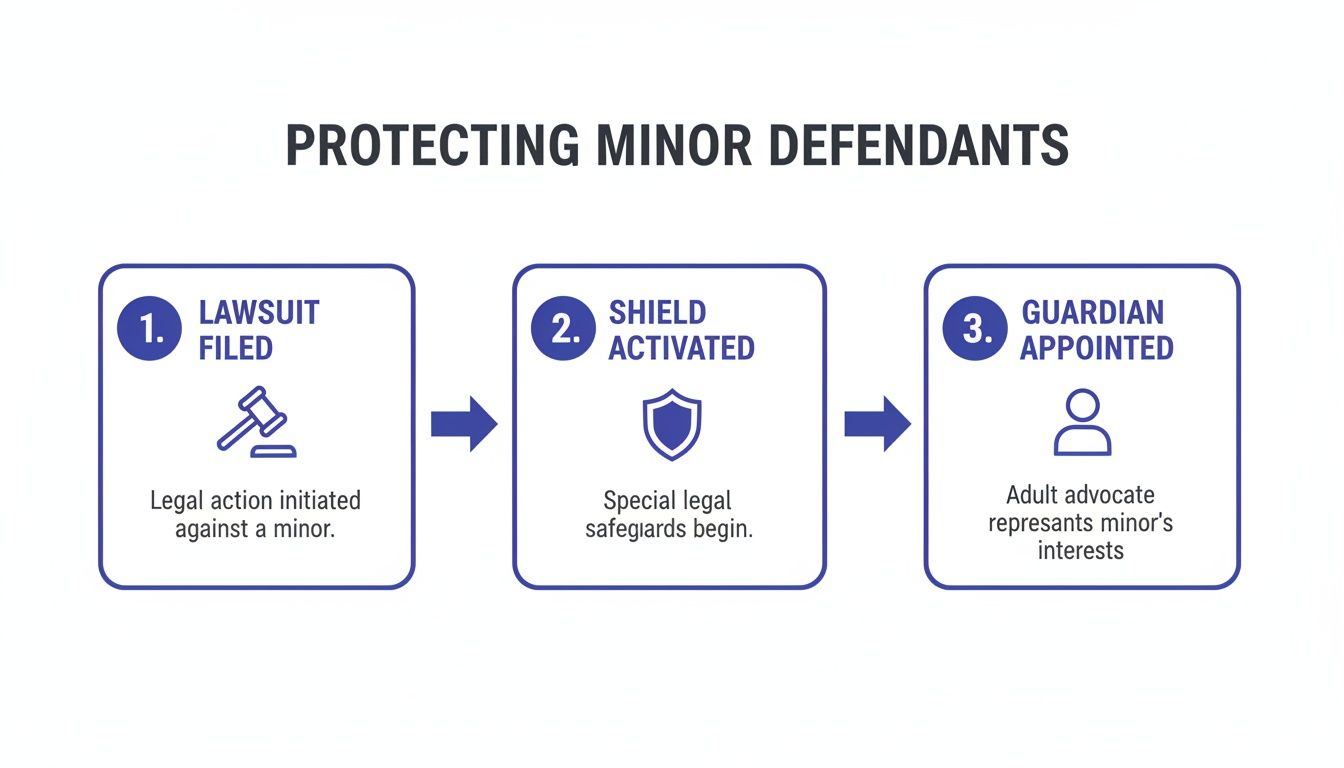
As you can see, activating this legal "shield" by appointing a guardian isn't just an option; it's a direct and necessary step to ensure the minor's protection is a primary concern, not an afterthought.
Securing Consent and Serving Notice
Here’s a common tripwire for many lawyers: forgetting to get the proposed guardian's written consent. A court simply will not appoint someone without their explicit agreement to take on the role. Your application must be supported by an affidavit from the proposed guardian themselves, clearly stating they're willing to step up.
Once your application is on record, the court issues a notice. This notice is served on the minor and their natural guardian (especially if they aren't the one being proposed). The whole point is to give them a chance to object or suggest someone else. Getting this step right is vital. If you need a refresher, check out our guide to service of summons under CPC.
Insights: Don't treat this stage as a formality. Procedural precision is paramount. I've seen decrees set aside for something as simple as failing to serve notice on the minor's mother (a natural guardian) when the father was proposed. The court's inquiry is a real, substantive check to ensure the minor's representation is absolutely beyond reproach.
The Court's Role and Final Appointment
After the notice period expires, the court looks into the matter. It will examine the affidavits, listen to any objections, and satisfy itself that the proposed person is genuinely fit for the job. If the court is convinced the guardian is suitable and has no conflicting interests, it will pass an order making the appointment official. They are now the guardian ad litem for the suit.
But what if no relative or natural guardian is willing or able to act? The court has a fallback. It can appoint one of its own officers, usually a pleader, to act as the guardian. This ensures the minor is never left undefended. In these cases, the court-appointed guardian is entitled to have their costs covered, typically by the parties involved as directed by the court.
For any practising lawyer, drafting these applications and affidavits with meticulous care is non-negotiable. This is one area where legal tech can give you a serious edge.
How Draft Bot Pro Can Help
Legal AI like Draft Bot Pro is a game-changer for navigating the appointment procedure under Order 32 Rule 3 CPC. Instead of starting from a blank page, you can generate court-compliant applications and the necessary supporting affidavits in minutes. The platform makes sure you've included all the critical declarations, like the absence of adverse interest and the guardian's consent. By using AI-powered tools, you slash the risk of procedural slip-ups that could sink your case, letting you focus on winning the actual legal arguments.
Choosing the Right Guardian Ad Litem
Once the application is filed and the court agrees a guardian is needed, the focus shifts to a crucial question: who is the right person to step in and defend the minor? Choosing a guardian ad litem under Order 32 Rule 3 CPC isn't just a box-ticking exercise. It demands a serious look at who can genuinely protect the minor's interests, not just show up in court.
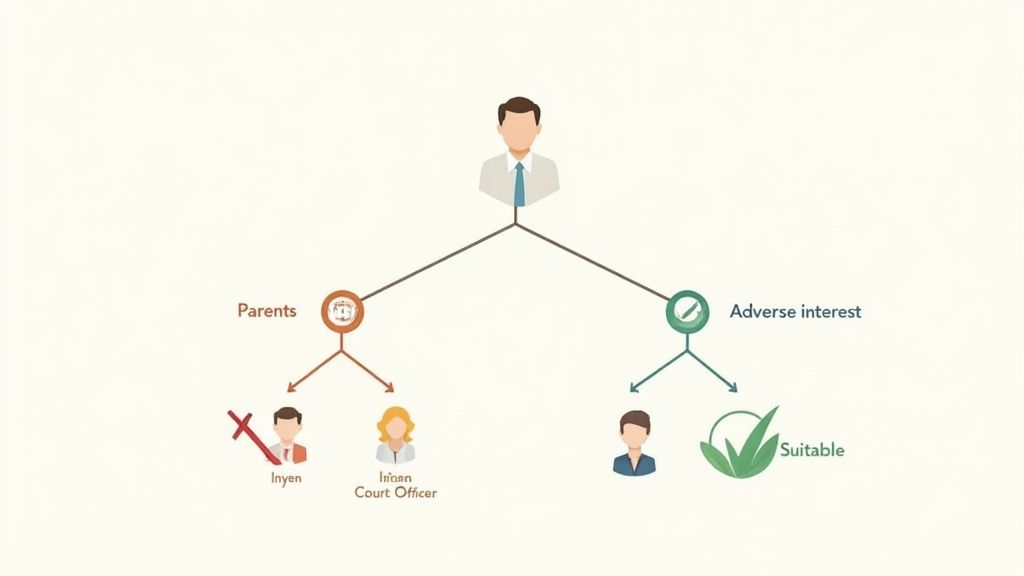
The Code of Civil Procedure spells out the ground rules quite clearly. To even be considered, a person must meet three non-negotiable criteria. Think of these as the absolute minimum requirements for a valid appointment.
First, the proposed guardian must be a major—an adult in the eyes of the law. Second, they have to be of sound mind. And third, perhaps most critically, they must have no interest adverse to the minor's in the lawsuit. It's this last condition that sparks the most intense courtroom debates.
Understanding "Adverse Interest"
So, what does an 'adverse interest' actually look like in practice? It’s any scenario where the guardian's personal agenda could clash with their duty to the minor. You don't even need to prove an actual conflict has happened; the mere possibility of one is enough to get someone disqualified.
Let’s take a classic example: a family property dispute. An uncle is proposed as the guardian for his minor nephew. But if that same uncle is also a defendant and is fighting for his own slice of the family property, his interests are directly opposed to the minor's. He can't possibly fight for his own share while impartially defending his nephew's claim—a bigger piece of the pie for him could mean a smaller one for the child. It’s a zero-sum game.
Courts are incredibly strict about this. They have consistently held that these procedural rules are mandatory, not just suggestions. In the 1993 case of Gurpreet Singh (minor) v. Chatterbhuj Goel, for example, the Punjab and Haryana High Court invalidated a decree simply because the guardian, though a brother, was never formally appointed under Rule 3. The court basically said that if you don't follow the procedure to the letter, prejudice to the minor is presumed. You can find more judgments interpreting these mandatory provisions to see just how seriously courts take this.
Before we dive into the court's preferences, it's helpful to see a clear breakdown of who makes the cut and who doesn't.
Guardian Suitability Checklist
Qualification Criteria (Must Have) | Disqualification Criteria (Must Not Have) |
|---|---|
Be an adult (major). | Be a minor. |
Be of sound mind and capable of making decisions. | Be of unsound mind. |
Be a resident of India. | Reside outside India without a local agent. |
Have no interest that conflicts with the minor's. | Have any interest adverse to the minor in the suit. |
Give written consent to act as guardian. | Be the plaintiff in the same suit. |
Be willing and able to diligently protect the minor. | Be a co-defendant with a conflicting interest. |
This checklist gives you a quick reference for the essential dos and don'ts when assessing or proposing a potential guardian.
The Court's Hierarchy of Preference
When it's time to pick someone, the court doesn't just pull a name out of a hat. There's a logical pecking order it usually follows. This isn't a rigid, unbreakable rule, but more of a practical guideline to find the best person for the job.
The typical hierarchy looks like this:
Natural Guardians: The first port of call is always the minor’s parents—the father or mother. The law presumes they have the child's best interests at heart.
Other Relatives: If the parents are out of the picture, unwilling, or have a conflicting interest themselves, the court will look to other close relatives like grandparents or adult siblings.
Court-Appointed Officer: If there's no suitable family member available or willing to step up, the court will appoint one of its own officers, usually a pleader, to take on the role.
Insights: As a lawyer, your ability to argue for or against a proposed guardian is a vital skill. If you are opposing a proposed guardian, focus on demonstrating a clear conflict of interest. Conversely, when proposing a guardian, your affidavit must meticulously establish that they are not just willing, but also completely free of any adverse interests, thereby strengthening your application.
This structured approach ensures that every minor defendant is represented by someone whose loyalty is undivided and whose sole objective is to protect the minor's interests throughout the litigation.
How Draft Bot Pro Can Help
Challenging or proposing a guardian requires strong, well-reasoned arguments. Draft Bot Pro can assist by helping you research case law related to 'adverse interest' under order 32 rule 3 cpc. You can quickly find precedents where certain relationships were deemed conflicting, giving you the legal ammunition to build a compelling case in court and ensure the right guardian is chosen for the minor.
Landmark Judgments That Shaped the Rule
The text of Order 32 Rule 3 CPC gives us the black-and-white procedure, but it's the courts that colour it in. Over decades, judicial pronouncements have chiselled away at the rule, refining its application and creating a rich tapestry of precedents every civil litigator needs to know by heart. These judgments are where the principles of natural justice come alive, showing us how the law protects a minor who's been dragged into court.
Getting into these cases is like getting a direct window into the judicial mindset. It helps you guess how a judge might react to your arguments about a procedural slip-up, a guardian's carelessness, or a claim that the minor’s case was compromised. Understanding this evolution isn't just academic; it's the bedrock of a solid litigation strategy.
The Shift from Automatic Nullity to Proving Prejudice
Before 1976, the legal world was a very different place. Courts took an incredibly rigid stance. If the procedure for appointing a guardian under Order 32 Rule 3 CPC wasn't followed to the letter, any resulting decree against the minor was often declared a nullity—void from the get-go. A simple procedural mistake was enough to bring the whole thing crashing down.
But everything changed with the CPC amendment of 1976, which brought Rule 3A into the picture. This new rule completely flipped the script.
Insights: Rule 3A shifted the burden of proof. It made it clear that a decree against a minor can't be thrown out just because there was a procedural hiccup in appointing the guardian. The minor, after coming of age, now has to prove that this procedural lapse actually caused them real, tangible prejudice.
This was a game-changer. The focus moved from procedural perfection to actual, substantive justice. A minor can no longer get a decree overturned on a mere technicality; they have to show that the flawed appointment genuinely hurt their case.
Distinguishing Irregularity from Illegality
Even with Rule 3A on the books, courts still draw a very sharp line between a simple procedural irregularity and a fatal illegality. This distinction is often the heart of the battle in appeals.
Irregularity: This covers minor slips. Think a slight delay in filing the consent affidavit or a small error in the notice served, as long as a guardian was appointed and they actually fought the case. If no prejudice is shown, courts are usually hesitant to set aside the decree for something like this.
Illegality: This is about fundamental, non-fixable defects. We're talking about the complete absence of a formal appointment order, appointing a guardian who clearly has a conflicting interest, or a situation where no real defence was ever put up. These are defects that strike at the very root of fair representation.
The need for Order 32 Rule 3 CPC often comes up in messy family and property disputes, where minors named as defendants are incredibly vulnerable without a proper guardian. The Law Commission’s 54th Report in 1971 was a major force behind Rule 3A, pushing for the requirement to prove prejudice. This change, which came into effect after 1976, is credited with stabilising around 90% of decrees involving minors, a trend noted in precedents from the Travancore-Cochin High Court. You can find more insights on how these rules protect minors in civil suits on legalbites.in.
What Constitutes Gross Negligence?
Another battleground shaped by case law is the idea of a guardian's gross negligence. Even if a guardian was appointed perfectly, if they completely failed to look out for the minor's interests, the resulting decree can still be challenged.
Courts have flagged several actions as gross negligence:
Not bothering to file a written statement.
Failing to show up in court or hire a lawyer.
Secretly working with the plaintiff against the minor's interests.
Ignoring an obvious and winning legal defence that was available to the minor.
Proving gross negligence opens up another route to attack a decree, even if the appointment process was flawless. It’s a powerful reminder that being a guardian isn't a passive role; it demands active, diligent, and honest work. Keeping up with these precedents takes a lot of hard work. If you're looking to sharpen your skills, you might be interested in our guide on how to do legal research for fast, practical results.
How Draft Bot Pro Can Help
Keeping tabs on every landmark judgment and the subtle shifts in judicial thinking is a massive task. This is where a tool like Draft Bot Pro becomes a lifesaver. Its AI-powered legal research can instantly pull up relevant case law on Order 32 Rule 3 CPC, including those crucial judgments that distinguish between an irregularity and an illegality, or define what 'gross negligence' truly means. By giving you instant access to the latest precedents, you can build stronger, more persuasive arguments backed by solid legal authority, making sure your strategy is always in sync with current judicial thinking.
Drafting Essentials and Common Mistakes to Avoid
The gap between knowing the law and executing it in the courtroom is where cases are won or lost. When it comes to Order 32 Rule 3 CPC, the quality of your drafting isn’t just a detail—it’s everything. A sharp, well-drafted application, a crystal-clear consent affidavit, and a precise proposed order don't just tick procedural boxes; they tell the court you’re competent, diligent, and serious.
Here, we get practical. We’ll walk through how to draft these crucial documents and, more importantly, flag the common tripwires that can put your entire case in jeopardy. A seemingly tiny mistake at this stage can snowball into a massive problem, potentially giving the other side grounds for a costly and time-consuming appeal down the line.
Core Drafting Components
An application to appoint a guardian ad litem rests on three pillars. Each one has a specific job to do, and each must be drafted with absolute precision to satisfy Order 32 Rule 3 CPC.
The Application: This is the document that kicks everything off. It needs to clearly identify the minor defendant, explain why a guardian is necessary, and formally propose a suitable person for the role. No ambiguity, just straight facts.
The Consent Affidavit: This is the sworn statement from your proposed guardian. It must explicitly state their willingness to act, confirm they are a major of sound mind, and—this is critical—declare they have no interest adverse to the minor in the lawsuit.
The Proposed Court Order: Submitting a draft order is just smart practice. It makes the judge’s job easier and ensures the final order accurately reflects the appointment, clearly naming the guardian ad litem. It shows you’ve thought the process through.
For documenting client statements, depositions, and hearings with precision, many lawyers are now using legal transcription software solutions to ensure every word is captured flawlessly—a foundational step for building any strong case.
Common Pitfalls That Can Derail Your Case
The procedural path of Order 32 Rule 3 CPC is littered with potential missteps. Dodging these common mistakes is non-negotiable if you want to protect the validity of any decree passed against a minor.
Forgetting Written Consent: A verbal "yes" is worthless in court. The proposed guardian’s consent must be in a written affidavit filed with the court. An appointment made without this is flat-out invalid.
Missing the "No Adverse Interest" Declaration: The affidavit isn't complete without an unambiguous statement that the proposed guardian's interests don't clash with the minor's. Omitting this is a fatal error.
Sloppy Service of Notice: The court must serve notice on the minor and their natural guardian (if they're not the one being proposed). Failing to ensure proper service can render the whole appointment defective.
Vague or Incomplete Affidavits: An affidavit is a formal legal document, not a casual note. Make sure every detail—the guardian's age, relationship to the minor, address—is accurate and complete. For a deeper dive, check out our guide to an affidavit under CPC in India.
Insights: These aren't just technicalities; they are fundamental safeguards. The court will scrutinise these papers to make sure the minor's representation is real and substantive, not just a box-ticking exercise. A defective appointment is a ticking time bomb, giving the other side a powerful ground for appeal long after you think the case is closed.
How Draft Bot Pro Serves as a Safety Net
Drafting these documents from scratch is a time sink and opens the door to human error. A simple omission can have severe consequences, making it a surprisingly high-stakes task. This is where modern legal tech gives you a serious edge.
Draft Bot Pro acts as an invaluable safety net for any practitioner handling Order 32 Rule 3 CPC. Its intelligent templates are built to ensure you’re always in full compliance with court requirements.
When you use Draft Bot Pro to generate an application or affidavit for appointing a guardian, it automatically includes all the essential clauses and declarations. The system even provides procedural checklists, so you won't forget critical steps like getting that written consent or declaring the absence of adverse interest.
By producing error-free documents every time, you sidestep the common mistakes that can weaken your case from the start. This frees you up to focus your energy on the actual legal arguments, confident that your procedural foundation is rock-solid.
Common Questions About Order 32 Rule 3
Alright, let's tackle some of the most frequent questions that pop up in practice when dealing with order 32 rule 3 cpc. Think of this as a quick-fire round to clear up common points of confusion and solidify your understanding.
What Happens if a Decree Is Passed Against a Minor Without a Guardian?
This is a huge procedural misstep, a classic rookie error. If the court passes a decree against a minor without formally appointing a guardian ad litem, that decree isn't binding on the minor. It’s what we call 'voidable' at the minor's discretion. This means it isn't automatically null and void, but the minor can have it thrown out.
In the old days, courts often treated such a decree as a complete nullity, dead on arrival. But things changed dramatically with the introduction of Rule 3A. Now, the ball is in the minor's court; they have to challenge the decree and actually prove they were harmed by the lack of proper representation.
How Can a Minor Challenge Such a Decree After Becoming an Adult?
Once they come of age, the clock starts ticking. The newly-minted adult has a window to go back to the very same court that passed the decree and file an application to have it set aside.
The heart of their argument can't just be "the procedure was wrong." They must show that the failure to appoint a guardian under order 32 rule 3 cpc caused them substantial prejudice. In simple terms, they need to convince the judge that their interests were completely neglected, leading to a raw deal. Just pointing to the procedural lapse won't cut it anymore; you have to connect that slip-up to real, tangible harm.
Insights: The winning strategy here is to prove that a properly appointed guardian would have changed the game. You need to show that they would have presented a stronger defence—maybe crucial evidence was ignored, a killer legal argument was missed, or the person who did act was negligent and torpedoed the minor's case.
What’s the Procedure if a Proposed Guardian Says “No, Thanks”?
You can't dragoon someone into being a guardian ad litem. The court is very strict about this; it needs the proposed guardian's express consent in writing, usually in the form of an affidavit. So, if the obvious choice—a parent or a close relative—refuses, the plaintiff has to find someone else.
What if there's no family member willing or able to step up? The court doesn't just throw its hands up. It takes control. Here’s how it usually plays out:
The court will officially record the refusal of the proposed guardian.
It then moves to appoint an officer of the court, typically a pleader, to act as the guardian.
This ensures the minor defendant is never left defenceless, protecting their interests no matter what.
How Did Rule 3A Completely Change the Game?
The arrival of Rule 3A in 1976 was a genuine turning point. Before this amendment, almost any tiny procedural flaw in appointing a guardian could render the whole decree void against the minor. This caused a lot of chaos, as judgments could be overturned years down the line on a mere technicality.
Rule 3A changed all that by introducing the crucial test of prejudice. It basically says you can't set aside a decree just because of some irregularity in the guardian's appointment. The minor now has to prove that this procedural error actually damaged their case and caused them real harm. The focus shifted from nitpicking procedural perfection to achieving substantive justice, making it much harder to get a second bite at the apple on technical grounds alone.
This simple change brought a lot more certainty and finality to lawsuits involving minors, making sure that only cases where a minor's interests were genuinely compromised would be reopened.
How Draft Bot Pro Can Help
When you're wrestling with tricky questions about order 32 rule 3 cpc or trying to figure out what constitutes "prejudice" under Rule 3A, you need answers fast. This is where Draft Bot Pro becomes your secret weapon. Its AI legal research function lets you dig up relevant case law and statutory commentary in seconds. You can ask it to find precedents where decrees were successfully challenged post-Rule 3A, helping you build a much stronger, well-supported argument for your client. It ensures you walk into court fully prepared.
Are you ready to make your legal practice more efficient? Draft Bot Pro is the AI legal assistant built by Indian lawyers, for Indian lawyers. Trusted by over 46,379 legal professionals, our platform helps you draft precise legal documents and conduct accurate research backed by verifiable sources. Stop wasting time and start focusing on what matters most—winning your cases. Try it today at https://www.draftbotpro.com.
