
A Guide to Service of Summons Under CPC

Serving a summons under the Civil Procedure Code (CPC) is how you officially let someone know they’re being sued. Think of it as the formal, court-approved notice that lands in a defendant's hands, telling them a lawsuit has been filed against them. This isn't just a formality; it's the foundational step that legally requires them to show up in court and gives them a fair shot at telling their side of the story.
The Critical First Step of Every Lawsuit
Imagine you’re invited to a crucial meeting you had no idea was even happening. Without that heads-up, you couldn’t prepare, attend, or defend your position. In the legal world, a summons is exactly that—a mandatory invitation to a lawsuit. It’s far more than a piece of paper; it’s the very bedrock of a fair and just legal process.
The entire civil justice system is built on a core principle known as ‘audi alteram partem’, a Latin phrase that simply means "let the other side be heard." Serving a summons is the first, most vital action that brings this principle to life. It ensures that no one can be hit with a court decision without first being given a proper chance to respond.
Why Is A Summons So Important?
A summons does a lot more than just notify someone. It performs several key jobs that protect everyone's rights and maintain the court's integrity:
Official Notification: It formally tells the defendant that a suit has been started against them, spelling out who the plaintiff is and what the claim is about.
Jurisdictional Authority: When a summons is served correctly, it establishes the court's power over the defendant. This is what makes everything that happens next legally binding.
Call to Action: It clearly states the date by which the defendant has to appear in court, either on their own or with a lawyer, to present their defence.
Prevents Secret Proceedings: It’s a powerful safeguard against one-sided or ex-parte decisions, where a judge might pass an order without ever hearing from the defendant.
This initial step is meticulously mapped out in the Code of Civil Procedure (CPC), 1908. Specifically, Order V lays down all the rules, from how a summons is prepared to how it's finally delivered. Getting this procedure right is critical; a mistake here can put the entire case at risk. Indian courts generally treat all the methods listed in Order V as equally valid, focusing on whether the defendant actually got the notice, even if there were minor slip-ups in the process. You can dive deeper into these procedural steps in this study on Indian civil litigation.
Insights
Think of serving a summons as the starting pistol in a race. Without it, the race can't legally begin. It makes sure every runner starts at the same line, with the same information, guaranteeing a fair contest from the get-go. Any attempt to start the race without properly alerting all the runners would just invalidate the entire event.
This is where legal AI tools like Draft Bot Pro can be a game-changer. By offering templates and guidance for drafting legally sound summons documents, it helps make sure this crucial first step is handled perfectly. This minimises the risk of procedural errors that could cause delays or even derail your case down the line.
How a Summons Is Actually Delivered
Getting a legal notice into the right hands isn't as simple as popping a letter in the post. The service of summons under CPC is a formal, carefully regulated process laid out in Order V, and for a good reason: it’s all about fairness. The law sets up a clear hierarchy of methods, starting with the most direct approach and only moving to alternatives when absolutely necessary.
Think of it like delivering a critical package that requires a signature on delivery. The first and best option is always to hand it directly to the person it's addressed to. If that doesn't work, you try a trusted family member at the same address. Only after you've exhausted these options do you consider leaving it securely at their door, with clear proof you were there. This step-by-step process is a legal requirement, not just a guideline, ensuring every reasonable effort is made to let the defendant know they're being sued.
Getting this wrong can lead to serious procedural headaches, causing massive delays or even getting the entire case thrown out.
This is why proper service is the bedrock of a fair trial.
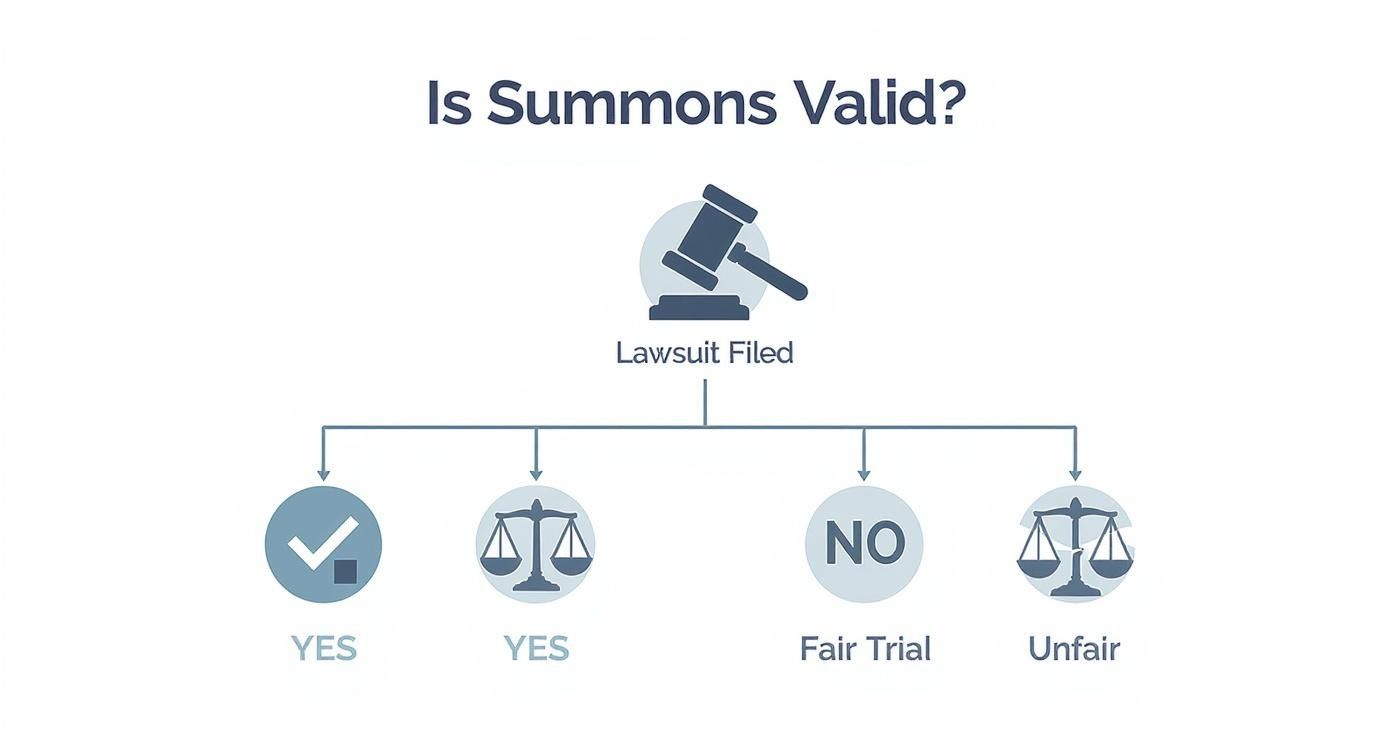
As you can see, without valid service, the whole legal process grinds to a halt before it even begins.
The Primary Modes of Service
The CPC gives top priority to methods that get the summons physically into the defendant's hands or those of a responsible representative. These are the classic, tried-and-true approaches that form the first line of delivery.
Personal or Direct Service: This is the gold standard. A court-appointed process server or an officer of the court personally delivers the summons straight to the defendant. The defendant is then expected to sign an acknowledgement confirming they've received it. You might also hear this called a dasti summons, which is when the court gives the plaintiff permission to deliver it themselves.
Service on an Agent: What if the defendant has an authorised agent—someone legally empowered to accept documents for them? Serving the summons to this agent is just as good as serving the defendant directly. This is a common scenario in business and commercial disputes where companies have designated agents for legal matters.
Service on an Adult Family Member: Let's say the process server has made a real effort but can't find the defendant at home. In that case, the summons can be left with any adult family member—male or female—who lives there with them. This is a practical way to ensure the notice gets into the household even if the defendant is out.
What Happens When a Defendant Can't Be Found or Refuses Service?
It's a classic problem: what do you do when a defendant seems to be actively dodging service, or just isn't around? Order V has this covered. If a defendant flat-out refuses to sign the acknowledgement, the serving officer simply makes a note of the refusal. Legally, the summons is now considered served.
Insights: The law is smart enough to anticipate this kind of behaviour. A defendant can't just stick their head in the sand and stop a lawsuit. Their refusal to accept the summons is documented and effectively becomes proof that they were notified, preventing them from crying foul later on.
If the defendant genuinely can't be located and there’s no agent or adult family member to accept the summons, the serving officer has one more move. They must affix a copy of the summons to a conspicuous part of the defendant's last known home or place of business—think the front door. This action, once properly documented in a report back to the court, counts as valid delivery.
To help you keep these methods straight, here's a quick comparison of the main service options under the CPC.
Comparing Summons Service Methods Under CPC
This table breaks down the primary ways to serve a summons, highlighting when each method is most appropriate and what's needed to prove it was done correctly.
Method of Service | Governing Rule (Order V) | Best Use Case | Proof of Service Required |
|---|---|---|---|
Personal/Direct Service | Rules 10, 12 | The most reliable method; when the defendant is locatable. | Signed acknowledgement from the defendant. |
Service on an Agent | Rule 13 | When the defendant has a legally authorised representative. | Signed acknowledgement from the agent. |
Service on Adult Family Member | Rule 15 | When the defendant cannot be found at their residence. | Signed acknowledgement from the family member. |
Affixing a Copy (Affixture) | Rule 17 | When the defendant or their agents refuse to accept service. | Report from the serving officer detailing the refusal/affixing. |
Substituted Service | Rule 20 | The last resort; when the defendant is actively avoiding service. | Court order, proof of publication/affixing as directed. |
Understanding these distinctions is crucial, as choosing the wrong method or failing to provide proper proof can jeopardise your entire case.
Substituted Service: The Last Resort
When all the usual methods have failed and the court is convinced the defendant is deliberately avoiding being served, the plaintiff can ask for substituted service under Order V, Rule 20. This isn't something you can just decide to do; it’s an exceptional measure that requires the court's explicit permission.
The court might order service through methods like:
Posting a copy of the summons somewhere prominent in the courthouse.
Sticking the notice to the defendant's last known address or workplace.
Publishing the summons in a daily newspaper that's widely read in the defendant's local area.
This makes sure that even a defendant who is trying their best to hide is still considered legally notified. Every step of this process, from the first failed attempt to the final report, demands meticulous records, usually in the form of a sworn affidavit. If you want to dive deeper into this critical document, check out our comprehensive guide to an affidavit under CPC in India.
This is where legal AI tools like Draft Bot Pro become incredibly helpful. It can generate the precise applications and affidavits required for substituted service, ensuring every detail is perfectly aligned with CPC rules. This not only saves lawyers a ton of time but also strengthens their case against any potential procedural challenges down the road.
The Digital Shift to Electronic Service
The old-school image of a process server physically handing over a summons is quickly becoming a relic of the past. As our lives have shifted online, so has the way legal notices are delivered. The service of summons under CPC has officially entered the digital age, swapping paper and postage for pixels and instant messages in a massive leap towards efficiency.
This isn't just the courts deciding to "go digital" on a whim. This change is firmly rooted in procedural law. Key amendments to Order V, Rule 9 of the Civil Procedure Code have formally swung the door open for electronic service. This creates a clear legal path for summons to be delivered via email, SMS, and even messaging apps like WhatsApp. It's a pragmatic move by the judiciary, acknowledging that in a world glued to smartphones, the fastest way to reach someone is often through the device in their pocket.
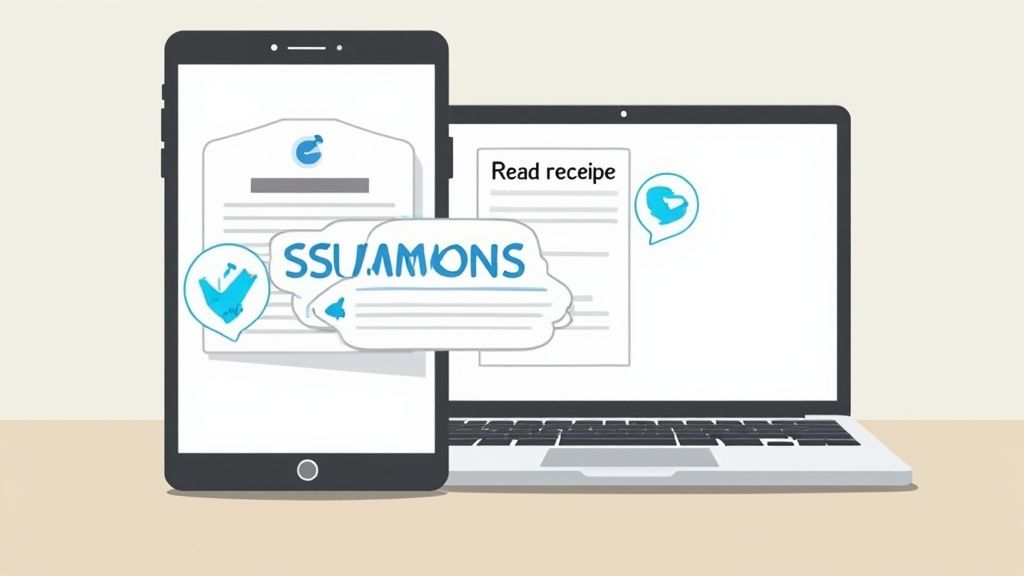
From Blue Ticks to Legal Proof
The million-rupee question that comes with this digital pivot is simple: how can you prove a message was actually received and read? Unlike a signed acknowledgement slip, the proof in the digital world looks very different. Courts have had to get creative in figuring out what counts as valid proof of delivery.
Thankfully, landmark court decisions have set a precedent, establishing that common digital signals can absolutely serve as legally acceptable evidence.
Email Read Receipts: That automated notification confirming the recipient has opened the email.
WhatsApp's "Blue Ticks": The infamous two blue checkmarks that show a message has been delivered and read.
SMS Delivery Reports: A simple confirmation from the mobile network that the text message landed on the recipient's device.
These digital footprints have become the modern-day equivalent of a process server's signed report, giving courts the confidence to confirm a defendant has been properly notified.
Navigating the Challenges of E-Service
Of course, this digital approach isn't a silver bullet. It has its own set of challenges. A defendant could easily claim they never saw the email, argue their WhatsApp "blue ticks" were on by default, or that someone else had their phone. So, what then?
To head off these potential roadblocks, the plaintiff has to bring solid proof to the table. A simple claim won't cut it; they need to file a formal affidavit with the court. This sworn statement must meticulously include:
A screenshot of the sent message, clearly showing the content, date, time, and the recipient's number or email address.
A screenshot of the delivery confirmation—whether it’s the blue ticks, a read receipt, or an SMS delivery report.
Evidence linking that specific phone number or email address directly to the defendant.
The Indian judiciary's embrace of electronic summons is a huge step forward, driven by the need to sync up legal procedures with how we communicate today. While the CPC originally insisted on physical delivery, amendments to Order V Rule 9 now explicitly allow service via email, WhatsApp, or other digital means, as long as there is verifiable proof of delivery. This shift is a direct attempt to boost service rates and combat the estimated 30% failure rate seen with traditional methods in some areas. For a deeper dive into this stance, you can learn more about how Indian courts are handling virtual procedures.
InsightsThe judiciary's acceptance of digital service methods shows a smart balance between upholding legal tradition and embracing practical efficiency. By recognising tools like WhatsApp, the courts are tackling one of the most stubborn causes of trial delays—the failure to serve summons—and paving the way for a faster, more responsive justice system.
Putting together the necessary paperwork for electronic service has to be done with absolute precision. The affidavit of service needs to be flawless to stand up in court. This is where legal AI can be a game-changer. A tool like Draft Bot Pro can generate a perfectly formatted affidavit for electronic service in minutes, making sure every required detail—from screenshots to declarations—is included and compliant with court standards. This helps legal professionals build an ironclad record of service that's tough for any defendant to poke holes in, protecting the case from procedural hiccups down the line.
Navigating Complex Service Scenarios
The standard way of serving a summons works just fine when the defendant is easy to find and willing to accept it. But let’s be honest, how often is legal practice that simple? More often than not, you'll be dealing with defendants who seem to vanish into thin air, live in another state, or are halfway across the world. Sometimes, you're not even serving a person, but a faceless corporation or a partnership.
Knowing how to handle these tricky situations is what separates a sharp lawyer from one whose case gets stuck before it even starts. Getting this right is absolutely critical to prevent your lawsuit from stalling at the very first hurdle.
Serving Defendants Across Jurisdictions
When your defendant lives outside the court’s local limits, a different set of rules kicks in. If they're still in India but in another state, things are relatively straightforward. The summons can be sent to the court in that area, which will then serve it as if it were one of its own.
Serving someone overseas is a different ball game entirely. It’s a more complex process governed by international agreements and specific CPC rules. Typically, this involves sending the summons through diplomatic channels to an authority in the foreign country. It can take time, but it's a non-negotiable step to ensure the service is legally valid.
Serving Corporations and Partnerships
You can’t just hand a summons to any employee you see and call it a day when you’re suing a company. The CPC has a very clear protocol for this.
For Corporations (Order XXIX): You must serve the summons on the secretary, a director, or another principal officer. Alternatively, you can deliver it to the corporation's registered office.
For Partnerships (Order XXX): Service is valid if it's made on any one of the partners. You can also serve it on the person managing the business at the firm's main office.
The whole point is to make sure the notice reaches the "directing mind and will" of the business. You need to be certain that the people in charge know they're being sued. On a related note, you might find our guide on the distinct process of delivering a summons to a witness in Indian law useful for understanding similar procedural details.
The Concept of Deemed Service
So, what happens when you send a summons by registered post, and the defendant either refuses it or just isn't there to collect it? This is where the powerful legal idea of "deemed service" comes into play. Thanks to Section 27 of the General Clauses Act, 1897, the law makes a smart assumption: a properly addressed and posted letter is presumed to have been delivered.
If a summons sent by registered post comes back with a note like "refused" or "unclaimed," the court will usually treat the service as complete. This clever rule stops defendants from dodging the legal process just by avoiding the postman. The ball is then in the defendant's court to prove they genuinely never received it.
InsightsDeemed service is a legal fiction, but it’s a necessary one. It’s designed to stop people from evading justice. A defendant's deliberate refusal to accept a summons shouldn't be allowed to grind the entire judicial process to a halt. Courts will always look at the full picture to decide if the refusal was just a tactic to cause delays.
The numbers tell a story of just how important this is. Studies on judicial reform reveal that issues related to serving summons and notices can take up about 25% of a civil case's entire lifespan. With a staggering 40 million civil cases filed in India each year, making service effective is absolutely essential for clearing the massive backlog. To combat this, many High Courts have created their own practice rules to handle tricky defendants and complex corporate entities. You can explore more about these challenges in this detailed report.
Working through these complexities requires careful and precise drafting, whether you're applying for a special service method or asking the court to step in. A legal AI tool like Draft Bot Pro can be a game-changer here. It can help you generate perfectly worded, rule-compliant applications for serving defendants in other states, requesting service through international channels, or drafting affidavits to prove deemed service, ensuring you hit every procedural mark.
Consequences of Improper Service and How to Avoid Them
What happens when the crucial first step of serving a summons goes wrong? It’s not just a minor procedural hiccup; the fallout can be severe enough to torpedo your entire lawsuit. A defective or improper service of summons under CPC is one of the most common weapons a defendant has to challenge a court's decision, especially one made when they weren't present.
Imagine this: you've gone through the entire legal process and secured a favourable judgment, only for the defendant to pop up and prove they were never properly notified. If they succeed, any subsequent order—particularly an ex-parte decree where only your side was heard—can be completely set aside.
This isn't just a setback. It throws you right back to square one. You're facing significant delays, wasted court resources, and a mountain of additional legal fees. Months, or even years, of progress can be erased in an instant.
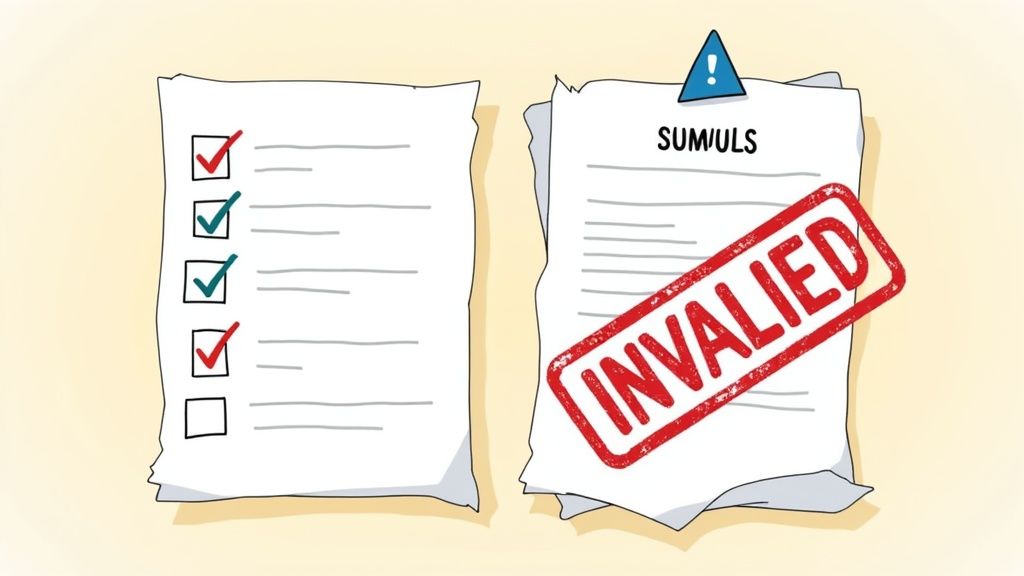
Grounds for Challenging Service
When a defendant wants to overturn an ex-parte decree, you can bet their lawyer will scrutinise every single detail of how the summons was served. They'll be looking for any failure to comply with the strict rules laid out in Order V of the CPC.
Here are some of the most common arguments they'll use:
Wrong Address: The summons was posted to an old or incorrect address, making it physically impossible for the defendant to have received it.
Failure to Follow Hierarchy: The plaintiff jumped straight to a method like substituted service (taping the notice to a door) without first making genuine, repeated attempts to serve it in person.
Improper Affixing: The court officer didn't stick the summons to a "conspicuous" part of the property, or worse, they failed to have independent witnesses confirm they did it.
No Due Diligence: The plaintiff claimed the defendant was untraceable without doing the basic legwork to find their current location.
Essentially, any slip-up or deviation from the legally mandated process creates an opening for the defendant to launch a successful challenge.
A Checklist for Bulletproof Service
To sidestep these expensive blunders, you have to treat the service of a summons as a critical part of your case strategy. A meticulous approach doesn't just ensure you're following the rules; it builds a rock-solid record that will hold up under the toughest legal scrutiny.
Verify the Address: Before you even think about filing, do your homework. Confirm the defendant’s current home and business addresses using reliable sources, and make sure you document every step of your verification process.
Document Every Attempt: The process server's report is your golden ticket of proof. Insist that it's detailed, noting the exact date, time, and result of each attempt to serve the summons. If the defendant refuses service, the report must clearly state who refused it and who witnessed the refusal.
Create a Detailed Affidavit: If you need to apply for substituted service, your affidavit has to be airtight. It needs to show the court, beyond a doubt, that the defendant is actively dodging service and that you've exhausted all other options. Be specific.
Preserve Electronic Proof: Using e-service? Keep an organised trail. That means screenshots, delivery confirmations (like WhatsApp's blue ticks), and any evidence that proves the email address or phone number belongs to the defendant.
InsightsThink of the summons stage as the foundation of your entire case. A shaky foundation will inevitably cause the whole structure to crumble when pressure is applied. Investing time and effort in meticulous, well-documented service is really an investment in the future strength of any decree you eventually win.
How Legal AI Acts as a Safeguard
Navigating the procedural maze of Order V demands absolute precision, and let's be honest, it's easy to miss a step. This is exactly where a legal AI tool like Draft Bot Pro becomes an indispensable ally. It functions as a procedural safety net, helping you draft documents that are fully compliant with CPC requirements.
Whether you're generating a flawless affidavit for substituted service or preparing an application for service via electronic means, Draft Bot Pro ensures every crucial detail is included. By following its structured guidance, you can build a robust paper trail that proves you followed the procedure to the letter. This dramatically lowers the risk of a successful challenge from the other side and helps fortify your case from the very beginning.
The Future of Summons and Legal AI
The journey of serving a summons under the CPC is clearly headed in one direction: towards technology. You can see it in the way the judiciary is thinking and acting. What was once a slow, paper-heavy chore is finally becoming a smarter, digital process. This isn't just about convenience; it's a direct response to the frustrating delays that have always plagued the start of a lawsuit.
This is exactly where legal AI tools are stepping in and making a real difference. They're turning this foundational legal step from a time-consuming headache into a smooth, efficient activity. The goal is no longer just to tick a procedural box, but to do it quickly, accurately, and with far less room for human error.
How Legal AI Is Reshaping Summons Procedures
Legal AI platforms are giving professionals a serious leg up by automating the creation of essential documents. Instead of starting from a blank page, lawyers can now generate pinpoint-accurate summons formats, applications for different modes of service, and all the necessary supporting affidavits with just a few prompts.
This kind of automation is a lifesaver in more complex situations. Think about applying for substituted service or drafting an affidavit for service via WhatsApp or email—every single detail has to be perfect. An AI tool ensures all the right components are there, formatted correctly, and perfectly in line with the Civil Procedure Code. For a broader look at how tech is changing the game across the board, it's worth checking out the latest in Legal Tech.
InsightsThe real magic of bringing AI into the summons process is its power to kill procedural mistakes before they happen. By guaranteeing compliance and creating a perfect paper trail, these tools help shield a case from future challenges, preventing those costly delays that pop up from an improperly served summons.
Building a More Efficient Justice System
The ripple effect of this tech integration goes way beyond just one case file. The service of a summons is notorious for being one of the biggest bottlenecks in a lawsuit. By speeding it up, AI helps chip away at the mountain of case backlogs clogging the Indian judicial system. When that very first step is done right and done fast, the whole timeline of the case can shrink.
Tools like Draft Bot Pro are right at the forefront of this shift. They offer the support needed to make sure every document related to a summons is compliant and effective from the get-go. This frees up legal professionals to sink their teeth into the real substance of the case, instead of getting tangled up in procedural knots. You can dive deeper into this by learning how to use AI for Civil Procedure Code (CPC) in India-india) and its practical uses.
By embracing these tools, lawyers aren't just making their own lives easier. They are actively helping build a legal practice that's more responsive, accessible, and ready for whatever comes next.
Frequently Asked Questions
When it comes to the service of summons under CPC, theory is one thing, but practice is another. Let's tackle some of the most common questions that pop up for both lawyers and clients navigating this crucial first step in a lawsuit.
What Happens If a Defendant Intentionally Avoids a Summons?
It’s an old trick, but the law has an answer for it. When a defendant is clearly playing hide-and-seek to dodge a summons, you're not out of luck. You can ask the court for permission to use ‘substituted service’ under Order V, Rule 20 of the CPC. This is the court's way of saying, "We'll find another way to make sure they're notified."
The court might authorise methods like:
Pasting a copy of the summons on the front door or another unmissable spot at the defendant’s last known home or office.
Publishing a notice about the summons in a local newspaper that people in the defendant's area are likely to read.
Once you’ve followed the court's specific directions for substituted service, the law considers the summons officially served. It carries the same legal weight as if you had placed it directly in the defendant's hands.
Is Service Via WhatsApp Legally Valid in India?
Yes, it is. Indian courts have caught up with the times and now recognise WhatsApp as a valid way to serve a summons. But there's a catch: you have to prove, without a doubt, that the defendant not only received the message but actually saw it.
The golden ticket here is a screenshot of the 'blue ticks' on WhatsApp, which serves as a digital receipt that the message has been read. To make it official, you’ll need to file an affidavit with the court, attaching that screenshot as proof. This is how electronic service is validated under the modern interpretation of Order V, Rule 9.
How Much Time Does a Defendant Get to Respond?
Once the summons has been successfully served, the clock starts ticking for the defendant. They have to file their side of the story, which is formally called a 'written statement'. The standard deadline for this is within 30 days from the day they were served.
Life happens, though. If the defendant has a genuine reason for needing more time, they can ask the court for an extension. However, this isn't a blank cheque—the total time granted, including any extension, cannot go beyond 90 days from the initial service date.
InsightsWhile tools like WhatsApp make service faster, they also open a new can of worms when it comes to client queries. For law firms juggling these new procedures, it's worth looking into how to enhance user support with a chatbot for FAQ to manage the flow of questions more effectively.
Getting these initial steps right is non-negotiable. An error here can derail a case before it even starts. Legal AI tools like Draft Bot Pro can be a massive help by generating the precise applications for substituted service or the necessary affidavits for electronic service, ensuring you’re fully compliant with the CPC from day one.
Don't let procedural slip-ups weaken your case. Draft Bot Pro helps you create flawless legal documents, including all the necessary applications and affidavits for serving a summons, so your case is built on a solid foundation. See how it works at https://www.draftbotpro.com.
