
A Guide to Section 15 of Hindu Marriage Act

So, a divorce decree has been granted. It might feel like the final chapter, but the law says, "hold on a moment." Before you can legally remarry, there's a crucial waiting period you need to respect. This is where Section 15 of the Hindu Marriage Act, 1955, comes into the picture. It's a legal safeguard designed to prevent a whole mess of future complications.
Understanding Section 15 of Hindu Marriage Act

Think of Section 15 as a mandatory cool-down period. Just like you'd wait for a high-value transaction to clear before moving on, this law ensures all legal loose ends from your previous marriage are tied up. It’s all about making sure the divorce is truly final and can’t be challenged later.
This provision isn't just a formality; it's a foundational rule that upholds the integrity of the entire judicial process, ensuring your next steps are built on solid legal ground.
The Core Conditions for Remarriage
Section 15 lays down some very clear, non-negotiable conditions. Essentially, a second marriage is only considered lawful when the first marriage has been irrevocably brought to an end. Jumping the gun can land you in serious legal trouble, potentially making your second marriage completely void.
Before you can remarry, here's what the law requires.
Condition | Explanation | Legal Implication |
|---|---|---|
No Pending Appeal | An appeal against the divorce decree must not be active in a higher court. | If an appeal is underway, the divorce is not considered final, and remarriage is prohibited. |
Appeal Period Has Lapsed | The statutory time limit for filing an appeal must have expired with no appeal being filed by either party. | Once this window closes, the divorce is legally confirmed, clearing the path for a lawful remarriage. |
Appeal Has Been Dismissed | If an appeal was filed, it must have been heard and dismissed by the higher court. | The dismissal of the appeal solidifies the original divorce decree, making it final. |
Meeting these conditions is absolutely essential. It’s the law’s way of ensuring that a new marital status isn’t created while the old one is still technically in dispute.
Why This Waiting Period Matters
This waiting period isn't just arbitrary red tape; it serves a critical purpose. With approximately 1.5 million divorce cases clogging up Indian courts as of 2021, the procedural clarity of Section 15 is vital. It protects every individual's fundamental right to appeal a court's decision without the added complication of a new marriage in the mix.
You can learn more about how court interpretations affect remarriage rules to see how this plays out in real-world scenarios.
InsightsNavigating these timelines can be tricky. A premature remarriage, even if it was an honest mistake, can lead to devastating consequences. We're talking about serious questions over the legitimacy of your second marriage and any children born from it. Getting this right is key to moving forward with peace of mind.
Thankfully, you don't have to decipher complex legal statutes on your own. A legal AI like [Draft Bot Pro](https://www.draftbotpro.com/) can help by breaking down these rules, creating personalised checklists, and even calculating those critical waiting periods based on your decree date. This kind of support helps you sidestep the common but costly mistake of remarrying too soon, making sure your next chapter is legally sound.
Understanding the Remarriage Waiting Period
One of the most critical parts of Section 15 of the Hindu Marriage Act is the mandatory waiting period before someone can legally remarry after a divorce. This isn't just an arbitrary delay. It’s a crucial legal safeguard designed to protect the integrity of the whole judicial process, specifically by preserving each person's right to appeal the divorce decree.
Think of this waiting period as a kind of 'legal cooling-off period'. It ensures the divorce process is completely and finally settled before an irreversible step—like a new marriage—is taken. This simple rule prevents a tangled legal mess where a divorce gets overturned on appeal after one of the parties has already remarried.
This all-important waiting period kicks in from the date the divorce decree is officially handed down by the court. The law clearly states a timeframe, which is typically 90 days, during which either party can challenge the decision by filing an appeal with a higher court. Remarriage is only on the table after this period has passed without an appeal, or if an appeal was filed but has been dismissed.
Consequences of Premature Remarriage
So, what happens if someone jumps the gun and remarries within that appeal window? The legal fallout can be serious and incredibly complicated. Courts have spent years debating whether such a marriage is completely void (meaning it was never valid to begin with) or merely irregular (defective, but maybe salvageable under specific circumstances).
This infographic breaks down the rules for remarriage in a really clear, visual way.
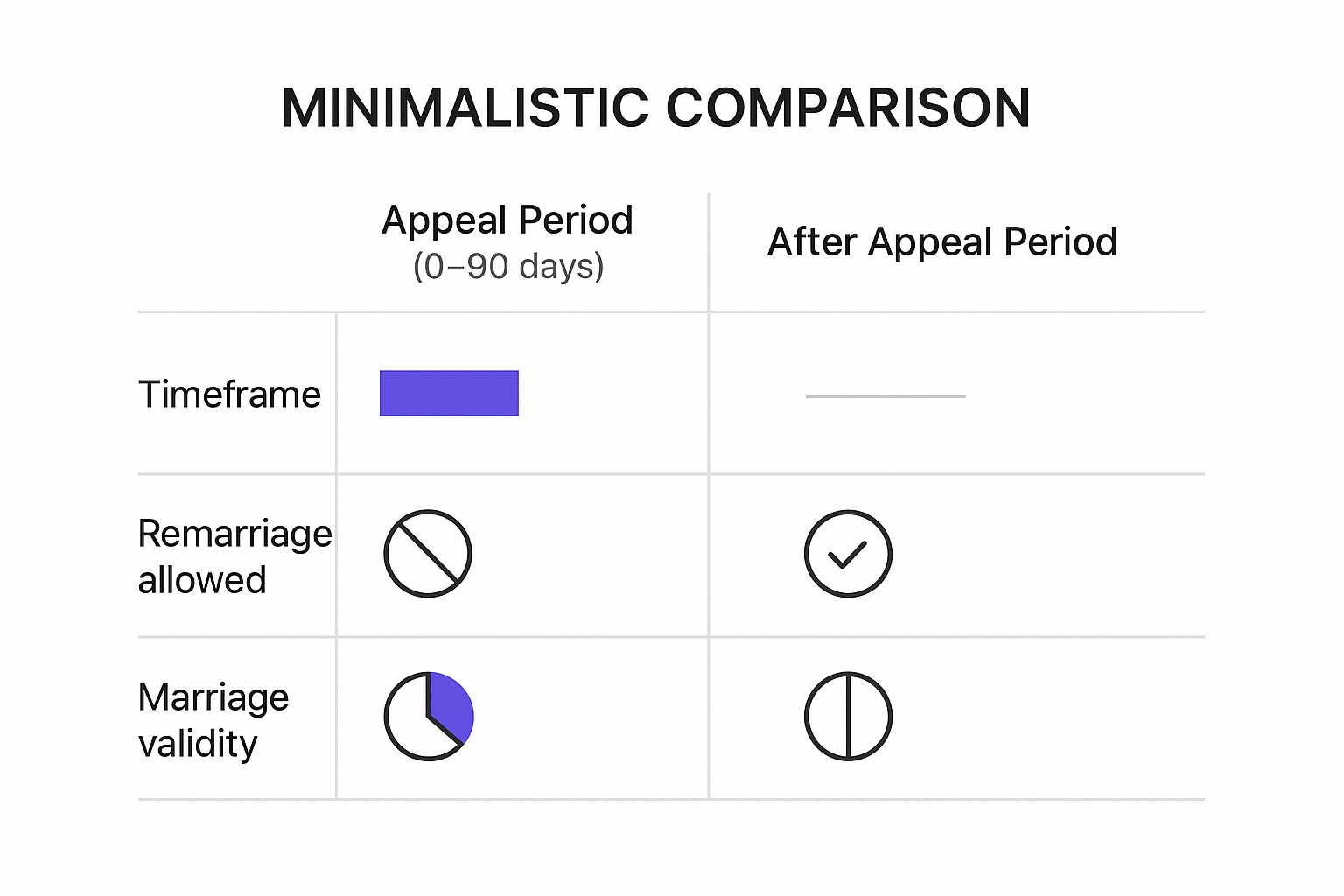
As you can see, remarriage is a strict no-go during that initial 0-90 day appeal period. Any marriage that takes place then faces a huge question mark over its legal validity.
A premature marriage throws everything into uncertainty. The legal status of the second spouse, and especially any children from that new union, could be thrown into question, leading to years of emotional and financial turmoil. Knowing the rules around this waiting period isn't just about following the law; it's about protecting your own future.
InsightsThe way courts look at this waiting period is slowly changing. While older judgments often took a very rigid, by-the-book approach, more recent rulings show a shift. Courts are now trying to balance the letter of the law with the real-life situations of the people involved. They are increasingly looking at the intent behind the remarriage and whether a strict interpretation would actually cause more injustice, particularly for children born from the second union.
The Indian legal system continues to wrestle with the finer points of Section 15, trying to find the right balance between legal certainty and the messy reality of people's lives. The law is constantly being refined to keep up with modern society, which just shows how law and societal norms are always in conversation. You can learn more about the evolution of the Hindu Marriage Act and its journey over the decades.
Trying to figure out these timelines and potential pitfalls on your own can be stressful. This is where a legal AI like [Draft Bot Pro](https://www.draftbotpro.com/) can help. By analysing the details of your divorce decree, it can calculate the exact date your waiting period ends, provide you with summaries of relevant court cases on premature marriages, and even generate a compliance checklist. It gives you a clear, reliable roadmap for when you can legally and safely remarry, saving you from future legal headaches.
How Section 15 Applies to Divorce vs Annulment
It’s easy to throw around the words "divorce" and "annulment" as if they mean the same thing. In everyday conversation, they might. But in the eyes of the law, they are worlds apart.
This distinction is absolutely critical when we talk about the right to remarry under Section 15 of the Hindu Marriage Act. The rules—specifically the waiting period before you can marry again—apply to divorces, but not to annulments.
Think of it like this: a divorce is like legally cancelling a contract that was once valid and active. An annulment, on the other hand, is like proving the contract was fraudulent or invalid from the very beginning, so it's declared void. One ends a valid union; the other says a valid union never existed.
This fundamental difference directly impacts how soon you can remarry. Since a divorce dissolves a real marriage, the law builds in a waiting period for appeals. But with an annulled marriage, there was never a legally recognised union to begin with, so the same logic doesn't apply.
The Immediate Right to Remarry After Annulment
When a court declares a marriage null and void under Section 11 or annuls it under Section 12 of the Hindu Marriage Act, it’s as if the marriage never happened. Poof. Gone.
As a result, the restrictions on remarriage laid out in Section 15 simply do not apply. The parties are immediately returned to their original single status, free to marry again without any mandatory waiting period.
Let's look at a practical example:
A divorced person: Receives their divorce decree on 1st January. They must wait for the appeal period (usually 90 days) to expire before they can legally tie the knot again.
An annulled person: Gets a decree of nullity on 1st January. Because the marriage was legally non-existent, they could technically remarry the very next day without violating Section 15.
Why the different treatment? Divorce requires a finalisation period to protect the rights of both parties in case of an appeal. An annulment, however, just confirms a legal reality that was already true.
For a deeper dive into the grounds for divorce, you might find our guide to Section 13B of the Hindu Marriage Act helpful.
InsightsThe logic here is sound. Section 15 is designed to prevent the chaos that would erupt if a divorce were overturned on appeal after one of the parties had already remarried. Imagine that legal mess! But with an annulment, the grounds are so fundamental (like bigamy or being within prohibited degrees of relationship) that the marriage is considered void from day one. There's no valid legal union to dissolve, so there's no need for the same kind of appeal period.
Divorce (Section 13) vs Annulment (Sections 11 & 12)
To make it crystal clear, let's break down the key differences between ending a marriage through divorce versus having it annulled. Understanding where you stand is the first step in knowing your rights.
Legal Action | Governing Section | Basis of Action | Applicability of Section 15 |
|---|---|---|---|
Divorce | Section 13 | Ends a legally valid marriage on specific grounds (e.g., cruelty, desertion). | Yes, the waiting period for appeal applies before remarriage is permitted. |
Annulment | Sections 11 & 12 | Declares a marriage was never legally valid from the start (void or voidable). | No, the restrictions do not apply; parties can remarry immediately. |
This table shows just how different the legal pathways and their consequences are. It’s not just a matter of terminology; it's a completely different legal reality.
A legal AI tool like Draft Bot Pro can help bring clarity to this complex distinction. By analysing your case details, it can help you understand whether you're looking at a divorce or an annulment, giving you a clear picture of your legal standing and the path to remarriage.
Landmark Judgments That Shaped Section 15
Laws aren't just static words on a page; they truly come to life and evolve inside the courtroom. The practical application of Section 15 of the Hindu Marriage Act has been dramatically shaped by a series of landmark judgments that have chipped away at its ambiguities. These cases tell a fascinating story of how the judiciary balances strict legal procedure with messy human realities.
Many of these pivotal rulings have grappled with one central question: what happens to a second marriage performed while an appeal against the first divorce is still pending? The answers have helped us understand whether such a marriage is completely void or just irregular, especially when it comes to the rights of children born from that union.
The Landmark Case of Lila Gupta vs Laxmi Narain
One of the most influential cases in this sphere is Lila Gupta vs Laxmi Narain. Here, the Supreme Court was faced with a second marriage that was conducted after a divorce decree was granted, but before the time limit for filing an appeal had passed. The court had to decide if this premature remarriage was legally valid.
The final ruling was a watershed moment. The Court decided that while getting remarried during the appeal period goes against the condition laid out in Section 15, the marriage itself is not automatically void. It is, however, at risk of being invalidated if the original divorce decree gets overturned on appeal.
This judgment brought in a crucial layer of nuance. It moved the conversation away from a rigid, black-and-white ban towards a more conditional one. The second marriage essentially exists in a state of legal limbo until the appeal process is over. This approach protects the sanctity of the appeal while also acknowledging the new marital reality that has been created.
InsightsThe broader trend you'll see in these judicial decisions is a careful balancing act. Courts are increasingly leaning towards interpretations that protect the rights of individuals—especially children from the second marriage—while still making sure the integrity of the legal process is upheld. It shows a compassionate shift from blindly following procedure to achieving real, substantive justice.
Clarifying the Rights of Children
Another critical area carved out by case law is the legitimacy of children born from a second marriage entered into during the appeal period. Courts have consistently leaned towards protecting the child's welfare, often granting them legitimacy under Section 16 of the Hindu Marriage Act, even if their parents' marriage is later declared invalid.
This ensures that children aren't unfairly punished for the procedural missteps of their parents. Keeping up with these landmark cases isn't just an academic exercise; it's essential for anyone navigating the complexities of family law. Taking a look at other landmark cases that transformed the Indian Constitution can give you a wider perspective on how judicial interpretation shapes our entire legal landscape.
How Draft Bot Pro Helps with Case Law
Trying to make sense of dense legal judgments can be incredibly tough. This is where a Legal AI tool like Draft Bot Pro becomes a game-changer. It can analyse landmark cases related to the section 15 of hindu marriage act and give you clear, plain-English summaries of the key findings and legal principles. Instead of spending hours poring over complex legal documents, you get the critical takeaways in minutes. This ensures you understand exactly how the law applies to your specific situation, without the headache.
How Legal AI Can Simplify Section 15 Compliance

Let's be honest, trying to understand family law, especially the tricky procedural rules in section 15 of hindu marriage act, can feel overwhelming. The language is dense, the timelines are non-negotiable, and a single mistake can have serious consequences. This is where modern Legal AI tools are stepping in, acting less like software and more like a sharp personal legal assistant.
These tools are brilliant at translating complex legal statutes into simple, plain English summaries. Instead of drowning in jargon, you get a straightforward explanation of your rights and what you need to do before you can legally remarry after a divorce. It makes the law accessible to everyone.
Practical AI Applications for Section 15
Picture this: you've just received your divorce decree. Your first thought is about starting fresh, but you know that legal compliance has to come first. This is where a Legal AI like Draft Bot Pro can provide immediate clarity.
Here’s how it works in practice:
Generating a Personalised Checklist: You provide your decree date, and the AI instantly creates a custom checklist. It outlines every single step you need to take before you can legally get remarried.
Calculating Critical Dates: It takes all the guesswork out of the equation by calculating the exact end date of the mandatory appeal period. No more worrying if you’ve jumped the gun.
Finding Relevant Case Law: Need to know how courts have interpreted Section 15 in situations similar to yours? The AI can instantly pull up and summarise the landmark judgments that matter most.
If you're curious about the mechanics behind how artificial intelligence can make complex legal processes so manageable, it's worth exploring the core principles of AI-powered workflow automation.
InsightsFor legal professionals, this is a game-changer for efficiency. A task that used to eat up hours of manual research—like digging up specific precedents on the validity of a second marriage—can now be completed in minutes. This frees up lawyers to focus on what truly matters: strategy and client support, instead of getting bogged down in procedural box-ticking.
Take the real-world example of Priya, who recently finalised her divorce. She was feeling anxious about the waiting period and wasn't entirely sure what her next steps should be. She uploaded her decree to Draft Bot Pro, and in an instant, the AI gave her a clear timeline and a simple summary of her legal position. This clarity gave her the power to plan her future with confidence, free from legal anxiety.
For legal practitioners aiming for this level of efficiency in their own practice, learning about AI for family law drafting is an absolute must.
Common Questions About Section 15 and Remarriage
Moving on after a divorce isn't just an emotional journey; it's a legal one, too. You need to be crystal clear on your rights and obligations, especially when it comes to remarrying. The rules here, specifically those in Section 15 of the Hindu Marriage Act, can be tricky and often lead to a lot of practical questions.
Getting the answers right is absolutely critical. You want to make sure your next chapter starts on a solid legal foundation. Let's break down some of the most common questions we hear, giving you direct, no-nonsense answers to help you sidestep any potential legal headaches.
What Happens if I Remarry Before the Appeal Period Is Over?
This is probably the most crucial question we get. Say you remarry before the appeal period—which is typically 90 days from the date of your divorce decree—is over. What happens? Well, your second marriage isn't automatically void, but it's on very shaky ground.
Here’s the real danger: if your ex-spouse decides to appeal the divorce within that window and actually wins, the court's original divorce order gets wiped out. Legally, it’s like it never happened. This means your first marriage is suddenly back in effect, which automatically makes your second marriage invalid and bigamous. That can throw your life into chaos, creating serious legal and personal problems for you, your new spouse, and any children you might have.
Does the Waiting Period Apply to a Mutual Consent Divorce?
Yes, it absolutely does. This is a common point of confusion. Many people think that because they and their ex-spouse both agreed to the divorce under Section 13B, the waiting period doesn't apply. That’s a mistake.
The law still allows for an appeal, even when the divorce was mutual. While it's certainly less common, it's not impossible. One party could, for instance, later claim their consent wasn't genuine—that it was given because of fraud, pressure, or some kind of misrepresentation. So, the waiting period under Section 15 of the Hindu Marriage Act acts as a crucial safeguard. You still have to wait for that appeal window to close before you can legally remarry.
Can I Remarry if My Ex-Spouse Dies During the Appeal Period?
This is a tragic situation, but it has very specific legal consequences. If your former spouse passes away after the divorce is granted but before the 90-day appeal period ends, their right to appeal essentially dies with them. The right to appeal a divorce is personal and can't be carried on by their family or heirs.
In this specific circumstance, the divorce decree becomes final and absolute the moment your ex-spouse passes away. You are then free to remarry immediately, without needing to wait for the rest of the appeal period to run its course.
InsightsUnderstanding these little details is key to staying out of legal trouble. The law is structured to make sure divorce decrees are final while still protecting everyone's right to appeal. Rushing into a second marriage without respecting these timelines can cause your new life to unravel before it even properly starts. It’s always, always better to play it safe and just wait out the legally required period.
Figuring out these legal nuances can feel overwhelming. This is another area where a legal AI can help. For example, Draft Bot Pro can look at your specific circumstances—whether you have a contested divorce, a mutual consent decree, or a unique situation like the death of an ex-spouse—and give you clear guidance based on the law and relevant court cases. It helps you understand exactly where you stand legally, ensuring you've ticked every box required by Section 15 before you move forward. Visit https://www.draftbotpro.com to see how it works.
