
A Guide to Insolvency of Partners in India
- Rare Labs
- Nov 10, 2025
- 17 min read

When a partner is legally declared unable to pay their debts, we call this partner insolvency. It's a massive deal, creating huge financial and operational headaches for the entire partnership. This one event can actually dissolve the whole firm unless the partnership agreement has a solid plan B, making it a critical threat to the business's survival.
Navigating the Ripple Effects of Partner Insolvency

When one business partner goes broke, the fallout doesn't just stop at their personal bank account. It spreads, and fast.
Think of a partnership like a sturdy bridge held up by several pillars. Each partner is a pillar. If one of those pillars crumbles under the weight of insolvency, what happens to the bridge? The entire structure is compromised. The load that pillar once carried is suddenly dumped onto the others, putting them under immense strain.
This is exactly what happens in a traditional partnership. The financial collapse of one person can bring the whole business they helped build to its knees. That’s because, in the eyes of the law, the partners and the firm are often seen as one and the same, creating a domino effect that’s incredibly tough to stop.
The Legal Landscape in India
To get your head around partner insolvency, you need to know which laws are in play. In India, the legal framework isn't a one-size-fits-all deal; it changes quite a bit depending on how the partnership is structured.
Here are the big three you need to be aware of:
The Indian Partnership Act, 1932: This is the OG law for general partnerships. It’s the one that lays down the principle of joint and several liability and clearly states that a partner going insolvent is grounds to dissolve the entire firm.
The Limited Liability Partnership Act, 2008: This act is for LLPs, which were specifically designed to shield partners from the financial mess of other partners. It treats the LLP as its own legal person, separate from the individuals involved.
The Insolvency and Bankruptcy Code (IBC), 2016: The IBC is the modern, all-in-one law for tackling financial distress. It sets out a strict, time-bound process for resolving insolvency for individuals, partnership firms, and LLPs, with the goal of finding a resolution rather than just liquidating everything.
These three laws are the foundation for how partner insolvency is handled. Understanding how they interact is the first, most crucial step in navigating this legal minefield.
Insights: Agreement vs. Statute A common mistake is thinking a partnership agreement can completely sidestep the law on insolvency. While a well-drafted agreement is vital for managing internal affairs—like how to buy out an insolvent partner's share or continue the business—it can't magically erase the solvent partners' liabilities to outside creditors under the Indian Partnership Act, 1932. Your agreement manages the relationship between partners, but the law dictates your obligations to the rest of the world.
The Role of Legal Technology
When you first get wind of a partner's financial troubles, you're suddenly wading through dense legal jargon and trying to figure out your immediate duties. It can be overwhelming. This is where a Legal AI called Draft Bot Pro can be a lifesaver.
For instance, Draft Bot Pro can help you make sense of complex clauses buried in your partnership deed or explain what key terms in the IBC actually mean for you. By using AI to get quick, clear-headed explanations, partners and their lawyers can make smarter decisions right from the get-go. Getting that initial clarity on your rights and responsibilities is absolutely vital for planning your next move before the situation spirals out of control.
The Legal Framework Governing Partner Insolvency
When a partner's financial world comes crashing down, you need to know which rulebook applies. Navigating partner insolvency in India means getting to grips with a few key pieces of legislation. It's a multi-layered landscape, and understanding it isn't just for lawyers—it's essential for any partner who wants to protect their business and personal assets.
The journey starts with the old guard: the Indian Partnership Act, 1932. This law governs traditional partnership firms and takes a very direct, and often harsh, approach when a partner goes bust. It’s built on a simple, powerful principle: the partners and the firm are one and the same.
This tight link has massive implications. If a partner's personal finances collapse, the law doesn’t just ring-fence the problem. To really appreciate the risk, every partner should be familiar with the rules around trading while insolvent, because one person’s financial trouble can quickly become everyone’s problem.
The Indian Partnership Act, 1932
Under the 1932 Act, a partner’s insolvency is a seismic event for the firm. The critical provision here is Section 34. It lays down a stark reality: the moment a partner is officially declared insolvent, they're out. They cease to be a partner immediately.
But it gets more serious. Unless your partnership agreement explicitly says otherwise, that one insolvency event can automatically trigger the dissolution of the entire firm. Just like that, the business is legally over. The remaining solvent partners are then left with the messy job of winding everything up, a process that can put their own personal assets on the line to clear the firm’s debts.
The Limited Liability Partnership Act, 2008
Realising just how tough the 1932 Act could be, the Indian legal system brought in a more modern, flexible structure: the Limited Liability Partnership (LLP) Act, 2008. This was a game-changer, offering a much-needed safety net.
The core concept is that an LLP is a ‘separate legal entity’—it has its own identity, distinct from its partners. This simple distinction makes all the difference. If a partner in an LLP goes insolvent, it doesn't automatically drag the whole firm down with them.
Here’s how the LLP Act shields the business and its partners:
Limited Liability: A partner’s liability is generally limited to the capital they put in. This means the personal assets of the other partners are protected from the insolvent partner's creditors.
Business Continuity: The firm can keep on ticking. The insolvent partner is out, but the business itself survives, as long as the LLP agreement is followed.
This structure smartly separates the financial fate of one individual from the overall health of the business.
To give you a clearer picture, let's compare how these two structures handle insolvency side-by-side.
Comparison of Insolvency Provisions Across Partnership Structures
Provision | General Partnership (Act of 1932) | Limited Liability Partnership (Act of of 2008) |
|---|---|---|
Partner Liability | Unlimited personal liability. A partner’s private assets can be used to pay firm debts. | Limited to the agreed contribution. Personal assets of other partners are protected. |
Effect of Insolvency | Partner ceases to be a partner. Can lead to automatic dissolution of the firm. | Insolvent partner ceases their role, but the LLP's existence is not affected. |
Firm's Legal Status | Not a separate legal entity from its partners. | A separate legal entity, distinct from its partners. |
Continuity | At high risk. The firm may be forced to dissolve upon one partner's insolvency. | High. The business can continue its operations without interruption. |
As you can see, the LLP structure provides a much more robust framework for business continuity and personal asset protection when faced with a partner’s financial distress.
Insights: The IBC Revolution The arrival of the Insolvency and Bankruptcy Code (IBC) in 2016 was a landmark reform. Before the IBC, sorting out partnership insolvencies was a slow, messy affair spread across different outdated laws. The IBC created a single, time-bound playbook, bringing a dose of much-needed efficiency and predictability to the entire process for both traditional partnerships and LLPs.
The Insolvency and Bankruptcy Code, 2016
The Insolvency and Bankruptcy Code (IBC), 2016, is India’s modern answer to financial failure. It created a consolidated framework for handling the insolvency of individuals, partnership firms, and LLPs. The IBC's main goal is to rescue businesses wherever possible, favouring resolution over liquidation.
Before the IBC, insolvency proceedings could drag on for years with uncertain outcomes. The new code brought speed and clarity. For instance, in Corporate Insolvency Resolution Process (CIRP) cases that ended in a resolution, the recovery rate for creditors averaged around 41%. The IBC provides a structured, time-bound process where a resolution professional takes charge, ensuring a fair and transparent outcome for everyone involved.
For partners facing insolvency, the IBC provides a clear roadmap for creditors to initiate proceedings and for professionals to manage the process, all within a predictable timeframe.
The Step-by-Step Insolvency Resolution Process
When a partner goes broke, it’s not a free-for-all. The law, specifically the Insolvency and Bankruptcy Code (IBC), 2016, lays out a formal, structured game plan. This isn’t just legal red tape; it's a carefully designed process to bring order to financial chaos. For everyone involved—from the partners themselves to the people they owe money to—getting a handle on these steps is absolutely critical.
The whole thing gets rolling with an insolvency application. Think of this as the official starting pistol. It can be fired by creditors who are owed money, or even by the partner or firm themselves if they see the writing on the wall and know they can’t pay their debts. This application is filed with the National Company Law Tribunal (NCLT), which acts as the referee for the entire process.
The moment the NCLT gives the application the green light, the clock officially starts ticking on a very strict timeline. This is where every piece of paper and every procedural step matters immensely.
Key Stages of the Resolution Journey
Once the application is accepted, a series of legally required events kick off. Each stage has its own set of players with specific jobs, all working toward a final resolution.
Appointment of an Interim Resolution Professional (IRP): The first thing the NCLT does is bring in an IRP. This person is a licensed insolvency expert who immediately takes the wheel, seizing control of the insolvent partner’s or firm’s assets and affairs. The existing management is effectively sidelined.
Declaration of a Moratorium: At the same time, a moratorium is declared. This is like hitting a giant legal "pause" button. It freezes all lawsuits and legal actions against the partner or firm. Creditors can't file new cases or continue old ones to get their money back. This creates a much-needed breathing room for the resolution process to unfold without constant interruptions. Getting legal notices out correctly during this period is vital, a tricky area where knowing the rules, like the service of summons under the CPC, really pays off.
Formation of the Committee of Creditors (CoC): The IRP’s next big job is to go through all the claims from creditors and assemble the CoC. This committee, made up mostly of financial creditors, becomes the main driver of the process. They're the ones who will ultimately evaluate and vote on any rescue plan.
Roles and Responsibilities of Key Players
To get through the insolvency of partners, you have to know who’s supposed to do what. It's a team effort, and every player has a crucial part to play.
Insolvent Partner: Their job is to be an open book. They must hand over complete and accurate financial details to the resolution professional.
Solvent Partners: They can’t just stand by. They have a legal duty to cooperate with the resolution professional, providing all the necessary info about the firm's assets and debts.
Resolution Professional (RP): This is the project manager. They oversee the entire show, protect the assets, keep the business running if possible, and bring potential rescue plans to the CoC.
Committee of Creditors (CoC): They hold the power. They review and vote on resolution plans, always aiming to get back as much of their money as possible.
This whole structure is built for speed. But in the real world? Things can get bogged down. Data from the Ministry of Corporate Affairs for 2023-24 shows the average insolvency process is taking around 679 days. That's a lot longer than the 330-day target under the IBC, usually because of legal battles. You can dig into more of these insolvency data trends on Dataful.in.
Insights: Mitigating Common Procedural Delays One of the biggest roadblocks in any insolvency case is the delay from messy paperwork or fights over who is owed what. The best way to dodge this bullet is to keep meticulous financial records long before there’s even a hint of trouble. Being proactive and using tools to keep claims and financial data organised can shave precious time off the process, helping you stay closer to the IBC's intended timeline.
How Legal AI Can Assist
Let's be honest, the IBC process is a mountain of paperwork and tight deadlines. This is where a Legal AI called Draft Bot Pro can be a game-changer. It can help draft that initial insolvency application with pinpoint accuracy, assist the resolution professional in verifying complicated creditor claims by checking documents, and ensure every filing and communication meets the IBC’s tough standards. By automating these tasks, Draft Bot Pro cuts down on human error and speeds up the administrative heavy lifting, freeing up legal professionals to focus on strategy.
What Happens to the Other Partners? Liabilities and Consequences
When a partner becomes insolvent, it’s not just their problem. The event sends shockwaves through the entire firm, putting its financial health and even its very existence on the line. How bad are the aftershocks? It all boils down to one critical factor: the legal structure of your partnership.
For a traditional partnership operating under the Indian Partnership Act, 1932, the situation is governed by a daunting principle: joint and several liability.
This isn't just legal jargon; it's a concept with serious real-world consequences. It means every single partner is on the hook for the entire debt of the firm, not just their slice of the pie.
Think about it. If the firm owes a supplier ₹1 crore and one partner goes bust, that creditor doesn't have to chase pennies. They can legally come after any of the remaining solvent partners for the full amount. This puts your personal assets—your home, your car, your savings—squarely in the firing line.
Traditional Partnerships vs. Limited Liability Partnerships (LLPs)
The staggering level of personal exposure is precisely why the Limited Liability Partnership (LLP) structure was created. It's designed to build a firewall between your personal finances and the business's troubles.
Let's lay out the differences because they are night and day:
Feature | General Partnership | Limited Liability Partnership (LLP) |
|---|---|---|
Partner Liability | Unlimited. Your personal assets are fair game for the firm's creditors. | Limited. Your liability is generally capped at the capital you've put into the business. |
Creditor Action | Creditors can sue any partner personally to recover the firm's debts. | Creditors can only go after the assets of the LLP itself, not the partners' personal wealth. |
Risk Exposure | Sky-high. Your financial security is tied to the actions and stability of every other partner. | Significantly lower. Your personal financial fate is detached from the firm's. |
This stark contrast is why so many modern businesses choose the LLP model. You get the collaborative spirit of a partnership without the terrifying financial entanglement that comes with unlimited liability.
Does the Business Survive?
Beyond the immediate financial threat, a partner's insolvency raises an existential question for the firm itself.
Under the 1932 Act, the insolvency of any partner is grounds for the automatic dissolution of the firm. That's the default rule. Unless your partnership deed specifically says otherwise, the business legally ceases to exist the moment one partner is declared insolvent.
The remaining partners are then thrown into the messy and often expensive process of winding everything up, paying off debts, and splitting whatever is left.
For LLPs, the story is completely different. An LLP is its own separate legal entity, much like a company. The insolvency of one partner doesn't automatically pull the plug on the entire operation. The LLP can carry on, providing crucial stability for the other partners, employees, and clients.
This infographic shows the typical journey once an insolvency application gets filed, from the initial trigger to the final resolution.
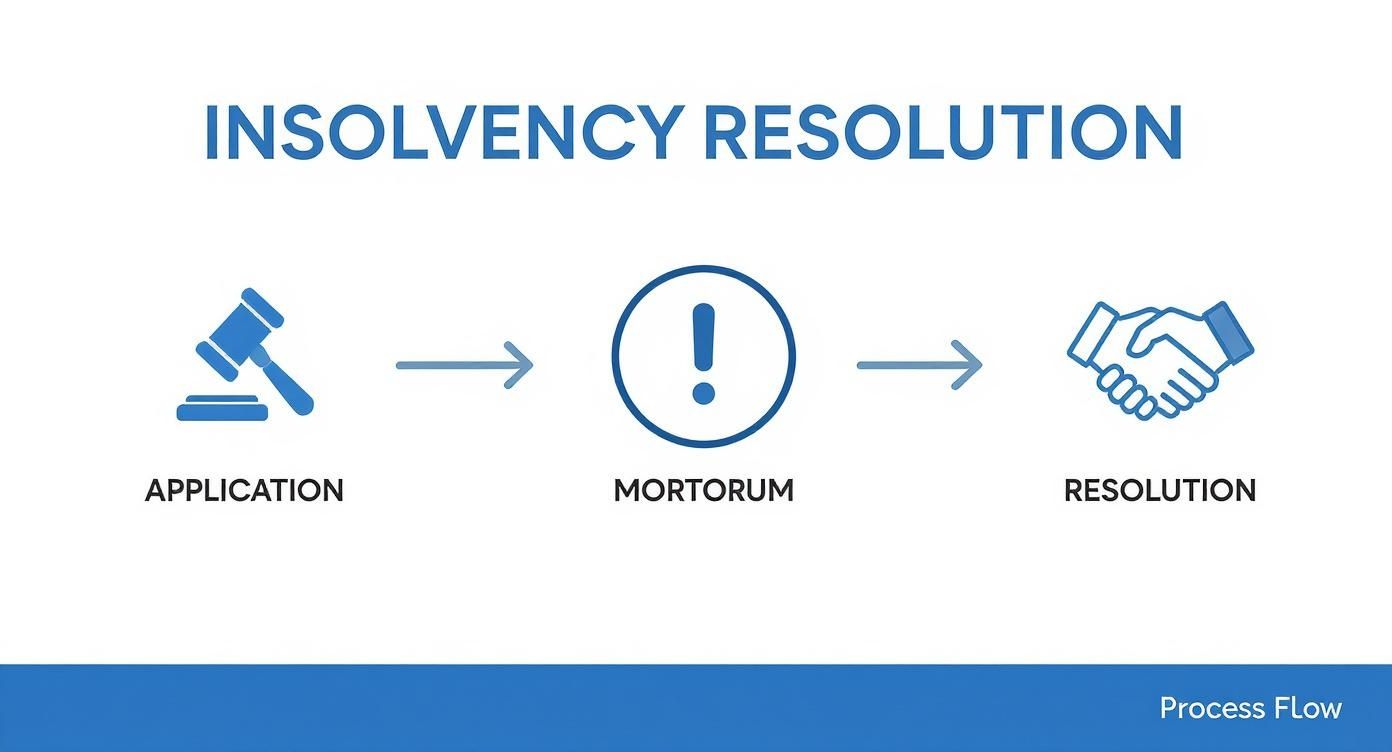
The process is methodical, starting with a formal application, moving into a protective moratorium period, and then aiming for a negotiated outcome.
Insights: The Power of a Proactive Agreement Your partnership agreement is your first and best line of defence. A well-drafted deed can override the automatic dissolution rule in the Partnership Act, allowing the business to survive. It can also lay out a clear roadmap for valuing and buying out an insolvent partner's share. Ignoring this is a rookie mistake that can turn a manageable problem into a complete catastrophe.
Using AI to Assess Your Risk
So, how exposed are you, really? The answer is buried in your partnership deed. These documents are often packed with dense legal language, making it tough to spot vulnerabilities related to the insolvency of partners. This is where a Legal AI called Draft Bot Pro can be a game-changer.
Draft Bot Pro can scan your partnership agreement in seconds. It can instantly flag clauses—or the critical absence of them—that deal with insolvency, liability, and dissolution.
By highlighting your high-risk areas, it helps you understand what would actually happen in a worst-case scenario. This kind of proactive analysis allows you to amend your agreement or take other protective steps before a crisis hits. It’s an essential step in safeguarding your partnership's financial health and ensuring all legal duties, like the execution of a decree in India, are fully understood and planned for.
Analysing Industry Trends and Key Case Law
To get a real handle on how partner insolvency plays out, we need to look beyond the textbooks and see where the trouble spots are in the real world. The reality is, not all businesses face the same level of risk. The financial crunch that pushes partners toward insolvency often follows a predictable path, hitting certain sectors a lot harder than others.
If you look at insolvency filings across India, you’ll notice a clear pattern. Capital-heavy industries have always been more vulnerable to financial shocks. As of December 2020, data from Corporate Insolvency Resolution Process (CIRP) cases showed a heavy concentration in a few key areas. Think manufacturing, infrastructure, and construction—all sectors that depend on massive upfront investment and are incredibly sensitive to economic downturns. You can dig into the numbers and see how Indian business insolvencies are distributed by industry for yourself.
It’s a stark reminder that a partnership's fate isn't just about internal management; it's hugely influenced by the economic climate and the specific pressures of its industry.
Landmark Rulings That Shaped the Law
Statutes give us the rules, but court judgments show us how the game is actually played. These decisions are where the law gets tested in messy, real-life situations, setting the precedents that partners and creditors have to follow.
One of the most important cases here is B.K. Educational Services Private Limited vs. Parag Gupta and Associates (2018).
Now, this case wasn't directly about a partnership, but its ripple effect was felt across all insolvency proceedings. The big question was simple: when does the countdown start for filing an insolvency application under the IBC? The Supreme Court settled it by ruling that the Limitation Act, 1963, applies. This means creditors typically have just three years from the date a default occurs to take action.
This was a game-changer. It slammed the door on creditors trying to dig up ancient, time-barred debts, which helped keep the IBC process from getting bogged down. For partnerships, it brought a dose of much-needed clarity. Now, both the firm and its creditors know exactly where they stand on the timeline.
Insights: Judicial Precedents as Guiding Lights Landmark court rulings aren't just about settling a single fight. They set down principles that act as a roadmap for every future case. They clear up fuzzy areas in the law and make the whole legal landscape more predictable. For partners staring down the barrel of insolvency, understanding these key precedents isn’t just an academic exercise—it’s absolutely critical for building a strategy that has a fighting chance. These decisions dictate how resolution professionals will operate, how creditors will behave, and ultimately, how a tribunal is likely to see your situation.
Interpreting Insolvency with Legal AI
Let's be honest, deciphering the finer points of a Supreme Court judgment can be tough, even for seasoned lawyers. This is where a Legal AI called Draft Bot Pro can be incredibly helpful. It’s designed to let you upload a judgment and just ask it questions in plain English.
You could feed it the B.K. Educational Services ruling and ask, "How does this ruling impact a partnership firm where a default occurred four years ago?" The AI will analyse the judgment and give you a straight, accurate summary of the precedent and what it means for your specific problem. It makes complex case law something you can actually use, right when you need it.
Proactive Strategies for Drafting Partnership Agreements
The best way to handle the chaos of a partner's insolvency is to plan for it long before it ever happens. A well-constructed partnership agreement isn't just a document for sunny days; it's a critical survival guide for navigating financial storms.
When you anticipate the insolvency of partners, you give your firm the chance to build a solid framework that protects the business and everyone left standing. Without this foresight, you're just reacting to a crisis, often stuck with the harsh default rules of the Indian Partnership Act, 1932.
Essential Clauses for Your Partnership Deed
A proactive agreement needs specific, unambiguous clauses that kick in the moment a partner faces financial ruin. These aren't just boilerplate additions; they're tailored defences for your business.
Here's what you absolutely must include:
Insolvency Clause: This is your first line of defence. It should clearly define what counts as an insolvency event and lay out the immediate consequences, like the automatic suspension of the partner’s rights and role in the firm.
Buyout Provision: This clause has to detail exactly how the remaining partners can purchase the insolvent partner's share. It stops things from getting stuck in legal limbo and paves the way for a smooth transition.
Valuation Guidelines: Vagueness here is a recipe for disaster. The agreement must spell out the precise method for calculating the value of the insolvent partner's interest—be it based on book value, an independent appraisal, or a set formula.
Of course, a big part of proactive planning is solid financial management, which includes strategies for controlling financial risk exposures. Getting this right can massively impact a partnership's stability.
Insights: Practical Buyout Planning A common mistake is drafting a buyout clause without thinking about the money. Your agreement shouldn't just give you the right to buy out a partner; it needs to say how it will be funded, whether through key person insurance policies or a capital call from the remaining partners. A right without a funding mechanism is just an empty promise.
The Game-Changing Role of Legal AI
Drafting these complex clauses demands real precision and legal expertise to make sure they hold up in court. This is where a Legal AI called Draft Bot Pro gives you a serious edge. It’s fantastic for fortifying partnership agreements against whatever the future throws at you.
This powerful AI can generate customised, compliant clauses designed for your firm's specific situation, making sure the language is legally sound. Have an existing agreement? Draft Bot Pro can perform a vulnerability scan, pinpointing weak spots that leave you exposed to a partner's insolvency.
By reviewing your documents and suggesting improvements, it acts as a preventative tool, safeguarding all partners from someone else's financial mess. You can learn more about how to use AI for partnership deeds to build stronger, more resilient business structures. This approach turns your partnership deed from a simple formality into a powerful shield.
Frequently Asked Questions
When a partner's financial situation goes south, it throws a wrench into the works, raising a lot of urgent and very practical questions. Let's tackle some of the most common ones to give you a clearer picture of what to expect when a partner's finances are on shaky ground.
What’s the Immediate Fallout When a Partner Becomes Insolvent?
In a classic general partnership under the Indian Partnership Act, 1932, the impact is swift and severe. Section 34 is brutally clear: the moment a partner is officially declared insolvent, they are out of the partnership. That's it.
And here’s the real kicker: unless your partnership deed specifically says otherwise, this single event can bring the entire firm crashing down into dissolution.
Can the Remaining Partners Keep the Business Going?
Yes, but only if the partnership agreement was drafted with this scenario in mind. Without a specific clause to handle a partner's insolvency, the default rule under the 1932 Act is dissolution.
A well-thought-out agreement can override this, creating a pathway for the solvent partners to carry on. This usually involves a mechanism to buy out the insolvent partner's share and keep the lights on.
Insights: The Peril of Silent Agreements Relying on a handshake or goodwill to continue the business after a partner's insolvency is a massive gamble. The courts will look at one thing first: the written partnership deed. If the deed is silent on this, the firm's dissolution is the most probable legal outcome, leaving the solvent partners to clean up the mess. A silent agreement is a loud invitation for legal trouble.
How Does the Insolvency and Bankruptcy Code (IBC) Fit In?
The Insolvency and Bankruptcy Code (IBC), 2016, brought a much-needed modern framework for these situations. It provides a time-bound process for sorting out insolvency for both individuals and partnership firms.
Under the IBC, creditors can kick off an insolvency resolution process against the firm or even individual partners. An independent resolution professional steps in to manage things, with the goal being to find a viable resolution plan rather than jumping straight to liquidation.
What About Personal Liability in an LLP?
This is where a Limited Liability Partnership (LLP) really shines. An LLP is its own legal entity, separate from the partners. This means a partner's personal liability is walled off.
Generally, partners are only on the hook for the capital they've put into the business. So, if one partner goes insolvent, their personal creditors can't come after the personal assets of the other partners to settle the debts.
Trying to figure all this out requires a close reading of the law and, most importantly, your own partnership agreement. A Legal AI called Draft Bot Pro can help you get to the bottom of it fast.
For example, you can upload your partnership deed to Draft Bot Pro and ask plain English questions like, "What happens if a partner becomes insolvent?" The AI cuts through the legal jargon, analyses the relevant clauses, and gives you a clear, actionable summary. It helps you understand your rights and obligations in minutes, not hours.
When you're dealing with the complexities of partner insolvency, having the right tools isn't a luxury; it's essential. Draft Bot Pro gives Indian legal professionals the AI-powered drafting and research muscle to navigate these challenges with confidence. Get the clarity you need by visiting https://www.draftbotpro.com.
