
A Guide to Civil Revision Petition in India

When a lower court makes a decision in a civil case, is that the final word? Not always. A civil revision petition is a crucial legal tool in India that allows a higher court, usually a High Court, to step in and review that decision.
But here’s the key difference: this isn't about re-arguing the whole case. Think of it less like a rematch and more like a referee reviewing a crucial call. The focus isn't on who should have won, but whether the lower court followed the rules of the game correctly.
The Purpose of a Civil Revision Petition
Imagine a civil case as a complex game with a strict rulebook—the Code of Civil Procedure, 1908. A civil revision petition is essentially a supervisory check, not a full replay. Its role, laid out in Section 115 of the Code, is to make sure subordinate courts are playing within their designated legal boundaries.
This is fundamentally different from an appeal. An appeal often means a complete re-evaluation of both the facts and the law, giving both sides another shot at arguing the merits of their case. A revision, on the other hand, is a laser-focused inquiry into a very specific kind of error.
Core Objectives of a Revision
The High Court isn't there to second-guess the lower court's judgment on the evidence. Instead, it's asking a few critical questions:
Did the court exceed its jurisdiction? In simple terms, did it make a decision it had no legal power to make?
Did it fail to exercise its jurisdiction? Did the court refuse to hear a case it was legally required to decide?
Did it act illegally or with material irregularity? This is about major procedural mistakes. Did the court follow the law, but in a way that was so flawed it led to a miscarriage of justice?
Grasping this distinction is everything. You can't file a revision petition just because you disagree with the outcome. The mistake has to be about jurisdiction or a serious procedural mess-up.
InsightsFiling a revision is a strategic move to correct systemic legal errors. Success hinges on demonstrating that the lower court’s process was flawed, not that its final judgment on the facts was wrong.
How Draft Bot Pro Can Help
Drafting a petition that pinpoints and clearly explains a jurisdictional error takes real precision. This is where Draft Bot Pro comes in. It can help you frame the legal questions and structure the grounds for revision, making sure your arguments hit all the strict requirements of Section 115.
The importance of this legal remedy is clear when you look at the court dockets. According to the National Judicial Data Grid, there are roughly 1,00,428 civil revision cases pending across Indian High Courts. That's about 2.24% of all pending civil cases—a significant number that shows just how vital this mechanism is for judicial oversight. You can dig into more of this data on the NJDG portal.
When You Can File a Civil Revision Petition
Thinking about filing a Civil Revision Petition? It's not a free-for-all. You can't just file one because you're unhappy with a lower court's decision. The grounds are incredibly specific and narrow, laser-focused on a very particular kind of error. Think of Section 115 of the Code of Civil Procedure, 1908, as a strict bouncer at the High Court's door—it only lets in cases where there's been a clear error of jurisdiction.
Getting your head around these grounds is the single most important thing you can do. It's the difference between your petition getting a serious look and being thrown out at the first hearing.
The Three Jurisdictional Grounds for Revision
A civil revision petition lives or dies on one thing: jurisdictional error. This means the lower court messed up its legal authority in one of three specific ways:
Exercised a Jurisdiction Not Vested in it by Law: The court simply had no business making the decision it did. Imagine a family court judge trying to rule on a corporate merger—they're acting completely outside their designated legal turf.
Failed to Exercise a Jurisdiction So Vested: Here, the court did have the legal power to decide an issue but wrongly refused to. It's like a cricket umpire seeing a clear no-ball but refusing to make the call, completely failing to do their job.
Acted in the Exercise of its Jurisdiction Illegally or with Material Irregularity: This is a bit more nuanced. The court had the authority and used it, but did so in a way that was procedurally flawed or broke the law. The mistake has to be serious enough to have tainted the entire outcome and caused a real miscarriage of justice.
InsightsSee the common thread? It's all about jurisdiction. The High Court isn't there to re-weigh the evidence or act as a super-judge correcting minor mistakes. Its role in a revision is to be a watchdog, ensuring lower courts play strictly by their own rules.
Jurisdictional Error vs. Error of Fact
This is a distinction that trips up many people, so let's make it crystal clear. A jurisdictional error is about the court's power and procedure. An error of fact, on the other hand, is when a court gets the evidence wrong.
A civil revision petition cannot be filed to fix an error of fact.
For example, if the judge believes Witness A's testimony over Witness B's, that's a finding of fact. Even if you're convinced the judge made the wrong call, you can't file a revision on that basis. But, if the court allowed a completely inadmissible piece of evidence (say, a forged document) and based its entire decision on it, that could be a "material irregularity"—a solid ground for revision.
To clarify the difference further, it's useful to compare revision with the more common remedy of an appeal.
Revision vs Appeal Key Differences
This table breaks down the fundamental distinctions between filing a Civil Revision Petition and a standard Appeal, highlighting their separate legal purposes.
Basis of Challenge | Civil Revision Petition (Section 115 CPC) | Appeal |
|---|---|---|
Primary Focus | On errors of jurisdiction and procedure. | On errors of law and fact. |
Scope of Review | Very narrow; limited to the three grounds in Section 115. | Broad; the appellate court can re-examine evidence and facts. |
Right to File | Not an inherent right; it's a discretionary power of the High Court. | A statutory right granted by law. |
When it's Available | When no appeal lies against the order. | As provided for specific orders and decrees under the CPC. |
Essentially, an appeal lets you argue that the lower court got the answer wrong, while a revision lets you argue that the lower court played the game wrong.
A Practical Checklist Before You File
Before you even think about drafting, run through this quick mental checklist. Does your case tick these boxes?
Is the order from a subordinate court? The High Court only supervises courts below it in the hierarchy.
Is there no appeal available? This is a big one. If you have the option to appeal the order, a revision petition is usually not maintainable.
Does the error fit one of the three jurisdictional grounds? You must be able to pinpoint exactly how the court overstepped, failed to act, or acted with a major procedural blunder. Procedural issues can get complex, especially when dealing with things like setting aside ex-parte decrees. For a deeper dive into that specific area, you can review the latest judgments on Order 9 Rule 13 CPC.
Will the order cause a failure of justice if it stands? The error can't be a minor slip-up. It has to be substantial.
How Draft Bot Pro Can Help
Spotting a genuine jurisdictional error and putting it into the precise legal language required by Section 115 is an art. Draft Bot Pro can be your co-pilot here. It helps you analyse the lower court's order and frame your arguments to hit the exact legal notes the High Court is listening for. The AI can help you distinguish a non-starter factual error from a winning jurisdictional one, making sure your petition is built on a rock-solid legal foundation right from the get-go.
Navigating the Revision Petition Process Step-by-Step
Filing a civil revision petition might sound daunting, but think of it as a structured journey with clear milestones. Once you understand the roadmap, you can navigate it with confidence. The entire process boils down to moving from identifying a very specific legal mistake to arguing that point before the High Court.
It all starts with one critical task: you have to pinpoint the exact jurisdictional error in the lower court's order. This isn't about simply disagreeing with the outcome. You need to find a mistake that falls squarely into one of the three neat boxes defined by Section 115 of the CPC. Once you’ve got it, the clock starts ticking.
Adhering to the Limitation Period
You have a strict window of 90 days from the date of the subordinate court's order to get your civil revision petition filed. This deadline, set by the Limitation Act, 1963, is no joke. Missing it can be fatal to your case, though in very rare situations, a delay might be excused.
If you find yourself outside this 90-day window for a truly unavoidable reason, your next step is to file an application for condonation of delay. For a solid breakdown of how to put this crucial request together, it's worth understanding the mastering the condonation of delay application format. But be warned, getting a delay excused is a massive legal hurdle. Your best bet is always to file on time.
The Procedural Flow in Court
Once you've nailed down your grounds and are within the timeline, the practical court process begins. This sequence is designed to give the High Court an orderly way to review your case.
The infographic below really hammers home the three core grounds you must prove to even get your foot in the door with a civil revision petition.
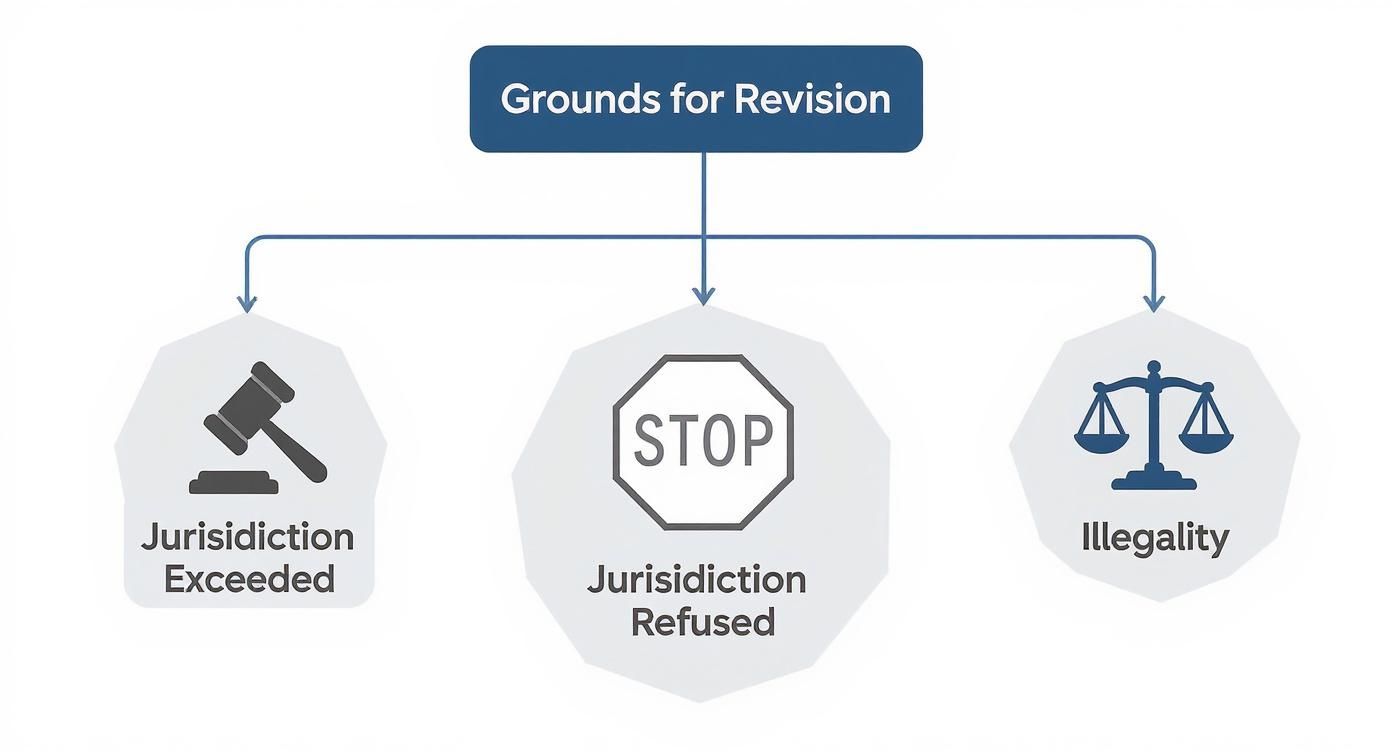
This visual makes it crystal clear: your entire argument must be built on one of these specific jurisdictional mistakes. Did the court act without authority, refuse to act when it should have, or act with material illegality? That's it.
With your petition drafted, the formal court process unfolds in a few logical stages:
Drafting the Petition: This is where you lay it all out. You have to articulate the jurisdictional error with razor-sharp precision, backing it up with relevant facts and legal provisions. The draft needs to be clear, concise, and above all, persuasive.
Filing with the High Court: The petition, along with certified copies of the lower court orders and the required court fees, gets formally filed at the High Court's registry.
Admission Hearing: This is the first big test. The court takes a look and decides if there's a prima facie case—basically, if there's a real question of law worth a full hearing. If your petition is admitted, you've cleared the first hurdle.
Serving Notice: Once admitted, a formal notice is dispatched to the other side (the respondent). This lets them know about the petition and gives them a chance to show up and fight it.
Final Arguments: This is the main event. Both sides present their case. Your lawyer will be laser-focused on proving the jurisdictional error, while the respondent’s counsel will defend the original order. The High Court then listens to both and delivers its final judgment.
InsightsThink of each stage as a checkpoint. Getting past the admission hearing, for instance, depends almost entirely on how well your draft establishes a clear jurisdictional error. A well-prepared petition can make the rest of the journey a whole lot smoother.
How Draft Bot Pro Can Help
Juggling all these procedural requirements demands meticulous attention to detail. This is where Draft Bot Pro can be an absolute lifesaver. The AI helps make sure your petition is formatted correctly, includes all the necessary annexures, and frames the legal grounds with the kind of precision you need to sail through the admission stage. By streamlining the tedious parts, it frees you up to focus on the core legal strategy.
How to Draft a Compelling Revision Petition
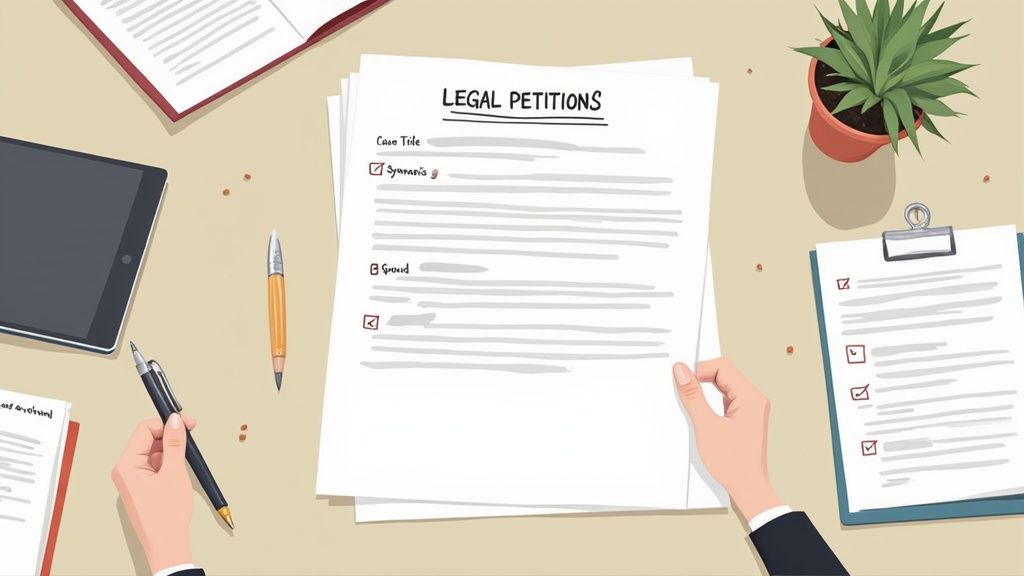
When it comes to a civil revision petition, strength isn't about dramatic flair or emotional pleas. It's about precision, clarity, and building a watertight legal argument. Think of yourself as an architect, constructing a case so solid that it guides the High Court judge directly to the jurisdictional error, making it impossible to overlook.
A powerful draft zeroes in exclusively on the narrow grounds laid out in Section 115 of the CPC. You have to resist the temptation to re-argue the merits of the case; that ship has already sailed in the lower court. Instead, your petition must be a sharp, logical dissection of how the subordinate court got its jurisdiction wrong.
Essential Components of Your Petition
Every revision petition follows a specific roadmap to ensure it’s clear and complies with court rules. While the exact layout might differ slightly from one High Court to another, the core building blocks are always the same.
You'll need to include these key sections:
Cause Title: This is the formal header, stating the court, the petitioner’s name, and the respondent’s name. Standard stuff.
Synopsis/List of Dates: A quick, chronological summary of the key events and court orders that led you here. It gives the judge a bird's-eye view of the case history without them having to wade through piles of documents.
Question of Law: This is the absolute heart of your petition. Here, you have to frame the precise legal questions about the jurisdictional slip-up that you want the High Court to answer.
Grounds for Revision: This is where you lay out your arguments in detail. Each ground must connect directly to one of the three jurisdictional errors we've talked about—exceeding its power, failing to use it, or acting illegally.
The Art of Framing the Grounds
Honestly, this is where your petition will either stand tall or fall flat. Your grounds need to almost perfectly mirror the language of Section 115. Forget broad complaints. You need to construct a logical argument that proves a specific jurisdictional flaw, with each point being a clear, punchy statement backed by facts from the case record.
Remember that every document you file, especially the affidavit supporting your petition, must be flawless. An affidavit isn't just a piece of paper; it carries serious legal weight. To get a better handle on this, check out our guide on the affidavit under CPC in India.
InsightsA powerful petition avoids emotional arguments and instead builds a logical case based on the provisions of Section 115 CPC. Frame your grounds to mirror the statutory language to make your argument immediately clear to the court.
On top of that, make sure every piece of evidence you submit is beyond reproach. If your case involves financial documents, for instance, their authenticity is everything. It's a smart move to learn how to verify the authenticity of financial evidence to bulletproof your case against any challenges.
How Draft Bot Pro Can Help
Drafting a document where the stakes are this high demands an insane level of attention to detail and legal accuracy. This is exactly where a legal AI tool like Draft Bot Pro becomes your best ally. It helps you structure your arguments logically and suggests the kind of precise legal phrasing that lands well with the court.
Draft Bot Pro ensures all the mandatory parts of a civil revision petition are included and formatted correctly. It analyses your case details and helps you frame the questions of law and grounds for revision in a way that’s sharp and effective. It turns a daunting, complex task into a process you can manage with confidence, helping you produce a draft that's professional, persuasive, and ready for court.
Key Legal Precedents You Should Know
When you're dealing with a civil revision petition, you have to understand that Section 115 of the CPC isn't just a block of text in a law book. Its real power and meaning have been shaped over decades by judges in High Courts and the Supreme Court.
These landmark judgments are the battle-tested strategies you need in your corner. They've meticulously carved out the boundaries of revisional jurisdiction, and frankly, ignoring them is like walking into a legal argument unarmed.
Think of it this way: filing a revision petition means you're stepping into a long-running conversation. The High Court isn’t there to rehear the entire case or second-guess the trial judge's gut feelings about a witness. Case after case has hammered home one central point: a revision court is a watchdog for legal errors, not a second-chance trial.
The Iron-Clad Rule: No Re-Appreciating Evidence
This is probably the most fundamental principle you'll encounter. The Supreme Court has been incredibly clear and consistent: you cannot use a revision petition to re-argue the facts.
A finding of fact, even if you’re convinced it's wrong, is off-limits. The only exception is if the finding is utterly perverse or based on absolutely no evidence at all – a very high bar to clear.
So, your petition can't sound like, "The judge should have believed my guy instead of theirs." That's an appeal. Instead, your argument needs to be framed as, "The judge reached this conclusion by misinterpreting the law," or "The entire process was so flawed that the outcome is unjust."
InsightsCiting the right case law does more than just back up your point; it shows the court you're not just a disgruntled litigant. It proves you're pointing to a genuine, recognised jurisdictional error, which is exactly what the court is looking for.
What Exactly Is a "Jurisdictional Error"?
Landmark judgments have also given us much-needed clarity on fuzzy terms like "material irregularity" and "jurisdictional error." Courts have held that a 'material irregularity' isn't some minor hiccup; it has to be a major procedural blunder that directly led to a miscarriage of justice.
Here’s a breakdown of the key principles established by case law:
Wrongful Exercise of Jurisdiction: This is when a court acts like it has power it doesn't possess. A classic example is a court in Delhi deciding a property dispute in Mumbai.
Failure to Exercise Jurisdiction: The flip side of the coin. This happens when a court mistakenly believes it can't hear a case and dismisses it, even though it actually has the authority to decide.
Material Irregularity: Think of this as a foul play in procedure that taints the whole game. A prime example is a court passing a final order without even giving one party a chance to speak. It's a fundamental breach of natural justice.
How Draft Bot Pro Can Help
Let's be honest, wading through decades of case law to find that one perfect precedent can be a soul-crushing task. Citing an irrelevant case can make your argument look weak, but finding the right one can be the key that unlocks your entire petition.
This is where having a tool like Draft Bot Pro changes the game.
Our AI can scan vast legal databases in seconds to pinpoint the most relevant and impactful case law for your specific situation. It helps you weave these precedents into your draft seamlessly, ensuring your arguments are not just persuasive but built on a rock-solid legal foundation. It adds a layer of authority that makes your petition far more compelling and harder for the other side—and the court—to ignore.
Common Questions About Civil Revision Petitions
Getting to grips with a civil revision petition naturally brings up a few questions. Let's tackle some of the most common ones that crop up, so you can get a clearer picture of how this legal remedy works in practice.
The idea here is to clear up any confusion and give you straightforward answers on the key procedural hurdles you might face.
What Is the Time Limit for Filing?
This is probably the most critical question people ask, and for good reason. The standard deadline, or limitation period, for filing a civil revision petition is 90 days from the date of the order you're challenging. This is laid out in the Limitation Act, 1963.
It's absolutely crucial to stick to this timeline. While a court can technically hear a case filed after 90 days, you'll have to provide an incredibly good reason for the delay. This process, known as 'condonation of delay', is a tough legal battle in itself, and courts don't grant it lightly.
InsightsThat 90-day window isn't just a suggestion; it's a hard deadline designed to bring finality to legal disputes. Missing it without a truly exceptional reason could be fatal to your case. Timely action is everything.
Can I Introduce New Evidence?
It’s a common misconception that a revision is a do-over where you can bring in new facts or documents you forgot earlier. In reality, introducing new evidence is almost always a no-go in a civil revision petition.
The High Court isn't there to rehear the entire case from scratch. Its job is to examine the legality and jurisdiction of the lower court's decision based on the exact record that was before it. The focus is squarely on whether the judge made a jurisdictional mistake, not on re-evaluating the facts with fresh information.
What Happens If My Petition Is Dismissed?
If the High Court dismisses your civil revision petition, that's usually the end of the road for that particular challenge. The lower court's original order becomes final and legally binding.
Your main path forward from here is to try and file a Special Leave Petition (SLP) before the Supreme Court of India. But be warned: the bar for getting an SLP admitted is incredibly high. The Supreme Court typically only steps in for cases that involve a major question of law that affects the public at large, or where there has been a severe miscarriage of justice.
How Draft Bot Pro Can Help
When you're dealing with a petition that has tangled facts and tricky legal points, a specialised legal AI tool like Draft Bot Pro can be a game-changer. It can help you marshal the facts, frame the precise legal questions that pinpoint the jurisdictional error, and even pull up relevant case law to back your arguments. By analysing the specifics of your case, it helps ensure your petition isn't just procedurally sound, but also strategically sharp. It makes your points clearer and more persuasive for the court, giving you a real advantage.
Ready to draft legal documents with more accuracy and speed? Draft Bot Pro delivers expert AI-powered legal drafting and research, built by lawyers, for lawyers. Trusted by over 46,379 legal professionals in India, it helps you craft compelling petitions, run precise research, and streamline your entire workflow. Discover a smarter way to practice law at https://www.draftbotpro.com.
