
Your Ultimate Guide to Section 406 IPC

Section 406 of the Indian Penal Code (IPC) lays down the punishment for criminal breach of trust. At its heart, this law deals with situations where someone dishonestly misuses property that was entrusted to them. It’s a powerful section that criminalises the betrayal of a trust-based relationship for personal gain, making it a critical tool in many commercial and personal disputes.
Decoding Criminal Breach of Trust Under Section 406

Think about this: you hand over your expensive watch to a jeweller for a simple repair. A week later, you find out he sold it and pocketed the cash. This isn't just a case of bad service or a civil tiff. This is where the law steps in, specifically under Section 406 IPC. This provision is designed for scenarios exactly like this, where trust—the very foundation of countless daily transactions—is deliberately broken for dishonest profit.
This guide will break down this frequently used law in a practical way, moving beyond the dense legal text. Section 406 is a common battleground, from business partnerships imploding to messy family property fights. It often walks a fine line between a genuine criminal offence and a civil claim for recovery, and knowing the difference is key.
The Three Pillars of the Offence
To truly get a grip on Section 406, you need to understand its three core components. Any case built on this section stands or falls on these pillars.
Entrustment: This is the starting point. The property in question must have been willingly given to the accused for a specific purpose. This act creates a relationship of trust, a fiduciary duty.
Misappropriation: The accused must have then dishonestly used, sold, or otherwise disposed of that property for their own benefit, going directly against the terms of the trust.
Dishonest Intention: This is the mental element, the mens rea. The act of misappropriation must be driven by a clear dishonest intent to cause a wrongful gain for themselves or a wrongful loss to the rightful owner.
These three elements are the bedrock of any Section 406 prosecution. If you can't prove all three, the case simply won't hold up. This is a crucial distinction, as the courts often see civil disputes being wrongly forced into a criminal mould—a practice they strongly discourage.
Insights Getting the ingredients of Section 406 right from the very beginning is absolutely critical. I've seen countless cases fall apart because the initial complaint was poorly drafted or failed to establish one of these core pillars. A single mistake in framing the case can be fatal. This is where Legal AI like Draft Bot Pro can help by assisting in drafting complaints that precisely address each legal pillar.
A Modern Edge in Case Preparation
The initial stages—drafting the complaint, gathering precedents—are where you set the trajectory for the entire case. This is where specialised Legal AI tools like Draft Bot Pro can give you a serious advantage.
Imagine uploading your client's narrative and instructing the AI to instantly pull up relevant and verifiable case law on "entrustment" or "dishonest intent." It's a game-changer.
Beyond research, it can generate solid first drafts of complaints or legal notices. By analysing the facts you provide, Draft Bot Pro ensures all the essential ingredients of Section 406 IPC are clearly laid out, helping you build a water-tight case right from the get-go. It’s about combining sharp legal expertise with smart, efficient technology.
The Essential Ingredients of a Section 406 Offence
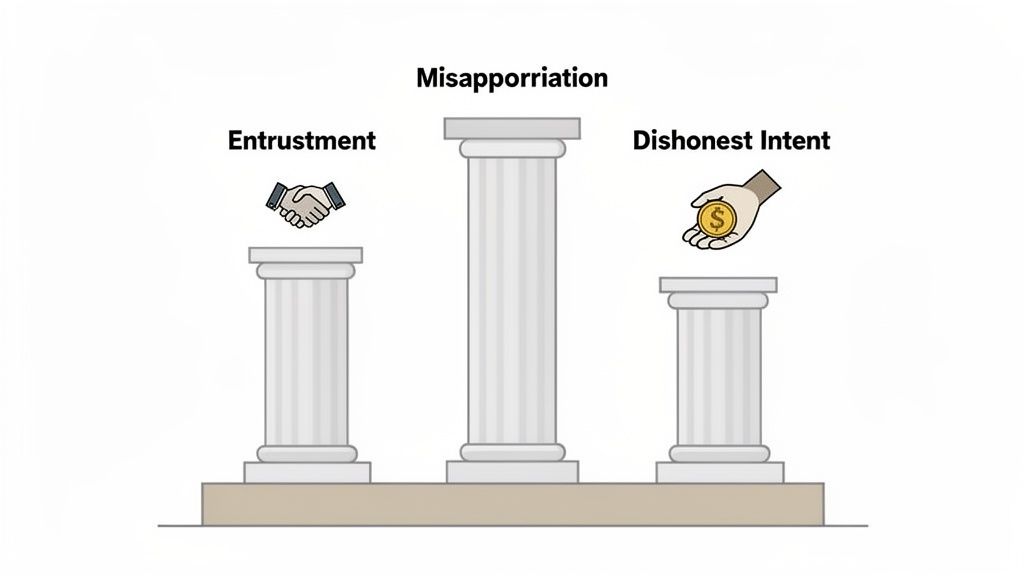
To make a charge of criminal breach of trust stick under Section 406 IPC, you need to prove a very specific set of legal ingredients. Think of it like a recipe—miss one element, and the whole case falls apart. It’s far more nuanced than just pointing to a financial loss and crying foul.
Let's break down each component, moving from dense legal theory to scenarios you’d actually encounter. We'll follow a partnership dispute to see how these concepts work in the real world.
Ingredient 1: Entrustment and Dominion Over Property
The first, and arguably most crucial, ingredient is entrustment. This isn't just handing something over. It’s a specific act where one person voluntarily gives property, or control over it, to someone else with the explicit trust that they will manage it in a certain way.
Imagine two partners, Rohan and Priya, launching a tech startup. Rohan is put in charge of the finances and given sole control over the company bank account, which holds funds from both of them. This isn't a gift or a loan to Rohan; Priya has entrusted him with dominion over that money for one reason only: to run the business.
This is worlds away from a simple sale. When you sell your car, the ownership is gone for good. But with entrustment, the original owner keeps their rights to the property. The person holding it is just a custodian for a specific purpose.
Ingredient 2: Dishonest Misappropriation or Conversion
Next up is the act that shatters the trust: dishonest misappropriation or conversion. This is the moment the accused decides to treat the property like it's their own.
Misappropriation: Using the property for a purpose completely different from what was agreed upon.
Conversion: Wrongfully getting rid of the property and cutting off the real owner's access to it.
Back to our partners. Rohan dips into the company account and takes ₹5 lakhs for a lavish personal holiday. He didn’t exactly "steal" it in the classic sense; he already had legal access to the funds. But he dishonestly misappropriated that money for his own benefit, directly violating the trust Priya placed in him.
This can’t be a vague accusation. It has to be a specific, identifiable action. We're not talking about bad business decisions here; we're talking about a deliberate act of using someone else's property for personal gain.
Ingredient 3: The Presence of Dishonest Intention (Mens Rea)
Finally, the prosecution has to prove dishonest intention, the legal term being mens rea. This is all about the accused's state of mind. The act of misappropriation must have been driven by a dishonest motive.
What often separates a criminal case from a simple civil dispute is the timing of this intention. For a Section 406 IPC offence, the dishonest thought doesn't need to exist from day one. Rohan might have had the best of intentions when he and Priya started the company.
The crime happens the moment he develops that dishonest intent and decides to use company money for his personal trip. It's this subsequent dishonesty that turns a business relationship into a criminal matter. It’s the conscious decision to betray a trust that was already in place.
Insights Drawing the line between a civil liability (like a simple debt) and criminal entrustment is a massive challenge in practice. Tools like Draft Bot Pro can help sharpen your strategy by analysing case files. You can upload documents like partnership deeds or bank statements, and its AI can help flag evidence that points specifically to entrustment, making your legal arguments more precise right from the start.
The courts are rightly cautious about this element. A conviction under Section 406 IPC can lead to imprisonment for up to 3 years, a fine, or both, so the burden of proof is high. The judiciary has repeatedly stressed that 'entrustment' is the foundation; without it, the case has no legs. In a recent landmark ruling, the Supreme Court quashed Section 406 charges precisely because the transaction was a simple sale, meaning ownership was fully transferred and there was no entrustment left to breach. You can dig deeper into this distinction on Cyril Amarchand Mangaldas's blog.
In short, a solid Section 406 IPC prosecution needs to show a clear chain of events: lawful entrustment of property, followed by a deliberate act of misappropriation, all driven by a dishonest intention that bloomed after the trust was established. Getting these ingredients right is everything.
Punishment and Aggravated Forms of the Offence
It’s one thing to understand the ingredients of criminal breach of trust, but it's another thing entirely to grasp the real-world consequences. The Indian Penal Code doesn't just define the crime; it lays out an escalating scale of punishments. The law is smart about this—it recognises that not all betrayals of trust carry the same weight. A breach committed by someone in a position of immense responsibility is, quite rightly, treated far more seriously.
The starting point is Section 406 IPC itself. For a straightforward, "vanilla" case of criminal breach of trust, the punishment can be imprisonment for up to three years, a fine, or both. This is the foundation, covering situations where the accused doesn’t fall into a specific professional role. But what happens when the person entrusted with the property holds a special position, like an employee or a public official?
This is where the law gets tougher, introducing aggravated forms of the offence. The logic is simple: a greater degree of trust, when broken, warrants a much stiffer penalty.
When the Offender Is a Clerk or Servant
Picture a company accountant who is trusted with managing the payroll but decides to siphon off funds for a personal shopping spree. This isn't just a simple breach; it's a betrayal by someone whose entire job is built on a foundation of trust and good faith.
For these exact scenarios, Section 408 IPC kicks in. It specifically targets criminal breach of trust by a clerk or a servant. Because of that special, employment-based relationship, the punishment is significantly harsher. An offence under Section 408 can land the offender in prison for a term that may extend to seven years, plus a fine. For a deeper dive, you can check out our complete legal guide to Section 408 IPC.
The Highest Level of Betrayal by Public Servants and Professionals
The law reserves its most severe penalties for those at the very top of the trust pyramid. We're talking about public servants, bankers, merchants, brokers, attorneys, or agents. When these professionals betray the immense trust placed in them, the damage isn't just personal—it can shake entire systems.
Section 409 IPC was drafted to deal with this grave form of the offence. The punishment reflects just how serious this violation is: imprisonment for life or imprisonment for a term that may stretch to ten years, along with a fine. The rationale is crystal clear. A banker misusing client funds or a public servant embezzling taxpayer money doesn't just steal money; they erode public confidence, causing harm that ripples outwards.
Insights When you're arguing for bail or trying to mitigate a sentence in a section 406 ipc case, historical data is your best friend. Experienced lawyers use tools like Draft Bot Pro to instantly pull up sentencing precedents and conviction stats for similar cases under Sections 406, 408, and 409. This allows them to build data-backed arguments, showing the court what a typical outcome looks like and strengthening their client's position with hard facts.
Section 406 IPC vs Aggravated Offences A Comparison
To really nail down the differences, it helps to see these sections side-by-side. The distinction boils down to the relationship between the accused and the person whose trust was broken.
Provision | Offender | Maximum Imprisonment | Key Element |
|---|---|---|---|
Section 406 IPC | Any person | Up to 3 years | General entrustment of property |
Section 408 IPC | Clerk or servant | Up to 7 years | Entrustment due to employment |
Section 409 IPC | Public servant, banker, agent, etc. | Life or up to 10 years | Entrustment due to professional or official capacity |
This progressive jump in punishment makes perfect legal sense. The law isn't just punishing the act of taking property; it's penalising the violation of a specific, heightened duty of care.
Despite these clear penalties, getting a conviction is another story. The National Crime Records Bureau (NCRB) data shows a conviction rate of just 28.4% for these cases. This figure is a stark reminder of the significant evidentiary hurdles prosecutors have to clear to prove their case beyond a reasonable doubt.
Distinguishing Section 406 From Similar Offences
One of the trickiest parts of practice is correctly pinning down a section 406 IPC offence when it looks so much like other financial crimes. The lines can feel blurry, but in the eyes of the law, they are sharp and absolutely critical. Pleading the wrong section isn't a minor slip-up; it can be a fatal flaw that gets your entire complaint thrown out.
So, what's the secret? It all comes down to the accused's state of mind—the mens rea—and, most importantly, when their dishonest intent kicked in. This mental element is the key that unlocks the correct charge.
Section 406 vs Section 420 Cheating
The most common mix-up is between criminal breach of trust (Section 406) and cheating (Section 420). Both involve someone being deceived and losing out financially, but the real difference is the timing of the fraud.
Think of it like this: in a classic cheating case under Section 420, the dishonest intention is there from the very beginning. The whole setup is a lie designed to trick the victim into handing over their property. The transaction is built on a foundation of fraud from the first word spoken.
In contrast, a section 406 IPC offence starts with a perfectly legal and honest transaction. The property is willingly and lawfully entrusted to the accused. The crime only happens after this act of trust, when the accused develops a dishonest mind and decides to misuse the property they were meant to protect.
Let's break it down with an example:
Cheating (Section 420): A seller knowingly advertises a cheap replica as a genuine antique watch. A buyer, believing the lie, pays a high price. The deception was present from the start.
Breach of Trust (Section 406): A watch owner gives their genuine antique timepiece to a jeweller for safekeeping. The jeweller initially accepts it with honest intentions, but a week later, sees an opportunity, sells the watch, and pockets the cash. The dishonesty began after he was entrusted with the property.
The Clear Line Between Trust and Theft
Another crucial distinction is between breach of trust and theft (Section 378 IPC). Here, the deciding factor is one simple word: consent.
With criminal breach of trust, the owner voluntarily hands over the property. There's a clear, consensual act of entrustment. The crime is the subsequent betrayal of that trust.
With theft, there is zero consent. The property is taken from the owner’s possession without their permission, with the plan to keep it for good. The initial act of taking is itself illegal.
This flowchart helps visualise how the offender's role impacts which section applies and how seriously the law treats the offence.
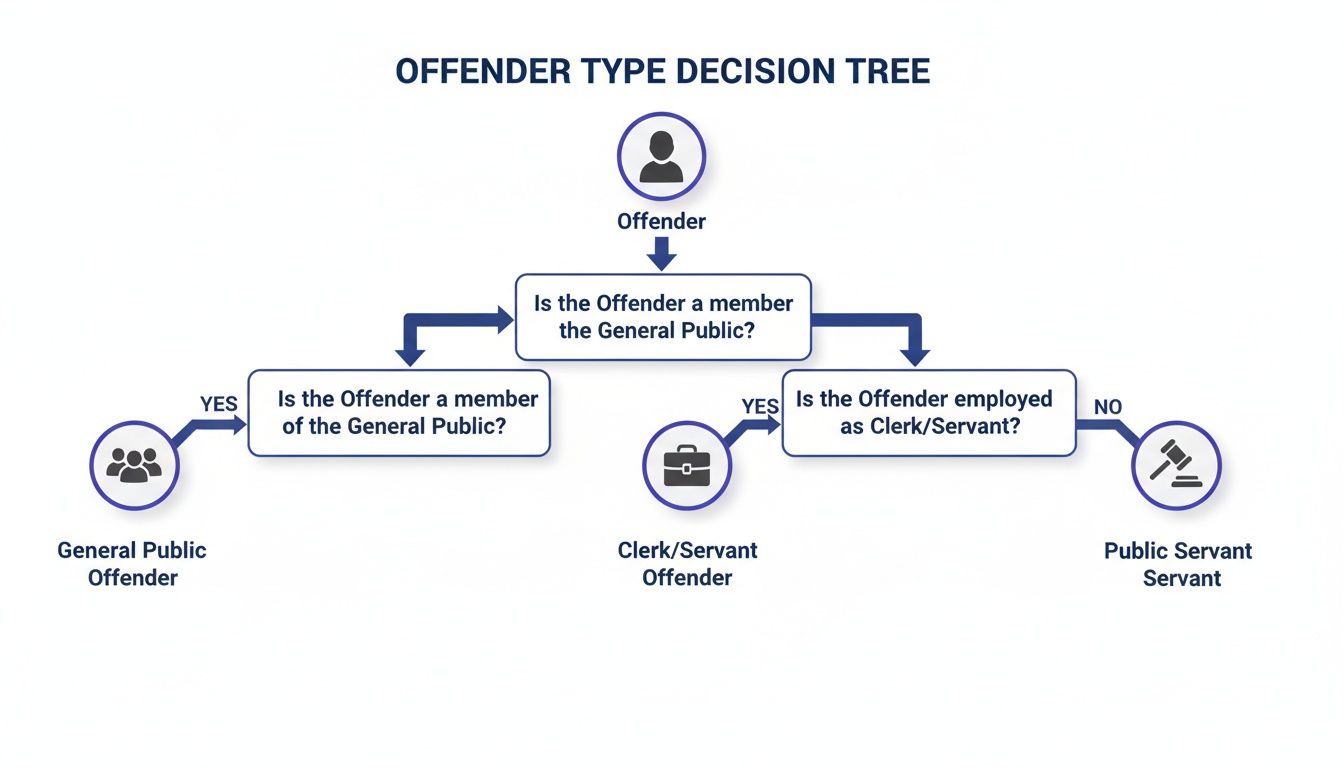
As you can see, the penalties escalate dramatically based on whether the offender is a regular citizen, an employee, or a public servant—someone who should be held to an even higher standard of trust.
Insights Misidentifying an offence is a common but preventable error. This is where a diagnostic tool like Draft Bot Pro becomes invaluable. Lawyers can upload a draft complaint or case summary and instruct the AI to analyse the alleged facts. It can highlight whether the narrative points more strongly towards an initial deception (cheating) or a subsequent betrayal of trust (Section 406), preventing a flawed legal strategy from the very beginning.
Civil Disputes in Criminal Clothing
Courts are getting tired of seeing purely civil disputes dressed up as criminal cases under section 406 IPC. And they've said so, repeatedly. A simple breach of contract—like failing to pay a debt on time—isn't automatically a criminal breach of trust.
For the case to have criminal legs, you must be able to prove a dishonest intention to misappropriate the property that was entrusted. Without that crucial element, the matter belongs in civil court, best handled through a recovery suit, not a criminal FIR. To understand a closely related offence, check out our guide on criminal misappropriation of property in our detailed guide.
Practical Guidance on Drafting Complaints and Defences
When a case under Section 406 IPC lands on your desk, your success often boils down to the quality of your drafting. It doesn't matter if you're filing the complaint or building the defence—a meticulously crafted document sets the stage for the entire legal battle. A weak one, on the other hand, can cripple your case from the get-go.
Moving from legal theory to the courtroom requires absolute precision. Every single word in that complaint, FIR, or bail application must be chosen to fortify your argument, leaving zero room for ambiguity.
Crafting a Strong Complaint for the Complainant
When you're drafting an FIR or a complaint for Section 406 IPC, your one and only job is to lay out the three core ingredients of the offence, clearly and without question. Vague accusations are useless here. You need to build your narrative on a foundation of specific, verifiable facts.
A winning complaint must detail the entire sequence of events, leaving no gaps. Kick things off by describing the act of entrustment—what property was handed over, who received it, and for what specific purpose?
To make your complaint bulletproof, make sure you cover these bases:
Detailed Entrustment: Get specific. State the exact date, time, and circumstances of the entrustment. Describe the property in detail and outline the terms of the trust, whether they were written down or agreed upon verbally.
Specific Misappropriation: Don't just say the accused "misused the funds." That's too generic. Instead, state something like, "he withdrew ₹50,000 on [Date] and used it to purchase a personal vehicle, contrary to the agreed purpose." Pinpoint the exact dishonest act.
Evidence of Dishonest Intent: You need to plead facts that point to a guilty mind (mens rea). This could be the accused's flat-out refusal to return the property despite repeated demands, evasive answers, or proof they used the property for personal gain when they were explicitly told not to.
Chronology of Events: Lay out a clear timeline. What happened, and when? Include dates you demanded the property back and detail the accused's responses (or lack thereof).
For instance, a clause might read: "That on 15th January 2024, the Complainant entrusted his gold chain, weighing approximately 50 grams, to the Accused for safekeeping while the Complainant travelled abroad. Despite the Complainant's return on 1st March 2024 and repeated written demands thereafter, the Accused has failed to return the said gold chain and has stopped responding to all communications, clearly indicating his dishonest intention to misappropriate the property for his own wrongful gain."
Building an Effective Defence Strategy
If you're on the defence side, your mission is to dismantle the prosecution's case by finding and exploiting its weakest links. A solid defence strategy almost always centres on proving that at least one of the essential ingredients of Section 406 IPC is missing.
Here are some of the most common—and effective—lines of defence:
Absence of Entrustment: Your first angle should be to argue that there was no "trust" to begin with. Was it a sale? A loan? A gift? If legal ownership of the property was transferred to the accused, the entire foundation of entrustment crumbles.
No Dishonest Intent: Show that the failure to return the property wasn't born from dishonesty. Perhaps there was a genuine business dispute, a misunderstanding of the terms, or an unforeseen inability to fulfil a contract. The goal is to prove the absence of a criminal mens rea.
Dispute is Civil in Nature: This is a powerful argument. You contend that the entire issue is a civil matter—like a simple breach of contract or an unpaid debt—that the complainant is trying to twist into a criminal case to apply pressure. Courts are increasingly cautious about this misuse of criminal law and are known to quash proceedings where no real criminal intent is visible. To better grasp these distinctions, you might find our guide on Section 417 for cheating laws helpful.
A bail application, for example, could argue: "The present dispute is purely of a civil nature, arising from a business transaction between the Applicant and the Complainant. The allegations do not disclose any element of dishonest intention, and the criminal proceedings are a clear abuse of process, initiated solely to pressure the Applicant into a financial settlement."
Insights Drafting these crucial documents is time-consuming and demands immense precision. This is where a Legal AI tool like Draft Bot Pro can be a game-changer. By feeding it a simple case summary, lawyers can generate a solid first draft of a complaint, legal notice, or bail application in minutes. The AI ensures all the key legal arguments and elements required under Section 406 IPC are included, speeding up the drafting process so you can focus on overall case strategy.
For legal practitioners looking to showcase their expertise in complex areas like this, investing in professional website design for lawyers is a smart move. A well-crafted online presence can attract the very clients who need your skilled guidance in these intricate matters.
Looking Down the Road: The Future of Prosecuting Financial Crimes in India
At its heart, a Section 406 IPC case boils down to three core pillars: entrustment, misappropriation, and a dishonest intent that follows. This is what sets it apart from cheating, where the deceit is there from the very beginning. As we've seen, the law rightly takes a dimmer view of trust being broken by professionals—people who should know better—reflecting the higher duty they owe.
But the ground is shifting beneath our feet. The judiciary is becoming increasingly wary of criminal law being used as a sledgehammer to crack what are essentially civil or contractual nuts. This trend means that as lawyers, our work needs to be surgically precise. At the same time, financial crimes are getting smarter, weaving complex digital webs that are hard to untangle. As these offences evolve, a solid grasp of cybersecurity in accounting is no longer just an IT issue; it's a fundamental part of a professional's fiduciary duty, and critical to preventing the very breaches that can lead to a Section 406 allegation.
Embracing the Future with Legal AI
As we look ahead, the principles of criminal breach of trust are set to transition into the new Bharatiya Nyaya Sanhita (BNS). This change makes a meticulous, detail-oriented practice more important than ever. Technology isn't just a nice-to-have anymore; it's a core part of staying competitive and delivering justice effectively.
Insights This is where legal AI platforms like Draft Bot Pro are becoming central to the modern lawyer's toolkit. By handling the heavy lifting of initial research and drafting, these tools free us up to focus on what really matters: high-level strategy and powerful client advocacy. It's this blend of seasoned human expertise and smart AI efficiency that will define success in the ever-changing field of financial crime prosecution.
Answering Your Burning Questions About Section 406 IPC
When you're dealing with a potential criminal breach of trust case, a lot of practical questions pop up. Whether you're a lawyer, a law student, or someone caught in the middle of a dispute, clarity is key. Let's tackle some of the most common queries that come across my desk about Section 406 IPC.
Can One Business Partner Slap a 406 Case on Another?
You bet they can. In fact, it happens all the time. Imagine one partner is given control of the company's bank account to pay suppliers. Instead, they siphon off funds to buy a personal car. That's a textbook example of a potential Section 406 IPC case.
The entire case hinges on proving that the funds were specifically entrusted for business use and then dishonestly used for something else. It's not just about a simple debt between partners; it's about the violation of that trust.
Do I Absolutely Have to Send a Legal Notice Before Filing an FIR?
Strictly speaking, no, it's not a legal roadblock to filing an FIR. But should you do it? Almost always, yes.
Think of a legal notice as the first crucial piece of evidence you're creating. It officially documents your demand for the property's return and, more importantly, the other person's failure to comply. This makes it much easier to argue they had a "dishonest intent" when you're standing before the police or a magistrate.
Insights Nailing the legal notice is half the battle. This is where tools built for lawyers, like Draft Bot Pro, can be a game-changer. It helps you draft a precise, fact-driven notice in minutes. By feeding it your case summary, it ensures you cover all your bases, building a solid foundation for your case before you've even filed anything.
What's the Clock Ticking on a Section 406 Complaint?
You have a three-year window to file a complaint under Section 406 IPC. The countdown starts from the day the offence took place. This time limit is laid out in Section 468 of the Code of Criminal Procedure (CrPC), which ties the limitation period to the maximum possible punishment for the offence—in this case, three years.
Can a Single Issue Be Both a Civil and a Criminal Case?
Absolutely. This is a concept that often trips people up, but it's fundamental. A single act of misappropriation can trigger two separate legal tracks.
The person wronged can file a civil suit to get their money or property back. At the same time, they can file a criminal complaint under Section 406 IPC to have the wrongdoer punished for the crime itself. The civil case is about recovery; the criminal case is about punishment. They aren't mutually exclusive and can proceed side-by-side.
For instance, if a senior manager embezzles company funds, the company can sue them in civil court for the stolen amount and also get an FIR registered for criminal breach of trust. One path seeks to make the company whole, the other seeks to hold the manager accountable to society for their crime.
Ready to streamline your legal drafting and research? Draft Bot Pro is the most verifiable and affordable Legal AI, built by lawyers, for lawyers. Generate precise legal documents, conduct accurate research with verifiable sources, and enhance your productivity instantly. Join over 46,000 legal professionals and try Draft Bot Pro today!
