
The Vishaka v State of Rajasthan Case And Its Lasting Impact
- Rare Labs
- Dec 7, 2025
- 18 min read

The landmark case of Vishaka v State of Rajasthan wasn't just a legal proceeding; it was the birth of India's first real framework for tackling sexual harassment at work. It all started with the horrific gang-rape of Bhanwari Devi, a social worker, and the complete collapse of the justice system that followed. This failure forced the Supreme Court's hand, leading it to create binding guidelines that stood as law until the POSH Act finally arrived in 2013.
The Case That Redefined Workplace Safety in India

It’s hard to imagine now, but before 1997, the idea of "workplace safety" for women in India was a dangerously grey area. The Constitution guaranteed fundamental rights, sure, but there was no specific law to call upon when it came to sexual harassment. This left countless women with absolutely no formal way to seek justice.
A workplace, which should be a place of growth and opportunity, could instead become a source of fear. Many were forced into an impossible choice: their career or their dignity. This massive legal void was thrust into the national spotlight by one horrifying incident, sparked by the courage of a social worker in rural Rajasthan named Bhanwari Devi.
A Catalyst for Change
The story of Vishaka v State of Rajasthan begins with a brutal act of retaliation in 1992. Bhanwari Devi was gang-raped by upper-caste men, a "punishment" for her work trying to stop a child marriage. What followed was a masterclass in systemic failure. She tried to get justice, but every door was slammed in her face.
The local police, buckling under political pressure, refused to even register a First Information Report (FIR). Medical reports were manipulated to downplay the assault. Unsurprisingly, the trial court acquitted all the accused, exposing a justice system completely incapable of protecting its own people.
This shocking outcome galvanised women's rights groups across the country. Led by the NGO Vishaka, they filed a Public Interest Litigation (PIL) in the Supreme Court. Bhanwari Devi's personal tragedy was about to become a national movement. You can find a deep dive into the case's constitutional angles on Jus Scriptum.
This PIL wasn't just about one woman's fight. It was about the fundamental right of every working woman to feel safe. The petitioners argued that the absence of a law was a direct violation of several constitutional guarantees.
Insights: The Vishaka judgment was a masterstroke in legal interpretation. With no domestic law to rely on, the Supreme Court cleverly leaned on the Convention on the Elimination of All Forms of Discrimination Against Women (CEDAW), an international treaty India had signed. This allowed the Court to fill the legislative vacuum and create guidelines that were legally binding.
The case forced everyone to ask some hard questions:
What exactly is a "workplace"?
Who is ultimately responsible for keeping it safe?
How can we deliver justice when the lawbooks are silent?
The Supreme Court’s answer would change Indian labour law forever. The judgment wasn't a temporary patch; it was a detailed blueprint for corporate and institutional responsibility, effectively creating law where a massive gap had existed for decades.
How Legal AI Can Provide Clarity
Getting to grips with the origins and details of a case like this is vital for any legal professional or organisation today. This is where a Legal AI called Draft Bot Pro can be a game-changer. Using its expert legal research feature, lawyers and HR managers can instantly pull up summaries and analyses of the Vishaka v State of Rajasthan judgment and all the important cases that followed. This isn't just about speed; it's about understanding the legal principles that became the bedrock of the POSH Act. It ensures that the policies you draft aren't just ticking a compliance box, but are genuinely informed by the historical and legal context of the law.
Understanding the Landmark Vishaka Guidelines
When the Vishaka v State of Rajasthan case sparked national outrage, it exposed a gaping hole in our legal fabric. Working women in India had constitutional promises of equality and dignity, but with no specific law against workplace sexual harassment, those promises felt empty. The Supreme Court of India stepped into this legislative void, and the result was a powerful set of binding directives that would act as the law of the land: the Vishaka Guidelines.
These weren't just gentle suggestions; they were a mandatory blueprint for creating safer workplaces. The Court laid out a practical, three-pronged strategy to tackle sexual harassment head-on. This was a monumental shift, forcing organisations to move away from simply reacting to incidents and instead focus on proactively building a culture of genuine respect.
The Three Pillars: Prevention, Prohibition, and Redressal
The entire framework of the Vishaka Guidelines stands on three core principles. Think of them as the foundation, walls, and roof of a safe workplace.
Prevention: The Court was crystal clear—the most important duty of any employer is to stop harassment before it even starts. This means actively educating and sensitising every single employee about what sexual harassment looks like and making it known, in no uncertain terms, that it won't be tolerated.
Prohibition: This pillar is all about drawing a line in the sand. For the first time in Indian law, the guidelines clearly defined and banned specific acts of sexual harassment, covering unwelcome physical, verbal, or non-verbal conduct of a sexual nature.
Redressal: When prevention measures fall short, there has to be a trustworthy system for justice. The guidelines mandated a formal complaints mechanism where anyone could report an incident without fearing backlash, and with the expectation of a fair, confidential, and timely investigation.
Insights: The true genius of the judgment was its practicality. Instead of a lofty, philosophical ruling, the Supreme Court gave employers a step-by-step manual. This single move transformed an abstract constitutional right into something tangible and enforceable inside every office, factory, and institution across the country.
Defining Sexual Harassment for the First Time
Before the Vishaka judgment, India had no standard legal definition for sexual harassment at the workplace. The guidelines filled this void with a definition that was both clear and inclusive.
Sexual harassment was defined to include such unwelcome acts as:
Physical contact and advances
A demand or request for sexual favours
Sexually-coloured remarks
Showing pornography
Any other unwelcome physical, verbal, or non-verbal conduct of a sexual nature
This was a critical development. It shifted the focus from the perpetrator's intent to the victim's experience. If the behaviour was unwelcome and sexual in nature, it qualified as harassment. This case remains a powerful example of judicial activism; you can read about other such cases in our guide to the top landmark judgements of the Supreme Court of India.
The Internal Complaints Committee: A Non-Negotiable Mandate
A cornerstone of the redressal mechanism was the mandatory creation of an Internal Complaints Committee (ICC). Under the guidelines, every single employer was required to set up this body to handle complaints.
The committee’s design was brilliant, built to ensure fairness and sensitivity. It had to be headed by a woman, and at least 50% of its members had to be women. Crucially, it also required an external third-party member—like an NGO representative—to prevent internal pressures or biases from derailing an investigation.
Below is a quick breakdown of what these groundbreaking guidelines established.
Key Components of the Vishaka Guidelines
Guideline Component | Description and Mandate |
|---|---|
Clear Definition | Provided the first legal definition of sexual harassment in India, focusing on unwelcome conduct of a sexual nature. |
Employer's Duty | Placed a direct responsibility on employers to prevent harassment and provide a safe working environment. |
Internal Complaints Committee (ICC) | Mandated the creation of a dedicated committee in every workplace to receive, investigate, and resolve complaints. |
Committee Composition | Specified that the ICC must be headed by a woman, have at least 50% female members, and include a third-party expert. |
Awareness and Sensitisation | Required employers to conduct regular awareness programmes to educate employees about their rights and the company's policy. |
Legal Force | Declared that these guidelines would have the force of law until Parliament enacted a formal statute on the matter. |
In its historic 1997 ruling, the Supreme Court didn't just create these rules out of thin air; it drew upon international conventions like CEDAW to fill that critical gap in our domestic law. It was a bold declaration that set a new standard for workplace safety in India.
How Draft Bot Pro Can Help
Drafting the foundational documents for POSH compliance, like your anti-harassment policy or the ICC's terms of reference, has to be done with precision. This is where a legal AI like Draft Bot Pro becomes invaluable. Using its AI legal drafting feature, HR managers and legal teams can generate policy documents that are not just legally compliant but also embody the core principles laid down in the Vishaka v State of Rajasthan case, ensuring every clause is robust and sound.
The Evolution from Guidelines to the POSH Act
The Vishaka Guidelines were a landmark move by the judiciary, stepping in to fill a legislative vacuum. For over a decade, they were the law of the land, the only real protection women had against sexual harassment at work. But they were always meant to be a stop-gap measure, a placeholder until Parliament could create a proper, dedicated law.
This journey—from a court directive to a full-fledged Act—is a crucial part of the story of workplace safety in India.
For a staggering 16 years, these guidelines were the sole legal framework. While groundbreaking, their implementation was patchy at best. The long wait made one thing crystal clear: India needed a more powerful, detailed, and legally binding law. This need eventually gave rise to the Sexual Harassment of Women at Workplace (Prevention, Prohibition and Redressal) Act, 2013—better known as the POSH Act.
The infographic below shows the three core pillars the Supreme Court established, which became the bedrock for the POSH Act that followed.
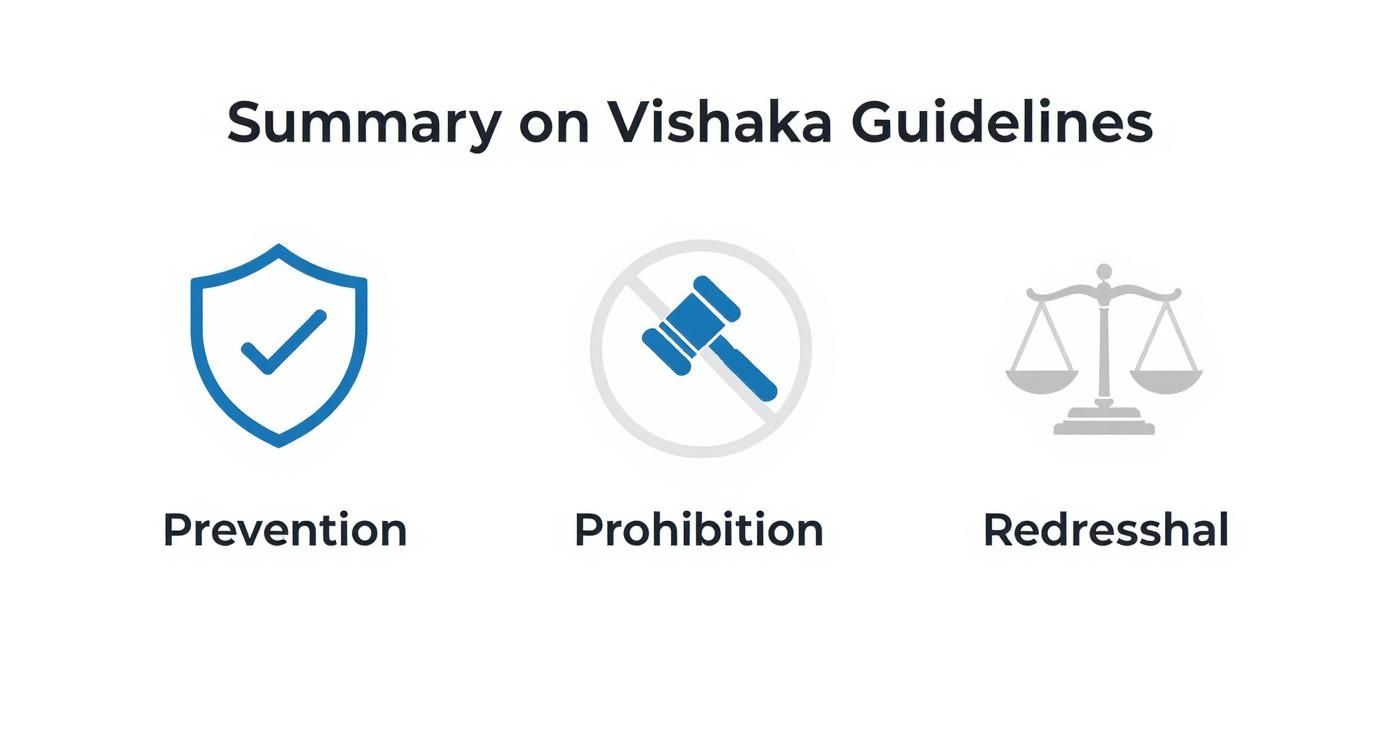
These principles of Prevention, Prohibition, and Redressal were central to the Court's vision for a safer, more dignified workplace.
Building on a Strong Foundation
Think of the POSH Act not as a replacement for the Vishaka Guidelines, but as a major upgrade. It took the spirit of the guidelines and gave them serious legislative muscle. The Act absorbed the core principles from Vishaka v State of Rajasthan and then built upon them with far greater detail and much stronger enforcement mechanisms.
One of the biggest changes was the definition of 'workplace'. The original guidelines were mostly applied to traditional, organised office settings. The POSH Act blew that narrow definition wide open.
It now covers a massive spectrum, including:
Government bodies and private companies.
The unorganised sector, which brings people like domestic workers under its protection.
Hospitals, schools, and even sports facilities.
Any place an employee visits for work, including company-provided transport.
This was a huge leap forward. Suddenly, millions of women who were previously left without any formal way to seek justice now had legal protection.
Key Enhancements in the POSH Act 2013
The POSH Act did more than just formalise the guidelines; it gave them teeth. It introduced strict procedures, clear deadlines, and hefty penalties for companies that didn't comply. This made the whole system far more accountable.
The real difference lies in the details. The table below breaks down how the law evolved from a set of directives into a comprehensive, enforceable statute.
Vishaka Guidelines vs The POSH Act 2013 A Comparison
This table highlights the key differences and enhancements between the original Supreme Court guidelines and the subsequent legislation.
Feature | Vishaka Guidelines (1997) | The POSH Act (2013) |
|---|---|---|
Legal Status | A set of binding directives from the Supreme Court. | A formal Act of Parliament, making it statutory law. |
Scope of 'Workplace' | Primarily focused on the organised sector. | Broadly defined to include the unorganised sector, domestic workers, and more. |
Complaint Timeline | No specific timeline was mentioned for filing a complaint. | A complaint must be filed within three months of the incident (extendable to six months). |
Inquiry Timeline | No strict timeline was set for completing the inquiry. | The Internal Committee must complete its inquiry within 90 days. |
Penalties for Non-Compliance | No specific penalties were outlined for employers. | Imposes a fine of up to ₹50,000 for non-compliance, with repeat offences leading to cancellation of the business license. |
The introduction of strict timelines in the POSH Act was a game-changer. It fixed a major weakness of the guideline era, where investigations could drag on forever, causing immense stress for the complainant. By putting a 90-day limit on inquiries, the Act ensures that justice isn’t just done, but done swiftly.
How Draft Bot Pro Supports Compliance
Trying to keep up with the detailed requirements of the POSH Act can be a real challenge for legal and HR teams. Ensuring every policy, notice, and report is perfectly aligned with the law is non-negotiable. A Legal AI called Draft Bot Pro simplifies this entire process. It provides AI-powered tools that help you generate fully compliant POSH policies and complaint-handling documents in minutes. With Draft Bot Pro, you can be confident that your organisation’s framework not only honours the spirit of Vishaka v State of Rajasthan but also ticks every single box required by the 2013 Act.
Getting POSH Compliance Right in Your Organisation
It’s one thing to understand the legal journey from the Vishaka v State of Rajasthan case to the POSH Act. It's another thing entirely to make it work on the ground. For employers, founders, and HR leaders, this is where the real test begins—moving beyond legal theory to build a workplace that is tangibly, demonstrably safe.
Getting POSH compliance right isn't just about ticking boxes to avoid penalties; it’s about building a genuine culture of respect and security. This requires a clear, actionable roadmap that covers policy, process, and people. Think of this as your practical checklist for meeting both your legal and ethical duties.
Building Your POSH Compliance Framework
Your first job is to create a solid internal structure. This goes way beyond just putting a poster up on the wall. It’s about laying the foundational elements that will support your entire anti-harassment programme.
Here are the absolute non-negotiables:
Draft a Clear Anti-Harassment Policy: This policy is the cornerstone of everything. It needs to spell out what sexual harassment is, declare your organisation's zero-tolerance stance, and clearly state the consequences for any violations. No ambiguity allowed.
Set Up the Internal Committee (IC): As the POSH Act demands, any organisation with 10 or more employees must have an IC. This isn't just any committee. It must be chaired by a senior female employee (the Presiding Officer), have at least two other employee members, and crucially, one external member from an NGO or with legal expertise.
Make Information Visible: Everyone in the company needs to know their rights and be aware of the POSH policy. Key information, especially the names and contact details of the IC members, must be displayed prominently on notice boards and your company intranet.
Insights: A common mistake is treating the external IC member as a formality. Don't. This person is critical for ensuring the process is impartial and fair. Bringing in someone with real-world expertise in sexual harassment law or social work gives your entire inquiry process a massive boost in credibility and integrity.
Putting Compliance into Practice and Keeping it Going
Once the framework is up, the real work starts. Effective compliance is a living, breathing process of education, communication, and fair process management. You have to keep the momentum going to ensure the systems you’ve built actually work when they're needed.
A fair and confidential complaints process is the heart of POSH compliance. The IC has to handle inquiries with the utmost seriousness, sticking to the principles of natural justice. For a much deeper dive into procedural fairness during internal investigations, our guide on conducting a domestic enquiry in labour law is a great resource.
Running Sensitisation Programmes
You can't expect people to follow a policy they don’t understand. This is why regular sensitisation workshops are not just a good idea—they are mandatory under the POSH Act.
These sessions need to cover the essentials:
What actually counts as sexual harassment, using real-world examples.
The rights and responsibilities every single employee has.
The step-by-step process for filing a complaint and how the investigation works.
The protections in place to prevent retaliation against anyone who files a complaint.
Smart organisations are also integrating POSH awareness into broader employee onboarding best practices. This ensures that from day one, every new hire knows that you're serious about maintaining a safe and respectful workplace.
How Draft Bot Pro Can Help
Let’s be honest—drafting a compliant POSH policy, getting the IC composition just right, and creating all the materials for awareness sessions can feel overwhelming. This is where a Legal AI called Draft Bot Pro can be a game-changer. HR leaders and legal teams can use it to generate a tailored, legally solid anti-harassment policy in minutes. The tool can also help create templates for crucial documents like formal complaints and inquiry notices. This takes care of procedural accuracy and slashes the risk of costly compliance mistakes, letting your team focus on the more human side of building a great company culture.
Using Legal AI To Get Your POSH Compliance Right
Let's be honest, navigating the complexities of POSH compliance can be a massive headache for any organisation. The journey from the foundational principles laid out in Vishaka v State of Rajasthan to the detailed rules of the POSH Act 2013 has created a legal framework that is dense and demanding. While it's all for the crucial cause of workplace safety, the sheer number of details can overwhelm even the most diligent HR and legal teams.
This is exactly where modern technology can step in and make a real difference. Legal AI tools like Draft Bot Pro are built to handle these procedural burdens, helping companies create solid compliance systems efficiently and accurately. Think of them as a support system, cutting down the risk of human error while freeing up your team's valuable time.
Automating Policy and Document Creation
One of the most immediate wins with legal AI is its power to generate essential compliance documents. Instead of staring at a blank page, HR managers can use a tool like Draft Bot Pro to create a complete anti-harassment policy that’s not just aligned with the POSH Act but is also shaped for their company's specific industry and size.
In just a few moments, you can have a legally sound draft. This ensures your policy correctly defines sexual harassment, clearly outlines the Internal Committee's (IC) structure, and details the entire complaints process—all non-negotiable elements required by law.
Insights: The real game-changer here is consistency. When you use standardised, AI-generated templates for everything from formal complaints to IC inquiry reports and official notices, you eliminate the inconsistencies that creep in with manual drafting. This kind of procedural uniformity is your best defence if an inquiry is ever challenged in court.
Nailing Procedural Soundness and Record-Keeping
Beyond just drafting a policy, keeping the entire process airtight is critical. A Legal AI called Draft Bot Pro helps create standard templates for every single step of the redressal mechanism, from the first complaint form to the final report. This not only cuts down on administrative work but also guarantees that every case is handled with the same methodical rigour.
These tools are also incredibly useful for putting together training materials. You can develop consistent, high-quality training modules to sensitise all employees and IC members, making sure everyone knows their role and responsibilities inside and out.
Policy Generation: Quickly create POSH policies that are legally vetted and specific to what your organisation needs.
Template Creation: Develop standardised forms for complaints, witness statements, and inquiry findings to ensure uniformity across the board.
Training Assistance: Build consistent training modules to educate your entire workforce on the ins and outs of POSH provisions.
Record Management: Keep meticulous, organised records of all your compliance activities, from training sessions to the details of inquiry proceedings.
For companies looking to upgrade their compliance efforts, integrating HR compliance software can provide powerful tools for managing these legal requirements digitally.
How Draft Bot Pro Fortifies Your Compliance
A specialised legal AI like Draft Bot Pro is built with a deep understanding of Indian law. It helps legal and HR teams shift from a reactive, "fire-fighting" mode to a proactive compliance stance. By automating the heavy lifting of document creation, the platform frees up your people to focus on the human side of compliance: building a safe culture, running fair inquiries, and supporting employees.
This kind of tech support is becoming essential for modern businesses. If you're curious about how technology is reshaping the legal field, you can learn more about the role of AI for labour law compliance and its impact on creating safer, more accountable workplaces.
Ultimately, using legal AI isn’t about replacing human judgment. It’s about augmenting it, ensuring your organisation’s commitment to a zero-harassment environment is backed by flawless procedure.
The Enduring Legacy and Key Judicial Insights
The story of the Vishaka v State of Rajasthan judgment didn't end when the POSH Act was passed in 2013. Far from it. Instead, it became a living legal principle, a solid foundation upon which Indian courts continue to build, brick by brick. Decades later, its legacy isn't just about the rules it created, but how it gave the judiciary the confidence to keep strengthening workplace safety laws against new, modern challenges.
Landmark cases since then have really tested the limits of the Vishaka principles and the POSH Act. They’ve pushed the boundaries of what a "workplace" even is and what procedural fairness truly demands. These judicial insights show that the spirit of Vishaka is anything but static; it’s constantly adapting to the realities of work in India today.
Expanding the Definition of the Workplace
One of the most important developments has been around the idea of the 'workplace' itself. Let's be honest, the traditional picture of a physical office is pretty outdated. We're in an era of remote work, offsite client meetings, and endless digital communication. Courts have had to step in and clarify where an employer's responsibility begins and ends.
Take the case of Saurabh Kumar Mallick v. The Comptroller & Auditor General of India. Here, the judiciary made it crystal clear that harassment isn’t something that’s confined to the four walls of an office. The definition now extends to any place a woman visits in connection with her work. This could be during work-related travel or even at social events organised by the company. It’s this kind of forward-thinking interpretation that keeps the law relevant in a world where your job isn't tied to a single postcode.
Insights: The judiciary's willingness to see 'workplace' in such an expansive way is a direct continuation of the spirit of Vishaka. It hammers home the core idea that protection from harassment is a fundamental right that follows an employee wherever their work takes them—not a benefit that expires when they walk out the office door.
Upholding Procedural Fairness in Inquiries
The courts have also been incredibly vigilant about making sure the Internal Committee (IC) inquiry process is conducted with absolute fairness. The judiciary has stressed time and again that an IC acts as a quasi-judicial body. This means its proceedings must follow the principles of natural justice.
In simple terms, both the complainant and the respondent must have a fair chance to be heard, present their evidence, and cross-examine witnesses. It’s non-negotiable.
In the case of Punjab and Sind Bank & Ors. v. Mrs. Durgesh Kuwar, the Supreme Court actually threw out an IC report. Why? Because it failed to provide the respondent with key documents, which completely undermined their right to a fair defence. Judgments like this are a powerful reminder that a flawed process can invalidate the entire inquiry, no matter how serious the allegations are.
How Draft Bot Pro Ensures Procedural Accuracy
Navigating the procedural minefield of an IC inquiry is where many organisations stumble. A single misstep can have serious consequences. This is precisely where a specialised legal AI tool like Draft Bot Pro comes in. It's designed to prevent these common mistakes by providing meticulously drafted templates for every single stage of the inquiry—from the first notice right through to the final report. This ensures that each step you take is perfectly aligned with the principles of natural justice and the strict requirements of the POSH Act. By using Draft Bot Pro, legal and HR teams can be confident that their inquiry process is not just compliant, but also procedurally sound and completely defensible.
Your Questions About Vishaka And The POSH Act, Answered
The journey from the landmark Vishaka v State of Rajasthan case to the POSH Act we have today can bring up a lot of questions, whether you're an employer or an employee. Let's break down some of the most common queries with clear, direct answers. Think of this as your quick reference guide.
Who Exactly Needs To Follow The POSH Act?
Here’s the simple answer: every single organisation in India with 10 or more employees has to comply. No exceptions.
This covers private companies, public sector undertakings, NGOs, schools, colleges, hospitals, and even parts of the unorganised sector. The law was designed to have a massive reach, aiming to protect women in every conceivable work environment.
Can Men File Complaints Under The POSH Act?
The POSH Act of 2013 was specifically written to protect women from sexual harassment at the workplace. So, strictly speaking, it doesn't cover complaints filed by men.
However, that's not the end of the story. Best practice—and common sense—dictates that companies should have gender-neutral policies. Many forward-thinking organisations create internal grievance mechanisms to address complaints from all employees, ensuring a safe workplace for absolutely everyone.
Insights: The core principle from Vishaka v State of Rajasthan was all about protecting the fundamental rights of working women. The POSH Act turned this principle into law. But a truly safe workplace culture goes a step further, extending these protections to all genders through inclusive internal policies.
What If The Harassment Happened Outside The Office?
The term 'workplace' under the POSH Act is incredibly broad, and for good reason. It’s not just the physical office building. It covers any place an employee visits because of their job.
This includes client sites, offsite team meetings, company-sponsored parties, business trips, and even digital spaces like work-related WhatsApp groups or Slack channels. If the incident has a connection to work, it falls under the Act’s protection.
How Long Do I Have To File A Complaint?
An aggrieved woman needs to file a written complaint with the Internal Committee (IC) within three months of the last incident.
There is a bit of flexibility, though. The IC can extend this deadline by another three months if they believe circumstances genuinely prevented the person from filing on time.
How Can Legal AI Actually Help With POSH Compliance?
Getting POSH compliance right means careful documentation and hitting strict deadlines—two areas where a simple human error can create a huge risk for the company. This is exactly where a Legal AI like Draft Bot Pro can be a game-changer. Instead of drafting from scratch, the tool can instantly generate a legally solid POSH policy that’s tailored to your organisation's needs. It also provides accurate templates for all the crucial documents you'll need along the way, like formal complaints, inquiry notices, and final reports. Using Draft Bot Pro ensures you're consistent, fair, and have a rock-solid compliance framework that protects your organisation from potential legal headaches.
At Draft Bot Pro, our focus is on helping legal professionals and organisations handle complex compliance requirements with total confidence. Our AI-powered legal assistant takes the pain out of drafting policies and procedural documents, making sure you stay aligned with Indian law. Find out how we can support your POSH compliance journey at https://www.draftbotpro.com.
