
Section 19 of Domestic Violence Act: A Quick Guide

Section 19 of the Domestic Violence Act is a game-changer. It gives courts the power to issue something called a residence order—a legal tool designed to protect a survivor's right to live in their shared home and stop an abuser from throwing them out on the street.
The Lifeline of a Shared Household

Picture this: you're living in fear, and on top of the abuse, your partner threatens to evict you from your own home. It's a terrifying reality for countless survivors, who suddenly face the double trauma of violence and potential homelessness. This is exactly the kind of coercive tactic that Section 19 of the Protection of Women from Domestic Violence Act (PWDVA), 2005, was designed to stop. It's an immediate and powerful legal shield.
At its heart, a residence order is all about securing a safe place for the person who has been harmed. It makes it crystal clear that a survivor cannot be kicked out of the home she shares with her abuser, no matter whose name is on the property deed. It's a true lifeline, offering stability and security right when it's needed most.
Why Is This Right So Important?
This protection is especially critical in India, where it's common for women not to have property registered in their names. The law wisely looks beyond ownership papers and focuses on the reality of the relationship—the "shared household." It recognises that a home is built on cohabitation, not just title deeds.
Insights A residence order does more than just keep a roof over a survivor's head. It restores a sense of dignity and control, giving them the breathing room they desperately need to plan their next steps without the immediate threat of being displaced. It fundamentally shifts the power dynamic, reinforcing that safety is a non-negotiable right.
And this legal protection is becoming more crucial than ever. Academic analysis of NCRB data reveals a stark trend: complaints filed under the PWDVA and IPC 498A jumped by a staggering 53% between 2014 and 2022. This surge shows a growing awareness and reliance on tools like Section 19. If you're interested in the numbers, you can dive into the detailed findings in this report on domestic violence case trends.
To help you understand exactly what a court can do under this section, here's a quick breakdown of the key protections.
Key Protections Under a Section 19 Residence Order
Type of Court Order | What It Means for a Survivor | Real-World Example |
|---|---|---|
Restraining Dispossession | The abuser is legally blocked from throwing the survivor out of the shared home or trying to sell/transfer the property without the court's permission. | A husband is prevented from changing the locks or forcibly removing his wife's belongings from their marital home. |
Directing Removal of Abuser | The court can order the abuser to leave the shared household, ensuring the survivor's immediate safety. | If the violence is severe, the court can order the abusive partner to move out, allowing the survivor and her children to remain safely in the home. |
Restraining Entry | The abuser is prohibited from entering any part of the shared household where the survivor lives. | The court can order the abuser not to enter the main house, even if he continues to live in an outhouse on the same property. |
Arranging Alternate Accommodation | If staying in the shared home isn't safe or practical, the court can order the abuser to provide and pay for a similar, safe alternative home for the survivor. | A court orders the husband to pay the rent for a 2BHK flat in the same neighbourhood for his wife and child, ensuring their standard of living is maintained. |
These orders give the court a flexible and powerful toolkit to tailor the relief to the specific circumstances of each case, always prioritising the survivor's safety and well-being.
The Role of Legal Technology
Navigating the court system to get a residence order can feel overwhelming. You have to present the facts clearly and ground your application in the right legal principles to get swift relief. It's a high-stakes process.
This is where technology can make a real difference. A specialised legal AI tool like Draft Bot Pro can help lawyers and survivors put together precise, effective applications. By structuring the narrative and making sure every necessary detail is included, it helps build a rock-solid case from the get-go.
Keep in mind, a residence order is often just one piece of the puzzle. It's frequently used alongside other remedies. You can learn more about how it connects with financial support by reading our guide on Section 20 of the Domestic Violence Act, which covers monetary relief.
The Powers a Court Holds Under Section 19
A residence order under Section 19 of the Domestic Violence Act isn't some rigid, one-size-fits-all remedy. Think of it more like a toolkit, giving the court a flexible and powerful set of instruments to protect a survivor based on their unique and often dangerous situation. The Magistrate's authority isn't just about declaring a person's right to live in the house; it's about issuing concrete, enforceable commands to make sure they are actually safe.
These powers are specifically designed to counteract the common tactics of control and coercion that abusers use. By knowing exactly what orders a court can pass, a survivor and their lawyer can ask for the precise relief needed to build a safe environment, turning the abstract right to shelter into a real, tangible thing.
Preventing Eviction and Securing the Home
The most fundamental power under Section 19 is the court's ability to stop an abuser from throwing the survivor out of the shared household. This is the first line of defence, and it's absolutely critical.
Imagine this: a husband, in a fit of rage, threatens to change the locks and chuck his wife's belongings onto the street. An order under Section 19(1)(a) would make that illegal. This simple but powerful injunction stops an abuser from weaponising the threat of homelessness.
But it goes further. The court can also prevent the abuser from selling the house or ending a rental agreement just to indirectly force the survivor out. It's about closing loopholes and making sure the physical space itself is secure for the aggrieved person.
Removing the Abuser from the Premises
When a survivor's safety is on the line, the court can take a much stronger step: ordering the abuser to leave the shared household. This is a powerful measure under Section 19(1)(b) that puts the well-being of the survivor and any children first.
What this means is if the domestic violence is severe, the court can direct the abusive partner to find somewhere else to live. This allows the survivor to stay in the familiar, stable environment of her home. It rightly shifts the burden of displacement from the victim to the person causing the harm.
The court can also get very specific with its restraining orders, such as:
Barring entry: Forbidding the abuser from entering any part of the shared household where the survivor is living.
Restricting access: Keeping the abuser away from the survivor's workplace or the children's school.
Ceasing communication: Ordering the abuser to stop all contact—no texts, no calls, not even messages through other people.
Insights Landmark judgments have consistently backed and even expanded these powers. Courts have interpreted "shared household" in a broad sense, hammering home the point that a woman's right to residence is paramount, regardless of who actually owns the property. This judicial evolution ensures the law remains a strong shield for survivors, adapting to the messy realities of domestic life and stopping abusers from hiding behind legal technicalities.
Ensuring Alternative Secure Housing
Sometimes, going back to the shared household just isn't safe or practical. For these situations, Section 19 gives the court the power to order the abuser to either find alternative accommodation for the survivor or pay rent for a suitable home.
The crucial part here is that the alternative housing must be at the same level as the shared household. This is to ensure the survivor's standard of living doesn't suddenly plummet. For example, if they were living in a three-bedroom flat, the court could order the abuser to pay the rent for a similar property in a safe area. This provision is vital; it means a survivor doesn't have to choose between their safety and financial ruin.
Getting these reliefs requires a well-drafted petition that clearly asks for them. This is where legal technology can be a game-changer. Draft Bot Pro helps legal professionals articulate the need for each specific order, from restraining dispossession to demanding rent for alternative housing. The AI helps structure the application to ensure every safeguard available under Section 19 of the Domestic Violence Act is considered and argued for persuasively, boosting the chances of securing complete protection for the client.
Who Actually Qualifies for a Residence Order?
To get the protection of a residence order, the law hinges on two simple but powerful questions: Who is an ‘aggrieved person’, and what counts as a ‘shared household’? The answers are much wider than most people think, stretching far beyond just a husband and wife. Getting these definitions right is your first real step towards safety under Section 19 of the Domestic Violence Act.
The law describes an ‘aggrieved person’ as any woman who is, or has been, in a domestic relationship with the person committing the violence. This isn't just legalese; it's a deliberately broad safety net. It’s not just for wives. It’s designed to protect women in live-in relationships, mothers, daughters, sisters, and even widows who have lived with their abuser.
The “Aggrieved Person”: A Wide and Inclusive Net
This all-encompassing approach gets a fundamental truth right: domestic abuse isn't confined to marriage. It can poison any family dynamic. A sister being harassed by her brother, a mother being mistreated by her own son, or a daughter-in-law facing cruelty from her in-laws—all these women can be considered an ‘aggrieved person’ under the Act.
The crucial link is the ‘domestic relationship’. Stripped down, this just means two people who live or have lived together in a shared household and are connected by blood, marriage, or adoption. Being able to spot the red flags early is key, and it's worth understanding the recognizing signs of dating or being married to a narcissist to better assess your own situation.
The "Shared Household": It’s Not About Ownership
The second piece of the puzzle is the ‘shared household’, and this is where a lot of confusion comes in. Let’s clear this up: a shared household is not about who owns the property. It’s about where you, the aggrieved person, lived with the abuser. It's the home you shared, and it doesn't matter whose name is on the title deed or the rent agreement.
Think of it this way: the law treats the ‘shared household’ as a ‘family home’, not just a legal asset. Its real value is in the life and memories built there, which gives the survivor a powerful right to stay put.
This means a woman can claim a right to live there even if:
The house is owned solely by her husband.
The house is owned by her in-laws (like her father-in-law or mother-in-law).
It’s a joint family property.
The home is a rented property.
Insights This isn't just theory; the courts have backed this up time and time again. In several landmark rulings, the Supreme Court has made it crystal clear that a wife's right to live in the shared household doesn't disappear just because her husband doesn't own it. If they lived there together as a family, it qualifies. This has been a game-changer, stopping in-laws from simply kicking out a daughter-in-law from the only home she knows.
How Legal AI Can Help You Build Your Case
Proving these two things—that you are an aggrieved person and that the house is a shared household—is the bedrock of your application. You have to lay out the facts clearly and convincingly for the court.
This is where a legal AI tool like Draft Bot Pro can be a massive help. It guides you in structuring your application, prompting you for the specific details needed to describe the domestic relationship and establish your claim to the shared household. By helping you build a coherent and legally solid narrative from the very beginning, it strengthens your case for getting a residence order under Section 19 of the Domestic Violence Act.
Filing Your Application for a Residence Order
Thinking about securing a residence order under Section 19 of the Domestic Violence Act can feel like staring up at a mountain. It seems intimidating, but it's actually a well-defined path designed to get you to safety—and quickly. Let's break it down into clear, manageable steps to demystify the journey and empower you to take back control.
This guide will walk you through the entire process, from that first crucial report to your initial day in court. At its core, the entire process hinges on one key connection: the link between you, the aggrieved person, and the shared household you're trying to secure.
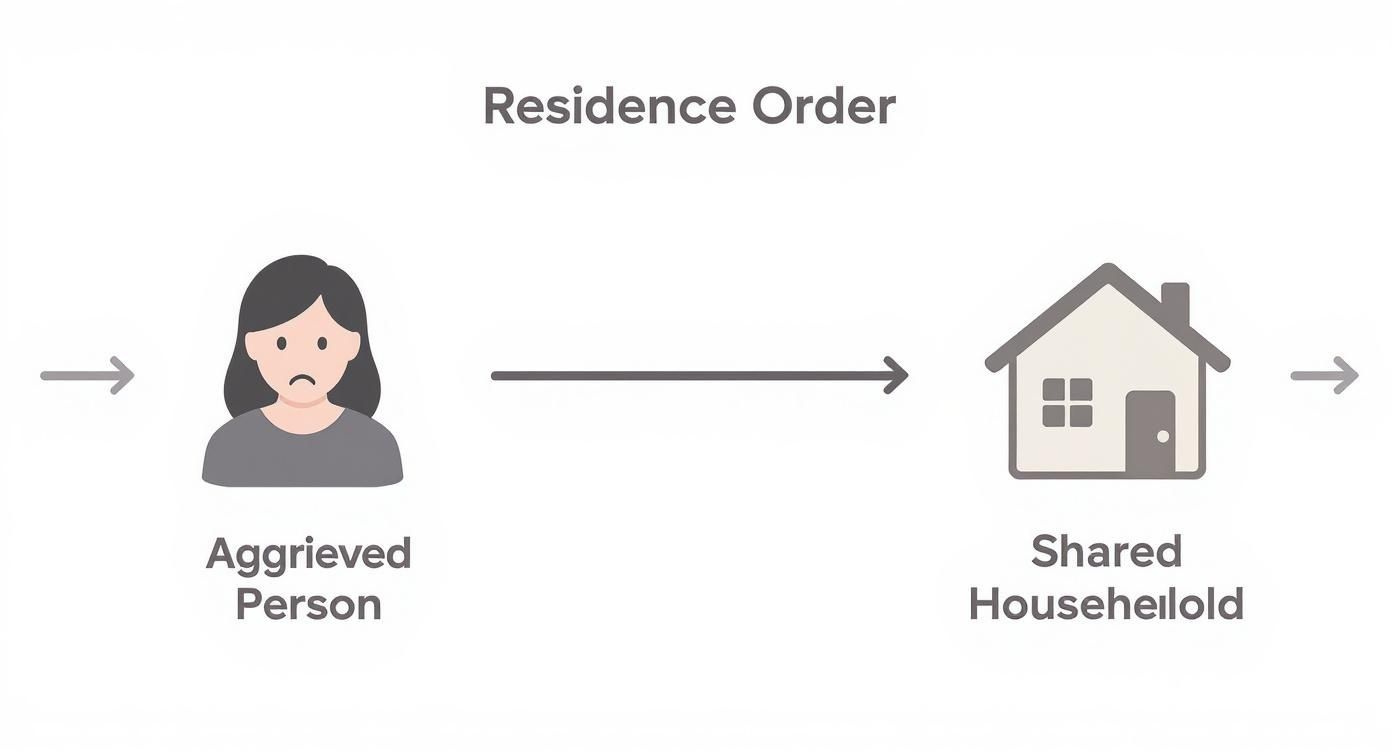
As this visual shows, establishing that link is the very foundation of any claim under Section 19. It all starts there.
Step 1: Document Everything and Gather Your Evidence
Long before you set foot in a courtroom, your most powerful ally is evidence. The court needs a clear, undeniable picture of the abuse and your solid connection to the shared household. Start gathering anything and everything that supports your story.
What does that look like in practice?
Photographs or videos: Document every physical injury or bit of damaged property. Timestamps are your friend.
Messages and Emails: Don't delete anything. Save those threatening texts, abusive WhatsApp messages, or malicious emails.
Medical Records: Keep all reports, prescriptions, or bills from doctor's visits related to injuries from the abuse.
Proof of Residence: Collect utility bills, rent agreements, bank statements, or any official correspondence showing you lived in the shared household.
This documentation isn't just a collection of files; it's the factual backbone of your application. It builds a story supported by tangible proof, making it incredibly difficult for the abuser to deny your claims.
Step 2: The Domestic Incident Report (DIR)
The first formal step you'll take is often filing a Domestic Incident Report (DIR). You can do this by approaching a Protection Officer, a police officer, or a service provider registered under the Act. Think of the DIR as the official starting pistol for your legal case.
This report becomes a key document when you file your application, so it's crucial to be as detailed and accurate as you possibly can. The DIR is submitted directly to the Magistrate and forms the initial basis of your entire complaint.
Step 3: Drafting and Filing the Application
With your evidence and DIR ready, it's time to file an application under Section 12 of the PWDVA before the Magistrate. This is the formal legal document where you'll lay out the history of abuse and specifically ask for a residence order under Section 19 of the Domestic Violence Act.
This is where precision is paramount. A well-drafted application that clearly states the facts, establishes the domestic relationship, and proves the existence of a shared household can dramatically speed up the entire process.
Insights A strong application does more than just state the facts—it tells a compelling story. It needs to connect the dots for the Magistrate, revealing a clear pattern of abuse and demonstrating the urgent need for protection. This persuasive narrative is often what convinces a court to grant immediate interim relief at the very first hearing.
How Draft Bot Pro Accelerates the Process
Crafting a legally sound and persuasive application is critical, and this is where Draft Bot Pro comes in. This legal AI tool helps lawyers build a comprehensive application by ensuring all the necessary components are included and structured logically. It generates well-articulated clauses that present the facts persuasively, which is a huge advantage when you're trying to secure immediate relief for a survivor.
The platform is also a massive help when it comes to crafting supporting documents. For instance, you can learn more about how it helps prepare sworn statements in our guide on using AI for drafting affidavits.
The enactment of the PWDVA in 2005, which brought us Section 19, was a landmark moment for women's rights in India. Data from the National Crime Records Bureau (NCRB) paints a stark picture: there was an 80% increase in case filings under 'cruelty by husband and relatives' between 2006 and 2015. The numbers jumped from roughly 63,000 to over 113,000 cases. This trend suggests a growing awareness and use of the law, proving that more women are turning to these legal tools to find safety.
How Legal AI Helps Draft a Powerful Application
When it comes to securing immediate protection, the difference between success and a long, draining court battle often boils down to one thing: the quality of your application.
A poorly drafted petition under section 19 of the Domestic Violence Act can stall justice. But a powerful, precise one? That can secure life-saving relief at the very first hearing.
Many applications fall flat because they're vague, emotionally charged but legally weak, or simply miss critical details. It’s not enough to just say that abuse happened. The court needs a coherent story, backed by facts, that makes the need for a residence order undeniable.
This is where your drafting strategy becomes your most powerful weapon. A strong application acts as a clear roadmap for the judge, guiding them through the history of abuse and proving why the specific protections are needed. Getting this right from the start is non-negotiable.
From Vague Claims to Concrete Arguments
One of the most common mistakes is using general language. An abuser’s lawyer can easily pick apart vague accusations. The trick is to turn broad statements into specific, fact-based arguments that leave no room for doubt.
This is exactly where a legal AI assistant like Draft Bot Pro comes in. It prompts you for the specific details needed to build a solid case, helping structure the survivor's story into a compelling legal narrative. It’s about turning raw, emotional accounts into precise, persuasive legal language.
Just look at this 'before and after':
Before (Weak and Vague): "The respondent is very abusive and constantly harasses me and threatens to throw me out of the house. He makes my life miserable."
After (Improved with AI Assistance): "On the evening of 15th May 2024, the respondent, in an intoxicated state, physically barred the petitioner from entering the master bedroom and explicitly threatened, 'I will change the locks tomorrow and you will be on the street.' This incident is the latest in a recurring pattern of coercive control aimed at dispossessing the petitioner from the shared household."
The second version is specific and actionable. It gives the court a clear instance of abuse that directly justifies a residence order.
Making Sure No Critical Element Is Missed
A successful application under section 19 of the Domestic Violence Act has several essential components. Forget even one, and you could weaken your entire case. Legal AI acts as a smart checklist, making sure your application is complete and legally sound.
Insights A leading family law advocate highlights the three most critical elements for any Section 19 application: first, a detailed timeline of specific abusive incidents with dates; second, undeniable proof of cohabitation in the shared household; and third, a clear link between the abuse and the immediate threat of dispossession. Including these three pillars makes it much harder for the opposition to challenge the need for an urgent residence order.
To ensure your application is watertight, it's crucial to include several key elements. The table below breaks down what you need and why it matters.
Essential Elements of a Section 19 Application
Application Component | Why It's Critical | How Draft Bot Pro Assists |
|---|---|---|
Detailed Chronology of Events | Establishes a pattern of abuse, showing it wasn't a one-off incident. This gives the court context and demonstrates the escalating risk. | Prompts for specific dates, times, and descriptions of incidents to build a coherent and powerful timeline. |
Proof of Shared Household | This is a foundational requirement. You must prove you and the abuser lived together in the residence you're seeking to protect. | Reminds you to include evidence like rent agreements, utility bills, or witness statements to establish cohabitation. |
Specific Prayer for Relief | Clearly stating you want a residence order (and any other protections) is non-negotiable. Ambiguity here can lead to a weak or useless order. | Helps formulate precise legal prayers, ensuring you ask for exactly what you're entitled to under the Act. |
Link Between Abuse and Dispossession | You need to show the court that the abuse directly creates a threat of being thrown out or barred from the home. | Structures arguments to explicitly connect the abuser's actions (e.g., threats, changing locks) to the need for a residence order. |
Including these components isn't just good practice—it's essential for building a case that a judge can act on swiftly and decisively.
Draft Bot Pro helps integrate all these elements seamlessly. Since legal documents demand absolute accuracy, it's also important to understand how to reduce hallucinations in LLMs to ensure any generated information is reliable.
As you build your case, you might be curious about the bigger picture of AI in legal work. For a deeper look, check out our article that asks, "can I use AI to draft legal documents?". This technology doesn't replace legal expertise; it amplifies it, helping lawyers build stronger cases for those who need it most.
Common Questions About Section 19
When you’re in the middle of a crisis, trying to understand the law can feel like wading through deep, murky water. Bad advice and myths only make things harder. This section is here to be your lifeline, pulling you out of the confusion with clear, practical answers to the real-world questions that pop up around section 19 of the Domestic Violence Act.
Let's cut through the noise. These are the questions that survivors and their families ask every day, and here are the straightforward answers you need.
Can I Get a Residence Order if the House Belongs to My Mother-in-Law?
Yes, absolutely. This is one of the biggest misconceptions out there, but the law couldn't be clearer. The Protection of Women from Domestic Violence Act (PWDVA) isn't concerned with whose name is on the property papers; it cares about the ‘shared household’.
The Supreme Court of India has backed this up time and again. If you lived in a house with your partner as a family, it is your shared household. It doesn’t matter if it's owned by him, his parents, or even if it's a rental. The only thing that matters is that you lived there together.
This is a powerful safeguard designed to prevent abusers from using property ownership as a weapon to throw a survivor out onto the street.
What Happens If He Ignores the Residence Order?
A residence order from the court isn't a suggestion—it's a command. If the abuser violates it, he’s committing a serious criminal offence under Section 31 of the PWDVA. This is a big deal: the offence is cognisable (meaning the police can arrest him without a warrant) and non-bailable.
An abuser who breaches the order could face up to one year in jail, a fine, or both. The moment he violates the order, you need to inform the police and the Protection Officer immediately. You can also go straight back to the same Magistrate, who will take swift action.
Insights Document everything. If he breaches the order, take photos, record videos, save text messages, or get statements from anyone who saw it happen. This proof is gold when you go to court and will be critical for holding him accountable.
How Long Does It Take to Get a Residence Order?
The whole point of the PWDVA is to provide quick relief. The law itself says that courts should aim to wrap up cases within 60 days of the first hearing. While heavy caseloads can sometimes slow things down, the system is designed for speed.
In urgent cases, a survivor doesn't have to wait. The court can grant an ‘ex-parte’ interim residence order right at the first hearing. This means you can get immediate protection, even before the other side gets a chance to present their case. This interim order keeps you safe while the full case moves forward.
A sharp, well-drafted application that lays out all the facts and evidence clearly can really speed things up.
Can a Man File a Case Under the Domestic Violence Act?
No, he can't. The Protection of Women from Domestic Violence Act, 2005, was specifically created to protect women. The law defines the ‘aggrieved person’ as any woman who has been subjected to domestic violence while in a domestic relationship.
This law was a response to the very real social and economic vulnerabilities that women often face in our society. Men who are experiencing domestic abuse need to seek help through other legal avenues, like filing for divorce on the grounds of cruelty or lodging a complaint under the Indian Penal Code (IPC).
How Can Legal AI Help With All This?
Facing these legal battles is overwhelming, especially when you're trying to build a solid case. This is where technology can be a real game-changer. A legal AI tool like Draft Bot Pro helps lawyers and individuals tackle these issues with much more confidence.
For example, when you're claiming your right to a shared household that’s in your in-laws' name, Draft Bot Pro can help you pull up the exact Supreme Court judgments and legal points needed to make your application bulletproof. It helps you frame the facts in a way that’s legally sound, building your claim on a rock-solid foundation.
By helping you create a clear, comprehensive application from the get-go, the AI makes sure you’ve covered all your bases. That kind of preparation can make all the difference in getting a quick, positive outcome under section 19 of the Domestic Violence Act.
Ready to build a stronger case with less stress? Draft Bot Pro helps lawyers and law students create expert legal documents, find the right case law, and speed up their entire drafting process. Join over 46,000 legal professionals in India who already trust our platform. See what the future of legal drafting looks like at https://www.draftbotpro.com.
