
A Modern Guide to the Types of Evidence in Indian Law

Think of building a legal case like constructing a building. Your arguments are the walls, and each piece of evidence is a brick. Without strong, well-placed bricks, the entire structure will collapse under the slightest pressure. That's why getting a real grip on the different types of evidence isn't just academic—it's absolutely critical for any legal professional in India.
This isn't just theory. Every single piece, whether it's a witness speaking in court or a crucial contract, is a structural component holding up your claims.
And right now, this landscape is undergoing a monumental shift. The old Indian Evidence Act, 1872 (IEA), which was the law of the land for over a century, has been replaced by the new Bharatiya Sakshya Adhiniyam, 2023 (BSA). This isn't a minor update; it's a complete overhaul that significantly changes how we handle evidence, especially digital information. Navigating this new framework requires a clear roadmap.
The Foundational Pillars of Evidence
At its core, the Indian legal system splits evidence into two fundamental categories: oral evidence and documentary evidence. This foundational distinction has been carried over from the IEA straight into the new BSA.
This simple flowchart breaks it down visually.
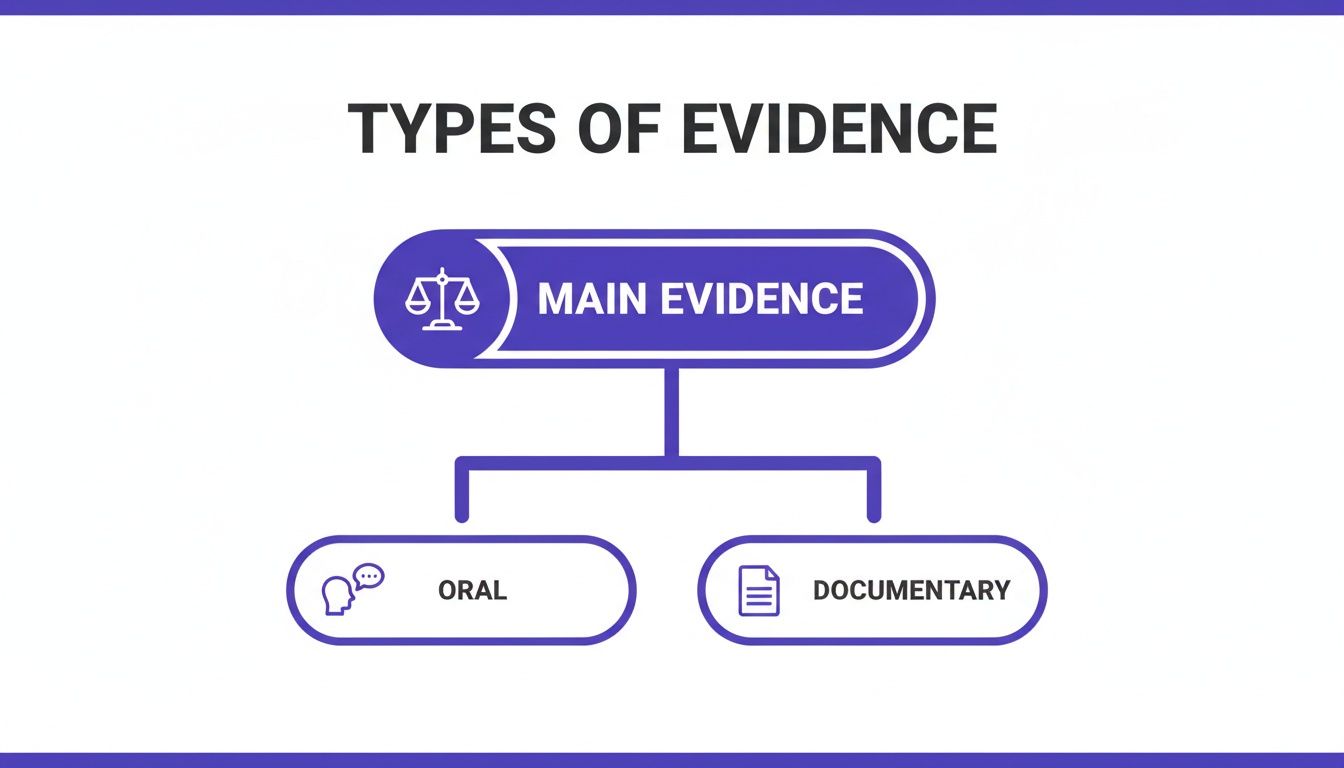
It’s a straightforward hierarchy, but it’s the starting point for everything. No matter how complex a piece of proof seems, it traces its roots back to one of these two categories.
Adapting to the New Legal Framework
The move to the BSA brings both challenges and opportunities. Legal teams have to get up to speed—fast. You need to align your strategies with new definitions and admissibility rules. If you don't, you risk having critical evidence thrown out, which could sink your entire case. For instance, knowing the right procedure for calling a witness has never been more important. You can learn more in our detailed guide to summons for witnesses in Indian law.
Insights For legal professionals grappling with these changes, accuracy is everything. Misinterpreting a provision or failing to meet a new procedural requirement can be detrimental. This is where modern tools become indispensable.
This is exactly where a legal AI assistant can make a real difference. Legal AI like Draft Bot Pro helps legal professionals quickly adapt by providing instant analysis of new provisions and flagging compliance requirements.
Evidence Categorisation: It can scan through your case files and instantly classify every piece of evidence.
Compliance Checks: It automatically flags key requirements under the new BSA, helping you avoid costly mistakes.
Strategic Support: It ensures every document and statement is correctly prepared for court.
For example, a tool like Draft Bot Pro is built specifically for the Indian legal system. It can automatically categorise evidence from your uploaded documents and highlight what you need to do to comply with the BSA, making sure your case is built on a solid, legally sound foundation.
Evidence Types at a Glance Under the BSA
To help you get a quick handle on things, here's a simple table summarising the main evidence categories you'll be dealing with under the new law. It's a handy cheat sheet for the core concepts.
Evidence Category | Core Concept | Common Example | Governing Provision (BSA) |
|---|---|---|---|
Oral Evidence | Statements made by witnesses in court regarding a fact under inquiry. | A witness testifying about what they saw during an incident. | Section 53 |
Documentary Evidence | All documents, including electronic records, produced for the court's inspection. | A signed contract, a sale deed, or a certified copy of a public record. | Section 2(d), Section 54 |
Primary Evidence | The original document itself presented for the court's inspection. | The original will of a deceased person. | Section 56 |
Secondary Evidence | Certified copies, copies made from the original, or oral accounts of the contents of a document. | A photocopy of a lost sale deed or a witness recalling the contents of a letter. | Section 57 |
This table covers the fundamentals, but remember, the real skill lies in knowing how to apply these concepts effectively in the heat of a case.
Oral and Documentary Evidence in Modern Practice
In the world of Indian law, oral and documentary evidence are the two foundational pillars your case is built on. While they might sound a bit old-school, the new Bharatiya Sakshya Adhiniyam (BSA) has really shaken things up, especially in defining what a "document" even is anymore. Getting a grip on how these apply today is non-negotiable if you want to build a case that holds up in court.
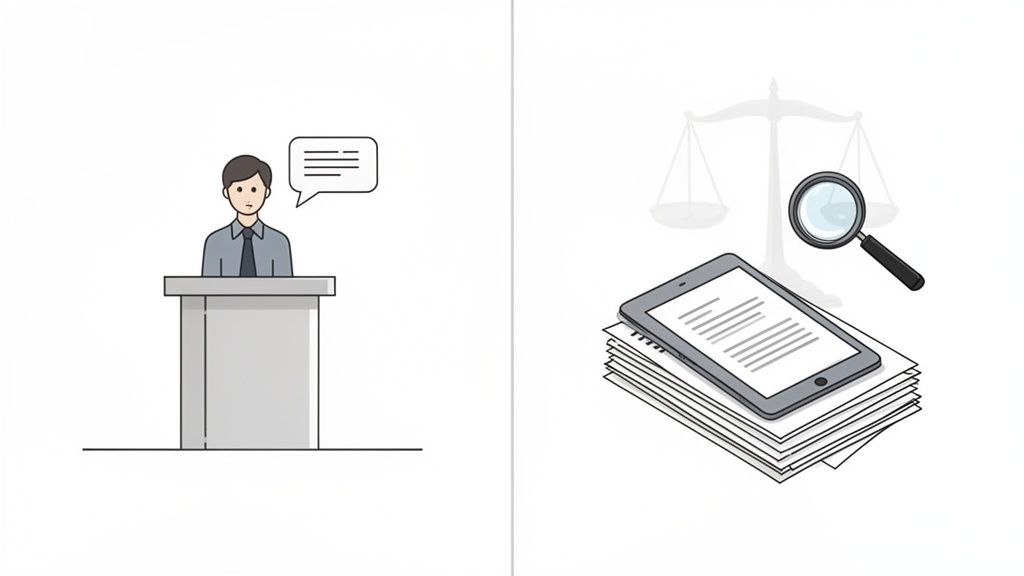
Oral evidence is, quite simply, what’s said out loud. It's the testimony a witness gives on the stand, governed by Section 53 of the BSA. Think of it as the human story of your case—the part that breathes life into the cold facts for the judge.
Crucially, this testimony must be direct evidence. This isn't just a suggestion; it's a hard rule. The witness has to be talking about something they personally saw, heard, or sensed. No secondhand stories.
Navigating the Nuances of Oral Evidence
You can't overstate the impact of a good witness, but their testimony is bound by strict rules. The biggest hurdle? The rule against hearsay. Hearsay is when a witness tries to testify about something someone else told them.
For example, a witness saying, "Ravi told me he saw the car speeding," is pure hearsay and will get shot down immediately. The court doesn't want to hear what Ravi said; it wants Ravi on the stand, saying it himself.
A solid courtroom strategy means getting your witnesses ready to give testimony that is clear, direct, and believable. This involves:
Focusing on Direct Perception: Drill them to stick to what they personally experienced. No more, no less.
Anticipating Cross-Examination: Prepare them for the tough questions that will inevitably come, challenging their memory and credibility.
Avoiding Speculation: Witnesses state facts. They don't offer their opinions, guesses, or interpretations of what happened.
The Evolving World of Documentary Evidence
Documentary evidence has exploded under the BSA. We're not just talking about dusty paper contracts and sealed letters anymore. Today, this category covers everything from official reports and business records to emails, WhatsApp chats, and server logs. It’s a massive, critical part of modern litigation.
The single most important concept here is the difference between primary and secondary evidence.
Insights Primary evidence is the original document itself—what lawyers call the "best evidence." Secondary evidence is just a copy, or even someone's memory of what the original said. The court always wants the original unless you have a legally bulletproof reason why you can't produce it.
Let's make this practical. The original, signed sale deed is primary evidence. A photocopy of that deed is secondary. You can't just waltz in with the photocopy; you first have to prove the original was lost, destroyed, or is being held hostage by the other side who won't hand it over. For a deeper dive into these procedures, check out our litigator's guide to the production of documents under the CPC.
How Legal AI Prevents Critical Errors
Trying to manage a mountain of documents while making sure every single one is admissible is a nightmare. It’s tedious, painstaking work. One simple mistake—like forgetting to secure the primary document when it's needed—can get a game-changing piece of evidence thrown out. This is exactly where a legal AI assistant becomes your secret weapon.
Imagine uploading your entire case file and letting an AI do the heavy lifting. This is how Draft Bot Pro acts as a lawyer's second brain:
Automated Document Scanning: The AI rips through every file, from contracts to emails, instantly flagging its type and any potential admissibility problems.
Evidence Flagging System: It can spot documents where primary evidence is a must, sending you an alert to track down the original long before you're on the spot in court.
Admissibility Analysis: The system can even analyse witness statements and documents for sneaky hearsay issues, giving you a heads-up so you can fix your strategy.
Using Draft Bot Pro helps you find and fix these evidentiary weak spots before they become a problem. It ensures that when you walk into that courtroom, every document you rely on is compliant, admissible, and ready to make your case—preventing the kind of simple procedural blunders that can completely derail an otherwise winning argument.
Mastering Digital Evidence Under the New BSA Rules
The world of evidence is changing faster than ever, and nowhere is that more obvious than in the digital realm. What we used to think of as supporting proof has now jumped to centre stage. In one of the most game-changing updates, the new Bharatiya Sakshya Adhiniyam, 2023 (BSA) has completely rewritten the rules for electronic and digital records.
This is a massive shift. Under the old Indian Evidence Act, 1872, a printout of an email was secondary. Now, the BSA treats electronic records as primary evidence. This means a certified printout of a server log or a WhatsApp chat can carry the same legal punch as an original, signed paper contract. You can get a deeper sense of what this means by exploring more insights on the BSA's impact.

For those of us in the legal profession, this isn't just a minor tweak—it demands a whole new way of thinking. We have to get good at handling this new-age evidence to build cases that are not just strong, but future-proof.
Understanding the Scope of Digital Evidence
When we say "digital evidence," what are we really talking about? The scope is huge, and it's far more than just emails. The BSA acknowledges a whole universe of digital formats as legitimate proof.
Basically, think of it as any information that’s stored or sent in binary form that can be brought into a courtroom. This includes things like:
Communications: Emails, SMS, WhatsApp messages, and even social media DMs.
Device Data: Call logs, GPS location data, and browser history.
Server and Network Information: Server logs, IP address records, and website data.
Emerging Technologies: Blockchain entries, cryptocurrency transaction records, and files from cloud storage.
Each one of these can paint a powerful, time-stamped picture of events—a picture that’s often much harder to argue with than a person's memory.
The New Standards for Admissibility
Of course, with great power comes great responsibility. While digital evidence is now primary, the BSA is very strict about how it can be admitted. This is to stop fraud and tampering. You can't just hand over a screenshot and call it a day.
The whole game now is proving the authenticity and integrity of that electronic record. This boils down to two non-negotiable steps: maintaining a crystal-clear chain of custody and providing a valid certificate of compliance.
Insights That certificate required under the new BSA rules is not just a piece of paper. It's a sworn statement confirming the device that created the record was working properly and that the data itself is untouched. Get the certificate wrong, and your digital evidence is likely to be thrown out.
This level of detail is there for a reason: to make sure the evidence the court sees is a true and unaltered copy of the original data.
Preserving the Digital Chain of Custody
The chain of custody is the logbook for your digital evidence. It's a detailed, chronological history that tracks who touched the data, when they touched it, and what they did with it—from the second it's collected to the moment it's presented in court.
Keeping this chain intact is everything. Any gap or question mark gives the other side an opening to claim the evidence was tampered with, which could make it completely worthless.
Here are a few practical tips to get it right:
Create Forensic Copies: Never work on the original device or data. Always create a bit-for-bit forensic copy (an "image") and work from that. The original stays pristine.
Document Everything: Write down every single action. Log the date, time, who was involved, and the exact software or tools you used for collection and analysis.
Use Hashing Algorithms: Generate a unique digital fingerprint (a hash value) for the original data. If the hash of your copy matches the original's hash, you've just proven the data hasn't been changed.
Ensure Secure Storage: Keep the original evidence and all copies locked down in a secure, access-controlled place to prevent anyone from messing with it.
Automating Compliance with Draft Bot Pro
Let's be honest, meeting the BSA's strict certification requirements is a headache. The wording has to be perfect, and you have to cover every single legal base. One small slip-up can have disastrous consequences for your case.
This is exactly where a specialised legal AI tool becomes a lifesaver. Draft Bot Pro is built to handle these complex rules for you. It automates the entire certification process, making sure your digital evidence is up to the court's standards, every single time.
Here’s how it helps:
Automated Certificate Generation: The AI creates a perfectly worded and legally compliant certificate needed to submit electronic evidence, cutting out hours of tedious drafting.
Up-to-Date Legal Research: Need the latest Supreme Court or High Court rulings on digital evidence? Draft Bot Pro can pull them up instantly, giving you the most current case law to back up your arguments.
Compliance Checklists: The tool can generate checklists to make sure your chain of custody documents are complete and ready to stand up to any challenge.
By using Draft Bot Pro, you take the guesswork and human error out of handling digital evidence. It frees you up to focus on strategy, knowing your foundational proof is solid, compliant, and ready for court.
Making Sense of Expert and Forensic Evidence
Sometimes, the facts of a case dive into highly specialised territory where everyday evidence just won't cut it. This is where expert evidence and forensic evidence come in. They aren't just about what someone saw or heard; they get into the scientific "why" and "how," translating complex data into a story the court can understand.
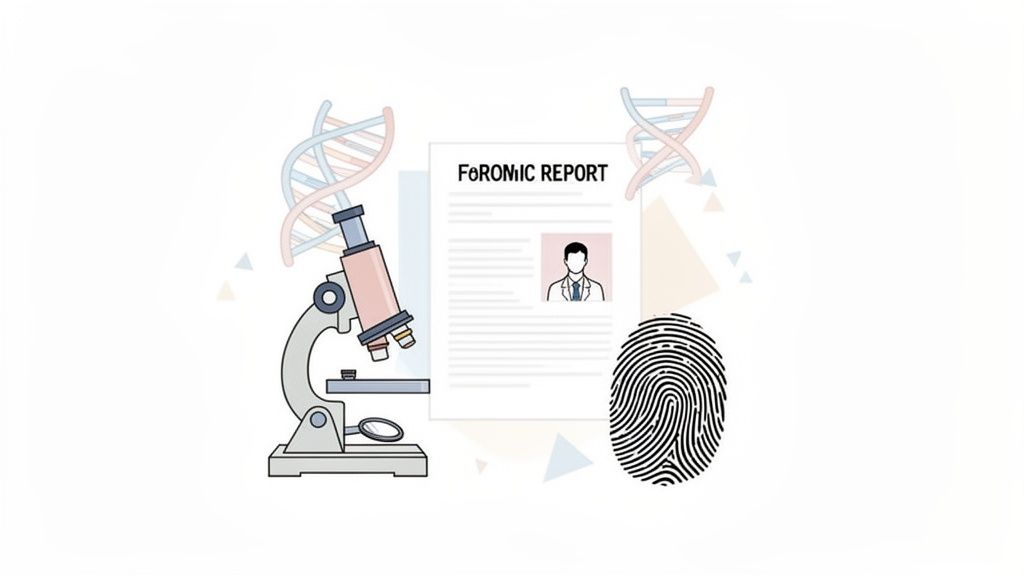
Under Section 39 of the Bharatiya Sakshya Adhiniyam (BSA), an expert—be it a doctor, an engineer, or even a handwriting analyst—can offer their professional opinion on a matter. Their job isn't to be a witness in the traditional sense, but to interpret the facts through the lens of their specialised skill.
Getting Expert Testimony Right
Here's the thing: your expert's credibility is just as crucial as their opinion. A sharp, clear-thinking expert can make complicated issues seem simple and lend immense weight to your argument. On the flip side, an expert who is easily rattled or discredited can sink your entire case.
When you put an expert on the stand, your goal is simple: clarity and persuasion. First, you have to establish their credentials and convince the court they know their stuff. Then, their testimony needs to be broken down into plain English, steering clear of dense, technical jargon that will lose everyone in the room.
Think of common scenarios where this plays out:
Medical Reports: A doctor explaining the specific cause of an injury or death.
Ballistics Analysis: A firearms expert linking a bullet from a crime scene directly to a suspect's gun.
Handwriting Analysis: A specialist confirming or denying the authenticity of a signature on a contested will.
The Rise of Forensic Evidence
Forensic evidence has exploded in importance within India's criminal justice system, and there's a huge legislative reason for it. The Bharatiya Nagarik Suraksha Sanhita, 2023 (BNSS) now makes forensic evidence collection mandatory for 23 serious offences that carry a sentence of seven years or more. For any modern lawyer, this means getting comfortable with forensics is no longer optional.
Forensic science is all about applying scientific methods to physical evidence to forge objective links between a suspect, a victim, and the crime scene itself. It’s a vast field that produces some of the most powerful evidence you can bring to court.
Insights Unlike a witness whose memory can fade or be biased, forensic evidence is built on scientific fact. A DNA match or a clean fingerprint provides a level of certainty that’s incredibly difficult for the other side to argue against.
Some of the key disciplines you'll encounter are:
DNA Analysis: Comparing biological traces like blood or hair to build a genetic profile.
Fingerprint Analysis: Matching the unique ridge patterns left at a scene to a suspect.
Digital Forensics: Pulling apart data from phones, laptops, and servers to uncover hidden information.
In the most complex digital cases, niche skills like blockchain forensics are becoming essential for tracing sophisticated data trails.
How Draft Bot Pro Gives You a Strategic Edge
Let's be honest, wading through expert and forensic reports can be a nightmare. They're often long, packed with technical language, and full of complex data that needs careful translation into a solid legal argument. This is exactly where a legal AI assistant can give you a massive advantage.
Draft Bot Pro is built to cut through this complexity. When you upload a dense forensic or expert report, you can:
Get AI-Powered Analysis: The tool scans and digests intricate reports in seconds, pulling out the most critical findings and flagging potential weaknesses.
Find Corroborating Case Law: It instantly searches for relevant case law that either backs up your expert's findings or helps you challenge the opposition's expert.
Draft Compelling Arguments: Draft Bot Pro helps you build powerful, well-supported arguments based on the report's data, saving you hours and ensuring your submissions are rock-solid.
This means you can either confidently reinforce your expert's testimony with solid precedent or methodically dismantle the other side's claims, giving you a decisive upper hand in court.
Winning Arguments with Circumstantial Evidence
What happens when there’s no smoking gun? No eyewitness to the crime itself? This is where the real art of lawyering comes into play. You have to build a powerful, convincing argument from a series of indirect clues. This is the world of circumstantial evidence—where you don't prove a fact directly, but infer it from a web of related facts.
Think of it like building a chain. A single link might seem weak, almost insignificant on its own. But when you connect multiple links—each a piece of circumstantial evidence—you forge a strong, unbreakable chain of events that points undeniably to a single conclusion.
The Unbreakable Chain of Guilt
Indian courts don't take convictions based on circumstantial evidence lightly. In fact, they've set a very high bar. To secure a conviction, the prosecution must prove that the chain is complete, without a single gap, and that every single link points exclusively to the guilt of the accused. There can be no other logical explanation.
Consider this classic scenario:
A witness sees the accused storm into a house clutching a knife.
Moments later, neighbours hear a piercing scream from inside.
The same witness sees the accused fleeing the house, their clothes stained with blood.
Inside, the victim is found, dead from a stab wound.
Nobody saw the actual stabbing. But the linked circumstances weave a compelling and complete narrative of guilt. Each piece builds on the last, leaving no room for reasonable doubt. To really get a grip on how investigators solidify these links, understanding forensic pathology is invaluable, as it often provides the scientific bedrock for the chain of events.
Understanding Presumptive Evidence
Running parallel to circumstantial evidence is the concept of presumptive evidence. This is a legal tool where a court is allowed—or sometimes required—to assume a fact is true based on other proven facts. The Bharatiya Sakshya Adhiniyam (BSA) lays out three types of presumptions that every lawyer absolutely must have in their toolkit.
Think of these presumptions as legal shortcuts. They help the court move forward when direct proof of a fact is elusive or simply impossible to get.
Insights Presumptions aren't evidence in themselves; they are rules about evidence. They work by shifting the burden of proof, essentially telling the other side: "Either accept this presumed fact, or you better bring some solid evidence to disprove it."
Here’s a breakdown of the three key types:
'May Presume' (Discretionary Presumption): The court has the choice to presume a fact is proven until it's disproven. For instance, if a stolen watch turns up in someone’s pocket shortly after a theft, the court may presume they are either the thief or received stolen goods. The ball is then in the accused's court to explain how they came by the watch legally.
'Shall Presume' (Rebuttable Presumption): This one is stronger. The court must consider a fact proven unless and until the opposing side brings evidence to disprove it. A classic example is the presumption that a child born during a valid marriage is legitimate. The court is bound to accept this, unless compelling evidence proves otherwise.
'Conclusive Proof' (Irrebuttable Presumption): This is the final word. When one fact is declared conclusive proof of another, the court must accept it as proven. No arguments, no counter-evidence allowed. For example, a final judgment from a competent court is conclusive proof of the matter it decided between the parties involved. Game over.
How Draft Bot Pro Strengthens Your Argument
Building a case on circumstantial evidence demands painstaking research and an airtight argument. You have to demonstrate to the court that your "chain of events" isn't just a good story, but is supported by a solid foundation of established legal precedent.
This is where an AI legal assistant can be an absolute game-changer.
With Draft Bot Pro, you can instantly find critical precedents where convictions were upheld on similar circumstantial grounds. Just upload your case facts, and the AI can:
Find Supporting Case Law: In seconds, it pulls up Supreme Court and High Court judgments that mirror your line of reasoning.
Analyse Precedents: It breaks down exactly how the courts in those cases connected the circumstantial dots to arrive at a guilty verdict.
Draft Persuasive Arguments: It helps you weave these powerful precedents directly into your legal submissions, giving your arguments the legal muscle they need to convince the court.
By using Draft Bot Pro, you can transform a collection of scattered, indirect facts into a compelling, legally fortified narrative that’s built to win.
Courtroom Strategy and Evidence Admissibility
Knowing the different types of evidence is one thing; using them to win in court is another game entirely. This is where theory hits the road. Moving from simply identifying a piece of evidence to deploying it with tactical precision is what separates the novices from the seasoned pros. The outcome of your case often boils down to two make-or-break concepts: relevance and admissibility.
Just because a fact feels important doesn't mean a judge will let it in. Relevance is the first, most basic hurdle: does this piece of information actually help prove or disprove a core issue in the dispute?
But admissibility is the real gatekeeper. It's a much stricter, rule-based filter. Think of it this way: a confession is almost always relevant to a criminal case. But if that confession was bullied out of the accused, it becomes inadmissible, no matter how much it seems to prove. Getting this distinction right isn't just academic—it's the foundation of every move you make in court.
From Theory to Tactical Application
Every single piece of evidence, whether it's a witness speaking from the stand or a complex digital file, needs its own specific game plan for introduction. You can't just toss a document at the judge. You have to lay the proper foundation, making sure each item is presented in a way that ticks all the legal boxes.
This means you need to get comfortable with the mechanics of the courtroom:
Introducing Exhibits: This is a methodical process. You mark the item, show it to the opposing counsel, and then formally tender it to the court.
Laying Foundations: Before you can even talk about what's in a document, you have to establish where it came from and why it's trustworthy.
Preserving the Chain of Custody: For any physical or digital item, you must be ready to prove its journey from the crime scene to the courtroom was secure and unbroken. This shuts down any argument that it was tampered with.
Avoiding common mistakes is just as critical. The hearsay rule, for instance, is a minefield. You might have a witness ready to share a bombshell statement, only for it to be shot down as inadmissible hearsay, forcing you to scramble for a new plan on the spot.
The Role of Draft Bot Pro in Courtroom Preparation
A winning courtroom strategy isn't improvised; it's built, piece by piece, long before you ever say, "May it please the court." It demands painstaking preparation, iron-clad documentation, and a rock-solid grasp of the law. This is where an AI-powered legal assistant becomes your most valuable strategic partner.
Draft Bot Pro helps you assemble a case presentation that's not just persuasive, but legally bulletproof.
Insights Courtroom success is so often decided by the quality of your homework. A small mistake in a pleading or a missing case citation can sink your credibility before you even begin your argument. An AI assistant ensures your foundational paperwork is perfect, freeing you up to focus on questioning witnesses and making your case.
With Draft Bot Pro, you can take charge of your prep work:
Draft Flawless Pleadings: Generate legally sharp plaints, written statements, and applications that frame your arguments and evidence correctly from the get-go.
Create Evidence Checklists: Automatically produce detailed checklists for your specific case, making sure you have every document, certificate, and report ready for battle.
Prepare Legal Memos: Instantly pull together research and draft comprehensive legal memos with on-point citations. This gives you the legal firepower you need to back up your arguments in court.
By handling these crucial prep tasks, Draft Bot Pro makes sure your courtroom presentation is not just compelling, but unshakeable. For a closer look at how AI is changing the game, check out our guide on AI for Evidence Act analysis in India. This kind of support lets you focus on what really counts—delivering a winning performance when it matters most.
Evidence FAQs: Quick Answers to Tough Questions
Navigating the labyrinth of evidence rules can trip up even seasoned lawyers. Here are some quick, practical answers to the questions we see pop up most often, especially with the new laws in play.
What's the Real Difference Between Admissibility and Relevancy?
Think of it like getting into an exclusive club.
First, you have to be relevant. This is the initial check at the door. Does your piece of evidence even belong here? Does it have a logical connection to what the case is about? If the bouncer can see you're on the list (i.e., you have a connection to a fact in issue), you've passed the first test.
But then comes admissibility. This is the strict, legal dress code. Just because you're on the list doesn't guarantee entry. Was that confession obtained by force? Was the document properly stamped? Relevancy is a question of common sense and logic. Admissibility is a non-negotiable question of law. A piece of evidence must clear both hurdles to make it inside the courtroom.
How Does the Bharatiya Sakshya Adhiniyam (BSA) Actually Change the Hearsay Rule?
Let's be clear: the core principle that hearsay evidence is generally not allowed in court hasn't gone anywhere. The BSA keeps that fundamental rule firmly in place. All the classic exceptions you know—like dying declarations (now under Section 26) or entries made in the ordinary course of business—are still your trusted tools.
The real shift is more subtle. It comes from how the BSA treats electronic records. By giving them a clearer path to being considered primary evidence, the law indirectly affects how hearsay contained within them might be viewed. It's not a new exception, but a more modern pathway for admissibility, as long as you have the proper certifications nailed down.
Can Draft Bot Pro Tell Me if My Evidence is Fake?
Let's get straight to the point. Draft Bot Pro is your brilliant legal AI associate for research and drafting, not a digital Sherlock Holmes. It can't run a forensic analysis to tell you if a signature on a document is a forgery or if someone has sneakily edited a video file. That's a job for a forensic expert.
But here’s where it becomes your secret weapon. When you're faced with questionable evidence, you can use Draft Bot Pro to instantly pull up the latest Supreme Court and High Court rulings on proving authenticity. It can help you find the exact case law you need on evidence tampering and, most importantly, draft the killer motion you need to challenge that evidence (or defend your own) in court. It gives you the legal ammunition, you pull the trigger.
Ready to build stronger cases without the late-night library sessions? Draft Bot Pro is the AI legal assistant built by Indian lawyers, for Indian lawyers. It's time to supercharge your research, perfect your drafts, and get that strategic edge you need. Join over 46,000 legal pros and try Draft Bot Pro today.
