
A Lawyer's Guide to Winning with IPC Section 397

Section 397 of the Indian Penal Code isn't your typical criminal offence. Think of it less as defining a new crime and more as a serious upgrade to an existing one. It's a powerful sentencing provision that kicks in when a robbery or dacoity gets violent, imposing a mandatory minimum punishment of seven years' rigorous imprisonment.
Essentially, Section 397 is an amplifier for justice. It sends a clear message that using deadly weapons or causing serious harm during a theft will be met with severe consequences, aiming to deter criminals from escalating their actions.
Unpacking the Power of IPC Section 397

So, what exactly triggers this provision? Section 397 comes into play when an already serious crime—robbery or dacoity—becomes even more dangerous. The law singles out specific actions by the offender at the time of the crime:
Using a deadly weapon.
Causing grievous hurt to any person.
Attempting to cause death or grievous hurt to any person.
If any of these boxes are ticked, the offence is elevated, and the harsher penalty of Section 397 applies.
More of a Sentencing Enhancer Than a Standalone Offence
It’s crucial to understand that you can't be charged only under Section 397. It works hand-in-hand with the core offences. For a conviction under this section to hold up in court, the prosecution must first prove that a robbery (as defined in Section 390) or a dacoity (Section 391) actually took place.
Only after establishing the foundational crime can the aggravating factors from Section 397 be brought in to justify the mandatory minimum sentence.
For a quick overview, here are the essential details of IPC Section 397.
IPC Section 397 at a Glance
Attribute | Details |
|---|---|
Nature of Provision | Sentencing enhancer for aggravated robbery or dacoity. |
Minimum Punishment | Seven years of rigorous imprisonment. |
Triggering Acts | Use of deadly weapon, causing grievous hurt, or attempting the same. |
Core Offences | Must be read with Section 390 (Robbery) or Section 391 (Dacoity). |
Cognizability | Cognizable (police can arrest without a warrant). |
Bailability | Non-bailable. |
Triable By | Court of Session. |
This table shows just how seriously the law treats these aggravated offences. It’s also worth noting that while IPC Section 397 has been replaced by Section 311 of the Bharatiya Nyaya Sanhita (BNS) under the new criminal laws, countless ongoing cases and legal precedents are still governed by the original IPC section. For a deeper dive into its procedural aspects, you can find more details on platforms like LawRato.
How a Legal AI like Draft Bot Pro Can Help You Navigate Section 397
Handling a case involving Section 397 means diving deep into case law and meticulously analysing the facts. Did the witness actually see a weapon? Do the medical reports meet the definition of 'grievous hurt'? This is where specialised legal AI can be a game-changer.
Instead of spending hours manually sifting through documents, a tool like Draft Bot Pro can instantly scan a case file and flag the crucial evidence. It can pinpoint witness testimony describing the weapon or highlight the specific injuries in a medical report that align with Section 397's requirements. This frees up legal professionals to focus on strategy rather than paperwork.
By letting AI handle the initial heavy lifting of research and drafting, lawyers can build much stronger, more precise arguments from the get-go.
Breaking Down the Core Ingredients of Section 397

To make a charge under Section 397 stick—or to defend against it effectively—you have to break it down into its essential parts. Think of it as a three-part legal test. The prosecution has the tough job of proving every single part beyond a reasonable doubt. If even one ingredient is missing, the whole charge falls apart.
The entire case is built on one foundation: a primary offence must have been committed. Before anyone even starts talking about the seven-year minimum sentence, the court has to be completely satisfied that a robbery or dacoity actually took place. This is the absolute, non-negotiable starting point.
This first step is crucial. It ensures the section is only used for seriously aggravated forms of theft that involve violence or the immediate threat of it, not just any simple theft.
Ingredient 1: The Foundational Offence
The first hurdle for the prosecution is proving the act of robbery or dacoity, as the Indian Penal Code defines them. Robbery, under Section 390, isn't just theft; it's theft supercharged with the element of causing (or trying to cause) death, hurt, or wrongful restraint. Dacoity, under Section 391, is simply a robbery pulled off by a group of five or more people.
Without solid, convincing evidence of this foundational crime, any discussion about deadly weapons or serious injuries is legally pointless. The entire case under IPC Section 397 hangs on this one prerequisite.
Ingredient 2: Using a Deadly Weapon
This is where things often get heated in the courtroom. The law is very specific: the offender must 'use' a deadly weapon. That one word, 'use', is everything. Courts have consistently ruled that 'using' a weapon means a lot more than just having one on you.
Consider these two scenarios:
Scenario A: A robber has a knife in their pocket during the crime but never shows it.
Scenario B: A robber pulls out a knife, points it at the victim, and threatens them to hand over their valuables.
Legally speaking, only Scenario B would likely trigger Section 397. The act of 'using' the weapon requires some kind of overt action. It has to be brandished, pointed, or employed in a way that is meant to intimidate, threaten, or terrorise the victim. Merely carrying it isn't enough.
Insights from Legal PracticeThe line between possession and use is a critical battleground in these cases. A smart defence often hinges on showing that while a weapon might have been present, it was never actively used to commit the crime or instil fear. This can effectively pull the offence out of the harsh territory of Section 397.
Ingredient 3: Causing Grievous Hurt or Attempting Death
What if no deadly weapon was used? The prosecution still has another way to invoke Section 397. They must prove that the offender either caused grievous hurt or attempted to cause death or grievous hurt while committing the robbery or dacoity.
Let's unpack that a bit:
Causing Grievous Hurt: This isn't just any injury. It refers to the severe kinds of harm defined in Section 320 of the IPC, like a permanent loss of sight, a bone fracture, or any injury that puts a person's life in danger. A simple slap or a shove won't cut it.
Attempting to Cause Death or Grievous Hurt: Here, the focus is on the offender's intent and actions. For instance, swinging a heavy iron rod at someone's head—even if they duck and it misses—could easily be seen as an attempt to cause grievous hurt.
A 2023 Madras High Court ruling illustrates this perfectly. A conviction under Section 397 was overturned because the victim, though robbed, didn't suffer any grievous hurt or face a life-threatening act. The court was clear: since no weapons were used and no severe injuries were inflicted, the essential ingredients for Section 397 were simply not met. The conviction for the robbery itself remained, but the harsher charge was dismissed. This just goes to show how critical it is for the prosecution to prove these specific harms.
How Legal AI like Draft Bot Pro Can Streamline Your Case Analysis
When you're handed a complex case file involving IPC Section 397, sifting through pages of documents to pinpoint these specific ingredients can be a real grind. This is exactly where a legal AI assistant like Draft Bot Pro can be a game-changer. By uploading documents like the FIR, witness statements, and medical reports, you can tell the AI to instantly flag any mention of these core elements.
Draft Bot Pro can scan witness testimony for descriptions of a weapon being brandished or cross-reference a medical report to see if an injury qualifies as 'grievous hurt'. This kind of automated analysis shaves hours off your manual review time, letting you quickly size up the strengths and weaknesses of a case and start building a smarter legal strategy right away.
The Critical Difference: "Using" vs. Just "Having" a Weapon
In the high-stakes world of IPC Section 397, no word is more fiercely debated than 'uses'. It’s a game-changer. This single term is often the pivot upon which a case turns, deciding whether an accused faces a mandatory minimum of seven years behind bars or a lesser penalty. It's the bright line drawn by the courts between someone just having a weapon on them and actively using it to create terror.
For any lawyer handling these cases, grasping this distinction isn't just academic—it's a core strategic tool. The courts have been crystal clear: merely having a knife in your pocket during a robbery is worlds away from brandishing it to scare a victim. This nuance ensures the heavy hammer of Section 397 is reserved for offenders who truly escalate the violence and fear.
What Does 'Use' Actually Mean? It's an Overt Act.
The legal principle is pretty straightforward. For Section 397 to stick, the offender must do something tangible with the weapon. An overt act. The whole point of this act has to be to create fear, apprehension, or sheer terror in the victim's mind, making them give up their property. Put simply, the weapon has to be put into motion as a tool of intimidation.
Picture this: two people commit a robbery. One has a gun tucked away, never seen by the victim. The other pulls out a small knife and starts shouting threats. Under the strict interpretation of Section 397, only the person who waved the knife can be pinned under this section. It doesn't matter that the hidden gun is objectively more dangerous.
This is a crucial point because it zeroes in on the offender's action and its effect on the victim, not just the mere presence of a weapon.
The Phool Kumar Precedent: The Case That Defined It All
The landmark Supreme Court judgment in Phool Kumar v. Delhi Administration was the case that really cemented this interpretation. The court picked apart the word 'uses' and concluded it means something much more than just possession. It requires the weapon to be actively put to work for the robbery.
Insights from the Supreme CourtThe Supreme Court held that the 'use' of a weapon under Section 397 involves showing it off in a menacing way. The act of brandishing, pointing, or otherwise displaying the weapon to frighten the victim is what qualifies as 'use'. This makes sure the provision targets the heightened blame of an offender who actively leverages a weapon to get what they want.
This ruling has been the bedrock of how this section is understood ever since. It prevents the mandatory minimum sentence from being slapped on everyone involved in a crime, focusing instead on who did what.
It's About Individual, Not Group, Liability
A major takeaway from this interpretation is that Section 397 works on individual liability. It doesn't rope in everyone based on a 'common intention' like Section 34 of the IPC does.
Here’s what that means in practice:
Only the Person Who Acts is Liable: The individual who actually 'uses' the deadly weapon, causes grievous hurt, or tries to, is the one who gets charged under Section 397.
No Free-Riding Charges: If one member of a dacoity crew uses a weapon, the others aren't automatically on the hook for a Section 397 charge just because they were there. They’d still be liable for dacoity under Section 395, but not for this aggravated offence unless they also used a weapon or caused hurt.
This distinction is a lifeline for defence lawyers arguing against a wrongful Section 397 charge in group cases. The prosecution has to prove, with solid evidence, exactly which person used the weapon.
This very principle was just recently reinforced. The Supreme Court's stance in Phool Kumar v. Delhi Administration and later rulings has made it clear: to trigger Section 397, the offender must actively 'use' a weapon to terrorise the victim—just having it isn't enough. A three-judge bench including CJI NV Ramana, AS Bopanna, and Hima Kohli reiterated that 'use' means brandishing or showing the weapon to threaten, which is what justifies the mandatory 7-year minimum rigorous imprisonment.
How a Legal AI like Draft Bot Pro Can Sharpen Your Arguments
When you're building a defence around the 'use' versus 'possession' argument, citing the right case law is everything. Manually digging up and summarising key judgments like Phool Kumar eats up precious time. This is where a tool like Draft Bot Pro gives you a serious edge.
You can use its AI-powered legal research to instantly find and break down relevant judgments. Just ask for case law defining 'use' under Section 397, and you'll get concise summaries of the landmark rulings, complete with citations. This helps you quickly assemble solid precedents, beef up your written submissions, and argue your case in court with confidence. You might also be interested in how grievous hurt is defined, which we cover in our guide on Section 325 IPC punishment.
Navigating The Web Of Allied Legal Provisions
Section 397 of the Indian Penal Code doesn’t operate in a vacuum. Think of it as a major highway in a complex road map of laws dealing with robbery and dacoity. Knowing the main highway is essential, but to truly understand the legal landscape, you need to know all the connecting roads and alternate routes.
For any lawyer, whether prosecuting or defending, mastering these allied sections is a matter of strategy. It’s what separates a correctly framed charge from a weak one, and it dictates whether an alternative plea is possible or if the prosecution has simply overreached. The IPC creates a tiered response to crimes of theft and violence, and each section marks a different level of severity.
The Graduated Penal Ladder Of Robbery And Dacoity
The IPC lays out a clear hierarchy for these offences. Punishments get steeper based on factors like how many people were involved and the level of violence used. Section 397 sits high up on this ladder, but it’s crucial to see how it connects to the rungs below it. This system ensures the punishment truly fits the crime.
IPC Section 397 is deeply intertwined with these other provisions. For example, Section 391 defines dacoity as a robbery committed by five or more people. This is punishable under Section 395 with up to life imprisonment. But if just one of those offenders uses a deadly weapon or causes grievous hurt, Section 397 kicks in with its mandatory minimum of seven years’ rigorous imprisonment. The law is so stringent that even preparing for dacoity is a serious crime under Section 399, carrying a sentence of up to 10 years.
This chart nails the critical difference between merely having a weapon and actually using it—the very act that triggers Section 397.
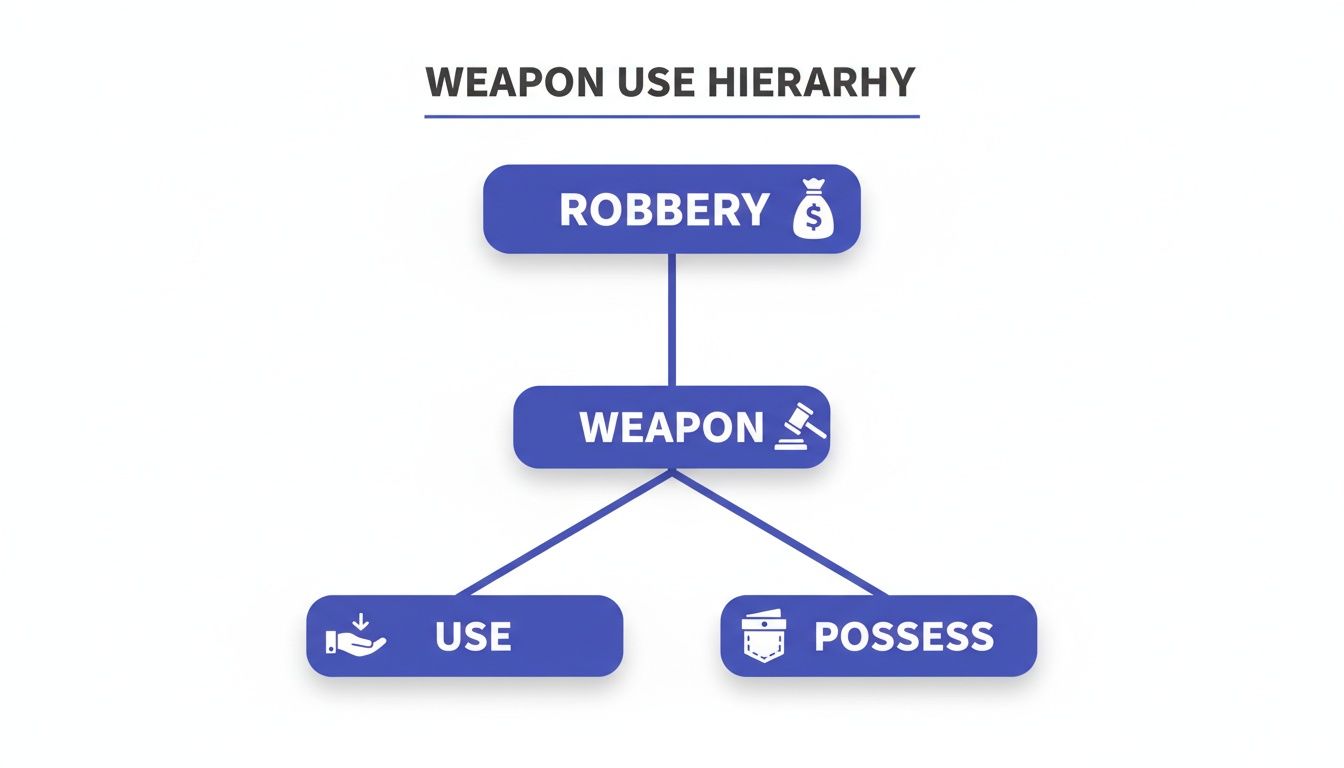
As you can see, 'use' isn't just about possession; it's a specific action that elevates the entire offence, a key point in any legal argument.
Comparing Key Sections: A Closer Look
Legal battles are often won or lost in the subtle differences between Sections 397, 398, and 395. Take Section 398, for instance. It covers the attempt to commit robbery or dacoity while armed with a deadly weapon. It carries the same tough seven-year minimum sentence but applies when the crime itself isn't successfully completed.
To make things crystal clear, let's break down the key distinctions.
Comparison of IPC Sections 397, 398, and 395
Provision | Core Element | Act Required | Minimum Punishment |
|---|---|---|---|
Section 397 | Successful Robbery or Dacoity | Using a deadly weapon or causing grievous hurt. | Seven years RI. |
Section 398 | Attempt to Commit Robbery/Dacoity | Being armed with a deadly weapon during the attempt. | Seven years RI. |
Section 395 | Dacoity | Commission of dacoity by five or more people. | No minimum, but up to life imprisonment. |
This table shows exactly what circumstances each section is built for. The distinction between "using" a weapon in Section 397 and "being armed" with one in Section 398 is a classic example of a nuance that can completely change a case's outcome. Similarly, getting a handle on group liability is crucial, a topic you can dive into with our complete guide to Section 148 IPC on rioting while armed.
Insights on Legal StrategyA common defence tactic is to argue for conviction under a lesser-included offence. If the prosecution can't prove the 'use' of a weapon beyond a reasonable doubt, a sharp defence lawyer might concede that a robbery occurred but argue that the strict conditions of Section 397 aren't met, pushing for a conviction under the general Section 392 (Punishment for robbery) instead.
How a Legal AI like Draft Bot Pro Clarifies Your Legal Path
Getting lost in this web of provisions is easy. Frame a charge under the wrong section, and the prosecution’s case is instantly weakened. Misunderstand the nuances, and a defence strategy crumbles. This is where AI-powered legal tools give you a real edge.
Draft Bot Pro can analyse the facts of your case and point to the most appropriate sections to apply. It cross-references your evidence with the specific ingredients of Sections 395, 397, and 398, ensuring you start with legal accuracy. This helps you build precise charge sheets or legal notices, backed by a solid understanding of how these laws interact, saving you time and preventing strategic blunders.
Landmark Judgments That Define Section 397
The black-and-white text of a statute gives you the rules of the game. But it’s in the courtroom, through the rigorous process of judicial interpretation, that the real meaning and power of the law are forged. This is especially true for IPC Section 397.
Over the years, the Supreme Court of India has handed down a series of critical judgments that have chiselled away the ambiguities of this tough provision. These rulings aren't just academic exercises; they are the very foundation of any solid litigation strategy, clarifying contentious terms and setting the ground rules for how lawyers on both sides must approach these high-stakes cases.
If you’re a legal professional dealing with Section 397, getting these precedents into your DNA is non-negotiable.
The Core Principle: It’s All About Individual Liability
The single most important principle hammered out by the courts regarding Section 397 is individual liability. This is the legal firewall that stops the provision from being slapped onto every single person involved in a robbery or dacoity.
The judiciary has been crystal clear: the harsh mandatory minimum sentence is reserved only for the specific person who actually commits the aggravating act.
So, who does the law target? The offender who personally uses the deadly weapon, causes the grievous hurt, or attempts to do so. The courts have thrown out the idea of roping in co-accused through vicarious or constructive liability, where one person's actions could make everyone else equally guilty under this specific section.
This distinction is massive. It ensures the most severe penalties are kept for those who personally escalate the violence, not accomplices who may have been present but didn't commit the specific act themselves.
Ganesan v. State: The Modern Authority on the Matter
The Supreme Court put a fine point on this issue in the case of Ganesan v. State (2021 SCC OnLine SC 1023). A bench headed by the then-CJI NV Ramana delivered a decisive ruling that hammered home the principle of individual guilt.
The Court held, in no uncertain terms, that Section 397 applies only to the specific 'offender' who personally brandishes and uses the weapon. You can't just apply it vicariously to their partners in crime. This judgment wasn't out of the blue; it built on a solid line of earlier rulings, like Dilawar Singh v. State of Delhi (2007) 12 SCC 641, which had consistently favoured individual liability over a group-based guilt.
The Ganesan ruling is now the go-to authority. For defence counsel, it's a powerful precedent to shield clients from being unfairly dragged into a Section 397 charge because of what someone else did.
Insights on Judicial ConsistencyIf you look at the trajectory from Dilawar Singh to Ganesan, you see a clear pattern. The Supreme Court has consistently worked to prevent Section 397 from being misused. The courts are guarding the seven-year mandatory minimum sentence, making sure it’s not applied loosely and reinforcing the idea that heavy punishments demand direct, personal wrongdoing.
What This Means for Your Litigation Strategy
These landmark judgments have a direct, real-world impact on how IPC Section 397 cases are fought in court.
For the Prosecution: You've got a high bar to clear. It’s not enough to just prove a weapon was present during a dacoity. You must bring forward solid, unambiguous evidence that ties a specific accused to the act of using that weapon. This usually means you need rock-solid eyewitness testimony or compelling forensic proof.
For the Defence: The principle of individual liability is your best friend. A core defensive strategy is to poke holes in the evidence identifying exactly who used the weapon. If there’s any confusion, contradiction, or ambiguity in the witness statements, you can create reasonable doubt and potentially get the Section 397 charge thrown out.
Knowing these judicial precedents inside and out is crucial. To get a wider perspective, you might want to explore our article on the top 8 landmark judgments of the Supreme Court of India.
How a Legal AI like Draft Bot Pro Makes Precedent Research Faster
Building a winning argument means standing on a strong foundation of case law. But let's be honest, manually digging up, reading, and summarising key precedents like Ganesan and Dilawar Singh is a massive time sink. This is exactly where Draft Bot Pro gives you a serious edge.
Instead of spending hours in the library or sifting through online databases, you can simply give the AI a brief of your case. Draft Bot Pro will instantly generate a comprehensive legal memo, identifying and summarising the most relevant landmark judgments on IPC Section 397, complete with accurate citations. It allows you to grab the core legal principles in minutes and weave them straight into your drafts and courtroom arguments, ensuring everything you say is backed by the highest judicial authority.
Winning Courtroom Strategies for Prosecution and Defence
Navigating a case under IPC Section 397 demands more than just knowing the black-letter law; it requires a battle-tested strategy. Whether you're building a case for the prosecution or dismantling it for the defence, the outcome often turns on your ability to prove—or disprove—the core ingredients of the offence. Success here is all about precision, preparation, and knowing exactly where to apply pressure.
For both sides, the real fight is rarely about whether a robbery happened. Instead, it’s a laser-focused battle over the aggravating factors. Was a deadly weapon actually used? Did the victim suffer grievous hurt? Was there a clear attempt to cause death? These are the questions that determine if the heavy seven-year minimum sentence comes into play.
A Roadmap for the Prosecution
Building an airtight case for Section 397 is a methodical process, one focused on gathering irrefutable evidence. Your objective isn't just to prove a robbery occurred, but to paint a vivid picture of the terror and violence that justifies the enhanced punishment.
Your strategy must zero in on these points:
Establishing the 'Use' of the Weapon: This is your most critical task. You need to prove an overt act by the offender. Secure clear, consistent eyewitness testimony describing exactly how the weapon was brandished or used to intimidate. Police seizure memos (panchnamas) and forensic reports confirming the weapon's nature are your essential backup.
Proving Grievous Hurt: If your case hinges on an injury, the medical evidence is your cornerstone. You must ensure the medical report explicitly details injuries that fall squarely within the definition of "grievous hurt" under Section 320 of the IPC, like fractures or life-endangering wounds. The doctor's testimony is vital to connect the accused's actions directly to these specific, severe injuries. For particularly complex cases, getting an expert opinion from a specialised medico-legal consultancy can add significant weight to your arguments.
Demonstrating Intent: The offender's actions must scream intent. They must show a clear desire to terrorise or inflict serious harm. Witness accounts describing spoken threats, menacing gestures, or how close the weapon was held to the victim are incredibly powerful tools for establishing this crucial element.
Battle-Tested Tactics for the Defence
As defence counsel, your strategy is one of surgical precision. You need to find the prosecution's weakest link and exploit it to create that all-important reasonable doubt. The mandatory minimum sentence makes this a high-stakes fight where every single detail matters.
Focus your attack on these key areas:
Challenge the 'Use' of the Weapon: Aggressively cross-examine witnesses on the specifics. Was the weapon just seen, or was it actively brandished? Pounce on any inconsistencies in testimony about the weapon's description, its location, or the way it was supposedly used.
Question the 'Deadly' Nature: Scrutinise the weapon itself. If it was a small kitchen knife or a blunt object, you can argue that it doesn't meet the high threshold of a "deadly weapon" capable of causing death in the ordinary course of things.
Dispute the Injury: If grievous hurt is the allegation, put the medical evidence under a microscope. Was the injury actually a simple hurt that the prosecution is trying to magnify? Expose any procedural slips in the medical examination or any ambiguities you can find in the doctor’s report.
Insights on Courtroom AdvocacyA powerful defensive move is to expose the gaps between the initial complaint (FIR) and what witnesses say later in court. If the victim’s first statement to the police never mentioned a weapon being used to threaten them, but that detail suddenly appears during their testimony, you can argue it's a later embellishment. This can seriously damage the prosecution's credibility.
How a Legal AI like Draft Bot Pro Sharpens Your Strategy
Winning in court starts long before you step inside; it starts with superior preparation. A legal AI tool like Draft Bot Pro can be your strategic partner. For the defence, you can use it to draft a compelling bail application that systematically picks apart the grounds for invoking Section 397, highlighting every weakness in the prosecution's case.
Furthermore, by uploading witness statements, you can ask Draft Bot Pro to generate sharp, incisive cross-examination questions designed to expose inconsistencies and undermine the credibility of key prosecution witnesses. This means you walk into the courtroom not just ready, but several steps ahead.
Answering Your Key Questions on IPC Section 397
Let's clear up some of the most common points of confusion that arise in practice when dealing with Section 397. Getting these distinctions right is crucial.
Is Section 397 a Standalone Offence?
Not at all. Think of it as a sentencing add-on, not a separate crime. You can't just charge someone under Section 397 by itself. The prosecution first has to prove the core offence of either robbery (Section 390) or dacoity (Section 391). Only then does Section 397 kick in to impose a stricter, mandatory minimum punishment.
Does it Apply to the Whole Gang?
This is a classic trap for the unwary. The answer is a firm no. Landmark court judgments have repeatedly clarified that Section 397 hinges on individual liability. It doesn't matter if five people committed a dacoity together; only the specific person who actually used the deadly weapon or caused grievous hurt gets slapped with a 397 conviction. You can't hold their accomplices vicariously liable under this specific section.
What’s the Minimum Jail Time?
Once the ingredients are proven, the law is rigid: the court must impose a rigorous imprisonment for a term of not less than seven years. There's no discretion to go below this mark.
The application of this section is far from rare. According to the National Crime Records Bureau, India saw over 2,800 dacoity cases filed under related sections. With urban robberies climbing by 12% in major cities from 2021, the use of weapons often brings Section 397 into play. You can dive deeper into how courts analyse the use of deadly weapons in robbery cases through various legal analyses.
Insights from a Practitioner's TakeThe real courtroom battle in a Section 397 case almost always boils down to two things: the fine line between merely 'possessing' a weapon versus actively 'using' it, and the principle of individual liability. Whether you're prosecuting or defending, your entire strategy will likely be built around these two pillars. Get them right, and you're in a strong position.
Juggling complex legal arguments and drafting precise documents for criminal cases can be incredibly demanding. A legal AI assistant like Draft Bot Pro can be a game-changer.
Draft Bot Pro can help you pinpoint specific case law, dissect evidence against the core ingredients of ipc section 397, and craft razor-sharp legal arguments in minutes. See how our AI can become your essential paralegal at https://www.draftbotpro.com.
