
A Lawyer's Guide to Maintenance Pendente Lite in India

When a marriage breaks down, the legal battle that follows can be a long and draining process. For a spouse who is financially dependent, this period can be incredibly daunting. How are they supposed to pay for rent, daily expenses, and the steep costs of litigation itself? This is where the crucial legal concept of maintenance pendente lite comes into play.
Think of it as financial first-aid. It’s a temporary support order from the court, meant to keep the financially weaker spouse afloat while the main matrimonial case is still being decided. The term itself, pendente lite, is Latin for "while the litigation is pending."
This provision, most notably found under Section 24 of the Hindu Marriage Act, 1955, is a legal lifeline. It ensures that one party doesn't get starved into submission or forced to accept an unfair settlement simply because they've run out of money.
The Purpose of Interim Financial Support
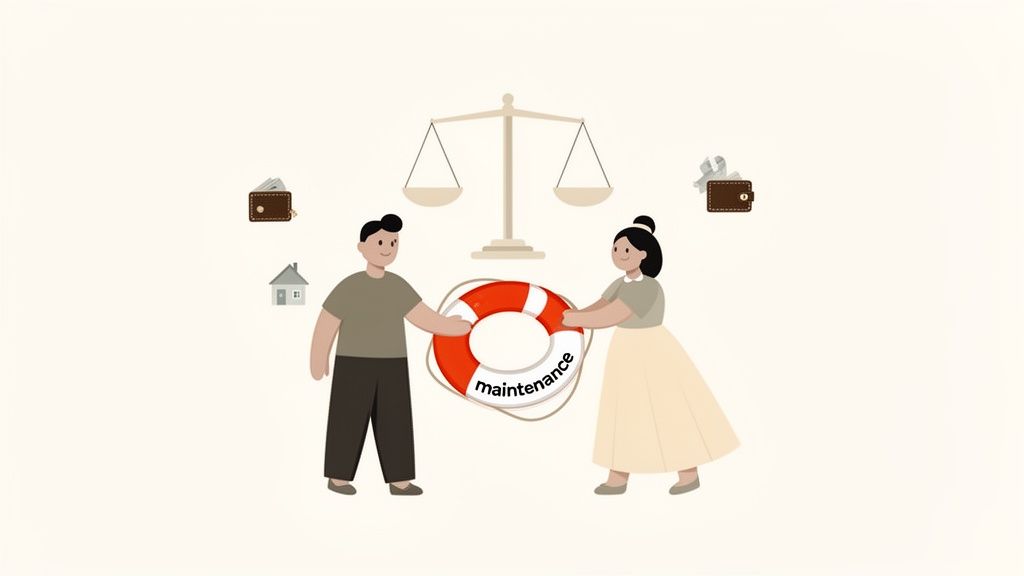
Imagine matrimonial litigation is a marathon. Maintenance pendente lite is the water and energy provided at regular intervals to a runner who might otherwise collapse before the finish line. Its purpose isn't to decide the final prize money, but to ensure both runners have a fair chance to complete the race.
At its core, this interim support is all about fairness. The law gets it—when a couple separates, the spouse who wasn't the primary earner is left in a vulnerable position. So, the court steps in to bridge that gap temporarily.
Key Objectives of Maintenance Pendente Lite
Financial Stability: First and foremost, it’s about covering the basics. This support helps the dependent spouse manage essential living costs like rent, groceries, and bills, preventing them from falling into debt or poverty while the main case drags on.
Access to Justice: Let's be honest, lawyers aren't cheap. This support helps level the playing field by giving the dependent spouse the funds to hire a lawyer and cover court-related expenses. Without it, the wealthier spouse could simply outspend them into silence.
Maintaining Status Quo: The court tries to prevent a drastic, overnight plunge in the standard of living for the dependent spouse and any children involved. The idea is to maintain a lifestyle that's reasonably close to what they were accustomed to during the marriage, at least until the final orders are passed.
The Role of Modern Legal Tools
In the old days, drafting and filing these applications was a tedious, manual process. But that's changing. Today, legal AI tools can make a huge difference. A lawyer using a platform like Draft Bot Pro, for example, can generate a sharp, well-argued application for interim maintenance in a fraction of the time.
By simply inputting the client's financial details and the case facts, the AI can help frame the arguments, structure the application, and even pull up relevant case law to justify the amount being claimed. In a situation where every day counts, this kind of speed is a game-changer for a client in desperate need of funds.
Insights The spirit behind maintenance pendente lite isn't to punish or reward anyone. It’s all about equity. A judge’s primary goal is to stop a situation where one person can use their financial muscle to bully the other into an unjust settlement. It's a temporary measure, designed purely to ensure both parties can stand on equal footing in court until the final verdict is delivered.
The Legal Framework and Eligibility for a Claim
To really get to grips with maintenance pendente lite, we need to pop the bonnet and look at the legal engine that makes it run. In India, the absolute cornerstone for this is Section 24 of the Hindu Marriage Act, 1955. Think of this section as the main switch that allows a spouse to claim interim support and money for legal fees while a case, like a divorce or judicial separation, is ongoing.
But the idea of providing temporary support isn't just a one-act show. It's a fundamental principle that pops up across India's diverse personal laws, making sure everyone has a safety net.
The Go-To Statutes for Interim Maintenance
The right to ask for financial help while a case is in court is a common thread woven through the rich tapestry of India's family laws. Each law provides a specific route for a financially dependent spouse to get the funds they need to stay afloat and fight their case fairly.
To make this easier, here's a quick rundown of the key legal provisions that power maintenance pendente lite claims.
Key Statutes for Maintenance Pendente Lite in India
A quick reference guide to the primary legal sections governing interim maintenance across different personal laws in India.
Statute | Governing Section | Key Feature |
|---|---|---|
Hindu Marriage Act, 1955 | Section 24 | The most widely cited provision, it's completely gender-neutral, meaning either the husband or wife can file a claim. |
Special Marriage Act, 1954 | Section 36 | Applies to civil and inter-faith marriages, offering a similar framework for support and litigation expenses. |
Parsi Marriage and Divorce Act, 1936 | Section 36 | Provides for alimony pendente lite specifically for the Parsi community during matrimonial proceedings. |
Divorce Act, 1869 | Section 36 | The relevant provision for Christian marriages, ensuring interim financial support is available during disputes. |
As you can see, this robust legal framework ensures that no matter which personal law applies to you, the fundamental right to seek financial help during litigation is well-protected.
Who Can Actually File a Claim?
One of the most forward-thinking aspects of Section 24 of the Hindu Marriage Act is its complete gender-neutrality. It shatters the common myth that only a wife can ask for maintenance. The law is crystal clear: either the husband or the wife can apply, levelling the playing field entirely.
To successfully get a maintenance pendente lite order from the court, an applicant has to tick three crucial boxes:
There's a Valid Marriage: You must first prove that a legally recognised marriage exists between you and the other person.
A Matrimonial Case is Already in Progress: You can't just file for interim maintenance out of the blue. It has to be part of a main case (like divorce) that is already active in court.
You Don't Have Enough Independent Income: This is the big one. You need to show the court that you don't have enough money to support yourself and cover the necessary costs of fighting the case.
Now, that phrase 'sufficient income' isn't set in stone. It's totally subjective and the court decides what it means based on the unique facts of your situation. It doesn't mean you have to be completely broke; it just means your income isn't enough to maintain the lifestyle you were used to during the marriage.
If you're looking for a deeper dive into other financial reliefs available, our guide on Section 20 of the Domestic Violence Act is a great place to start.
Insights These days, courts have zero patience for financial hide-and-seek. Thanks to the Supreme Court's landmark guidelines in the Rajnesh v. Neha case, both spouses are now required to file incredibly detailed affidavits of their income, assets, and liabilities. This isn't optional. This mandatory disclosure is a game-changer, helping the court make a fair call and stopping people from hiding their true financial picture.
How Courts Are Handling Gender Neutrality in the Real World
This isn't just theory; judges are actively applying the gender-neutral principle. Take a 2023 ruling from the Delhi High Court, for instance. The court upheld the principle but cleverly adjusted the maintenance amount. The husband was initially ordered to pay ₹30,000 per month, but the High Court tweaked it to ₹21,000 to sync up with an existing maintenance order from a Domestic Violence Act case. It’s a perfect example of how courts work to ensure fairness and prevent conflicting orders across different proceedings.
How Draft Bot Pro Can Help
When you're trying to prove your eligibility, getting the paperwork right is half the battle. This is where Draft Bot Pro comes in. It can help you put together a clear, well-structured affidavit of your assets and liabilities. Just upload your financial documents, and you can instruct the AI to organise everything into a powerful narrative that proves your need for maintenance pendente lite, making sure you hit all the legal marks.
How Courts Figure Out the Maintenance Amount
Deciding on the right amount for maintenance pendente lite isn't a simple math problem. There's no magical formula a judge can use. Instead, it’s a careful balancing act, a bit of an art, where the court weighs a whole host of factors to land on a number that feels fair to everyone involved.
The point isn't to make both spouses' incomes equal. It’s about making sure the dependent spouse can live with dignity and without falling into financial hardship while the case is ongoing. Think of it as a temporary financial bridge, not a permanent restructuring of wealth.
The Key Factors in the Judicial Mix
Every case is different, so the final amount is always tailored to the specific facts. Indian courts look at a wide range of things when they're working out the quantum of interim maintenance.
Here are some of the most critical elements they'll toss into the mix:
The Couple's Lifestyle: The court first looks at the standard of living the couple enjoyed while they were together. The maintenance needs to be enough for the dependent spouse to maintain a similar, though not necessarily identical, lifestyle.
Income and Earning Power: This is a big one. The court takes a hard look at what both spouses actually earn. But it doesn't stop there. It also considers their potential to earn. If one spouse is highly qualified but chooses not to work, the court will take that into account.
The Applicant's Needs: The genuine, day-to-day needs of the person asking for maintenance are front and centre. This covers everything from rent and groceries to utility bills and, importantly, the money needed to actually fight the court case.
Assets and Debts: What do both parties own, and what do they owe? A spouse with a healthy bank balance or other assets might get less, while someone drowning in debt might need more support.
You'll often hear lawyers talk about the ‘one-third of net income’ rule, which has popped up in various High Court and Supreme Court judgments. But let's be clear: this is just a guideline, a starting point. It's a benchmark, not a binding rule. A judge can, and often will, move away from this figure based on all the other factors at play.
Why Your Evidence is Everything
At the end of the day, the entire calculation comes down to solid proof. A judge isn't going to just take your word for it. You need documents to back up your claims. The person asking for maintenance has to build a strong case with clear evidence of their needs and the other party's income.
Insights What if one spouse tries to be clever and hide their real income? The courts have seen it all before, and they do not take kindly to these games. If someone deliberately conceals their finances or refuses to produce documents, the court is allowed to draw an ‘adverse inference’ against them. This basically means the judge can assume the hidden income is significant and might award a higher maintenance amount based on the applicant's claims and lifestyle evidence.
For example, the Madhya Pradesh High Court recently looked at a case for increasing maintenance. The court meticulously went through the financial disclosures from both sides, making it clear that the final amount has to match the husband's ability to pay and the wife's reasonable needs—not fund a life of luxury. You can see how the court broke it down in the full order regarding maintenance pendente lite. It’s a perfect illustration of why transparent financial evidence is non-negotiable.
Backing Up Your Claim with a Little Help from AI
Arguing for a specific maintenance amount requires more than just showing salary slips and bank statements. You need to show the court that your request is legally sound and supported by precedent. This is where a tool like Draft Bot Pro can be a game-changer. Its AI-powered legal research can instantly pull up relevant case law where courts awarded a certain amount of maintenance in similar financial situations.
You can upload the financial affidavits of both parties and ask Draft Bot Pro to find judgments involving similar income levels and family setups. When you present these precedents to the court, your claim is no longer just a request—it's a well-reasoned, legally-backed submission. This kind of strategic preparation can make all the difference in getting a fair order for your client.
Navigating the Application and Enforcement Process
Getting an order for maintenance pendente lite isn't a single event; it's a structured legal journey. You can think of it as a series of well-defined steps, where every detail matters. The process is specifically designed to be quick, so the dependent spouse gets financial support without being bogged down by procedural delays.
It all kicks off when you file an application under the relevant law, usually right inside the main case, like a divorce or separation petition. This application is more than just a request—it’s a formal legal document that lays the entire groundwork for the claim.
Kicking Off the Application
The first real step is drafting and filing the interim maintenance petition. This document needs to be crystal clear about the applicant's financial situation and why they need support, while also showing that the other party has the means to pay. Ever since the Supreme Court's game-changing judgment in Rajnesh v. Neha, this application is incomplete without a comprehensive affidavit of assets and liabilities.
This affidavit isn't optional. It demands a full and honest disclosure of:
Monthly income from every single source.
Details of all properties, both movable and immovable.
Information on any investments, shares, or other financial assets.
A complete breakdown of any debts and liabilities.
Once this is filed, the court sends a notice to the other spouse. They are then legally required to file their own detailed affidavit and a formal reply. This back-and-forth ensures that both sides have laid their financial cards on the table, giving the judge a transparent picture to work with.
Insights In my experience, most delays in getting an order come from a poorly drafted or incomplete initial application. If your petition is meticulously prepared from day one, backed up by solid documents for every claim, you can dramatically cut down the time it takes. Leave no room for doubt or ambiguity.
From Arguments to Enforcement
With all the paperwork filed, the case moves to the arguments stage. This is where the lawyers for both sides make their case, using the affidavits and evidence to paint a picture of the applicant's needs versus the respondent's income and lifestyle. The court then weighs everything and passes an order, either granting or denying maintenance.
But getting the order is only half the job done. What if the other party just decides not to pay? That's where enforcement comes in. If the payments don't arrive as ordered, the receiving spouse has to go back to court and file an execution petition. The court has some serious powers here—it can attach the defaulting spouse’s salary or even their property to make sure the dues are recovered.
The court's calculation process generally boils down to a few key factors.
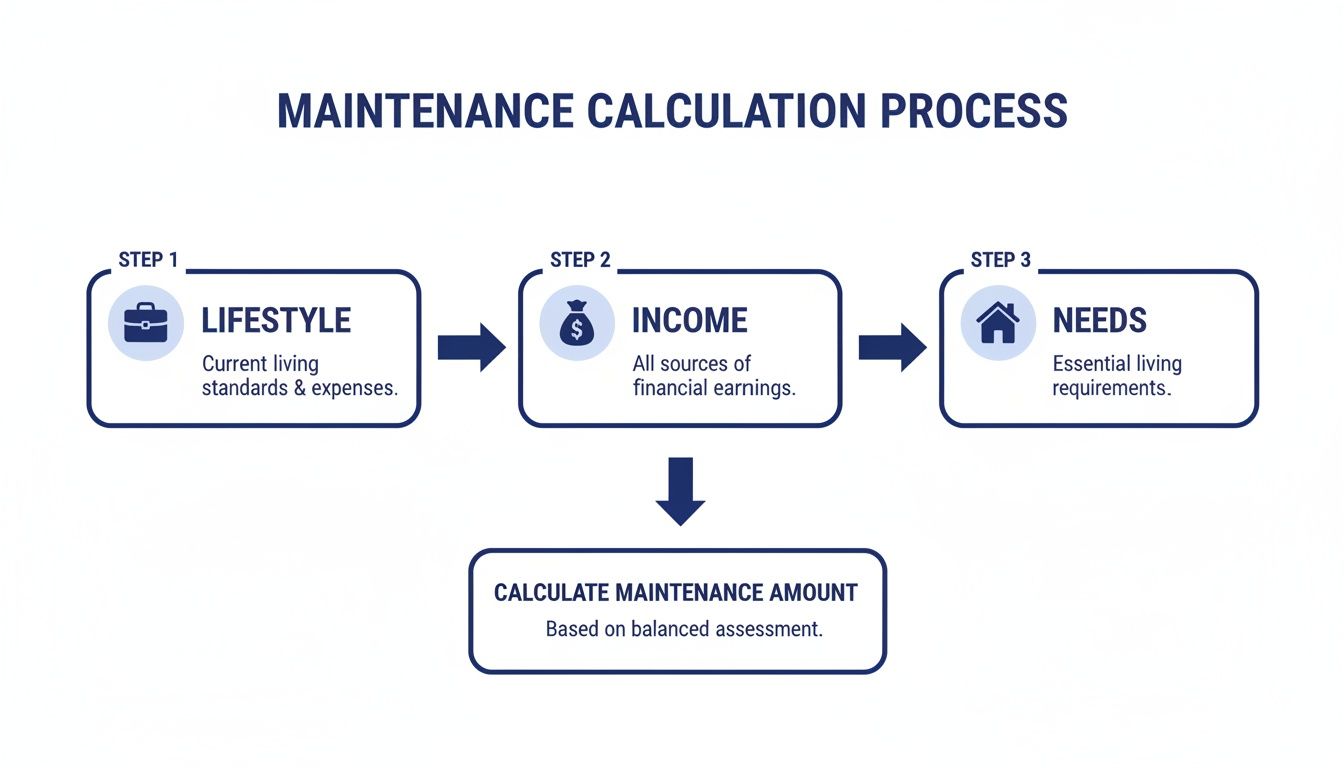
As you can see, judges primarily look at the lifestyle the couple was accustomed to, their respective incomes, and the essential needs of the applicant to land on a fair amount.
How AI Can Make This Process Less Painful
Let's be honest, the journey from filing to enforcement can be a real grind. This is where legal AI tools are becoming a huge help. A tool like Draft Bot Pro can help a lawyer put together a flawless initial application and the mandatory affidavit, making sure every single requirement from the Rajnesh v. Neha ruling is ticked off. You can just upload the financial documents and have the AI organise everything into the correct format, slashing the risk of human error that so often leads to delays.
And when it’s time to enforce an order, Draft Bot Pro can generate a strong execution petition in minutes. This means you can act fast to protect your client’s financial security, saving a ton of time and effort along the way.
Courts have consistently shown they are serious about preventing financial hardship during a case. In one interesting case, an application was denied at first but then granted on appeal. The court held that the duty to pay continued even when the main case was put on hold. This really shows how focused the judiciary is on the true purpose of maintenance pendente lite. You can explore more about this nuanced ruling and what it means for similar cases.
Drafting a Winning Maintenance Petition with AI
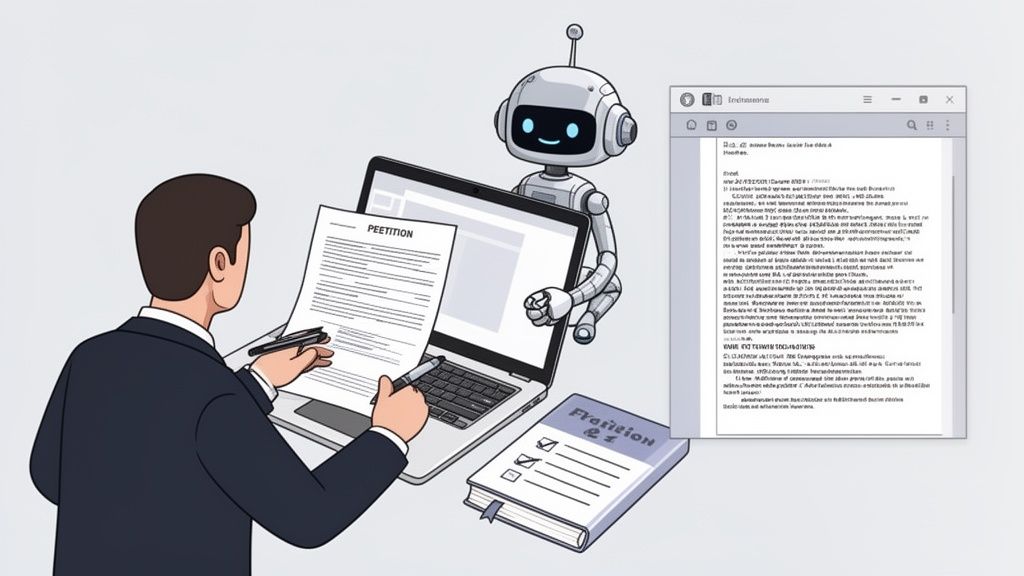
Putting together a strong petition for maintenance pendente lite is part science, part storytelling. It’s a delicate dance between presenting cold, hard numbers and weaving a compelling narrative that convinces the court of your client's needs. A truly effective petition does more than just ask for money; it builds a watertight case for why a specific amount is not just fair, but absolutely necessary.
The foundation of it all is precision. Every single claim, whether it’s your client’s monthly grocery bill or an estimate of the other party’s income, needs to be backed up with solid proof. Ambiguity is your worst enemy here. It opens the door to challenges and creates delays that ultimately hurt your client. Your goal is to hand the court a document so thorough and logically sound that it makes their job easy.
The Anatomy of a Powerful Petition
A knockout application for interim maintenance stands on several key pillars. Each one supports the other, creating a persuasive argument that leaves no room for doubt. If you miss even one of these, the whole structure can get wobbly.
To help you get it right every time, think of it like a checklist. This framework ensures your petition not only ticks all the legal boxes but is also strategically built to win.
Checklist for a Powerful Maintenance Petition
Here's a step-by-step checklist to ensure your Section 24 application is comprehensive and legally sound.
Checklist Item | Purpose | Draft Bot Pro Tip |
|---|---|---|
Clear Factual Matrix | To provide a concise background of the marriage, separation, and the current status of the main case. | Use a prompt like: "Create a factual matrix for a Section 24 application based on these case notes [insert notes]." |
Detailed Expense Breakdown | To justify the maintenance amount by itemising the applicant's monthly needs (rent, utilities, food, etc.). | Upload bank statements and ask: "Analyse these statements and create an itemised list of average monthly expenses." |
Evidence of Respondent's Income | To establish the other party's capacity to pay, using salary slips, ITRs, or lifestyle evidence. | Prompt the AI: "Based on this lifestyle description, suggest what documents to request to prove the respondent's income." |
Prayer for Relief | To clearly state the exact amount of monthly maintenance and litigation expenses being requested. | Draft Bot Pro can generate a legally precise prayer clause based on the calculated needs and respondent's income. |
This checklist isn't just about compliance; it's a strategic roadmap to a more persuasive and effective petition from the get-go.
Supercharging Your Drafting with Draft Bot Pro
Let's be honest, turning that blank screen into a polished, court-ready petition is a grind. This is exactly where a legal AI assistant like Draft Bot Pro becomes your most valuable associate. It handles the monotonous, time-sucking parts of drafting, freeing you up to focus on what really matters: strategy and client care.
Imagine your client drops off two years' worth of bank statements. Instead of spending hours with a calculator, you just upload the PDFs to Draft Bot Pro. A simple prompt—"Analyse these bank statements and calculate the average monthly income and essential expenditure"—gives you a perfectly structured summary in seconds.
Insights The real magic of using AI isn't just about working faster. It's about working smarter. When you delegate the number-crunching and formatting to a machine, you gain the mental space to build a more powerful legal story and stay two steps ahead of opposing counsel.
This completely changes how you work with evidence. Say the other party is hiding their true income but flaunting a lavish lifestyle online. You can feed details about their fancy cars, foreign holidays, and social media posts into the AI. Then, ask it to generate a set of pointed discovery questions or an application for direction to produce specific financial records. It helps you build a strong case for the court to draw an adverse inference.
From Data to Persuasive Drafts
One of the biggest hurdles in any maintenance pendente lite application is justifying the amount you're asking for. You have to prove to the court that your figure isn't just plucked out of thin air but is rooted in law and precedent. This is another area where AI shines.
With Draft Bot Pro's legal research tools, you can pull up relevant High Court and Supreme Court judgments in moments. Try a prompt like, "Find judgments where the court awarded maintenance of over ₹50,000 to a non-working spouse when the respondent's monthly income was between ₹2 lakh and ₹3 lakh." Just like that, you have powerful case law ready to be cited. To dig deeper into these techniques, check out our guide on AI for family law drafting.
By weaving these AI-powered workflows into your practice, you don't just draft petitions faster. You build stronger, data-driven, and legally sound arguments that maximise your client's chances of getting the financial support they desperately need.
Wrapping Up: Securing Your Client’s Financial Footing
As we've seen, maintenance pendente lite is much more than a procedural checkbox in matrimonial cases. It's a crucial mechanism for fairness, levelling the playing field so both spouses can get through the stress of litigation without being crushed by financial pressure right from the start.
We've walked through the gender-neutral laws that form the foundation of these claims, the different factors judges consider when deciding on an amount, and why careful, detailed drafting is so important. The key takeaway is this: when you blend your legal expertise with the right tools, you can protect your client’s financial stability during what is often the most difficult period of their lives. This approach helps you deliver sharp, well-supported solutions when they need them most.
Insights Getting an order for maintenance pendente lite can make a real, immediate difference for your client. It gives them the breathing room to make clear-headed decisions about their future, which often includes complex issues around their shared property. To dive deeper into this specific area, check out our guide on the legal meaning of the matrimonial home.
Using Legal AI to Get Better Results
This is where a legal AI assistant like Draft Bot Pro becomes a strategic partner. It helps you put together accurate, evidence-backed petitions in a fraction of the time, making sure all the procedural boxes are ticked from day one. This doesn't just cut down on delays; it strengthens your client's case from the get-go, allowing you to protect their interests with both speed and precision.
Frequently Asked Questions
When you're in the thick of matrimonial proceedings, the subject of maintenance pendente lite throws up a lot of practical, on-the-ground questions. Here are some straightforward answers to the queries that come up most often, for both lawyers and their clients.
Can a Working Spouse Claim Maintenance?
Yes, they absolutely can. The court isn't just looking at whether a spouse has a job; the real question is whether their income is ‘sufficient’ to let them live in a manner they were used to during the marriage, while also covering the hefty costs of litigation.
If there's a big gap in what each spouse earns, the court can—and often does—award interim maintenance to level the playing field. For instance, if one spouse is making ₹50,000 a month and the other brings in ₹3 lakh, it's pretty clear the first spouse's income isn't enough to maintain the marital standard of living. The court will likely step in to bridge that gap.
From What Date Is Maintenance Awarded?
The Supreme Court settled this quite decisively in the landmark case of Rajnesh v. Neha. The standard, accepted practice now is to award maintenance right from the date the application was filed.
This is a crucial rule. It ensures the dependent spouse gets financial support without being penalised for the inevitable delays that crop up in our legal system. While judges do have the discretion to pick a different date based on the unique facts of a case, the starting point is almost always the date of filing.
What Happens If a Maintenance Order Is Not Followed?
Ignoring a court order for maintenance is a serious misstep with real consequences. The spouse who is owed the money has every right to go back to the same court that passed the order and file an execution petition.
The court has some pretty strong tools to enforce its own order. It can:
Attach the defaulting spouse's salary, meaning the money is deducted by their employer and paid directly.
Seize property or freeze bank accounts to recover the outstanding amount.
In some situations, the court can even pause the main divorce proceedings or strike out the non-paying party's defence entirely until the arrears are cleared.
Insights The courts take enforcement very seriously. The whole point of maintenance pendente lite is to prevent one party from being financially starved during a lawsuit. They will use their full authority to make sure that doesn't happen.
How Can AI Help If the Other Party Hides Their Income?
This is a classic problem. While an AI tool can't send out an investigator, it can be a game-changer when you need to build a case for ‘adverse inference’ against the spouse who's not being transparent.
With a tool like Draft Bot Pro, for example, you can use its legal research feature to instantly pull up High Court and Supreme Court judgments where judges came down hard on a party for hiding their income. You can also use it to quickly draft sharp, precise discovery applications, demanding specific financial records. This helps you build a powerful circumstantial case, using evidence of their lifestyle to prove that their declared income is a fiction.
Ready to build stronger, evidence-backed maintenance petitions in a fraction of the time? Discover how Draft Bot Pro can become your strategic partner in securing your client's financial stability. Visit https://www.draftbotpro.com to see how our AI-powered tools can assist your legal practice today.
