
Drafting a Writ Petition Under Article 226 A Practical Guide

When a government body or public official oversteps their authority and tramples on someone's rights, what can you do? For legal professionals in India, the answer often lies in one of the most powerful tools in our constitutional arsenal: a writ petition under Article 226.
This isn't just another legal filing. It's a direct appeal to a High Court, asking it to exercise its extraordinary power to enforce fundamental and other legal rights against the state. It's the very heart of judicial review, giving us a way to hold the powers that be accountable.
The Bedrock of Judicial Review
Think of Article 226 as a crucial check and balance. It ensures that the actions of government bodies, public officials, and other state entities are fair, just, and, most importantly, legal. This provision has been a constant safeguard for citizens' rights, providing a direct, and often swift, remedy against administrative wrongdoing.
Dating back to debates in the Constituent Assembly on June 7 and September 7, 1949, Article 226 remains one of the most invoked parts of our Constitution. Its power is immense because it isn't limited to just fundamental rights; it covers any legal right. This gives it a much wider scope than Article 32, which is focused solely on fundamental rights in the Supreme Court. For a deeper dive into its historical context, the debates on constitutionofindia.net offer some fascinating insights.
What Are the Five Types of Writs?
The High Court wields its power under Article 226 by issuing five specific types of orders, or "writs." Knowing which one fits your client's situation is the first—and most critical—step.
Before we break them down, here’s a quick overview to get you started.
The Five Writs Under Article 226 at a Glance
Writ | Meaning | When It Is Issued |
|---|---|---|
Habeas Corpus | "To have the body" | To challenge an illegal detention and secure the release of a person wrongfully confined. |
Mandamus | "We command" | To compel a public authority or lower court to perform a statutory duty it has failed to do. |
Certiorari | "To be certified" | To quash an order of a lower court or tribunal that has acted without or in excess of its jurisdiction. |
Prohibition | "To forbid" | To prevent a lower court or tribunal from proceeding with a case that is outside its jurisdiction. |
Quo Warranto | "By what authority" | To question the legality of a person's claim to hold a public office. |
Let's look at these in a bit more detail.
Habeas Corpus: This is the ultimate safeguard for personal liberty. If someone is detained illegally, whether by the state or a private person, this writ forces the detainer to produce the person in court so a judge can determine if the detention is lawful.
Mandamus: Ever had a public official simply refuse to do their job? This is the writ for that. It’s a direct command from the High Court ordering a public body, corporation, or even a lower court to fulfil a public duty they've been neglecting.
Certiorari: This writ is used to correct errors of law. When a lower court or a tribunal passes an order without proper jurisdiction or in violation of the principles of natural justice, a High Court can issue a writ of Certiorari to quash that illegal order.
Prohibition: Think of this as the preventative version of Certiorari. It’s issued to stop a lower court or tribunal from continuing with proceedings where it has no jurisdiction. It literally prohibits them from going any further.
Quo Warranto: This is used to challenge someone's right to hold a public office. If you believe a person is illegally occupying a public position, this writ initiates a judicial inquiry into their authority to be there.
Insights The real magic of Article 226 is its adaptability. I've used a single petition to challenge a flawed government policy, another to force an official to take long-overdue action, and yet another to secure the immediate release of someone unlawfully detained. Its broad reach makes it an essential part of any litigator's toolkit.
How AI Is Changing the Game for Writ Petitions
Drafting a writ petition that is both persuasive and procedurally sound is an art form. It demands sharp research, logical structuring, and a keen eye for detail. This is where modern tools are making a real difference.
Legal AI assistants, like Draft Bot Pro, are becoming indispensable. Instead of spending hours on preliminary case law research or building a draft from scratch, these tools can get you started in minutes. For example, you can feed an impugned order into Draft Bot Pro, and it can instantly suggest relevant grounds, case law, and prayers. This lets you jump straight to refining the core legal arguments, which is a massive advantage when your client needs urgent relief.
Confirming Jurisdiction and Maintainability
Before you even think about drafting your writ petition under Article 226, you've got to clear two massive hurdles. First, which High Court actually has the power to hear your case? And second, is your petition even legally sound enough to be admitted?
Get either of these wrong, and you're looking at a swift dismissal. That means wasted time, wasted resources, and a frustrated client. Let's make sure that doesn't happen.
Navigating Territorial Jurisdiction
The first question is all about territorial jurisdiction. This simply means figuring out which High Court is the right place for your grievance. A High Court's power under Article 226 is tied to its geographical borders. You can establish jurisdiction in one of two main ways:
Situs of the Respondent: If the government body or authority you're up against is located within the state, that state's High Court has jurisdiction. Simple enough.
Cause of Action: If the "cause of action" – the bundle of facts that gives you the right to sue – happened wholly or even partly within a state, that state's High Court can hear the case.
That second point, the 'cause of action', is where things can get tricky. I’ve seen it trip up even seasoned lawyers.
Imagine a company registered in Mumbai takes a loan from a bank's Bhopal branch. The bank then issues a recovery notice from Bhopal. The company, wanting to challenge a central law as part of its defence, might try to file in the Delhi High Court. It sounds plausible, but it's a classic mistake. Courts have consistently ruled that jurisdiction follows the cause of action. Since nothing actually happened in Delhi, the Delhi High Court would have no authority to hear the case. This is a perfect example of how procedural nuts and bolts in our legal system have been tightened by High Court rulings over decades.
The Doctrine of Laches and Alternative Remedies
Once you've picked the right court, you need to ask if the court will even entertain your petition. This is the question of maintainability.
One of the fastest ways to get your writ petition thrown out is laches. It's a legal term for sitting on your rights and causing an unreasonable, unexplained delay in coming to court. The Constitution doesn’t give a hard deadline, but the expectation is that you act fast. If there’s been a significant delay, you absolutely must have a rock-solid explanation for it right there in your petition.
Just as critical is the rule of alternative remedy. High Courts are protective of their extraordinary writ jurisdiction. They generally won't step in if there's another perfectly good and effective remedy available under a different law, like a statutory appeal to a tribunal.
Insights Don't mistake the 'alternative remedy' rule for an absolute ban. It's a rule of discretion. I've successfully argued many times that a writ is maintainable despite another remedy. The key is to show a violation of fundamental rights, a complete disregard for the principles of natural justice, or that the order you're challenging was passed completely without jurisdiction.
This decision tree gives you a quick visual checklist for these preliminary hurdles.
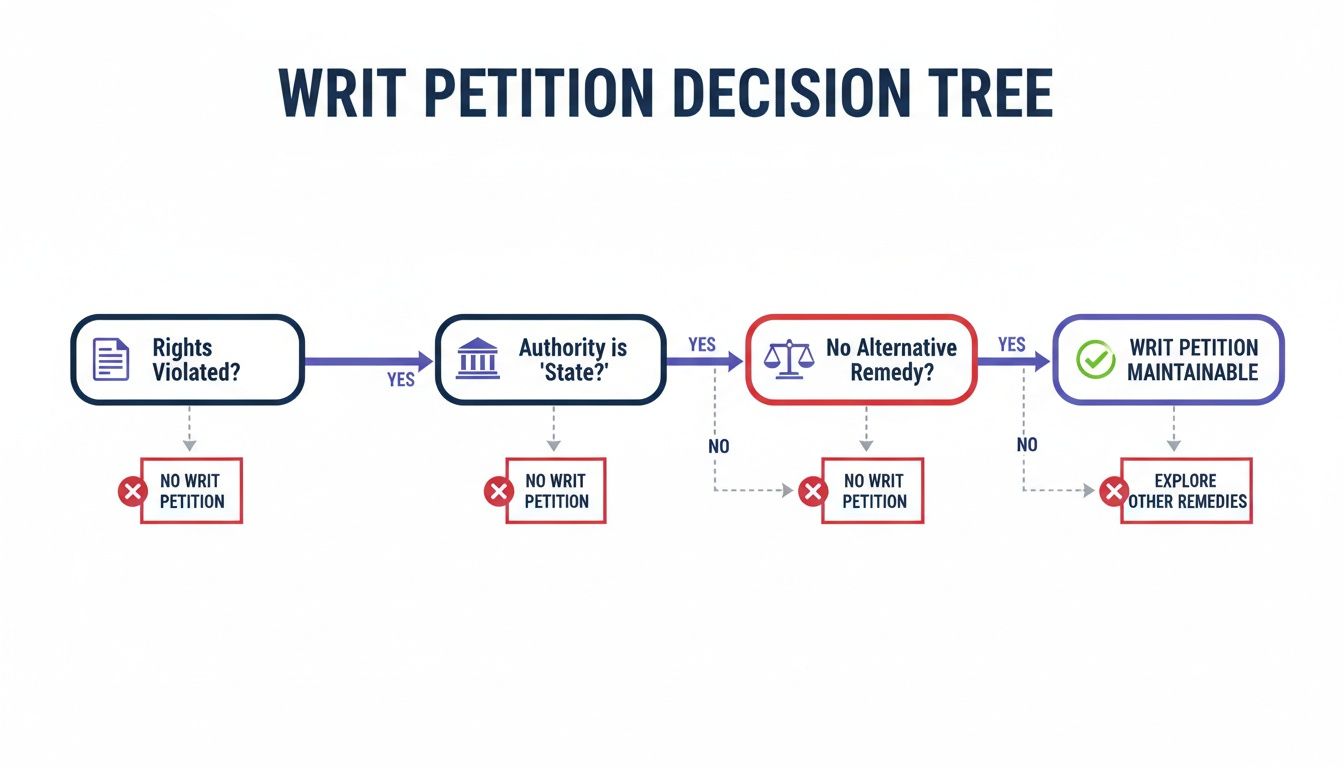
Running through this flowchart first ensures you’re not building your case on shaky ground before you invest hours in drafting.
Distinguishing Between Article 226 and Article 227
Here’s another common pitfall: confusing Article 226 with Article 227. They both grant powers to the High Court, but they are not interchangeable.
Article 226 is your tool for enforcing fundamental rights and other legal rights against the ‘State’. This is the court’s original jurisdiction, where it issues the classic writs.
Article 227, on the other hand, gives the High Court supervisory power over all subordinate courts and tribunals in its territory. Think of it as a tool to correct major jurisdictional errors or blatant illegalities in orders from lower courts.
A frequent mistake is filing a petition under both articles to challenge a judicial order. It muddies the waters and can weaken your arguments. Knowing the difference is crucial for framing your petition correctly.
How Draft Bot Pro Solidifies Your Case
Sorting through the complexities of jurisdiction and maintainability means diving deep into legal research to find judgments that back up your position. This is where a tool like Draft Bot Pro becomes a lifesaver.
Its AI Legal Research feature can dig up relevant case law on territorial jurisdiction based on the specific facts of your case in minutes. Worried about a potential delay? It can pull up precedents where courts either accepted or rejected similar delays, helping you craft a compelling explanation for laches. It’s all about arming yourself with the right arguments to avoid that dreaded preliminary dismissal. For a closer look at the research process, check out our guide on how to do legal research.
How to Structure Your Writ Petition
A well-drafted writ petition isn't just a document; it's a story that convinces the court to intervene. Think of it as a persuasive argument you're building, piece by piece, to guide the judge from the problem your client is facing to the specific solution you're seeking. Each section has a distinct role, and getting the flow right is half the battle.
If your foundation is weak—say, the facts are jumbled or the grounds are vague—the entire argument can fall apart under judicial scrutiny. This is where a methodical, organised approach really pays off, making your petition clear, logical, and far more likely to succeed.
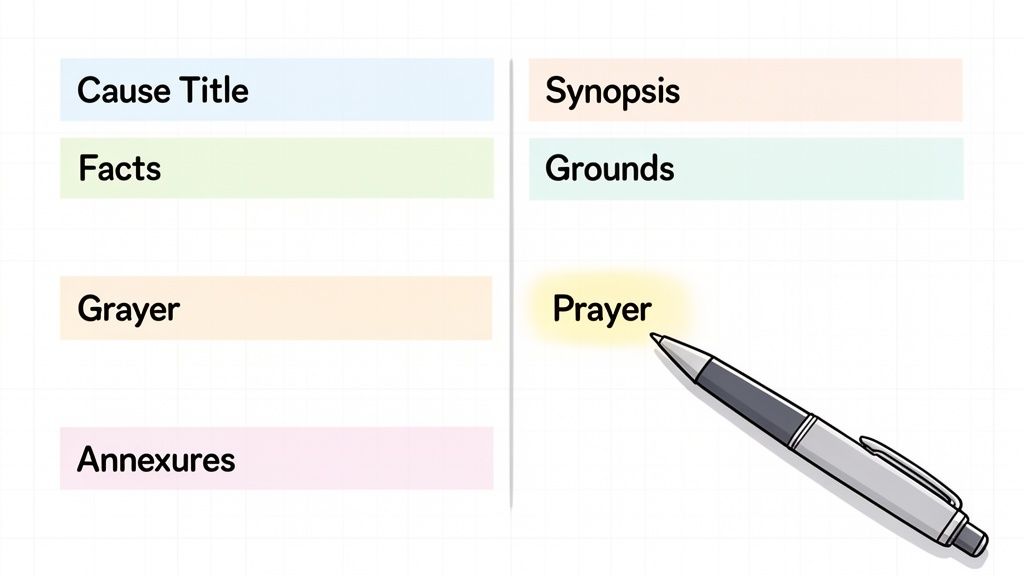
The Essential Components of Your Petition
While every High Court has its own filing peculiarities, the fundamental anatomy of a writ petition is fairly standard across the country. Nailing this structure ensures your petition looks professional and, more importantly, makes it easy for the court to quickly get to the heart of the matter.
Here's the typical order and what each part needs to do:
Cause Title and Memo of Parties: This is the formal front page. It names the court, identifies the Petitioner and Respondent, and states the nature of the filing (e.g., "Writ Petition under Article 226 of the Constitution of India"). The Memo of Parties must have the full, accurate names and addresses for everyone involved.
Synopsis and List of Dates: Think of the Synopsis as your one-page elevator pitch for the judge. It’s a crisp summary of the entire case. Right after, the List of Dates lays out a clean, chronological timeline of every key event that led to the petition.
Facts of the Case: This is where you tell the story. Lay out the factual background clearly and in sequence. The key here is to stick to the facts—don't start arguing the law just yet. Your goal is to present an unambiguous chain of events that sets the stage for your legal challenge.
Questions of Law: Now you frame the core legal issues. These should be pointed, specific questions that you want the court to answer based on the facts you've just presented.
Grounds for Relief: This is the legal core of your petition. Each "ground" is a self-contained argument connecting a specific fact to a legal principle. You must explain precisely why the respondent's action is illegal, arbitrary, or unconstitutional.
Averment on Alternative Remedy: You have to explicitly declare that there is no other equally effective and speedy remedy available to you. This is a critical hurdle you must clear to justify invoking the High Court’s extraordinary writ jurisdiction.
Prayer Clause: This might be the most important section of all. It’s where you tell the court exactly what you want. Be specific: quash this order, issue a writ of mandamus directing that action, etc. A vague prayer can sink an otherwise strong petition.
Affidavit: A sworn statement from the petitioner confirming that everything stated in the petition is true to their knowledge.
Annexures: This is your evidence. All supporting documents must be properly marked, paginated, and attached.
From Blank Page to Polished Draft
Staring at a blank screen when you need to draft a petition can be intimidating, especially when you're up against the clock. This is where smart tools can give you a massive head start without cutting corners on quality.
Insights Efficiency is everything for a busy lawyer. Instead of building the petition's skeleton from scratch every time, you can use a tool like Draft Bot Pro to generate a structured first draft. Simply upload the key documents—the government order you're challenging, for instance—and the AI can assemble a template with all the necessary sections already in place.
This simple step shifts your role from typist to strategist. You can jump straight into the high-value work: honing the legal arguments in the Grounds and perfecting the wording of the Prayer.
Crafting a Compelling Narrative
To make your petition truly persuasive, you need to go beyond just filling in sections. The Facts, for example, should read like a compelling story that builds context and shows the real-world impact on your client. Each paragraph must flow logically to the next, guiding the reader towards the inescapable conclusion that an injustice has occurred. If you want to sharpen this skill, resources on Legal Writing in Plain English are a fantastic place to start.
Likewise, the Grounds section demands more than just citing case law. You have to connect the dots. Show how that specific ruling or statute applies directly to the facts of your case. This methodical approach is what turns a simple complaint into a powerful legal argument that demands the court's attention.
Managing Annexures and Filing Formalities
A brilliantly drafted writ petition under Article 226 is only half the battle won. I’ve seen far too many strong cases get stuck—or even dismissed—at the registry simply because of procedural missteps. If your petition isn't supported by crystal-clear evidence and filed according to the High Court’s strict rules, it might never even make it in front of a judge.
This is where the less glamorous but absolutely essential work comes in: managing your annexures and mastering the filing formalities.
Think of annexures as the very foundation of your case. These are the documents—the impugned orders, the ignored representations, the official notices—that give weight to your claims. Each one needs to be meticulously marked, paginated, and referenced within the petition itself. A judge shouldn’t have to piece together your story; you need to present it so clearly that your evidence and arguments flow together seamlessly.
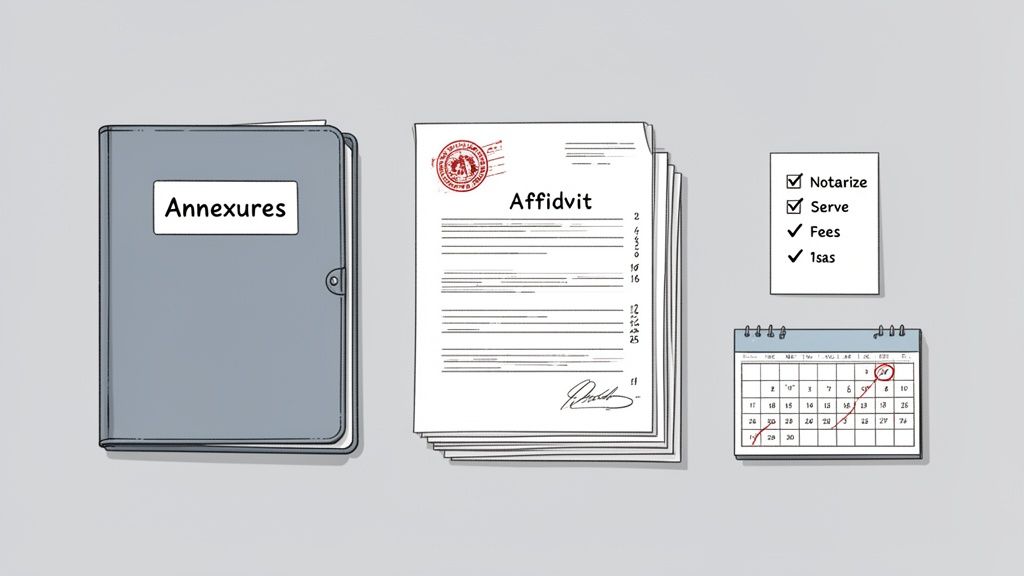
Organising Your Evidence Correctly
Getting your annexures in order isn't just about being tidy; it's a matter of credibility. The court needs to see a logical, verifiable progression of events, and your documents are the proof.
Here's the right way to do it:
Marking: Every document is an "Annexure." They are typically marked sequentially, like "Annexure P-1," "Annexure P-2," and so on (the 'P' stands for Petitioner). Simple, but critical.
Pagination: The entire petition, from the very first page to the last page of the final annexure, must have continuous page numbers. This is a non-negotiable rule and a surprisingly common reason for a filing to be returned with defects.
Referencing: When you discuss a document in your "Facts of the Case" or "Grounds," you have to point the judge exactly where to look. For example: "A true copy of the impugned order dated 01.01.2024 is annexed herewith and marked as Annexure P-1 (Pg. 25)."
This methodical approach transforms your arguments from mere assertions into evidence-backed submissions, making your petition exponentially more persuasive.
Navigating the Filing Process
Once your petition and annexures are perfectly arranged, you face the filing counter—a place with its own unique set of procedural hurdles. Missing even one small formality can get your case sent back with a defect list, leading to frustrating delays and unhappy clients.
Insights Every High Court has its own rulebook, and these can be incredibly dense and confusing, especially when you're under a time crunch. This is where AI can be a game-changer, acting as a procedural assistant. For instance, with Draft Bot Pro's 'Chat with PDF' feature, you can upload the specific High Court's practice rules. Instead of manually searching through hundreds of pages, you can just ask: "What are the margin requirements?" or "How many paper-books are needed for a writ?" and get an instant, accurate answer.
This kind of immediate access to procedural details is a massive advantage, helping you avoid those common errors that bog down the filing process.
Essential Filing Checklist
Before you even think about heading to the registry, run through this checklist. Getting these items right from the start will save you a world of trouble.
Checklist Item | Purpose | Common Mistake to Avoid |
|---|---|---|
Vakalatnama | An official document authorising you to appear for the petitioner. | Forgetting to have it signed by both the client and the advocate. |
Affidavit | A sworn statement by the petitioner verifying the petition's contents. | Not getting it properly notarised or attested by an Oath Commissioner. |
Court Fees | The requisite fee paid via stamps as per the state's Court Fees Act. | Miscalculating the fee amount, which can vary by state and relief sought. |
Process Fee (PF) | A separate fee for issuing notices to the respondents. | Failing to file the PF with the petition, delaying notice service. |
Serving Copies | Providing advance copies of the petition to all respondents. | Not keeping a record or proof of service, which the court often requires. |
The affidavit, in particular, is a document that demands perfection. If you need a refresher on its specific formatting and legal requirements, our guide to an affidavit under CPC in India is a great resource.
Paying close attention to these procedural details isn't just administrative work; it's about ensuring your strong legal arguments get the day in court they deserve.
Common Drafting Mistakes to Avoid
Even the most rock-solid case can completely fall apart if the writ petition is sloppily drafted. Theory is one thing, but courtroom practice quickly shows you the common traps that will irritate a judge and water down your arguments. Dodging these mistakes isn't just about good form; it’s about giving your client the best possible shot at winning.
One of the most common errors I see is a vague or overly broad prayer. A prayer that just asks the court to "do justice" is basically asking for nothing. You have to be precise. The court needs to know exactly what you want it to do—quash a specific order, issue a command to a particular authority, or declare an action illegal.
Another big mistake is muddling up the facts of the case with the legal grounds. The "Facts" section is for storytelling. It needs to be a clear, chronological narrative, free of legal arguments. The "Grounds" section is where you connect those facts to legal principles. When you blur these lines, you just confuse the reader and dilute the force of your arguments.
Vague Prayers vs Specific Relief
Let's look at a real-world example of how a weak prayer gets transformed into a powerful one. A lazy, unfocused prayer is a surefire way to get your petition dismissed at the admission stage.
Before (Ineffective):
"It is, therefore, most respectfully prayed that this Hon'ble Court may be pleased to issue an appropriate writ, order or direction, as may be deemed fit in the interest of justice."
This tells the judge nothing. It puts the burden on them to figure out what you're actually asking for.
After (Persuasive):
"It is, therefore, most respectfully prayed that this Hon'ble Court may be pleased to: a) Issue a writ in the nature of Certiorari to quash the impugned termination order dated 01.01.2024 (Annexure P-1) issued by Respondent No. 2; b) Issue a writ in the nature of Mandamus directing the Respondents to reinstate the Petitioner with full back wages and continuity of service."
See the difference? This version is crystal clear, actionable, and leaves zero room for misinterpretation.
The Peril of Incorrectly Citing Articles 226 and 227
A surprisingly common, and critical, error is mechanically filing a single petition under both Article 226 and Article 227. The Supreme Court has repeatedly condemned this practice, seeing it as a clear sign that the drafter doesn't understand the distinct powers these articles confer.
A writ petition under Article 226 is for challenging administrative actions of the 'State'. In contrast, Article 227 provides for the High Court's supervisory jurisdiction over lower courts and tribunals. Conflating them can be fatal to your case. If you feel this is an area you need to work on, exploring ways to improve your legal drafting skills can be incredibly beneficial.
The judiciary’s stance on this is unambiguous. When a petitioner wrongly files under Article 226 to challenge a judicial order from a civil court, the only proper course is to amend the cause title to bring it under Article 227. For a deeper dive into this crucial distinction, you can read the full analysis on rblaw.in.
Insights Think of Draft Bot Pro as your pre-flight checklist. Its AI can act as a quality control check, analysing your petition before you file. It can flag a vague prayer and suggest more specific language, or detect sections where you've mixed up facts and legal grounds. This kind of review ensures your final draft is clean, professional, and structurally sound.
Other Common Drafting Pitfalls
Beyond these major blunders, a few smaller errors can collectively chip away at your petition's credibility.
Forgetting Material Facts: If you leave out a key fact, you create a narrative gap that the other side will gleefully exploit.
Not Explaining Delays: If there's any delay (laches), you absolutely must explain it satisfactorily within the petition itself. An unexplained delay is one of the most common reasons for a petition to be dismissed.
Poorly Referencing Annexures: Just attaching documents isn't enough. You have to refer to each annexure clearly in the body of the petition and point to the specific part that's relevant (e.g., "...as is evident from the report filed by the committee (Annexure P-3, Page 25)").
By carefully avoiding these traps, you make sure your arguments are presented in the most logical and compelling way, massively increasing your chances of getting the relief your client needs.
A Few Common Questions, Answered
When you're dealing with the practicalities of a writ petition under Article 226, certain questions pop up time and again. Let's tackle some of the most common queries that lawyers run into, providing some quick, clear answers to keep you on the right track.
Can I File a Writ Petition Against a Private Company or Person?
As a general rule, a writ is aimed at the 'State' as laid out in Article 12 of the Constitution. But that’s not the whole story. The courts have recognised that this rule can't be absolute, and they've carved out some important exceptions over the years.
A writ of Habeas Corpus, for example, is a powerful tool that can certainly be issued against a private individual to challenge an illegal detention. More commonly in practice, if a private body is carrying out a public function—think of a private college, an electricity distribution company, or a cooperative bank—a writ of Mandamus can be brought against it. The key isn't who is performing the act, but rather the nature of the function they're performing. If it's a public duty, they're likely within the High Court's reach.
Is There a Hard Deadline for Filing a Writ?
The Constitution itself doesn't set a specific limitation period for filing under Article 226. But don't let that fool you into thinking you have unlimited time. Far from it.
Every petition is scrutinised under the doctrine of 'laches,' which essentially means you can't sit on your rights. An unreasonable and unexplained delay can be fatal to your case. If a significant amount of time has passed between the cause of action and you approaching the court, the petition can be dismissed on that ground alone. It's crucial to address any delay head-on and provide a solid, satisfactory explanation for it directly within the petition itself.
Insights "The rule of exclusion of writ jurisdiction due to an alternative remedy is a rule of discretion and not compulsion. In appropriate cases, despite available alternative remedies, writ courts can exercise jurisdiction, especially where there is a violation of natural justice, a fundamental right, or the order is wholly without jurisdiction."
What's the Real Difference Between an Interim Prayer and a Final Prayer?
Getting this distinction right is absolutely vital for protecting your client while the wheels of justice turn. The two prayers serve very different, yet complementary, purposes.
Final Prayer: This is your end game. It's the ultimate relief you want the court to grant, like an order to quash a wrongful termination letter or a direction compelling a municipality to perform a statutory duty.
Interim Prayer: This is your emergency relief. It’s a request for a temporary order to prevent immediate and irreversible damage while the main case is being decided. Think of a stay on a demolition order or a direction to maintain the status quo until the next hearing.
A well-argued interim prayer is often the most critical part of the initial hearing, as it can secure your client's position and prevent the main petition from becoming a fruitless exercise.
How Can Draft Bot Pro Help When a Writ is Urgent?
In urgent matters, time is the one thing you can't afford to waste. This is where legal AI tools give you a serious advantage, turning hours of tedious work into minutes.
Imagine you need to file an urgent writ. With Draft Bot Pro, you can upload the impugned order and get a structured first draft of the petition in just a few minutes. Its AI Legal Research can instantly pull up landmark judgments to back up your arguments. Got a question about a specific High Court rule? Use its 'Chat with PDF' feature on an uploaded rulebook for an immediate answer. This isn't about replacing your expertise; it's about amplifying it, giving you a powerful edge when every second is critical.
Ready to draft smarter, not harder? Draft Bot Pro is the AI legal assistant built by Indian lawyers, for Indian lawyers. Generate drafts, conduct accurate legal research, and get the support you need to build a stronger case in less time. Join over 46,379 legal professionals and see the difference for yourself at https://www.draftbotpro.com.
