
A Lawyer's Guide to Condonation of Delay Format in India

A condonation of delay application is your formal request to a court, asking it to overlook a delay in filing a document like an appeal or an application. It’s a critical plea arguing that substantial justice shouldn't be sacrificed at the altar of a procedural technicality, especially when a genuine, unavoidable reason caused the delay.
The Foundation of Your Condonation Application

In the Indian legal system, time is everything. We have strict deadlines, known as limitation periods, to ensure matters are dealt with promptly and litigation doesn't drag on forever.
But the law isn't blind to the realities of life. A client might be suddenly hospitalised, a crucial certified copy could be stuck in administrative limbo, or a sudden family crisis can throw a wrench in the most organised plans.
This is exactly where the condonation of delay application comes in. It's more than just a procedural formality; it's a substantive plea for justice. You're asking the court to look beyond the ticking clock and consider the very human circumstances behind the delay. For a deeper look into related principles and broader legal discussions, there are plenty of resources available.
Legal Roots in The Limitation Act, 1963
The entire concept rests on Section 5 of the Limitation Act, 1963. This powerful provision gives courts the discretion to accept an appeal or application filed after the deadline, provided the applicant can show they had "sufficient cause" for the holdup.
"Sufficient cause" is the heart of your application. The term is deliberately left undefined, giving judges the flexibility they need to deliver justice based on the unique facts of each case.
Courts have consistently emphasised that the quality of your explanation matters far more than the length of the delay. The Supreme Court, in State of Nagaland v. Lipok (2005), made it clear: a long delay backed by a solid, well-supported reason can be excused, while even a short delay with a flimsy excuse might not.
Insights: Remember, the rules of procedure are the handmaidens of justice, not its mistress. A meritorious case shouldn't be thrown out just because a deadline was missed due to circumstances beyond anyone's control. Your job is to tell a compelling, honest story and back it up with proof.
Before we dive into drafting, it’s worth having a quick reference for the absolute essentials.
This table summarises the non-negotiable elements every condonation of delay application must contain.
Essential Components of a Condonation Application
Component | Purpose and Key Details |
|---|---|
Cause Title | Standard format with Court Name, Case/Appeal Number, and Parties. Ensures proper indexing and identification. |
Application Title | Clearly state: "Application Under Section 5 of the Limitation Act, 1963 for Condonation of Delay". |
Introduction | Briefly introduce the applicant and the main matter (e.g., the appeal) that is being filed late. |
Chronology of Events | A day-by-day account explaining the entire period of delay. Must be precise, logical, and easy to follow. |
Grounds for Condonation | This is the core argument. Explain the "sufficient cause" with specific reasons (illness, administrative delay, etc.). |
Supporting Affidavit | A sworn statement by the applicant verifying the facts stated in the application. Lends credibility and is mandatory. |
Prayer | A formal request to the court to condone the delay of 'X' days and to take the main matter on record. |
Annexures | All documentary evidence (medical certificates, official letters, etc.) supporting your grounds for delay. |
Nailing these components creates a solid, professional foundation for your plea, making it easier for the court to understand and accept your arguments.
The Role of Legal AI in Drafting
Crafting a persuasive application demands precision and a strict adherence to legal standards. This is where a specialised Legal AI tool like Draft Bot Pro can be a game-changer. Instead of staring at a blank page, you can generate a compliant, structured template for your condonation application in minutes.
Draft Bot Pro helps by:
Getting the Format Right: It instantly produces a draft with the proper cause title, headings, and legal phrasing that Indian courts expect. No more second-guessing the layout.
Ensuring Consistency: The tool can generate both the main application and the supporting affidavit, making sure your facts align perfectly across both crucial documents.
Saving You Precious Time: By automating the structural and repetitive parts of drafting, it frees you up to focus on what truly matters—articulating the client's story and gathering the evidence that will win the day.
Ultimately, using Legal AI ensures your plea for justice isn't undermined by a simple drafting error. It helps you build a strong foundation, protecting your client's fundamental right to be heard.
Getting the Draft Right: A Step-by-Step Guide
Drafting a condonation of delay application isn't about plugging details into a template. It's about telling a story—a persuasive, honest, and legally sound story that convinces the court your delay was justified. Think of it as building a case, brick by brick. Every part, from the cause title to the final verification, has a job to do.
If you mess up one part, the whole structure can get wobbly. Your application needs a clear beginning (the intro), a detailed middle (the body and chronology), and a solid end (the prayer). Let's break down how to nail each one.
The Foundation: Cause Title and Heading
First things first, the Cause Title. This is the formal header at the top of the document, and it needs to be perfect. Get it wrong, and you look sloppy from the get-go. It has to match the court's required format exactly, listing the court's name, the original case or appeal number, and the full details of the parties involved (Appellant/Applicant vs. Respondent).
Right below that comes the heading. No room for creativity here. It should state, loud and clear: "Application Under Section 5 of the Limitation Act, 1963, for Condonation of Delay." This immediately tells the court what you're asking for and which law you're relying on. It’s a small detail, but getting these procedural basics right signals to the court that you know what you're doing.
The Heart of the Matter: The Chronology
This is where you make or break your case. The body of the application has to explain the "sufficient cause" for the delay, and vague excuses just won't cut it. "The applicant was unwell" is a classic example of what not to write. It's lazy and will almost certainly get your application tossed out.
The only way to do this right is with a day-by-day chronology of events. You have to account for the entire period of delay, from the day the deadline passed to the day you finally file.
Start Date: The very first day you were in delay.
End Date: The day you're filing the application.
The Gory Details: Explain what happened each day, or in small, specific blocks of days, that stopped you from filing.
Let's say the delay was due to a medical issue. A good chronology would look something like this:
"Para 3: From 15th May 2024 to 25th May 2024 (11 days), the Applicant was diagnosed with acute viral fever and was strictly advised complete bed rest by his physician. A copy of the medical certificate is annexed hereto and marked as Annexure A."
"Para 4: From 26th May 2024 to 5th June 2024 (11 days), while the fever had subsided, the Applicant suffered from severe post-viral fatigue and weakness, which made it physically impossible for him to travel to his counsel's office or undertake any strenuous activity. The doctor's follow-up prescription is annexed hereto and marked as Annexure B."
See the difference? This is a credible explanation backed by evidence, not a flimsy excuse.
Insights: Annexures Are Your Best FriendsNever, ever make a claim without backing it up with paper. Medical bills, hospital discharge papers, receipts for applying for a certified copy, courier tracking slips—these are not optional. Each document proves you're telling the truth. Make sure to reference every annexure clearly in the body of your application (e.g., "...as is evident from the receipt annexed and marked as Annexure C.").
Back It Up: The Power of Supporting Documents
Every seasoned lawyer will tell you that a day-by-day explanation with solid proof is non-negotiable. Courts have heard every excuse in the book, and they've grown tired of vague stories. You need to show, not just tell.
Here’s a quick checklist of common reasons for delay and the proof you'll need to attach:
Medical Grounds: Doctor’s certificates, hospital admission/discharge summaries, pharmacy bills.
Getting Documents: Stamped receipts showing the date you applied for certified copies and the date you received them.
Counsel's Mistake: An affidavit sworn by the lawyer themselves, admitting the bona fide error.
Personal Emergency: A death certificate of a close relative, travel tickets for an urgent family matter, etc.
These documents are the foundation of your application. Without them, you're just asking the court to take your word for it, and that's a gamble you don't want to take. For more on this, discover insights about mastering the condonation of delay application format and its evidentiary requirements.
Asking Nicely: How to Write the Prayer
After you’ve laid out your entire story, you need to formally ask the court for what you want. This is the Prayer. The tone here is critical—it should be humble, respectful, and precise. You are at the mercy of the court's discretion, so you're requesting, not demanding.
A solid prayer clause should cover three things:
Ask the court to condone the specific number of delayed days.
Ask the court to accept your main appeal or petition.
Include a catch-all for any other relief the court thinks is fair.
Here’s how it looks in practice:"It is, therefore, most respectfully prayed that this Hon'ble Court may be pleased to:a) Condone the delay of 47 days in filing the accompanying appeal;b) Take the accompanying appeal on record to be decided on its own merits; andc) Pass any such further order or orders as this Hon'ble Court may deem fit and proper in the interest of justice."
Always, always mention the exact number of days. It shows you've been diligent and aren't being casual with the court's time.
Sealing the Deal: Verification
The final piece is the Verification. This is a short declaration at the end where the applicant (or their authorised representative) swears that everything stated in the application is true to the best of their knowledge. It’s a formal statement of accountability. This is usually followed by a supporting affidavit, which we'll dive into next.
Can AI Give You a Head Start?
Drafting from scratch is a pain. It's tedious and easy to make a silly procedural mistake. This is where a Legal AI tool like Draft Bot Pro can be a real asset. It can generate a properly structured first draft in minutes, complete with the correct legal phrases and formatting. You then simply add your specific chronology, case details, and annexure references. It saves a ton of time and, more importantly, reduces the risk of making an unforced error that could get your application dismissed.
Drafting the Supporting Affidavit for Credibility
If the application is the story, the supporting affidavit is the oath that makes it believable. Think of it as a sworn statement, a solemn declaration that everything you've laid out in your condonation of delay application is true to your knowledge. It’s what elevates your narrative from a simple request to credible evidence the court can actually rely on.
Frankly, without a properly drafted affidavit, your application is just an unverified piece of paper. The affidavit legally binds the deponent (the person signing it) to the facts, making it the absolute cornerstone of your plea. You need to draft this with surgical precision, ensuring every paragraph perfectly mirrors the facts stated in the main application.
Structuring the Affidavit for Maximum Impact
The structure of an affidavit is pretty rigid and follows a clear legal convention. This isn't the place for creative writing; it’s all about factual accuracy.
Deponent’s Introduction: The affidavit always starts with the deponent introducing themselves. You'll state their name, age, address, and their connection to the case (e.g., "I, [Name], son of [Father's Name], aged about [X] years...").
Statement of Fact: The paragraphs that follow should systematically restate the key facts from your application. For instance, if paragraph 3 of your application details a medical emergency, a corresponding paragraph in the affidavit should state, "I say that the contents of paragraph 3 of the accompanying application are true to my knowledge." It's a simple, direct confirmation.
Verification Clause: This is the final, non-negotiable part. Here, the deponent swears that the contents of the affidavit are true and correct, and nothing material has been concealed. The date and place of signing are mandatory.
This simple process flowchart shows the essential steps to follow when drafting your application, which the affidavit must then support.
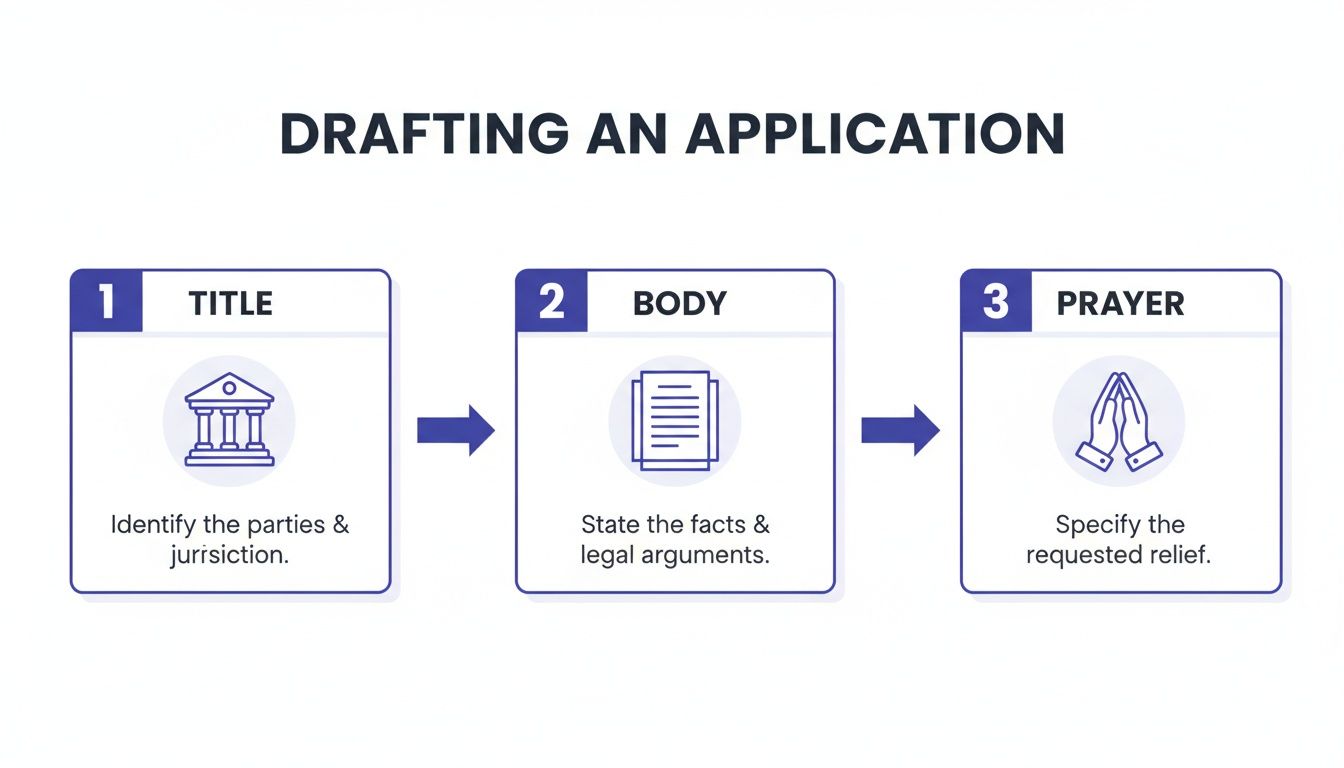
The visualization just underscores a key point: each section—from the formal title to the substantive body and the concluding prayer—builds upon the last. This creates a coherent, legally sound document that the affidavit must then validate, point by point.
The Power of Precise Language
In an affidavit, phrasing is everything. Vague language is your enemy. Instead of saying, "I was quite sick," be specific: "I was suffering from acute viral fever from [Date] to [Date] and was under medical care, as evidenced by the certificate annexed to the main application."
Every statement should be direct, factual, and verifiable. If you want to get into the nitty-gritty, you can explore your guide to an affidavit under CPC in India for more detailed formatting rules.
The goal is to leave zero room for doubt. Clear, confident statements backed by the evidence in your main application are a powerful combination.
Insights: The Perils of a False AffidavitRemember, an affidavit is a statement made under oath. Filing a false affidavit isn't just a procedural slip-up; it's a serious criminal offence under the Indian Penal Code, 1860, and can lead to perjury charges. Courts take this extremely seriously. Always ensure every single fact you state is 100% accurate and can be backed up with evidence.
Automating Accuracy with Draft Bot Pro
Making sure the condonation application and the supporting affidavit are perfectly aligned can be tedious work, and it's easy to make a small mistake. A tiny inconsistency is all opposing counsel needs to challenge the credibility of your entire plea.
This is exactly where a legal AI assistant like Draft Bot Pro comes in handy.
When you draft your condonation of delay application with the tool, it can generate a perfectly synchronised supporting affidavit at the same time.
Ensures Consistency: Draft Bot Pro automatically mirrors the facts from your application into the affidavit format, so you can forget about discrepancies.
Jurisdictional Compliance: The AI is programmed with the specific verification clause formats required by different courts across India, making sure you’re procedurally compliant.
Saves Critical Time: By automating this crucial but repetitive task, it frees you up to focus your energy on strengthening the core arguments and evidence in your main application.
Using Draft Bot Pro ensures your condonation of delay format is backed by an affidavit that is not only properly structured but also procedurally sound and factually consistent, giving it far more weight in court.
Valid Grounds and Supporting Case Law
A perfectly drafted application is useless without a solid legal backbone. The success of your condonation of delay format lives or dies on presenting a “sufficient cause” that the court finds both genuine and compelling. Let's get into the grounds that Indian courts actually accept and the landmark cases that will give your arguments some real teeth.
Common and Judicially Accepted Grounds
Courts are usually willing to condone delays when the reasons are bona fide and genuinely outside the applicant's control. But be warned: any hint of negligence or a lazy approach will get your application thrown out fast.
Here are some of the most successful grounds you can build your case on.
1. Illness of the Party or CounselThis is probably the most common reason we see. A sudden, severe illness, especially one that leads to hospitalisation or forces prolonged bed rest, is a very strong argument. The key is to provide a detailed timeline of the illness, backed up with hard evidence like medical certificates, hospital discharge summaries, and prescriptions.
2. Administrative or Procedural DelaysSometimes, the system itself is the cause of the delay. A classic example is a major delay in getting a certified copy of the court's order. This is a perfectly valid ground, but only if you can prove you applied for it promptly. Receipts showing the application date and the final collection date are your non-negotiable proof here.
3. Bona Fide Mistake of CounselThe Supreme Court has acknowledged that clients shouldn't suffer because of their lawyer's honest mistakes. This could be anything from miscalculating the limitation period to a genuine error in legal advice. This ground is a double-edged sword, though. It has to be a genuine mistake, not gross negligence. You'll almost always need an affidavit from the counsel explaining the error.
4. Personal Calamity or BereavementA death in the immediate family or another major personal crisis can obviously make it impossible for a litigant to focus on legal matters. Courts are generally sympathetic in these situations, as long as you clearly explain the timeline and impact. Where possible, back it up with evidence like a death certificate.
Insights: The Philosophy of Substantial JusticeThe Supreme Court has repeatedly said that procedural laws are the "handmaidens of justice." The ultimate goal is to decide cases on their merits, not to kick them out on technicalities. In Collector, Land Acquisition, Anantnag v. Mst. Katiji (1987), the court championed a liberal approach, pointing out that a litigant gains nothing by delaying their own case. This is the core philosophy that drives the entire concept of condoning delay.
Backing Your Grounds with Case Law
Citing relevant judgments gives your application instant authority. It shows the court your argument isn't just a plea for sympathy, but is grounded in established legal principles. A strong legal argument is built on solid research; learning how to conduct a literature review can give you a systematic way to find and weave in the right precedents.
Judicial decisions show a huge variation in both the length of delays condoned and their success rates. Courts look at delays ranging from a few days to several years, using their discretion based on documentary proof, not some rigid time limit. For example, Supreme Court jurisprudence shows there's no statutory maximum under Section 5; courts have excused multi-year delays for reasons like medical incapacitation or the pendency of related proceedings, as long as they were proven beyond doubt. You can explore detailed government orders and court practices on this matter to get a better sense of this judicial discretion.
For more on this, you might find our article on the top 8 landmark judgements of the Supreme Court of India helpful, as it covers some foundational legal principles.
Comparing Successful vs Unsuccessful Grounds
Knowing what works—and more importantly, what doesn't—is half the battle. This table breaks down the kinds of reasons courts are likely to accept versus those they'll almost certainly reject.
Analysis of Grounds for Condonation
It's crucial to distinguish between a genuine hardship and a mere excuse. Here’s a comparative look at grounds that hold up in court versus those that fall flat.
Grounds Likely to Succeed (with examples) | Grounds Likely to Fail (with examples) |
|---|---|
Documented Medical Emergency: Sudden hospitalisation of the litigant with discharge papers and medical certificates provided as proof. | Vague Illness: Simply stating "I was unwell for a month" without any supporting medical documentation. |
Delay in Certified Copy: Showing a receipt for a timely application and a late delivery of the certified judgment copy from the court registry. | Casual Approach: Forgetting the deadline or being "too busy" with other work, which just shows a lack of diligence. |
Bona Fide Legal Advice Error: Counsel's affidavit admitting a genuine misinterpretation of a new limitation law. | Gross Negligence: Counsel repeatedly failing to appear or file documents without any reasonable explanation. |
Act of God or Public Unrest: Filing was impossible due to a natural disaster (e.g., floods) or a declared public curfew in the area. | Inter-departmental Delays in a Company: Citing internal procedural holdups for signatures or approvals is usually seen as a self-created problem. |
Ultimately, the court wants to see a credible story supported by evidence, not a list of flimsy excuses.
How Draft Bot Pro Reinforces Your Application
Picking the right grounds and digging up the perfect case law takes a ton of time. Draft Bot Pro makes this critical step much easier.
Its legal knowledge base is designed to help you find relevant judgments and precedents that directly support your reasons for the delay. Just input the facts of your case, and our AI can suggest judicially accepted grounds and pull up influential Supreme Court or High Court cases. This doesn't just strengthen your condonation of delay format—it saves you hours of painstaking research, ensuring your application is built on a rock-solid legal foundation.
Filing Procedures and Common Mistakes to Avoid
A perfectly drafted condonation of delay application is a great start, but the job isn't done until it's properly filed. You'd be surprised how often a simple procedural mistake can trip you up at this last hurdle. Navigating the filing process, whether you're at the court registry or on an e-filing portal, demands real attention to detail.

The physical filing process has a few moving parts you need to get right. You have to correctly calculate and affix the court fees, make sure every page is properly numbered (pagination), and then assemble the entire set in the correct order.
Next up, you have to serve copies on the opposing counsel—a critical step that absolutely requires proof of service. If you're new to the nitty-gritty of service, our guide to service of summons under CPC breaks it all down.
Once that's done, you submit the complete set to the court's registry. They'll issue a diary number, which is the official confirmation that your application is in the system.
Navigating E-Filing Portals
With Indian courts increasingly shifting to e-filing, we've all had to get comfortable with the digital process. These portals are a huge time-saver, but they come with their own set of quirks. It's essential to have all your documents scanned and converted to the exact format and size the portal demands (usually PDF).
Don't be surprised if you run into technical glitches like payment gateway failures or documents that just won't upload. My advice? Always take screenshots of confirmation pages and any error messages. This can be a lifesaver if a technical issue causes another delay. Get to know the specific e-filing portal for the court you're dealing with well before your deadline hits.
Top Filing Mistakes and How to Fix Them
Even the most seasoned lawyers can slip up during the pressure of filing. Here are some of the most common pitfalls I've seen and how you can steer clear of them:
Vague Explanations: Just saying "the applicant was unwell" won't cut it. Solution: You need to provide a specific, day-by-day account of the illness, and crucially, refer to the medical certificates and hospital records you've attached.
Missing or Unreferenced Evidence: It’s a fatal flaw to mention a document in your application but forget to actually attach it. Solution: Make a checklist. Before you head to the registry, physically match every single annexure mentioned in the application (e.g., "Annexure A") with the actual document.
Incorrect Delay Calculation: Miscalculating the number of days of delay is more common than you'd think, and it's an embarrassing mistake to make. Solution: Double-check, then triple-check your math. Start counting from the day after the limitation period expired right up to the date of filing.
Defective Affidavit: An affidavit that isn't properly sworn, notarised, or that contradicts the main application will get your filing bounced immediately. Solution: Proofread the affidavit against the application line by line. Make sure the deponent has signed it in front of an Oath Commissioner or Notary.
InsightsThink of your final review as your last line of defence. Don't rush it. Treat it as a completely separate task. Read the entire set of documents one last time with fresh eyes, specifically hunting for these common errors. A single, careless mistake can completely undermine weeks of hard work.
Leveraging AI for a Flawless Filing
This is exactly where a tool like Draft Bot Pro gives you a serious edge. Its built-in checklists and structured templates act as a digital safety net. The AI makes sure your condonation of delay format is complete and that the supporting affidavit is perfectly consistent with your application.
By generating documents that are procedurally sound from the get-go, it drastically cuts down the risk of human error. It lets you walk up to the filing counter with confidence, knowing your paperwork is in perfect order.
Frequently Asked Questions
When you're dealing with a condonation of delay application, a few practical questions always seem to pop up. Let's tackle some of the most common queries I see from other legal professionals, moving beyond the basic drafting and filing steps.
Is There a Maximum Delay That Can Be Condoned?
This is a big one, but the answer is surprisingly straightforward: no. There is no statutory hard cap on the number of days under Section 5 of the Limitation Act, 1963. The courts are far more interested in the why behind the delay, not just the how long.
The focus is squarely on whether you can show 'sufficient cause'. Think of it this way: a very long delay with a rock-solid, genuine explanation can absolutely be condoned. Landmark cases like State of Nagaland v. Lipok have reinforced this time and again. On the flip side, even a short, one-week delay without a decent reason will likely get your application tossed out. It's the quality of your reasoning and the evidence you bring to the table that truly matters, not just the number of days crossed off the calendar.
What if My Lawyer's Mistake Caused the Delay?
It happens. A mistake by counsel can be a valid ground for condonation, but it's certainly not a get-out-of-jail-free card. The court needs to be convinced it was a genuine, bona fide error and not just plain carelessness or gross negligence.
If the advocate can provide a reasonable explanation—say, a genuine miscalculation of a newly amended limitation period or an honest oversight due to a crushing caseload—and backs it up with their own affidavit, judges are often inclined to be lenient. After all, the ultimate goal is to ensure the litigant isn't punished for their lawyer's honest mistake. But let's be clear: repeated sloppiness or a deliberate choice to ignore deadlines will never pass for 'sufficient cause'.
InsightsThe court’s real concern here is preventing a miscarriage of justice. It’s a balancing act. They weigh the client’s fundamental right to have their case heard on its merits against the critical need for procedural discipline. A candid, honest affidavit from the erring lawyer is absolutely crucial—it builds credibility and shows the court you're not trying to pull a fast one.
How Can Draft Bot Pro Prepare My Application?
This is where things get much easier. Draft Bot Pro can seriously cut down the time it takes to put together a polished condonation of delay format. You just choose the right template, and the AI immediately generates a structured draft with the proper cause title, headings, and legal phrasing.
From there, you simply plug in the specific facts of your case—your chronology of events, the detailed reasons for the delay, and so on. The tool will even generate the supporting affidavit for you, making sure it's perfectly consistent with the main application. What's more, its knowledge base can help you find relevant case law to bolster your specific grounds, and its built-in checklists are a lifesaver for catching common filing errors before you finalise everything.
Ready to stop worrying about drafting errors and get back hours of your time? Draft Bot Pro is the most verifiable and affordable Legal AI out there for Indian legal professionals. It was built by lawyers, for lawyers, to help you draft precise legal documents, run accurate research backed by real sources, and just make your entire workflow smoother. Join over 46,379 professionals who trust us to get it right.
