
A Complete Guide to Understanding Sec 360 CrPC in Indian Law

When a court finds someone guilty, the immediate assumption is often jail time. But what if the person is a first-time offender, the crime wasn't severe, and sending them to prison would do more harm than good? This is where Section 360 of the Code of Criminal Procedure (CrPC) steps in.
Instead of a mandatory prison sentence, Section 360 gives the court a powerful alternative: releasing the convicted person on probation of good conduct or after a simple warning, known as admonition. It's a crucial tool for reformative justice, designed specifically for those who stumble, not for hardened criminals.
The 'Why' Behind Section 360 CrPC

At its core, Section 360 represents a massive philosophical shift. It moves away from the old-school "lock 'em up and throw away the key" mentality towards a more rehabilitative approach. The law recognises that prison isn't always the answer.
Think of it this way: for a young person or someone who made a one-time mistake, prison can be a breeding ground for more serious crime. It can harden them, expose them to dangerous influences, and brand them for life. Section 360 is the legal system's way of hitting the pause button. It offers a calculated second chance, aiming to break the cycle of crime before it even starts.
The goal is simple: shield first-time offenders in minor cases from the brutal realities of prison life. By letting them stay in society under a watchful eye, the law nudges them towards good behaviour and helps them get back on their feet.
For a bird's-eye view, here's a quick breakdown of what Section 360 entails.
Quick Overview of Section 360 CrPC
This table summarises the core components of Section 360 for easy reference.
Key Aspect | Explanation |
|---|---|
Primary Action | Release on probation or after admonition (a formal warning). |
Core Purpose | To reform and rehabilitate offenders, not just punish them. |
Target Group | Primarily first-time offenders. |
Applicable Offences | Generally, offences not punishable with death or life imprisonment. |
Judicial Discretion | The court has the final say, based on the specific facts of the case. |
Conditions | The offender must enter into a bond to keep the peace and be of good behaviour. |
As you can see, the provision is carefully structured to balance justice with the potential for reform.
Who Actually Qualifies for This Second Chance?
This isn't a get-out-of-jail-free card for everyone. The court is extremely careful about who gets the benefit of sec 360 crpc. Eligibility is tight and depends on a few key factors:
The Seriousness of the Crime: This relief is off the table for heinous offences. It generally applies to crimes not punishable by death or life imprisonment, like many cases of theft or cheating.
The Offender's Age: The law is particularly lenient towards the young. For offenders under 21 years old, the scope of probation is often wider, reflecting the belief that they are more capable of reform.
Past Behaviour: This is a big one. The individual must not have any previous convictions. The entire spirit of the section is to help first-time offenders.
Character and Background: The court doesn't just look at the crime; it looks at the person. It will dig into their character, family background, and the specific circumstances that led to the offence. Was it a moment of desperation or a calculated act? This context matters immensely.
Streamlining the Application with Legal Tech
Getting the fundamentals right is one thing, but making a compelling case in court is another. This is where modern tools can make a difference. Legal AI platforms like Draft Bot Pro are becoming invaluable for practitioners. The AI can quickly analyse the case facts and cross-reference them with the strict eligibility criteria of sec 360 crpc. This saves hours of manual work and helps ensure you haven't missed a crucial detail. It frees up a lawyer's time to focus on what truly matters: crafting a powerful, persuasive argument for why their client deserves a chance at reform rather than a prison cell. If you're looking to sharpen your procedural knowledge, our guide on navigating India's criminal rules of practice is a great place to start.
The Philosophy and History Behind Probation in India
The idea of probation, which is the heart of Section 360 of the CrPC, wasn't a sudden invention. It was a huge leap in how we think about justice, a deliberate move away from a system that only cared about punishment to one that genuinely believes in rehabilitation. This wasn't just a legal tweak; it was a fundamental shift in understanding that locking someone up isn't always the answer.
For centuries, justice was simple and brutal: an eye for an eye. If you did something wrong, you were punished, period. But as legal systems evolved, people started asking tougher questions. Is prison really the best we can do, especially for a young person who made one stupid mistake or someone caught up in a minor scuffle?
From Punishment to Reform
This is where the idea of probation really took root. The thinking goes like this: some people can be steered back onto the right path without ever seeing the inside of a cell. In fact, prison can often do more harm than good. A young, first-time offender thrown in with hardened criminals is more likely to learn how to be a better criminal than a better citizen.
This reform-first philosophy has a two-pronged benefit:
For the Individual: It’s a second chance, but a structured one. The person gets to stay in their community, keep their job, and live a relatively normal life, all while proving to the court they can stay out of trouble.
For Society: Our prisons are bursting at the seams. Probation helps ease that pressure. More importantly, it stops the system from accidentally creating more career criminals, which makes everyone safer in the long run.
Section 360 CrPC is the modern-day legal tool that allows courts to put this philosophy into action. It gives them the framework to weigh the crime against the person's potential for reform.
Insights"The true measure of a justice system is not just how it punishes the guilty, but how it rehabilitates and restores them to society. Probation is a testament to the belief in second chances, recognising that a single misstep should not define a person's entire future."
Tracing the Legislative Roots
The concept of probation in Indian law has been a long time coming. Its journey stretches back an incredible 150 years, starting with Section 61 of the Criminal Procedure Code, 1872. It then found its way into the 1898 Code and eventually into the form we see today, each step showing a clearer intent from lawmakers to choose rehabilitation over pure punishment for less serious crimes.
You can really see this evolution by digging into the legislative history, and these detailed insights into the Law Relating to Probation are a great starting point.
The story doesn't end with the CrPC, either. The Probation of Offenders Act, 1958, was another massive step forward. While both Section 360 and this Act deal with probation, they operate in different lanes and have their own specific rules—a crucial distinction we'll unpack later. Knowing this background isn't just academic; it's essential for any legal professional. A legal AI tool like Draft Bot Pro can help by quickly summarising the legislative history and philosophical underpinnings of probation, providing valuable context for your legal arguments. This allows you to build a much stronger, more persuasive application for relief under Section 360 CrPC.
Getting Past the Gatekeeper: Eligibility and Judicial Discretion
The power under Section 360 of the CrPC isn't handed out lightly; it’s a specific judicial tool reserved for deserving cases. Getting the benefit of probation involves clearing a two-stage process. First, the offender has to tick all the mandatory, non-negotiable eligibility boxes. Only if they pass this stage does the court move on to the second part: applying its judicial mind to the specific, nuanced factors of the case.
Think of the eligibility criteria as a locked gate. If the offender doesn't have the right key—meaning they fail to meet even one of the basic statutory requirements—that gate stays firmly shut. The conversation about probation ends right there, no matter how compelling the arguments about their character or the circumstances might be.
The Non-Negotiable Checklist
Before a judge even starts thinking about whether they should grant probation, they have to be certain they can. This is a straightforward, black-and-white check against the conditions baked into Section 360 itself.
Here are the primary conditions:
Age of the Offender: The law draws a very clear line here. For a man under 21 years old or any woman, the court can consider probation for any offence not punishable with death or life imprisonment. For men 21 years or older, the window narrows considerably. Probation is only an option for offences punishable with imprisonment for seven years or less.
Nature of the Offence: The seriousness of the crime acts as a critical filter. Section 360 is built for less grave offences. It is completely off the table for crimes that carry a punishment of death or life imprisonment.
No Prior Convictions: This is probably the most important condition of all. The entire spirit of Section 360 CrPC is to give a second chance to first-time offenders. If the person has any previous conviction proved against them, they are immediately disqualified from this benefit.
These conditions are absolute. Failing even one means the court is legally barred from granting probation under this section.
The Art of Judicial Discretion
Once an offender makes it past these initial hurdles, the process shifts from a rigid checklist to a more human evaluation. This is where the court weighs the unique facts of the case, balancing the need for justice against the possibility of reform. The judge has to consider the "circumstances of the case," a broad phrase that covers several key areas.
These factors typically include:
Character of the Offender: The court looks beyond the crime itself. It digs into the person's general reputation, their background (antecedents), and their overall character. Someone with a history of good conduct and strong community ties is in a much better position.
The Specifics of the Offence: The context of the crime is crucial. Was it a cold, premeditated act, or was it a mistake made out of sudden provocation or desperate need? The motive and the way the offence was carried out heavily influence the court's decision.
Potential for Reform: At its core, this is a forward-looking provision. The judge must be convinced that releasing the offender on probation is more likely to rehabilitate them than sending them to prison would be.
Insights"Judicial discretion under Section 360 isn't just an arbitrary choice; it's a profound responsibility. The court has to meticulously weigh the scales, balancing the gravity of the offence against the flicker of reformative potential in the offender. It is this careful balancing act that truly defines the application of reformative justice."
Crafting an argument that covers both the strict eligibility and the subtle discretionary factors can be tricky. This is where legal AI tools like Draft Bot Pro can make a real difference. By uploading relevant case laws and client background details, a lawyer can prompt the AI to identify and structure arguments that hit both the mandatory criteria and the nuanced judicial factors. This helps legal professionals build a more thorough and persuasive case for probation, ensuring every angle is covered for the court.
The Probation Process: A Step-by-Step Guide
So, the court has found the accused guilty. What happens next? For a lawyer, understanding the procedural roadmap for probation under Section 360 CrPC is absolutely critical. It’s not an automatic "get out of jail free" card; it's a specific legal dance with defined steps that kicks off the very moment a conviction is handed down.
The moment the hammer of conviction falls, before any prison sentence is even considered, the court is legally obligated to stop and think: is this person a candidate for probation? This means running through the checklist we've already covered—age, the nature of the crime, and whether they have a criminal record.
This flowchart breaks down the court's core decision-making process when considering probation under Section 360.
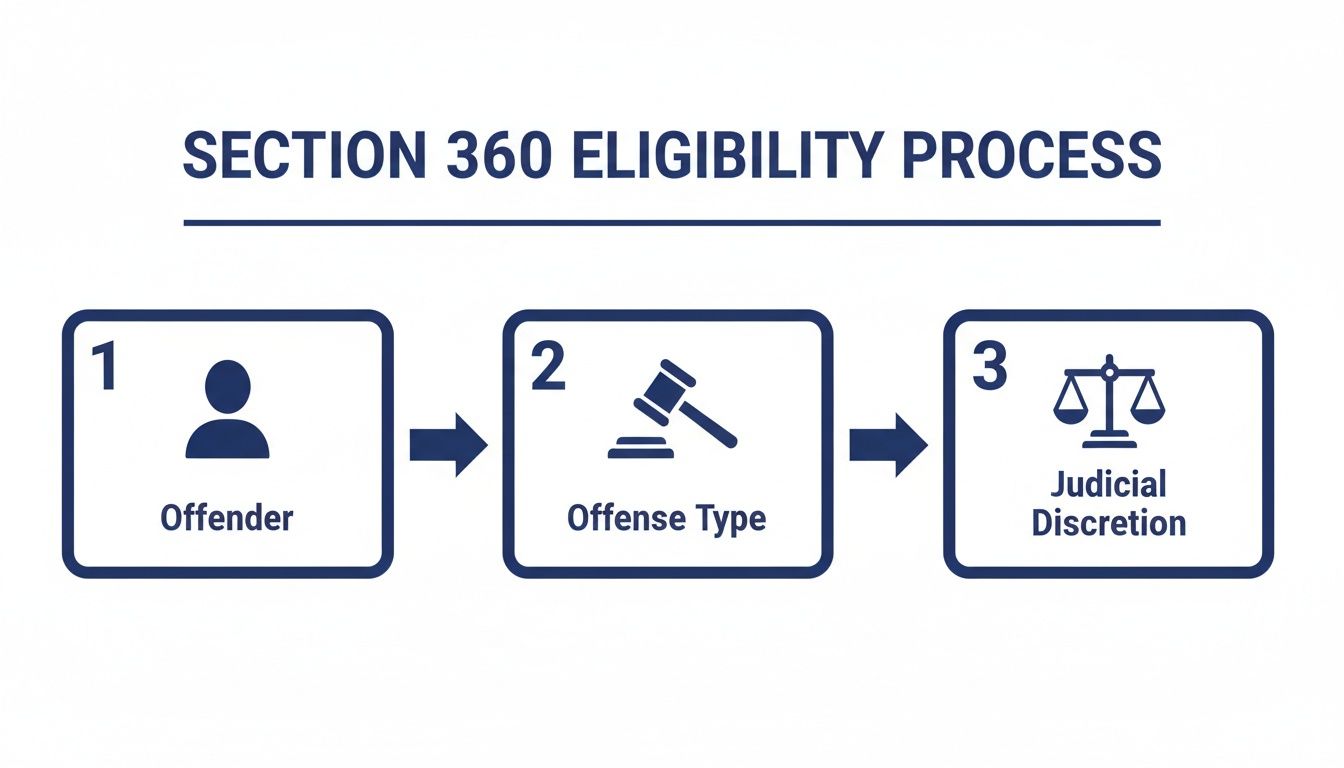
As you can see, once the basic eligibility boxes are ticked for the offender and the offence, it all comes down to the court's own careful judgment.
The Decisive Role of the Probation Officer's Report
If the court senses that the offender might be a good fit for probation, it will often call for a report from a Probation Officer. Think of this report as the court's eyes and ears on the ground. It’s an impartial, deep dive into the offender's life, character, and background.
The Probation Officer's investigation is quite thorough and typically covers:
Social and Family Background: What’s their home life like? Is there a support system?
Character and Antecedents: What’s their reputation in the community? What have they been up to?
Suitability for Reform: Is this person likely to learn their lesson and stay out of trouble if given a chance?
Now, this report isn't binding on the judge, but you can bet it carries a lot of weight. A glowing report can be the key that unlocks probation. A negative one? That’s a serious uphill battle. Legal AI like Draft Bot Pro can assist in preparing submissions in response to a probation officer's report by highlighting positive aspects from client information and suggesting counterarguments to potential negative points.
The Bond: Securing Release with Conditions
If the court green-lights probation, the offender isn’t just sent on their way. They must sign a bond – a formal, legally binding promise to the court. This bond is the heart of the probation order, designed to keep them on the straight and narrow.
The bond will always have a core condition: to keep the peace and be of good behaviour for a set period, which can't be longer than three years. But the court can also add other specific conditions it feels are needed to prevent the person from reoffending.
These extra strings might include things like:
Staying under the supervision of a Probation Officer.
Living at a specific address.
Keeping away from alcohol or drugs.
This isn't just based on a handshake, either. The bond needs sureties—people who vouch for the offender and are on the hook financially if the bond's conditions are broken.
InsightsThe bond is far more than a piece of paper; it’s the legal anchor of the entire probation order. It’s a contract where the court offers freedom in exchange for a solid promise of good conduct and adherence to the rules.
What Happens if the Bond is Broken?
The courts don’t take breaches of a probation bond lightly. If there's proof that the offender has slipped up and violated any condition, the court can issue a warrant for their immediate arrest.
Once they're hauled back into court, that protective shield of probation is gone. The judge is then free to sentence them for the original crime they were convicted of. It’s a serious deterrent that ensures the second chance given under Section 360 CrPC is treated with the respect it deserves.
Landmark Judgements and Key Legal Insights
The black and white text of a statute gives you the rules of the game. But the real strategy, the true meaning of the law, is hammered out in the courtroom. For sec 360 crpc, it's the landmark judgements from the Supreme Court and various High Courts that have breathed life into the provision, turning it from a simple clause into a powerful tool for reformative justice.
Getting to grips with these precedents isn't just some academic box-ticking exercise. It's a strategic imperative. Knowing the right case to cite can be the difference between a weak plea and a compelling argument that persuades a judge to grant probation.
When Courts Can't Just Say "No" to Probation
One of the most important rulings every young lawyer should know is Chandreshwar Sharma vs State of Bihar. This case fundamentally changed how courts must handle their duties under Section 360. It set a critical precedent that prevents the arbitrary denial of a second chance.
The Supreme Court was crystal clear: when an offender is eligible for probation, the court can't just brush past Section 360. If the judge decides against granting probation, they have a mandatory duty to write down specific, valid reasons for that refusal right there in the judgement. A silent order just won't cut it anymore.
This principle is a lifesaver in cases involving minor offences. For example, in the Chandreshwar Sharma case, the Court stressed that this duty applies squarely to convictions for theft under Section 379 of the IPC. This stops courts from mechanically sending people to prison without first giving the reformative option a serious thought.
The Clash of Laws: Section 360 vs. The Probation of Offenders Act
Another tricky area that the courts have clarified is the relationship between Section 360 CrPC and the Probation of Offenders Act, 1958. Time and again, judgements have confirmed that the 1958 Act has a much wider scope. In jurisdictions where it's in force, it usually trumps Section 360.
Insights"The judiciary has consistently acted as the guardian of Section 360's reformative spirit. By insisting on reasoned orders and clarifying procedural ambiguities, the courts have ensured that the provision remains a meaningful instrument of justice, not just a footnote in the statute book."
This isn't just a legal fun fact; it's a crucial fork in the road for your legal strategy. Before you even start building an argument around Section 360, you have to check if the Probation of Offenders Act applies. These landmark judgements give you the roadmap. If you want to dive deeper into judicial thinking, our article on the top 8 landmark judgements of the Supreme Court of India is a great place to start.
Using Legal AI to Your Advantage
Let's be honest, keeping track of decades of judgements and finding the one that fits your case perfectly is a massive job. This is where modern tools like legal AI, specifically Draft Bot Pro, become your personal paralegal.
Instead of spending days in a library, you can simply upload your case brief and facts. You can then prompt the AI to find precedents where probation was granted in similar situations or to pull up judgements that back your argument for applying sec 360 crpc.
Draft Bot Pro can sift through enormous case law databases in minutes, giving you summarised findings and the exact legal reasoning you need to cite. This allows you to build a rock-solid application for probation, backed by the full weight of judicial authority, all while saving you countless hours of grunt work.
Drafting Effective Applications with Legal AI

When it comes to sec 360 crpc, a powerful application can be the single most important factor standing between probation and a prison sentence. It’s not just about ticking legal boxes; crafting a document that is both legally airtight and genuinely persuasive is a true art form. You need to strike a delicate balance between presenting the facts and telling a compelling human story.
A successful application goes far beyond just stating that the offender is eligible for probation. It needs to paint a picture for the court. You should carefully highlight the offender’s positive traits—a clean record, good character, and a real potential for reform. At the same time, it’s crucial to explain the specific circumstances of the offence, providing context that can soften its perceived severity. Together, these elements lay the groundwork for a successful plea for a second chance.
But let's be honest, building this kind of application from the ground up takes time. A lot of time. It demands hours of meticulous drafting, editing, and refining.
Cut Down on Drafting Time with Draft Bot Pro
This is exactly where legal AI tools like Draft Bot Pro can be a game-changer. Instead of staring at a blank page, you can use specific prompts to generate a structured first draft of a probation application in minutes. For instance, just input your client’s background information and the details of the offence, and the AI will create a solid framework to build upon.
This AI-assisted approach ensures you cover all the essential bases, from citing the right case law to structuring arguments around judicial discretion. This frees you up to focus your valuable time and energy on what really matters: refining the narrative, honing the strategy, and making the application truly persuasive.
Insights"An effective Section 360 application is a strategic blend of legal precision and human storytelling. It must not only prove eligibility but also persuade the court that rehabilitation is a more just and effective outcome than incarceration."
Key Elements and AI-Powered Precision
Whether you're drafting manually or with an AI assistant, your application must address the core considerations a judge will have. This means clearly showing that your client isn't a threat to society and that granting probation aligns with the law's reformative goals. A common and often fatal pitfall is failing to provide clear, compelling reasoning on these points.
In fact, the procedural requirement to justify a decision is frequently overlooked by the courts themselves. A 2023 BPR&D analysis brought a shocking statistic to light: a staggering 65% of trial courts were either unaware of or not complying with the mandatory requirement under Section 361 to record their reasons for denying probation. This single procedural error led to 28% of appeals being successful on this ground alone in High Courts. You can dive deeper into these statistics in the full overview from the National Judicial Academy.
Using an AI tool like Draft Bot Pro helps ensure critical legal points like these aren't missed. To further boost your practice's efficiency and manage the complex needs of modern legal work, exploring essential IT solutions for law firms is a smart move. Integrating the right technology helps you create stronger, error-free legal documents every time. To learn more about this, check out our guide on how you can use AI to draft legal documents.
Getting to Grips with Sec 360 CrPC: Your Questions Answered
When you're first navigating the intricacies of Section 360 CrPC, a lot of questions can pop up. This is especially true for law students and junior advocates trying to apply theory to practice. Let's tackle some of the most common queries to make sure these key concepts are crystal clear.
Is Probation Under Sec 360 an Option for Every Crime?
Not at all. Its use is actually quite specific and reserved for less severe offences. You can't argue for probation in very serious cases, particularly those that carry a punishment of death or life imprisonment. The law just doesn't allow it.
It’s really designed for situations where the crime isn't grave. For anyone 21 years or older, it generally applies to offences punishable with a jail term of not more than seven years. But the most crucial hurdles are the offender's age and, critically, the fact that they have no prior criminal convictions on their record.
What Happens if Someone Breaks the Rules of Their Probation?
Courts don't take a breach of probation lightly. If an offender messes up and violates any of the conditions set out in their bond, the court has the power to issue a warrant and have them arrested right away.
Once they're brought back before the judge, the protective bubble of probation is gone. The court can then sentence them for the original crime they were convicted of. That means the suspended jail time can come crashing back down on them.
Does Getting Probation Wipe the Conviction from Your Record?
This is a massive point of confusion, so let's be clear: being released on probation under Section 360 CrPC absolutely does not erase the conviction. The finding of guilt stays firmly on the person's record.
What probation actually does is hit the pause button on the prison sentence. Instead of being sent to jail, the offender gets a chance to reform while living in the community, but they have to stick to strict, court-ordered conditions for a specific period.
Despite its obvious benefits, Section 360 is shockingly underused. A 2022 study by the National Judicial Academy found that probation is granted in less than 5% of eligible cases in the lower courts. This is a big reason our prisons are overflowing, with over 5.5 lakh undertrials as of 2023, according to NCRB stats. You can read more about the underutilisation of sec 360 crpc on restthecase.com. It points to a huge gap between what the law intends and how it's actually used on the ground.
InsightsTruly mastering Section 360 CrPC isn't just about knowing the text of the law. It’s about building a compelling case for a second chance, and that requires a smart approach to your drafting and research. Having tools that can dig up the right precedents and help you structure your arguments can be the difference-maker.
This is where legal AI platforms like Draft Bot Pro can be a game-changer. You can upload the details of your case, and the AI can help you put together a structured draft of your probation application, pinpoint supporting case law, and make sure you've ticked all the procedural boxes. It saves a ton of time and seriously strengthens your plea for reformative justice.
Ready to stop burning the midnight oil on tedious legal drafting and research? Let Draft Bot Pro do the heavy lifting. Our AI-powered legal assistant helps you create precise, well-researched legal documents in a fraction of the time, so you can focus on building a winning case. Join over 46,000 legal professionals in India who trust our platform. Start drafting smarter, not harder, by visiting https://www.draftbotpro.com today.
