
A Clear Guide to Section 13 B Hindu Marriage Act

When a marriage has run its course, the legal process doesn't have to be a battlefield. That's where Section 13B of the Hindu Marriage Act comes in. It provides a civilised, amicable path for couples to dissolve their marriage through mutual consent.
This provision is a cornerstone of modern Indian family law. It lets spouses end their marriage without the messy business of fault-finding or blame, as long as they've lived separately for at least one year and both agree the marriage is beyond repair.
Unpacking the Purpose of Mutual Consent Divorce
Believe it or not, before Section 13B was added to the Hindu Marriage Act, 1955, divorce was always an adversarial fight. One spouse had to drag the other to court and prove they were guilty of a specific marital sin—things like cruelty, adultery, or desertion. This old system often turned the end of a marriage into a public spectacle, filled with accusations and long, emotionally draining legal wars.
The introduction of Section 13B in 1976 was a game-changer. It acknowledged a simple truth: sometimes, a marriage just breaks down, and it's nobody's "fault." It gives couples a dignified alternative, letting them move on by mutual agreement instead of through conflict.
The Philosophy Behind Section 13B
At its heart, the idea is to give a clean exit to couples who have both decided their relationship can't be saved. This non-confrontational approach has some massive advantages over a messy, contested divorce:
Less Animosity: When you remove the need to prove who did what wrong, you dial down the bitterness. This is absolutely critical, especially when children are caught in the middle.
Saves Time and Money: Contested divorces can get stuck in the system for years. A mutual consent divorce is worlds faster, usually wrapping up within 6 to 18 months.
Predictable Outcome: Because both parties agree on everything upfront—alimony, property division, child custody—there are no nasty surprises. The outcome is certain and accepted by both sides.
Insights Think of Section 13B as a negotiated settlement rather than a courtroom brawl. Its primary goal isn't to punish anyone. It’s about providing a structured, peaceful dissolution when both people agree that getting back together is off the table. The focus shifts from assigning blame to creating a path for a respectful separation.
How a Legal AI Can Assist from the Start
Navigating the procedural maze of a mutual consent divorce demands precision. This is where a legal AI tool like Draft Bot Pro can become your secret weapon right from the get-go.
Before you even start drafting the petition, you can use its AI Legal Research feature. Need to find precedents on what "living separately" really means in your jurisdiction? Or the latest Supreme Court judgments on waiving the cooling-off period? A quick search gives you the answers.
This initial legwork ensures your strategy is built on solid ground, making the entire process smoother for your client. It saves you valuable time and helps you set realistic expectations from day one. Of course, it's also crucial to understand the rules for remarriage, which you can dive into with our guide on Section 15 of the Hindu Marriage Act.
Meeting the Legal Requirements for Your Petition
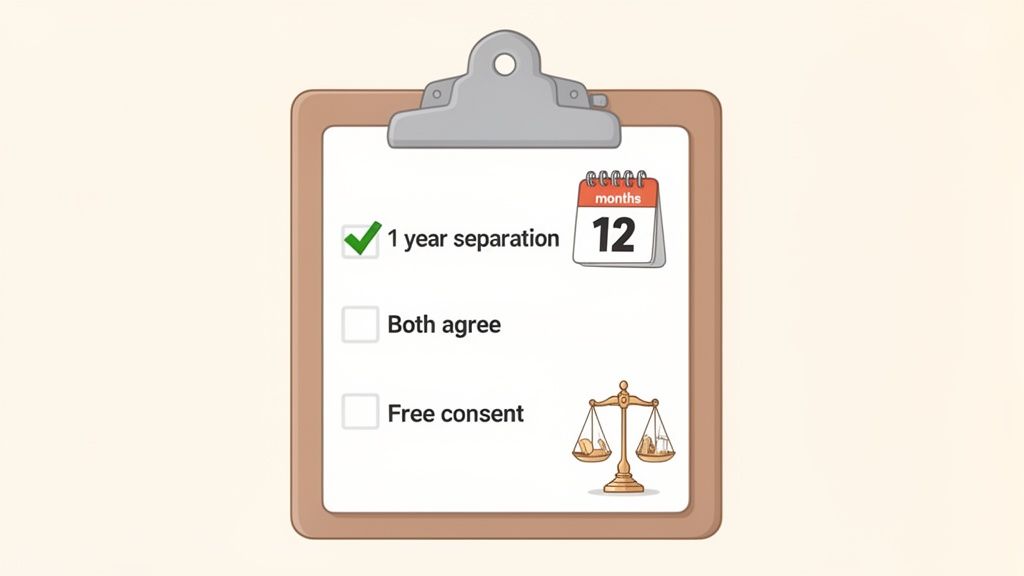
To get a divorce by mutual consent off the ground, your petition has to nail three core legal requirements. These aren't just boxes to tick; they are the absolute foundation of a valid petition under Section 13 B Hindu Marriage Act, and you can bet the court will examine each one with a fine-toothed comb.
Think of them as the three legs of a stool. If even one is wobbly, the whole thing comes crashing down. Let's get into exactly what the court is looking for.
H3: The One-Year Separation Mandate
First up, the couple must have been "living separately" for at least one year right before filing the petition. This is a crucial point and, honestly, where a lot of confusion comes from.
"Living separately" doesn't always mean living in two different cities. While that's the clearest proof, the courts have taken a broader view. The real test is the end of the marital relationship—the animus deserendi, or the clear intention to stop living together as a couple. It's entirely possible for a husband and wife to be under the same roof for financial reasons or for the kids, yet still be considered "living separately" because they no longer function as a married couple.
H3: The Marriage Has Broken Down Irretrievably
The second pillar is the shared understanding that the couple has "not been able to live together." This goes beyond just saying you've been apart; it's a joint admission that the marriage is beyond repair.
In simple terms, both parties need to tell the court that they've tried to make it work, but have both accepted that continuing the marriage is impossible. This united front is what convinces the court there's no hope for reconciliation.
H3: Consent Must Be Genuinely Mutual
The third, and arguably most critical, pillar is that both parties have "mutually agreed that the marriage should be dissolved." This consent has to be real, voluntary, and completely free from outside pressure.
The court needs to be absolutely sure that no one was bullied, tricked, or manipulated into signing the papers. This is a non-negotiable part of Section 13 B Hindu Marriage Act. Even a hint of coercion or fraud can bring the entire process to a screeching halt.
Here’s a quick mental checklist to run through:
Separation Period: Have the parties been living apart as a couple for a solid one year or more before filing?
Irretrievable Breakdown: Do both sides agree, without a doubt, that they can't live together and that all efforts to fix things have failed?
Free Consent: Is everyone's agreement to the divorce completely voluntary, with no force, fraud, or undue influence involved?
Insights The judge's main job here is to confirm the consent is authentic. It's common for a judge to speak with both parties directly in chambers to ensure their decision is truly their own. This is a safeguard built into the system to protect people from being pressured, making sure the final divorce decree is rock-solid and can't be challenged later.
The introduction of Section 13B back in 1976 was a game-changer, creating a direct path for divorce by agreement. It requires a one-year separation before filing and a 'cooling-off' period of at least six months after the first motion. While the landmark Amardeep Singh v. Harveen Kaur case confirmed the separation period is mandatory, courts have shown some wiggle room on the cooling-off period in unique situations. They've sometimes waived it under Article 142 of the Constitution, especially when a couple has been separated for a very long time. You can read a detailed case analysis of the landmark ruling on Section 13B.
Making sure these conditions are clearly and strongly stated in your draft is non-negotiable. An AI tool like Draft Bot Pro can take the facts you input and ensure the petition hits every one of these legal marks, making your case stronger from the get-go.
Navigating the First and Second Motion Timeline
Think of a mutual consent divorce under Section 13B of the Hindu Marriage Act as a two-act play. Act One is the First Motion. Then there's an intermission—the famous "cooling-off" period. The finale is Act Two, the Second Motion, which brings down the curtain with a final decree. As a lawyer, getting this timeline right is everything. It helps manage your client's expectations and keeps the case moving smoothly.
Kicking Things Off: The First Motion
The process begins when both spouses jointly file their divorce petition with the appropriate family court. This isn't just a simple form; it's a sworn statement confirming a few critical facts: they've been living apart for at least one year, they've realised they can't live together anymore, and they've mutually agreed to end the marriage.
Crucially, all the messy details—alimony, child custody, how property will be split—must be ironed out and attached to this petition. Once it's filed, the court sets a date for the First Motion hearing. Here, the judge will see both parties in person, check their IDs, go over the petition, and, most importantly, confirm that their consent is real and hasn't been forced. If the court is satisfied, it passes an order, and the clock starts ticking on the cooling-off period.
What’s the Point of the "Cooling-Off" Period?
The law carves out a mandatory waiting period of at least six months, but no more than eighteen months, between the First and Second Motions. This is what everyone calls the "cooling-off" period.
This window isn't just about administrative delay. It's a purposefully designed pause, giving the couple a final, legally mandated chance to think things over. The hope is that with some time away from the stress of court, they might just find a path to reconciliation.
Below is a quick reference table to help you keep track of the key stages in this process.
Section 13B Procedural Timeline
This table summarises the key stages, timelines, and legal actions involved in a mutual consent divorce process under Section 13B.
Stage | Action Required | Statutory Timeline | Key Considerations |
|---|---|---|---|
First Motion | Jointly file the divorce petition with all settlement terms. | After a minimum of 1 year of separation. | Both parties must appear in court to verify their voluntary consent. |
Cooling-Off Period | A mandatory waiting period for potential reconciliation. | Minimum 6 months; Maximum 18 months from the First Motion. | This period is intended to be a final chance for the couple to reconsider. |
Second Motion | File a second motion to confirm the continued desire for divorce. | After the 6-month cooling-off period but before the 18-month deadline. | Failure to file within 18 months invalidates the original petition. |
Final Decree | Court hears the second motion and grants the divorce decree. | Following the Second Motion hearing. | The court's final order legally dissolves the marriage. |
Understanding this timeline is crucial for guiding clients and ensuring no critical deadlines are missed.
Moving for the Final Decree: The Second Motion
If the six months pass and the couple is still certain about their decision, it's time to file the Second Motion. This has to be done before the eighteen-month deadline runs out from the date of the First Motion.
At the Second Motion hearing, the court does one last check. It confirms that the consent is still mutual and that neither party has had a change of heart. If everything checks out, the court grants the decree of divorce, and the marriage is officially over.
Insights That eighteen-month deadline is non-negotiable. If the Second Motion isn't filed in time, the entire petition is thrown out. It’s the law's way of saying that if a couple doesn't actively pursue the divorce after the waiting period, it assumes they've reconciled or no longer wish to proceed.
Can You Skip the Cooling-Off Period?
For years, the six-month wait was set in stone. But the law is a living thing, and a landmark Supreme Court case, Amardeep Singh v. Harveen Kaur, changed the game for section 13 b hindu marriage act. The Court recognised that sometimes, forcing a couple to wait just prolongs their misery. It held that the cooling-off period isn't mandatory in every single case and can be waived.
A judge might agree to a waiver if you can prove:
The couple has already been separated for well over the statutory one-year period.
Every attempt at mediation and reconciliation has failed, and there's zero chance of them getting back together.
They’ve already settled everything—alimony, custody, and property—with no disputes left.
Making them wait the full six months would serve no purpose other than to drag out their suffering.
To get a waiver, you’ll need to file a separate application along with the First Motion petition, laying out the evidence that these conditions are met. This judicial flexibility is a huge step forward, acknowledging that when a marriage is irretrievably broken, a forced wait is pointless. The law has certainly come a long way since 1976. For a deeper dive, you can explore the evolution of mutual consent divorce in India.
How Draft Bot Pro Can Help with Procedural Steps
Navigating these steps means drafting flawless documents, from the main petition to the waiver application. Draft Bot Pro is a fantastic co-pilot for making sure every document is spot-on. For example, the affidavits filed with your petition have to be precise. You can use the AI to generate a legally sound affidavit that ticks all the court’s boxes. For more on that specific document, check out our guide on crafting an affidavit under the CPC in India. Getting your paperwork right from the start prevents unnecessary delays and makes your case stronger from day one.
How to Draft a Flawless Petition and Settlement
A well-drafted petition is the backbone of a smooth mutual consent divorce. It’s not just paperwork; it's a clear, legally binding roadmap that lays out the couple's agreed-upon future. Getting this document right from the start is absolutely crucial for a hassle-free process under Section 13B of the Hindu Marriage Act.
Think of the petition as the architectural plan for the divorce. If the plan is flawed—full of vague language or missing details—the entire structure can become unstable and lead to ugly disputes down the line. The goal is to create a rock-solid document that leaves zero room for misinterpretation.
This timeline shows just how straightforward the path can be when the petition is drafted properly, from the first filing to the final court order.
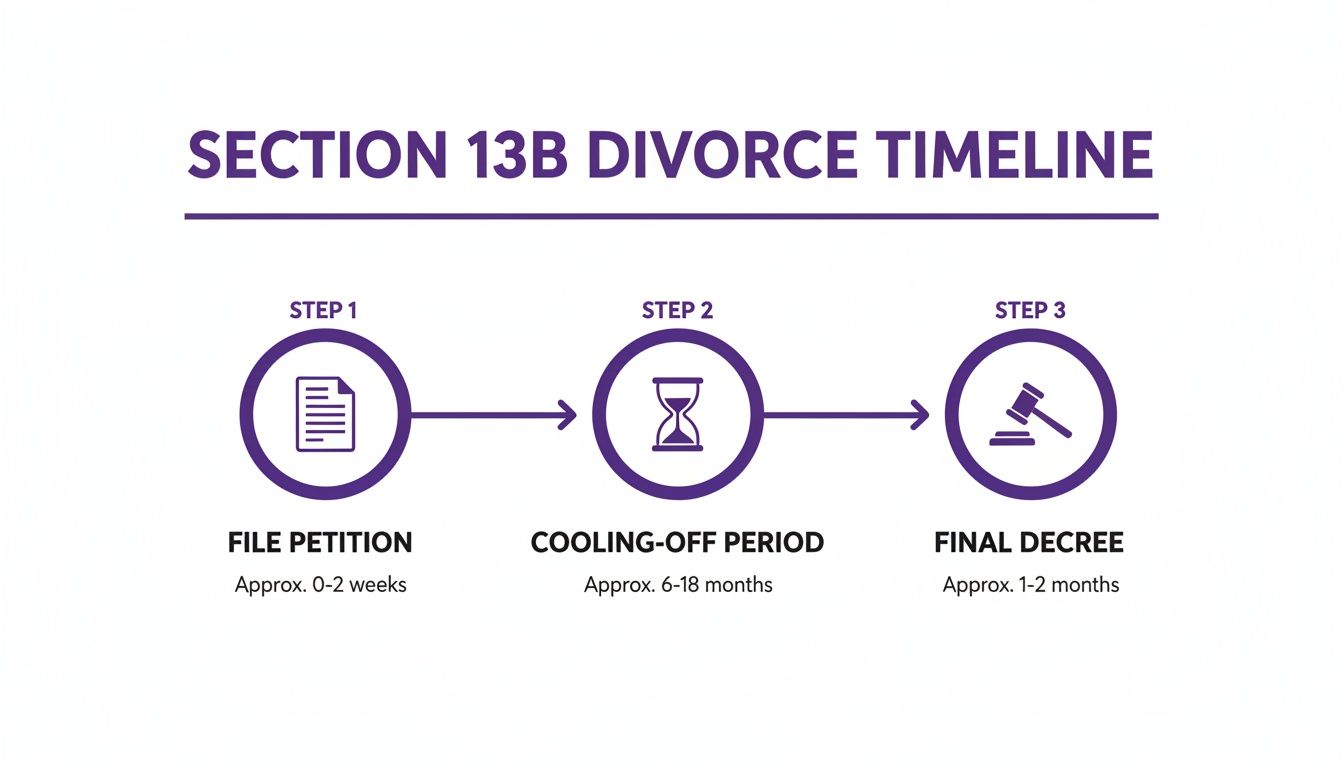
As you can see, a precisely drafted petition is what kicks the whole process into motion efficiently.
Essential Elements of the Joint Petition
Every joint petition for a mutual consent divorce has a few non-negotiable parts. These are the facts the court needs to see to confirm that all the legal requirements have been ticked off.
Details of the Marriage: You'll need the date and place the marriage was solemnised. Don't forget to attach a certified copy of the marriage certificate.
Date of Separation: State the exact date the couple started living separately. This is critical—it must be at least one year before filing the petition.
Statement of Reconciliation Failure: The petition has to spell it out: the parties haven't been able to live together and have both agreed the marriage is irretrievably broken.
Drafting the Settlement Agreement
The settlement agreement, which you'll often hear called a Memorandum of Understanding (MoU), is truly the heart of the mutual consent process. This is where you need to meticulously detail every single term the couple has agreed on to head off any future fights.
Pro Tip The language in a settlement agreement has to be ironclad. Vague terms like "reasonable access" for child visitation or "equitable distribution" of assets are just invitations for future litigation. Be concrete. Specify exact dates for visitation and list every single asset with its agreed-upon division.
Key areas you must cover in the settlement agreement include:
Alimony/Maintenance: Be specific. Is it a lump sum or periodic payments? What's the exact amount and the payment deadline? State clearly that this is a full and final settlement.
Child Custody and Support: Detail the custody arrangement (sole, joint, or shared), the visitation schedule, and the precise amount and duration of child support payments.
Division of Property: List out all marital assets—both movable and immovable—and spell out exactly who gets what.
The Role of AI in Perfecting Your Draft
Drafting these documents requires an almost painful level of attention to detail. One overlooked clause can create massive problems later. This is where legal AI can be a massive help for legal professionals.
A tool like Draft Bot Pro can take your client's raw settlement terms and turn them into a polished, court-ready petition. You just upload the agreed-upon points, and the AI generates a legally sound document, complete with all the necessary statutory clauses and perfect formatting. It acts as a safety net, making sure no critical element is missed, which can save you hours of manual drafting and review. For any practitioner looking to level up, it's always worth learning more about how to improve your legal drafting skills with modern tools.
This AI-assisted approach helps ensure accuracy and consistency, freeing up lawyers to focus on client strategy instead of getting bogged down in administrative tasks. It helps you produce flawless petitions that will stand up to judicial scrutiny, making the journey through the Section 13B of the Hindu Marriage Act process smoother for everyone involved.
Comparing Mutual Consent and Contested Divorce
To really get why Section 13B of the Hindu Marriage Act is so important, you have to put it side-by-side with its polar opposite: a contested divorce under Section 13. These two paths for ending a marriage couldn't be more different. One is built on agreement, the other on outright conflict.
Think of it this way: a mutual consent divorce is like a negotiated business merger where both sides agree on the terms and present a united front. A contested divorce? That's a hostile takeover. One party has to legally prove the other is "at fault" based on very specific grounds laid out in the statute. This single difference flips the entire dynamic from collaboration to confrontation.
The practical consequences are huge, affecting everything from how long it takes and how much it costs, to the immense emotional toll it takes on the clients and their families.
Mutual Consent (Sec 13B) vs Contested Divorce (Sec 13)
Choosing between these two routes is one of the most critical strategic decisions in any matrimonial case. The procedural and emotional landscapes are worlds apart. A contested divorce can drag on for years, demanding lengthy trials, mountains of evidence, and gruelling cross-examinations—all things you simply don't have in a Section 13B proceeding.
The table below breaks down the key distinctions.
Aspect | Section 13B (Mutual Consent) | Section 13 (Contested Divorce) |
|---|---|---|
Basis for Divorce | Mutual agreement that the marriage has irretrievably broken down. | Proving specific "fault-based" grounds like cruelty, desertion, or adultery. |
Timeline | Typically 6 to 18 months, and the cooling-off period can sometimes be waived. | Can easily take 3 to 5 years or even longer, snarled up in court backlogs and appeals. |
Emotional Cost | Far lower stress and animosity. It’s a process based on cooperation. | Extremely high emotional and psychological strain from public accusations and conflict. |
Financial Cost | Significantly more affordable due to fewer hearings and a shorter timeline. | Can become incredibly expensive, with steep lawyer fees and litigation costs piling up. |
Evidentiary Burden | Minimal. The parties just need to show they meet the basic requirements. | Heavy. The petitioner carries the full burden of proving their allegations with evidence. |
Grasping these differences is crucial for advising clients properly. It helps them weigh the real-world benefits of a peaceful, managed separation against the high stakes and uncertainty of a protracted legal battle.
Grounds for Divorce and Gender Protections
When you dig into Section 13, you’ll notice that the grounds for divorce aren't entirely symmetrical. While both spouses can file on nine shared grounds like cruelty or adultery, Section 13(2) gives four additional, exclusive grounds to wives.
These include situations like the husband's pre-existing marriage (bigamy), a conviction for severe sexual offences, or if the marriage took place before she was fifteen. This isn't an oversight; it's a deliberate structure by Parliament, recognising that wives often need stronger legal protections in matrimonial disputes. You can discover in-depth analysis of Section 13B appellate use for more on this topic.
Insights The biggest advantage of Section 13B is control. The clients—not a judge—decide the outcome. They negotiate and agree on alimony, custody, and how property is divided. In a contested divorce, all that control is handed over to the court, which introduces a huge amount of risk and unpredictability.
How Draft Bot Pro Can Help
What happens when a mutual agreement just isn't on the table? You have to file a contested divorce petition. This requires drafting that is both precise and powerful, clearly laying out the grounds for the court.
This is where Draft Bot Pro comes in. It can generate a solid first draft of a contested divorce petition for you. Just upload your case notes and key facts, and you'll get a structured document that articulates the grounds clearly. It's a massive time-saver and ensures all your crucial legal points are covered right from the start.
Answering Your Clients' Common Questions About Mutual Consent Divorce
Even when the path seems straightforward, clients will always have questions when navigating a mutual consent divorce. As their counsel, you know that handling the finer points of Section 13B of the Hindu Marriage Act requires having solid, direct answers ready. It’s how you manage expectations and, more importantly, build trust.
Let's break down some of the most frequent questions that crop up, arming you with clear, practical responses grounded in law and recent judicial thinking.
Can One Person Back Out After the First Motion?
Yes, absolutely. This is probably the most critical point to understand about mutual consent. The agreement to divorce must be genuine and continuous, right up until the moment the judge passes the final decree. The Supreme Court has been crystal clear on this: consent given for the First Motion must still be present for the Second Motion.
If one party has a change of heart and withdraws their consent, the court simply cannot grant a divorce under Section 13B. The joint petition dies then and there. This forces the other person, if they still want to end the marriage, to file a contested divorce on one of the grounds laid out in Section 13. The mutual consent journey, however, is over.
What If We Can't Agree on Alimony or Custody?
A complete, iron-clad agreement on all ancillary matters is the very foundation of a mutual consent petition. This isn't just about agreeing to separate; it’s about agreeing on everything—alimony (maintenance), who the children will live with, visitation rights, and how every last piece of marital property will be divided. If these terms aren't settled and put in writing, you don't have a valid joint petition.
Any lingering disagreement on these key issues means the divorce isn't truly by "mutual consent" in the eyes of the law. The court's job is not to negotiate a settlement for the parties. If you can't agree, the only path forward is a contested divorce, where a judge will hear both sides and make these decisions for you.
Insights The court’s role in a Section 13B case is not to mediate disputes but to verify a pre-existing agreement. If there is no comprehensive agreement on all fronts, the very foundation of the mutual consent petition is absent, and the court has no choice but to dismiss it.
Is the Six-Month Cooling-Off Period a Hard and Fast Rule?
Not anymore. While the statute prescribes this six-month waiting period between the two motions, the Supreme Court’s landmark ruling in Amardeep Singh v. Harveen Kaur changed the game. It gave family courts the discretion to waive this period in certain situations.
You can make a strong case for a waiver if your clients can show that:
They've already been living apart for a long time (much more than the one-year minimum).
There's zero chance of them getting back together.
All financial and custody issues are genuinely and fully resolved.
Making them wait another six months would do nothing but prolong their misery.
To get the waiver, you need to file a separate application with the court, clearly explaining why your clients' situation fits these exceptional criteria.
What Happens If a Couple Reconciles During the Waiting Period?
That's precisely what the cooling-off period is for! The law wants to give couples a final chance to reconsider. If they decide to get back together during the six-to-eighteen months between motions, they just... do nothing.
They simply don't show up to file the Second Motion. If the Second Motion isn't filed within the maximum 18-month window, the original petition automatically lapses. The court dismisses the case, and they remain legally married. Inaction is all that's required.
How Can AI Help Me Make a Stronger Case?
When you’re trying to get that six-month period waived, your argument is only as good as the precedents you cite. This is where a specialised tool like Draft Bot Pro becomes a game-changer for legal research. Forget spending hours digging through case law databases.
Imagine you could just ask the AI, "Find recent High Court judgments that waived the six-month cooling-off period under Section 13B where the parties had been separated for over five years." In seconds, you get a clean, curated list of relevant cases, complete with sharp summaries and direct links to the judgments. This allows you to build a powerful, evidence-backed application for your client, saving you invaluable time and giving you the upper hand in court.
Ready to make your legal practice more efficient? Draft Bot Pro is the AI assistant built by Indian lawyers, for Indian lawyers. From drafting flawless petitions to conducting pinpoint legal research, our platform is designed to handle the heavy lifting so you can focus on strategy. Join over 46,000 legal professionals who trust us to deliver accurate, verifiable, and fast results. Explore how we can support your work at https://www.draftbotpro.com.
