
Settlement of Industrial Disputes: A Practical Resolution Guide

When disagreements between employers and their teams escalate, they can't just be left to fester. That's where the formal process for the settlement of industrial disputes comes in. It’s a structured system designed to resolve conflicts over things like wages, working conditions, or union rights in a way that’s fair, efficient, and keeps the peace.
Understanding Workplace Conflict in India
Think of an industrial dispute as a workplace disagreement that’s moved beyond a simple chat in the HR office. When management and employees hit a wall on a critical issue, the situation can quickly spiral, damaging productivity and creating a toxic work environment. A clear, structured settlement process is what stops these sparks from turning into a full-blown fire.
The real goal here is to maintain what's called 'industrial peace'. Unresolved disputes don’t just hurt the people directly involved; they can lead to damaging strikes, lockouts, and serious economic consequences for everyone. Having a reliable pathway to resolution is absolutely essential, both for business stability and for protecting the rights of workers.
The Foundation of Industrial Harmony
The framework for settling industrial disputes in India is built to give everyone multiple options. The idea is to start with collaboration and only move to more formal, legal steps if the initial attempts don't work. The system progresses through three core methods:
Conciliation: Think of this as guided negotiation. A neutral third party steps in to help both sides talk it out and hopefully find a solution they can both live with.
Arbitration: This is a voluntary step where both parties agree to hand the problem over to a private, impartial expert who will make a decision that is legally binding.
Adjudication: When all else fails, the dispute goes to a formal, court-like system. This involves Labour Courts and Tribunals that issue a final judgment that both sides must follow.
A Historical Perspective on Disputes
The world of industrial relations in India has changed a lot over the decades. The number of disputes has often been a mirror, reflecting the country's economic and social mood. Back in 1970, for example, India saw a staggering 2,889 disputes, which cost the economy a massive 20.5 million person-days of work.
Fast forward to 2014, and that number had dropped to 143 disputes. While that's a huge improvement, those disputes still affected over a million workers, showing that the underlying challenges in employer-employee relations haven't disappeared. The way we resolve these issues has clearly evolved, but the need for effective mechanisms remains as strong as ever.
Insights Getting dispute resolution right isn’t just about following the law; it's a strategic imperative. When you manage conflicts proactively, you protect your company’s reputation, keep your team's morale high, and ensure your operations run smoothly—all critical ingredients for long-term success.
Today, modern tools are becoming a game-changer in this complex field. Legal AI platforms like Draft Bot Pro are helping legal and HR teams by automating the creation of crucial documents, from the first notice to the final settlement agreement. This ensures every piece of communication is precise, compliant, and drafted in a fraction of the time, cutting down the risk of procedural mistakes. By handling the heavy lifting of documentation, professionals can focus their energy on strategy and negotiation. To learn more, check out our guide on how AI is supporting HR compliance in India.
The Path to Amicable Agreement Through Conciliation

When an industrial dispute reaches a deadlock, conciliation is often the first formal step toward finding a resolution. Think of it less like a courtroom battle and more like a guided negotiation. A neutral third party steps in, not to pass judgment, but to help the employer and employees find common ground and forge their own solution.
This entire process is built on collaboration. The goal isn't for one side to win and the other to lose; it's about finding a win-win outcome that everyone can live with. By design, conciliation dials down the hostility and encourages open, honest conversation. This makes it a fantastic tool for preserving workplace relationships, even after a serious disagreement.
The Key Players in Conciliation
The government appoints specific authorities to facilitate the conciliation process. These individuals are crucial, as they set the tone for the talks and steer the conversation toward a productive end. There are two main types:
Conciliation Officer: This is an individual appointed for a specific region or industry. They're the most common first point of contact for disputes. Their job is to dive into the issue quickly and do everything they can to coax both parties toward a fair and amicable settlement.
Board of Conciliation: This is a more formal setup, usually brought in for bigger, more significant disputes. It’s composed of a chairman and two or four other members, with equal numbers representing the employer and employee sides. The Board operates with a more structured approach and has broader investigative powers.
Most disputes start with a Conciliation Officer. If a settlement can't be reached within 14 days, the officer has to submit a "failure report" to the government. This is often the trigger for the government to step in and constitute a Board of Conciliation for a more intensive effort.
How the Conciliation Process Unfolds
The path through conciliation is clearly laid out by law. It kicks off when a dispute is officially referred to a Conciliation Officer or Board. From there, the facilitator gets both parties to the table to air their grievances, state their cases, and explain what they want.
The facilitator’s primary role is to listen, suggest potential compromises, and clear up any misunderstandings that are clouding the issue. They act as a neutral go-between, making sure high emotions don't derail the progress. Critically, the process is time-bound; the law sets strict timelines to stop disputes from dragging on forever.
Insights A settlement reached during conciliation isn't just a handshake agreement. Once it’s signed by both parties, it becomes legally binding and enforceable. This gives the process real teeth and ensures all the hard work results in a lasting resolution.
Conciliation in Action: A Wage Dispute Scenario
Let's paint a picture. A workers' union at a manufacturing company demands a 15% wage increase, pointing to the rising cost of living. Management pushes back, saying anything over 5% is financially impossible. The talks have stalled. The dispute is sent to a Conciliation Officer.
The officer starts by meeting with each side separately to get the full story and understand their real-world constraints. Then, they bring everyone together. Instead of letting them stick to their rigid demands, the officer guides the conversation toward more creative solutions.
After a few intense sessions, a compromise is floated: a 9% wage increase, but with an improved annual bonus tied directly to productivity. This way, the workers get immediate financial relief, and the company’s costs are linked to performance. Both sides agree, a settlement is signed, and a potentially damaging strike is avoided.
Now, managing the paperwork for all this—from the initial notices to the final settlement agreement—can be a massive headache. This is where a legal AI tool like Draft Bot Pro can be a game-changer. It helps HR and legal teams generate precise, compliant documents in a fraction of the time, making sure every stage is properly recorded. This frees up the human negotiators to focus on what really matters: finding that crucial middle ground.
Navigating the Voluntary Path of Arbitration
When the collaborative spirit of conciliation just isn't enough to bridge the gap, arbitration steps in as a more structured, yet still voluntary, path to resolving industrial disputes. Think of it as a private court, one that both parties willingly agree to enter.
In this forum, an impartial expert—the arbitrator—hears both sides of the story. But unlike a conciliation officer who just nudges the parties towards a deal, the arbitrator acts like a judge. They deliver a final, legally binding decision, which is known as an 'award'. This shifts the dynamic from open-ended negotiation to a clear, decisive resolution.
The whole process hinges on one simple but powerful idea: consent. Arbitration can't be forced on anyone. It’s a journey that only begins when both the employer and the workers agree to hand over their dispute to an arbitrator.
Crafting the Arbitration Agreement
For arbitration to be legally sound under the Industrial Disputes Act, 1947, it all starts with a formal arbitration agreement. This isn't just a handshake deal; it's a written contract laid out as per Section 10A. This document is the bedrock of the entire process, giving the arbitrator the official authority to decide the matter.
The agreement must be crystal clear about the specific issues on the table. It also has to name the person or people who will act as the arbitrator. Getting these details right is absolutely crucial. It sets the ground rules and prevents any arguments down the line about what the arbitrator was supposed to be deciding.
Insights The real magic of arbitration is its unique blend of formality and flexibility. You get a binding decision, just like in a court, but you also get to choose your own 'judge' and have a say in the timeline. This makes it a go-to option for disputes that need a quick turnaround or a decision-maker with specialised industry knowledge.
Who Can Be an Arbitrator?
Choosing the right arbitrator is probably the single most important decision the parties will make. They can pick any independent person they both trust and agree on. More often than not, they’ll look for someone with serious credibility and expertise—think retired judges, senior advocates, or highly respected industry veterans.
The non-negotiables for an arbitrator are impartiality and fairness. They can't have any connection to either side that could even hint at bias. This neutrality is what ensures the final award is based purely on the facts and legal arguments presented.
For example, imagine a dispute over complex work standards at an engineering firm. The parties might pick a retired chief engineer to arbitrate. Who better to understand the technical nuances of the case than someone who has lived and breathed that world? Their decision is likely to be far more practical and informed than one from a judge without that specific background.
Putting together a solid arbitration agreement is a serious legal task. One poorly worded clause or a missed detail can give the losing party grounds to challenge the award in court, completely defeating the purpose of a swift resolution. This is where modern legal tools can be a game-changer. A Legal AI like Draft Bot Pro can be invaluable for drafting comprehensive agreements that tick every box under Section 10A. It helps ensure that critical clauses—covering everything from appointing the arbitrator to defining the scope of the dispute—are watertight. By handling the foundational drafting, Draft Bot Pro frees up legal professionals to focus on strategy. You can learn more about using AI to create stronger arbitration clauses and bulletproof your agreements from the start. It’s about building a solid foundation for a fair and final resolution.
When to Use Adjudication Authorities
So what happens when the back-and-forth of conciliation stalls, and a voluntary agreement to arbitrate just isn't happening? This is where the dispute resolution process enters its final and most formal stage: adjudication. It’s the compulsory legal route, the point where the government steps in and refers the dispute to a judicial body for a binding decision.
Think of it as the ultimate backstop. It ensures that even the most stubborn conflicts have a clear path to resolution, preventing them from simmering indefinitely. Once the government refers a case, both parties must participate. The proceedings are quasi-judicial, mirroring a court with evidence, arguments, and examinations, all leading to a legally enforceable decision known as an "award."
Understanding the Three Tiers of Adjudication
The Industrial Disputes Act, 1947, doesn't use a one-size-fits-all approach. Instead, it sets up a three-level hierarchy for adjudication, with each body having a distinct jurisdiction. The nature of the conflict—whether it’s a single employee's grievance or an issue rocking an entire industry—determines which authority will hear the case.
This structure is smart. It makes sure disputes are handled at the right level, from localised issues to conflicts with nationwide implications.
The three primary adjudication authorities are:
Labour Courts: These are the first-line responders, primarily dealing with disputes concerning individual workers' rights. Think wrongful dismissals, withdrawal of customary perks, or questioning the legality of a specific strike or lockout.
Industrial Tribunals: These tribunals have a much broader scope. They tackle issues that impact a larger group of workers or even an entire company. This is where you'll see cases about wages, working hours, bonus structures, and rules of discipline being thrashed out.
National Tribunals: Reserved for the big ones. The Central Government sets these up to handle disputes of national importance. They step in when an issue affects industrial establishments across multiple states or is so significant it demands a single, uniform decision for the whole country.
The infographic below really helps visualise how these authorities differ in the types of cases they handle and their place in the hierarchy.
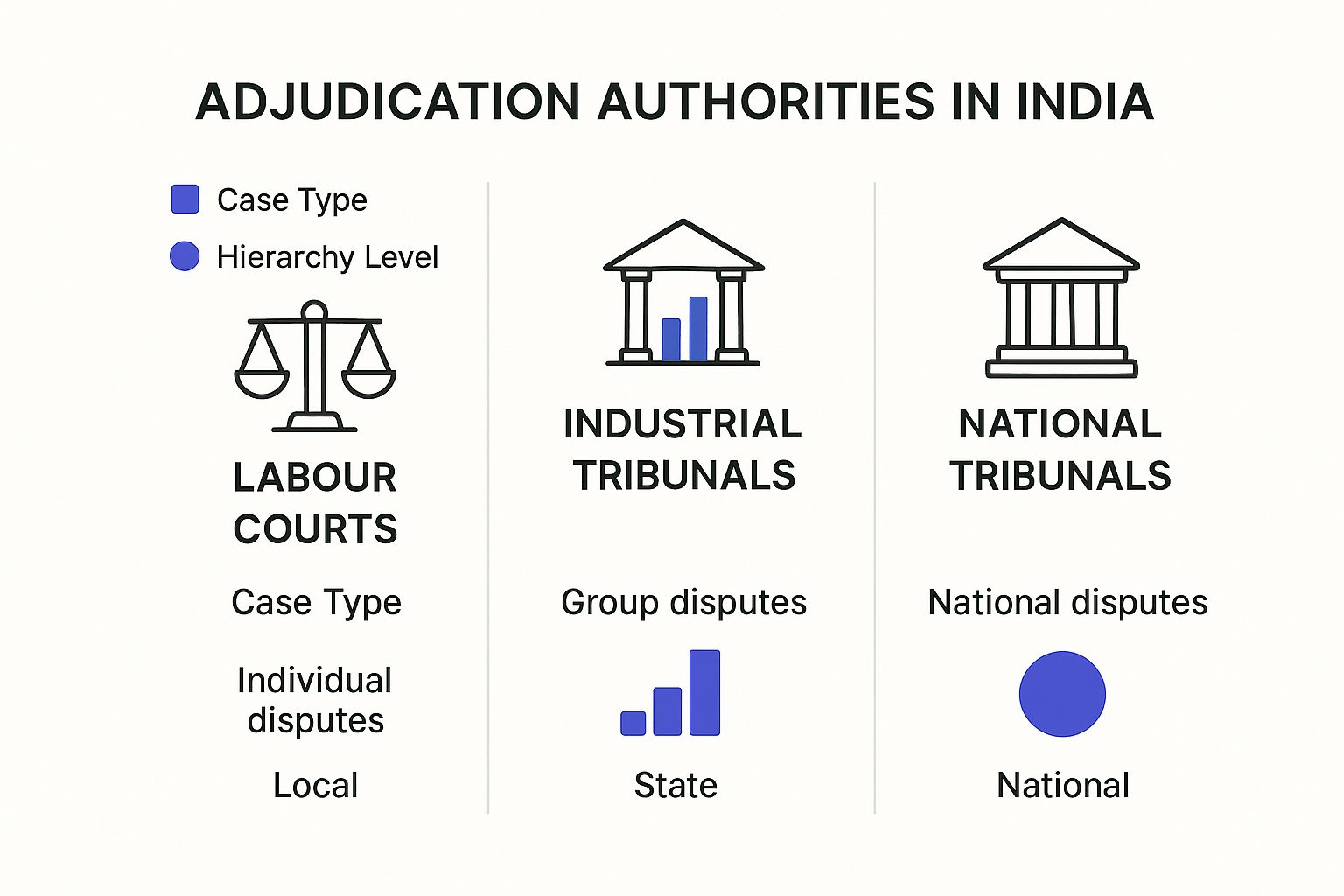
As you can see, the system is designed to scale. It handles individual matters locally through Labour Courts and tackles widespread industrial conflicts at the top with National Tribunals.
The Government Referral Process
Here’s a crucial detail: parties can’t just walk up to these courts and tribunals and file a case. The "appropriate government"—either state or central, depending on the industry—must first refer the dispute. This only happens after the government is satisfied that conciliation has failed and a formal judgment is the only way to maintain industrial peace.
This referral process acts as a filter. It ensures that only genuine, intractable disputes make it into the formal legal system, reinforcing the Act's preference for amicable settlements first and foremost.
Insights The real power of adjudication lies in the finality of its "award." Unlike conciliation, which hinges on mutual agreement, an award is a conclusive judgment. Both parties are legally bound to follow it, bringing a definitive end to even the most heated industrial conflicts.
Comparison of Adjudication Authorities in India
To really get to grips with how these bodies differ, it’s helpful to see their features side-by-side. The table below breaks down the key distinctions between the Labour Court, Industrial Tribunal, and National Tribunal.
Feature | Labour Court (Section 7) | Industrial Tribunal (Section 7A) | National Tribunal (Section 7B) |
|---|---|---|---|
Primary Jurisdiction | Matters in the Second Schedule (e.g., individual dismissal, withdrawal of benefits). | Matters in the Second or Third Schedule (e.g., wages, bonuses, working conditions). | Disputes of national importance or affecting more than one state. |
Constituted By | State Government. | State Government. | Central Government. |
Composition | One person (Presiding Officer) with specific judicial qualifications. | One person (Presiding Officer) with specific judicial qualifications. | One person (Presiding Officer) with qualifications of a High Court Judge. |
Scope of Disputes | Primarily individual worker rights and specific employer actions. | Broader issues affecting groups of workers or an entire industry within a state. | Issues with national implications requiring a uniform, binding decision across states. |
This comparison highlights the tiered structure designed to match the authority's power and scope with the scale and complexity of the dispute, ensuring an appropriate forum for every kind of industrial conflict.
The Persisting Challenge of Industrial Disputes
Even with these well-defined mechanisms, industrial unrest is far from a thing of the past. While data shows a general decline in the number of disputes, their impact can still be massive. For example, back in 2010, there were 431 disputes, but they involved over 10 lakh workers—a clear sign of large-scale conflict.
By 2014, the person-days lost had dropped to 3.63 million, suggesting resolutions were getting better. However, recent state-level data from 2020 through mid-2024 shows ongoing friction in key sectors like coal mining and railways. These stats paint a picture of slow, uneven improvement, reinforcing just how vital the adjudication process remains. For a deeper dive into the numbers, you can explore the evolution of labour disputes in India.
Preparing for adjudication isn't a casual affair; it demands meticulous documentation and rock-solid legal arguments. This is where legal AI tools like Draft Bot Pro can be a game-changer. The platform helps legal teams get their case in order by organising evidence, drafting precise legal submissions, and researching relevant case law. It helps build a compelling argument for the tribunal, making sure every point is backed by strong legal precedent.
The Economic Impact of Unresolved Disputes
When the talking stops and the formal paths of conciliation and arbitration hit a dead end, the economic consequences can be brutal. This is where things get serious, often escalating into strikes (when employees stop working) or lockouts (when employers temporarily shut down operations). These aren't just symbolic gestures; they are potent economic weapons that leave a trail of damage.
An unresolved dispute doesn't just stay within the factory gates. It sends shockwaves outwards, disrupting production lines, bringing services to a halt, and cracking supply chains. The direct costs are easy to spot: workers lose wages, and the company loses revenue. But the invisible, indirect costs often cut deeper—a tarnished brand reputation, eroded customer trust, and nervous investors.
Measuring the True Cost of Conflict
So, how do we actually measure this impact? The most direct metric is the loss of "person-days"—a simple unit that represents one person's working day. When this number swells into the millions, it's a clear sign of a massive hit to the nation's productivity and GDP. A solid system for settling industrial disputes isn't just about keeping the peace; it's an economic shield.
Just look at the history books. India’s turbulent mid-1970s saw a huge spike in labour unrest. In 1974, industrial disputes shot up to 2,938 cases, pulling in 28.55 lakh workers and wiping out a staggering 402.6 lakh person-days of productivity. After the Emergency ended in 1977, conflicts flared up again, with the infamous 1992 Bombay textile strike single-handedly costing 748 lakh man-days. These numbers paint a stark picture of the economic bleeding caused by unresolved grievances.
Insights Industrial harmony isn't just a nice-to-have social goal; it's an absolute economic necessity. Every single person-day lost to a strike or lockout is like a small crack in the country's economic foundation. Effective settlement mechanisms are the tools we need to patch these cracks before they turn into chasms.
Getting Ahead of the Problem with Risk Mitigation
Dealing with the financial risks of industrial disputes means you can't just wait for a problem to happen. You need to be proactive. Smart companies actively hunt for potential conflict points and tackle them head-on before they explode into full-blown crises that bring everything to a standstill. The economic fallout from these disputes can easily derail major projects, which is why understanding broader principles of managing risk in project management is crucial for building a more resilient operation.
This is where modern technology can be a game-changer. Legal AI tools like Draft Bot Pro are perfect for this forward-thinking approach. It can dig through years of historical dispute data and internal communications, helping legal and HR teams spot recurring conflict patterns. These insights allow a company to fix systemic problems—whether they're related to pay structures, working conditions, or how people communicate—long before they escalate into a formal dispute. By making it easier to analyse past agreements and communications, Draft Bot Pro helps build a more predictive, preventative strategy for keeping the peace.
Actionable Insights for Effective Dispute Resolution
Knowing the law is one thing, but actually settling an industrial dispute? That often comes down to smart strategies and the right mindset. The truth is, the best resolution is the one that stops a formal dispute before it even begins. Your first line of defence should always be a solid internal grievance procedure.
Think of it like a pressure release valve for the workplace. It gives employees a clear, safe, and structured path to raise concerns before they fester and boil over. When these internal systems are fair and responsive, they can squash the vast majority of issues, protecting morale and saving everyone from a costly, drawn-out process.
But what happens when a dispute does go formal? Preparation is everything. Whether you're an employer or an employee heading into conciliation or arbitration, you need to shift your thinking. This isn't a battle to be won; it's a problem to be solved. That means leaving the confrontational attitude at the door and bringing a constructive one to the table.
Preparing for a Successful Outcome
You can't just show up to a dispute resolution forum and hope for the best. Success is built on careful groundwork. You need a clear strategy, solid evidence, and realistic goals. A well-prepared party is always in a much stronger position to get a settlement that lasts.
Here are a few practical steps to get you ready:
Gather Your Evidence: Pull together every relevant document. We're talking employment contracts, emails, performance reviews, company policies—anything and everything that touches on the issue. Strong documentation is the bedrock of any good case.
Know Your End Goal: Before you even start talking, you need to know what a "win" looks like for you. Is it a specific financial sum? A change in a company policy? Getting a job back? A clear objective keeps your arguments focused.
Keep it Professional: Disputes are emotional, no doubt about it. But letting anger take over is a fast track to failure. A calm, respectful, and solution-focused tone is far more persuasive and keeps the lines of communication open.
The Strategic Role of Technology in Dispute Resolution
In today's world, technology gives you a powerful edge in industrial relations. AI-driven tools can dig into historical data to find patterns in workplace conflicts that the human eye might miss. This is where a legal AI assistant like Draft Bot Pro can be a game-changer.
By analysing past grievances and settlement agreements, Draft Bot Pro can spot recurring problems. Maybe it's a specific clause in employment contracts that consistently sparks disagreements. This kind of insight allows a company to be proactive—to fix its policies and stop the same conflict from happening over and over again.
Insights Technology isn't just about working faster; it's about working smarter. Using AI to analyse dispute data lets you shift from being reactive—just dealing with problems as they pop up—to being proactive. You can fix the root causes of conflict before they ever disrupt your workplace.
And when you do reach a settlement, the wording of that agreement is absolutely critical. If it's ambiguous or poorly drafted, you're just inviting future legal challenges and undoing all your hard work. Draft Bot Pro helps legal teams craft settlement agreements that are clear, precise, and legally sound, leaving no room for argument down the line. To learn more, check out our guide on using AI to strengthen dispute resolution clauses and bulletproof your agreements.
At the end of the day, the goal is a process that's both fair and efficient. If you want to explore the wider world of non-judicial options, it's worth reading up on the benefits of alternative dispute resolution methods. By combining proactive internal policies, rock-solid preparation, and the strategic use of technology, both sides can navigate industrial disputes far more effectively.
Frequently Asked Questions
What's the First Step in Settling an Industrial Dispute?
Officially, the first step is usually conciliation, where a government officer steps in to mediate. But realistically, the best first move is always to tackle the issue internally. A robust grievance redressal system can often solve the problem long before it becomes a formal industrial dispute.
Is an Arbitration Award Final?
Absolutely. An arbitration award is legally binding on everyone involved and can be enforced by a court. You can't just appeal it because you don't like the outcome. It can only be challenged under very specific and narrow grounds, like proving the arbitrator was guilty of misconduct.
Who Can Send a Dispute for Adjudication?
Here’s a common point of confusion: you can't just walk into a Labour Court or Tribunal and file a case. The dispute has to be referred for adjudication by the appropriate government authority. They are the gatekeepers.
Insights This referral process is critical to understand. The government essentially acts as a filter, making sure that the heavy machinery of adjudication is only used when other, more collaborative methods have already failed. It’s the system's way of pushing for a peaceful resolution first.
What's the Real Difference Between Conciliation and Arbitration?
Think of it like this: in conciliation, a neutral third party acts as a facilitator. Their job is to help you and the other side find common ground and reach a mutual agreement. They can't force a decision on anyone.
In arbitration, however, you and the other party voluntarily hand over the decision-making power to a neutral arbitrator. They hear both sides and then issue a final, binding decision, which is called an 'award'. Legal AI like Draft Bot Pro can be a massive help here, especially for drafting clear arbitration agreements that spell out the arbitrator's authority perfectly.
Ready to make your legal drafting faster and more accurate? Draft Bot Pro is the most verifiable and affordable Legal AI for Indian legal professionals. See how we can support your work at https://www.draftbotpro.com.
