
how to file case in labour court: A Practical Guide

Thinking about taking your employer to a labour court in India? Hold on a second. Before you can even get your foot in the courtroom door, there are two crucial steps you absolutely must take: sending a formal legal notice and going through a mandatory conciliation process.
These aren't just administrative hoops to jump through. They're the foundation of your case and a legal prerequisite before any court will even look at your dispute.
Your First Moves Before You Sue
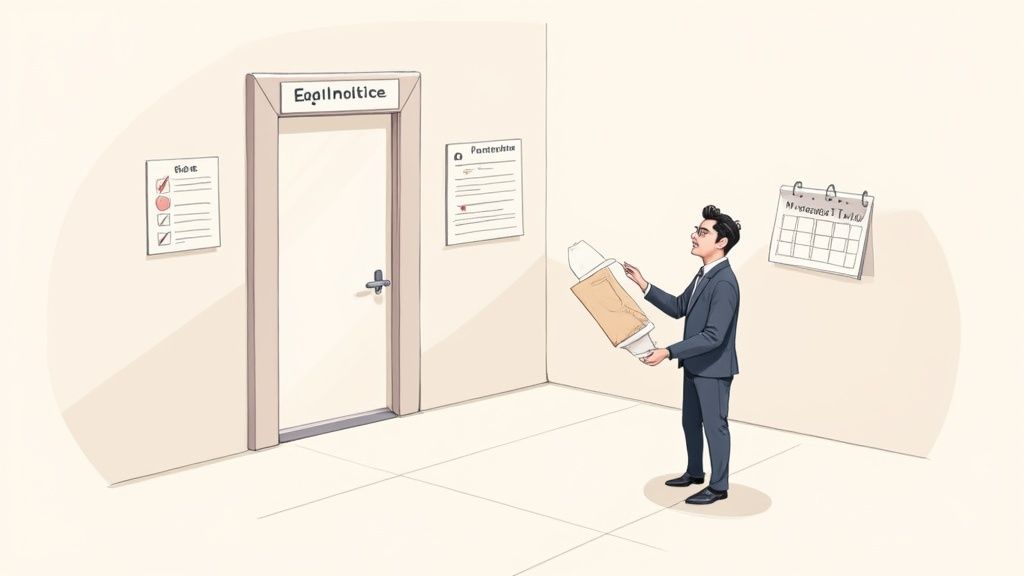
Before you start drafting court documents, you have to navigate these preliminary stages. Trying to bypass them and go straight to court is not just a bad idea—it's usually impossible. The system is set up to push for a resolution first, giving you a chance to state your case and potentially settle things without a drawn-out legal fight.
Successfully completing these steps is your ticket to the main event. It shows the court you’ve acted in good faith to resolve the issue amicably, which instantly adds credibility to your claim right from the get-go.
The Power of a Well-Crafted Legal Notice
Your very first move is to send a detailed legal notice to your employer. This isn't just a strongly worded letter; it's a formal document that officially puts the company on notice about a potential legal battle. It’s a strategic play that accomplishes several things at once.
Most importantly, it gives your employer a clear, final chance to fix the problem. You'd be surprised how often a sharp, well-drafted notice is all it takes to get a settlement offer on the table, saving everyone a lot of time, money, and stress.
Your notice needs to be laser-focused. Make sure it includes:
The full story: Lay out the facts that led to the dispute, keeping it in chronological order.
The legal basis: What laws were broken? Reference the specific sections of the labour laws that support your claim.
Your demands: Be crystal clear about what you want. Is it reinstatement, back wages, or compensation? Spell it out.
A deadline: Give the employer a reasonable timeframe to respond, typically 15 to 30 days.
Insights: Think of the legal notice as your first piece of evidence. It creates an official paper trail of your grievance and establishes the date you formally brought it up. This timeline can become incredibly important later in court. This is also where an AI tool like Draft Bot Pro can provide an initial advantage by helping you structure the notice with the correct legal format and tone, ensuring it's taken seriously from the moment it's received.
How Legal AI Can Give You an Edge
Drafting a solid legal notice can be intimidating. The language has to be just right for it to have the intended impact. This is where a legal AI tool like Draft Bot Pro can be a game-changer. You provide the details of your situation, and it can generate a strong first draft. It helps ensure you’ve covered all the essential components, giving you a professionally structured document to fine-tune with your lawyer. It sets a serious tone from day one.
Making Sense of the Conciliation Process
If the legal notice doesn't do the trick, your next mandatory stop is conciliation. You’ll need to approach the conciliation officer at the labour department in your jurisdiction. This person is a neutral mediator, not a judge. Their only job is to try and broker a settlement between you and your employer.
During the conciliation meetings, both sides get to tell their story. The officer will probe for compromises and look for any middle ground. It's the system's last-ditch effort to keep the dispute out of court. If your employer previously conducted a domestic enquiry, you can bet its findings will be a major topic of discussion here. It pays to understand how a https://www.draftbot.com/post/domestic-enquiry-in-labour-law-a-complete-guide works so you're prepared.
If you and your employer just can't see eye-to-eye and the conciliation fails, the officer issues a "failure of conciliation" certificate. This piece of paper is gold. It’s your official pass to the labour court—without it, your case is a non-starter. Seeing how legal pros handle these initial steps is always smart; for example, looking at client onboarding best practices can show you how law firms methodically gather information to build a case from the ground up.
Building Your Case with Essential Documents

A labour court case isn’t won on passionate arguments alone; it’s won with cold, hard evidence. Once you’ve handled the preliminary steps, your entire focus needs to shift to building a fortress of proof. This is the moment you gather every single piece of paper, every email, and every message that tells your side of the story.
Think of yourself as a detective putting together a case file. Each document is a piece of the puzzle. When assembled correctly, it presents an undeniable picture of the facts to the court. This stage is methodical and demands meticulous attention to detail. Trust me, a single missing document can seriously weaken an otherwise solid claim.
Gathering Your Core Employment Records
The bedrock of your evidence will always be your official employment documents. These records don't just establish the terms of your employment; they create the official timeline of events. You need to start by collecting every one of these—they are non-negotiable for proving your relationship with the employer and the very basis of your dispute.
Your main goal here is to create a complete paper trail of your entire time with the company. Make both physical and digital copies of everything. Some documents you absolutely must have include:
Appointment Letter: This is the contract that started it all. It outlines your job title, salary, and the terms you agreed to.
Salary Slips: Collect every last one. They are concrete proof of your earnings, any deductions, and how long you were employed.
Termination Letter: If you were fired, this document is critical. It should state the official reason for your dismissal, which will almost certainly be a central point of contention.
Full and Final Settlement Statement: If your employer provided one, this document details the final payments they made. It's crucial for any disputes over unpaid dues.
Insights: Let's be honest, organising this mountain of paperwork can feel overwhelming. This is where a legal AI can become a strategic partner. For instance, Draft Bot Pro lets you create a secure digital case file where you can upload and categorise each document. The system can help you see your evidence visually and flag any obvious gaps, making sure your case is built on a complete and powerful foundation before you even think about drafting your claim.
Expanding Your Evidence Arsenal
Beyond the core records, you need to collect supporting evidence that adds context and muscle to your narrative. This is where communications and financial records become your best friends. They can back up your claims and dismantle any arguments your employer might try to make.
Look for any written communication that is relevant to your dispute. An email where you raised a concern or a WhatsApp message that proves a point can be incredibly persuasive. You should also be digging up:
Bank Statements: These can prove that salaries weren't paid on time or that certain promised amounts never hit your account. Be sure to highlight the relevant entries.
Email Correspondence: Search your inbox for all communication with HR, your manager, or even colleagues related to the issue. This includes performance reviews, warning letters, or discussions about the dispute itself.
Witness Details: Think about colleagues who witnessed key events or can vouch for your claims. Right now, just get their names and contact information. Their testimony comes later, but identifying them early is crucial.
Filing a case in an Indian labour court is a structured process, largely governed by laws like the Industrial Disputes Act, 1947. This legislation sets out specific procedures and timelines, often requiring you to file a claim within six months of the dispute arising. Your detailed complaint, backed by this organised evidence, must clearly state the nature of the dispute, whether it's wrongful termination, unpaid dues, or something else.
Essential Document Checklist for Your Labour Court Case
To make sure you don't miss anything, here’s a quick checklist of the critical documents you'll need to gather before filing your case. Having these ready will ensure your claim is as strong as possible from day one.
Document Category | Specific Examples | Why It's Important |
|---|---|---|
Employment Contracts | Appointment Letter, Offer Letter, Promotion Letters | Establishes the official terms of your employment and role. |
Financial Records | Salary Slips, Bank Statements, Reimbursement Claims | Proves your earnings, confirms payment (or non-payment), and tracks financial disputes. |
Termination Documents | Resignation/Termination Letter, Relieving Letter | Provides the official reason for employment ending, which is often a key point of dispute. |
Company Communications | Emails with HR/Manager, Warning Letters, Performance Reviews | Creates a timeline of events and can show a pattern of behaviour or prior complaints. |
Settlement Papers | Full and Final (FnF) Settlement Statement | Details the final dues paid or owed, crucial for financial claims. |
Having these documents neatly organised is half the battle won. It shows the court you're prepared and makes it much easier for your advocate to build a compelling case.
Organising Your Proof for Maximum Impact
Once you have all your documents, organisation is everything. You can't just hand the court a messy pile of papers and expect a good outcome. Arrange everything chronologically to tell a clear, logical story from beginning to end.
Creating a simple index or a timeline can help you, your lawyer, and the judge quickly find any piece of evidence when needed. For certain documents, like sworn statements from witnesses, you may need to prepare a formal affidavit. You can learn more about how to structure this by checking out our guide on preparing an affidavit under CPC in India.
A well-organised file demonstrates professionalism and makes your case much easier for the court to understand and follow—and that’s a significant advantage to have on your side.
Crafting a Powerful Statement of Claim
Once you’ve systematically gathered your evidence, the real work begins: putting your case onto paper in a formal document called the Statement of Claim. Make no mistake, this document is the foundation of your entire case. It's the very first thing the court reads and it sets the tone for everything that follows. A weak or confusing claim can sink your case before it even starts, no matter how strong your evidence is.
Think of the Statement of Claim as the official, complete story of your employment dispute. It needs to be told in a structured, legally sound way. Your goal is to be clear, concise, and persuasive, laying out the facts, the laws that were broken, and what you’re asking for, all in a manner the judge can easily grasp and act on.
The Anatomy of a Winning Claim
A strong Statement of Claim is more than just a list of grievances; it's a carefully built argument. Each section has a specific job to do, building on the last to create a compelling case. A standard claim follows a very logical path.
It kicks off with the Title and Parties, which clearly states the name of the labour court, your name (the claimant), and your employer's details (the respondent). Right after that comes the Narration of Facts. This is where you tell the story of your employment and the dispute, but it must be in strict chronological order.
Start from the day you joined the company and walk the reader through all the key events. Lead them step-by-step to the incident that sparked the dispute, whether it was your termination, unpaid wages, or something else. Each paragraph should be a clean, factual statement, backed by the evidence you've already collected.
Connecting the Dots: From Facts to Legal Violations
Just listing what happened isn’t enough. You have to connect those facts to specific violations of the law. This is the crucial part where you show the court how your employer broke the rules. You need to point to the exact sections of Indian labour laws that were breached.
For example, if you were fired without a good reason or without following the proper process, you’d cite the relevant provisions of the Industrial Disputes Act, 1947. If your fight is over unpaid overtime, you might point to the Payment of Wages Act, 1936. This legal foundation is what turns your personal complaint into a legitimate legal case the court can adjudicate.
Insights: Let's be honest, legal drafting can be intimidating. The language is precise, and a small mistake can have big consequences. This is where a specialised legal AI tool like Draft Bot Pro can be a game-changer. You input the key facts, and the AI generates a structured, legally sound first draft of your claim. It helps ensure you've included all the necessary legal jargon and procedural elements, making a daunting task much more manageable.
The "Prayer for Relief": Asking for What You Want
The final, and arguably most important, part of your claim is the Prayer for Relief. This is where you stop telling the story and start telling the court exactly what you want it to do. You have to be specific about the remedies you're seeking from your employer.
Common prayers in labour court cases include:
Reinstatement: Asking to get your job back.
Back Wages: Demanding payment for the entire time you were unlawfully out of work.
Compensation: Requesting a sum of money for the harassment, mental stress, or financial loss you've endured.
Payment of Dues: Seeking any unpaid salary, gratuity, bonus, or other money you are owed.
You can, and often should, ask for more than one thing. For instance, you might ask for reinstatement with full back wages. Be direct and crystal clear, because the court's final order will be shaped by what you've specifically asked for in your prayer.
Real-World Example: A Case of Wrongful Termination
Let's put this into practice. Imagine an employee, Priya, was fired shortly after she raised serious concerns about unsafe working conditions. Her Statement of Claim would flow like this:
Title and Parties: It would name the specific Labour Court, list Priya as the Claimant, and her company as the Respondent.
Narration: The story would begin with her joining date and highlight her positive performance record. It would then detail the specific safety issues she reported via email on a certain date. Finally, it would state the date she was terminated, pointing out that the official reason given was "poor performance," which her records clearly contradict.
Legal Violations: Here, the claim would argue that her firing was a classic case of retaliatory termination. It would state that this action violates the principles of natural justice and specific sections of the Industrial Disputes Act.
Prayer for Relief: Priya would pray for reinstatement to her old job, full back wages from the date she was fired, and compensation for the mental agony this situation caused.
By structuring her claim this way, Priya creates a clear narrative that directly links the company’s action (firing her) to her protected activity (raising safety concerns), making her case incredibly compelling. This structured approach is the key to telling your side of the story effectively in court.
Understanding the Court Filing Process
You've done the hard work. Your Statement of Claim is sharp, your evidence is perfectly organised, and now you're standing at the courthouse door. This next part is all about taking that preparation and turning it into a formal legal case. This is where the wheels of justice officially start turning.
Filing isn't as simple as dropping off a stack of papers. You need to be certain you're in the right court, submit everything in the correct format, and know what to expect next. Getting this stage right is absolutely critical for a smooth start.
This infographic gives you a bird's-eye view of what goes into a solid claim, showing how you move from identifying the parties to laying out the facts and making that final prayer for relief.
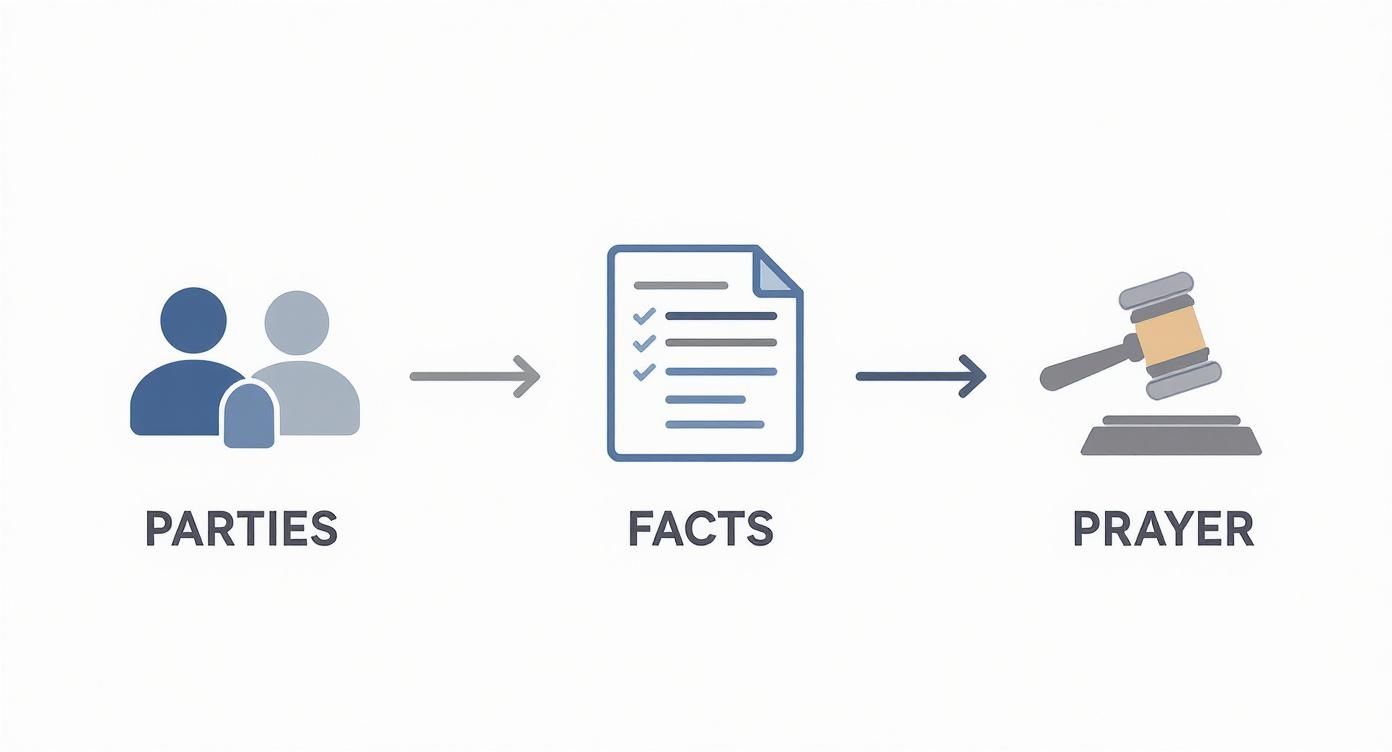
Think of it as a narrative. Each piece of your claim builds on the last, creating a powerful and coherent legal argument that's easy for the court to follow.
Finding the Right Court: Jurisdiction Matters
Before a single page is filed, you have to figure out which labour court or industrial tribunal has the jurisdiction to even hear your case. In simple terms, jurisdiction is the court's legal authority over a specific case and a specific geographical area. Filing in the wrong court is a rookie mistake, but a common one, and it can get your case thrown out before it even begins, causing serious delays and frustration.
So, how do you find the right court? It usually comes down to one of two things:
Where You Worked: The most common approach is to file in the city or district where your job was located.
The Company's Head Office: You might also have the option to file where your employer's registered or main office is located.
If you worked for a big company with offices all over, the key is the "cause of action"—meaning, where did the actual dispute happen? That's your guiding star. When in doubt, a quick visit or call to the local labour department office can clear up any confusion and save you a massive headache down the line.
The Nuts and Bolts of Submission
Once you’ve confirmed the correct court, it’s time for the physical act of filing. This means submitting your Statement of Claim along with every piece of supporting evidence you've gathered. Be prepared to make multiple copies of the entire set—one for the court's record, one for you, and one for each party you're filing against (your employer).
You'll also need to file an affidavit. This is a formal, sworn statement where you confirm that everything you've presented in your claim is true to the best of your knowledge. It’s an extra layer of seriousness and verification for your submission.
The process for filing a labour case in India is getting better, with digital reforms slowly making things more efficient. For instance, the Employees' Provident Fund Organization (EPFO) has made changes to speed up related claim settlements. To stay on top of these kinds of changes, it's worth following updates from legal experts like Dentons Link Legal.
Insights: The sheer volume of paperwork and procedural rules can be overwhelming. This is where a legal AI assistant like Draft Bot Pro can be a lifesaver. It can help format your documents to meet court standards and even draft the necessary affidavits, making sure your filing is complete and correct from the get-go.
What Happens Immediately After You File?
As soon as the court clerk accepts your documents, your case is officially on the books. It gets registered and is assigned a unique case number, which will be your reference for everything that follows. The court doesn’t just let your file gather dust; things start moving right away.
The first official action is to issue a notice to your employer. This is a formal summons letting them know a case has been filed against them. They'll receive a copy of your Statement of Claim and a date for the first hearing. By this date, they are required to show up in court, usually with their lawyer.
This is a huge step. Your employer is now legally required to respond. If they ignore the notice and don't show up, there can be serious consequences—the court might even decide to proceed without them. Understanding this immediate timeline helps you manage your own expectations and get ready for that all-important first day in court.
Navigating the Court Proceedings
Getting your Statement of Claim filed is a huge step forward, but it’s really just the starting line. The real work of proving your case—the part that wins or loses it—happens inside the courtroom. This process isn't random; it follows a clear path with predictable stages. Knowing what's coming next helps you stay prepared and cuts down on the anxiety.
Framing of Issues: Defining the Battleground
Once the court's notice reaches your employer and they show up, the first real piece of legal business is the framing of issues. This is where the judge looks at your claim and your employer's written reply to figure out the exact points you disagree on.
Think of these as the official questions the court needs to answer to close your case. For instance, if you're claiming wrongful termination and your employer says it was due to poor performance, a key issue might be framed as: "Whether the termination of the claimant was illegal and unjustified."
From this point on, every piece of evidence and every argument is laser-focused on answering these specific questions.
Your Evidence and the Test of Cross-Examination
With the issues set, you enter the evidence stage. This is your moment to formally present all those documents you’ve been carefully gathering. Your lawyer will submit them to the court, and you'll back them up with a sworn affidavit to confirm they're genuine. This is how you get your proof onto the official record.
Then comes what many consider the most crucial part of any trial: cross-examination. After your evidence is in, your employer’s lawyer gets to question you about it. Their job is to poke holes in your story, find inconsistencies, or challenge the credibility of your proof.
It can feel intense, no doubt. The trick is to stay calm, listen to every question like it's the only one that matters, and answer truthfully. Stick to the facts. This isn't the time for emotional speeches; it's about giving clear, consistent answers that hold up under pressure.
Taming the Chaos with Technology
A legal case is a storm of dates, deadlines, and details. You’ve got court hearings, submission deadlines for documents, and notes from every proceeding. It’s a lot to juggle, and missing a single deadline can seriously hurt your case. This is where a bit of modern tech can make a world of difference.
Insights: A legal case involves many dates and deadlines. We'll explore how Draft Bot Pro can act as your personal case manager, helping you track court dates, manage submission deadlines, and even generate summaries of proceedings. This AI support keeps you organised and on top of your case, facilitating better collaboration with your lawyer.
Using a tool like this gives you a digital command centre for your entire case. It makes sure you and your lawyer are always on the same page, preventing crucial details from ever falling through the cracks. It turns a potentially chaotic process into a structured, manageable workflow.
The Final Arguments: Tying It All Together
Once both sides have presented their evidence and gone through cross-examination, the case moves to its final act: the final arguments. This is your lawyer's chance to connect all the dots for the judge. They'll weave together the facts, the evidence you presented, and the relevant labour laws into one compelling story.
The argument will hammer home how the evidence proves your side of the story and directly answers the issues framed at the very beginning. It will also expose any weaknesses in your employer’s defence. Naturally, their lawyer will then get up and do the same for their side.
This is the last chance to persuade the court. A powerful, well-reasoned final argument can leave a lasting impression and can absolutely swing the outcome in your favour. After the arguments conclude, the court reserves the matter for judgement, and you wait for the final verdict.
Common Questions About Filing a Labour Case
Stepping into the world of labour law can feel like learning a new language. It’s completely natural to have questions pop up as you figure out how to file a case in the labour court. Getting clear answers to these common queries can help you move forward with much more confidence.
Can I File a Case Without a Lawyer?
Legally, yes. You absolutely have the right to represent yourself in labour court, and the system is designed to be accessible. You can certainly handle the initial filing on your own.
However, the journey gets complicated very quickly after that first step. Navigating evidence rules, cross-examining witnesses, and making persuasive legal arguments are skills lawyers spend years honing. Having a legal professional in your corner can dramatically improve your chances of a favourable outcome.
What Is the Timeline for a Labour Court Case?
This is one of the most common questions, and unfortunately, there's no single answer. The duration of a labour court case in India varies significantly from one situation to the next. The timeline really depends on the complexity of your dispute, the specific court's caseload, and any procedural delays that might crop up.
A relatively straightforward case might be wrapped up within one to two years. But more complicated matters involving extensive evidence or multiple witnesses can easily stretch longer. It's wise to be patient and mentally prepare for a marathon, not a sprint.
What Kinds of Disputes Belong in Labour Court?
Labour courts and industrial tribunals handle a broad spectrum of employment-related conflicts. You can approach the court for many different grievances against an employer.
Some of the most common issues we see include:
Wrongful Termination: Being fired without a valid reason or without following the proper procedure.
Unpaid Dues: When an employer fails to pay salary, bonuses, or other wages you've earned.
Benefit Disputes: Problems related to gratuity, provident fund (PF), or leave encashment payments.
Unfair Labour Practices: Any action by an employer that violates established labour laws and norms.
Insights:For those looking to manage the initial stages themselves, technology can be a powerful ally. Legal AI tools like Draft Bot Pro can assist in preparing the initial Statement of Claim and getting your documents in order. This can give you a strong start, but for the intricate court proceedings that follow, professional legal advice is invaluable.
How Much Does It Cost to File?
The good news is that the official court filing fees are deliberately kept very low in India. This is to ensure that cost isn't a barrier to seeking justice. You can typically file a case for a nominal sum.
The primary expense you'll run into is the lawyer's fees. These can vary widely based on the lawyer's experience, the city you're in, and how complex your case is. Always have a transparent discussion about the fee structure with your advocate before you commit. It's also worth knowing that there are other routes; understanding the settlement of industrial disputes can offer cost-effective options outside of a full court battle.
Ready to take control of your legal drafting and research? Draft Bot Pro empowers lawyers and law students across India to create precise legal documents and conduct accurate research in minutes. Join over 46,000 legal professionals who trust our AI to build stronger cases. Explore the future of legal work at https://www.draftbotpro.com.
