
Execution Petition for Recovery of Money: A Complete Guide

So, you've gone through the entire court battle and finally have a decree in your favour. Congratulations! That's a huge milestone. But as many of us in the field know all too well, winning your case is often only half the battle.
An execution petition for recovery of money is the legal crowbar you need to get what's rightfully yours. It’s the formal application you file to get the court’s machinery moving, turning that paper decree into actual money in your account.
Winning Your Case Is Only Half the Battle
It’s a common misconception among clients—and even some junior lawyers—that once the judge bangs the gavel, the losing party (the 'judgment-debtor') will simply write you a cheque. If only it were that simple. The reality is often a frustrating game of cat and mouse.
This is where the execution petition for recovery of money becomes your most critical legal tool. Without it, your hard-won court order is just a symbolic victory. It has no teeth. This petition is what legally compels the other side to pay up.
The Real Challenge of Enforcement
The journey from decree to cash can be a long one, riddled with frustrating delays. Debtors can be notoriously tricky, doing everything from hiding their assets and transferring property to using every legal loophole to stall the payment process. And before you even get to this stage, you have to win the initial case, which might involve navigating complex issues like understanding how to prove defamation and win your case to secure a judgment for damages in the first place.
InsightFiling an execution petition isn't just a procedural step; it's a strategic one. A well-drafted petition that clearly points out the debtor’s assets—specific bank accounts, properties, or other valuables—makes the court's job easier and significantly fast-tracks the recovery. It shows you've done your homework.
This is an area where modern legal tech can give you a serious edge. A specialized Legal AI tool like Draft Bot Pro can help you frame the petition with the precision required by the Civil Procedure Code. This dramatically cuts down the risk of your petition being rejected for technical errors, which is a surprisingly common reason for delays right at the start.
To help you visualise the process, here's a quick rundown of the key milestones.
Key Stages From Decree to Recovery
Navigating the execution process involves several distinct stages, each with a specific goal. Understanding these steps helps you anticipate what's next and prepare accordingly.
Stage | Objective | Governing Provision (CPC, 1908) |
|---|---|---|
Obtaining the Decree | Secure a final, enforceable court order. | Section 2(2) |
Drafting & Filing Petition | Formally request the court to enforce the decree. | Order 21, Rule 10 & 11 |
Notice to Judgment-Debtor | Inform the debtor that enforcement has begun. | Order 21, Rule 22 |
Attachment of Property | Legally seize the debtor's assets (movable/immovable). | Section 51, Order 21, Rule 41-57 |
Sale of Attached Property | Auction the assets to realise the decreed amount. | Order 21, Rule 64-96 |
Realisation & Payment | Distribute the sale proceeds to the decree-holder. | Order 21, Rule 93 |
Each of these stages is a critical link in the chain leading to your financial recovery.
The infographic below gives a bird's-eye view of how the petition connects your legal victory to the final payout.
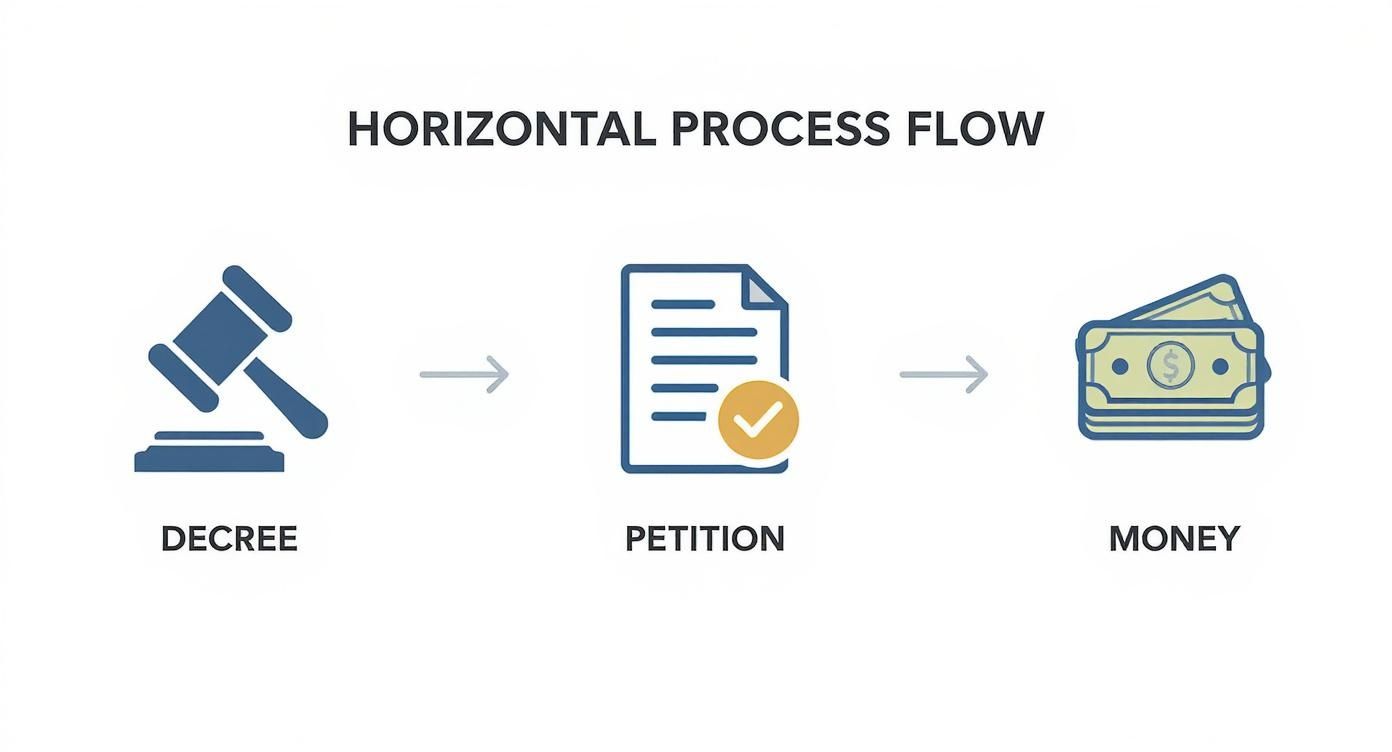
This isn't a niche problem, either. The scale of the challenge is massive. As of October 2025, a staggering 8,82,578 execution petitions are pending in district courts across India. This backlog highlights just how crucial it is to file an airtight, compelling petition right from the start to avoid getting lost in the system.
Understanding the Legal Framework for Execution
Before you can even think about drafting an effective execution petition for recovery of money, you have to get a handle on the rules of the game. This isn't just a matter of filling out a form; it's about building your case on the solid ground of Indian law. The main rulebook here is the Code of Civil Procedure, 1908 (CPC)—a piece of legislation that's over a century old but still runs the show in civil litigation.

Think of the CPC as your instruction manual. Specifically, Sections 36 to 74 set out the big-picture principles of execution, while Order 21 dives into the nitty-gritty, step-by-step procedures. Getting comfortable with these provisions isn't just recommended; it's essential for success.
Key Players and Core Concepts
The legal jargon can feel a bit much at first, but it's actually pretty simple once you break it down. At this stage, you're the decree-holder—the person who won the case and now holds the court's decree (the judgment). The party on the other side, the one who owes you the money, is the judgment-debtor.
The whole point of an execution proceeding is to make the judgment-debtor pay up. But here's the catch: the court isn't going to do this on its own. It's on you, the decree-holder, to get the ball rolling by filing the petition. This is where your strategy truly begins, as you need to tell the court exactly what you want it to do.
InsightOne of the most common mistakes is a generic petition that just asks the court to 'recover the money'. That’s not going to get you very far, very fast. You have to be specific and tell the court the mode of execution you want it to use. The clearer your request, the quicker the court can take action.
Choosing Your Mode of Execution
The CPC provides the court with some pretty powerful tools to enforce a money decree. Your job is to pick the right tool for the job, based on what you know about the judgment-debtor's assets and financial situation.
Here are the main options available under Section 51 of the CPC:
Attachment and Sale of Property: This is the go-to method. You can ask the court to seize (attach) and then sell off the judgment-debtor's property to settle the debt. This could be movable assets like cars or valuables, or immovable property like a flat or a piece of land.
Arrest and Detention in Civil Prison: This sounds drastic, and it is. If the debtor is deliberately avoiding payment even though they have the money, the court can order them to be detained. It doesn't directly get you the cash, but the very real threat of jail time is often a powerful motivator.
Appointment of a Receiver: Let's say the judgment-debtor owns a business or a property that brings in regular income, like rent. You can ask the court to appoint a receiver—an impartial person who will manage that asset and channel the profits towards paying off your decree.
The method you choose is critical. If you know the debtor has a steady job, attaching a portion of their salary is often far more efficient than trying to sell a disputed property. For a more detailed look at these options, check out our practical guide to the execution of a decree in India.
How Legal AI Cuts Through the Complexity
Knowing these rules is one thing. Applying them to draft a petition that's legally watertight is a whole other challenge. This is precisely where a Legal AI tool like Draft Bot Pro becomes a game-changer. Instead of flipping through pages of the CPC, you can rely on the AI to generate a petition that perfectly aligns with your chosen mode of execution.
For instance, if you decide to go for the attachment of property, Draft Bot Pro can help you phrase the prayer in the correct legal terminology, making sure you include all the details required under Order 21. This kind of precision does more than just strengthen your petition; it helps you sidestep preliminary objections from the judgment-debtor, which can save you a world of time and money.
How to Draft a Compelling Execution Petition
Okay, you've won the case and have a decree in your favour. Now for the real work: getting the money you're owed. This is where drafting a solid execution petition for recovery of money comes in. Think of it less like creative writing and more like building a watertight legal argument. Your petition needs to be precise, detailed, and leave zero room for interpretation.
A well-drafted petition makes it incredibly easy for the court to understand what you're asking for and why, which can significantly speed up the process.

This isn’t just about saying, "they owe me money." You have to meticulously lay out every single detail for the court, from the case title to the final prayer. Every section must be legally sound and factually accurate to stand up to the inevitable scrutiny from the judgment-debtor's lawyer.
Structuring the Core Components of Your Petition
A well-structured petition is everything. You're not just following a format for the sake of it; you're building the foundation for a successful recovery. The tabular format prescribed under Order 21, Rule 11 of the CPC is a mandatory requirement, designed for clarity and to help the court quickly grasp the key facts.
Here’s what absolutely must be included:
The Cause Title: This needs to be an exact match of the original suit. Get the court name, suit number, and the full names and addresses of all parties (decree-holder and judgment-debtor) perfect.
Date of the Decree: State the exact date the judgment was passed.
Amount of the Decree: Specify the principal amount the court awarded.
Costs Awarded: Don't forget to include any legal costs the judgment-debtor was ordered to pay.
Interest Calculation: Detail the interest that has accrued from the date of the decree right up to the day you file the petition.
Previous Execution Applications: If you've tried to execute the decree before, you must disclose the details and what happened.
Getting these basics right from the start is crucial. It prevents your petition from being sent back with objections, which is a common and frustrating cause for delay.
Calculating the Total Amount Due with Precision
This is one of the most critical parts of your draft. The total amount isn't just the principal sum from the decree. It includes all the accumulated interest and any costs that were awarded. A simple calculation error here can create a dispute that grinds the whole process to a halt.
Make your calculation transparent and dead simple for the court to follow.
For instance:
Principal Decree Amount: ₹5,00,000
Interest Awarded: 12% per annum from the date of the decree.
Costs Awarded: ₹25,000
Calculation: If exactly one year has passed, the interest is ₹60,000. Your total claim is ₹5,00,000 + ₹60,000 + ₹25,000 = ₹5,85,000.
Lay this out clearly in the petition. It shows you've done your homework and helps the court verify the amount without needing to ask for more information.
InsightCountless petitions get stuck because of vague descriptions of the judgment-debtor's assets. A prayer asking to attach "the bank account of the judgment-debtor" is useless. You need the bank name, branch, and account number. For a property, you need the full address, survey number, and boundaries. Precision is your best friend here.
Crafting a Powerful Prayer for Relief
The 'prayer' is the knockout punch of your petition. It's where you tell the court exactly what you want it to do. Your wording must align perfectly with the mode of execution you've chosen under Section 51 of the CPC.
Here are a couple of real-world examples to guide you:
For Attachment of a Bank Account: "The decree-holder prays that this Honourable Court be pleased to attach the funds lying in the judgment-debtor's Savings Account No. [Account Number] with [Bank Name], [Branch Address], to the extent of the decretal amount of ₹5,85,000."
For Attachment of Immovable Property: "The decree-holder prays for the attachment and subsequent sale of the immovable property owned by the judgment-debtor, specifically the residential flat located at [Full Address], Survey No. [Number], admeasuring [Area], to realise the decretal amount."
You'll almost always need to file a sworn statement alongside your execution petition. For a deeper dive, check out our guide on preparing an affidavit under the CPC in India.
The Role of Legal AI in Drafting
Let's be honest, drafting an execution petition that nails all these details can be a real grind. It’s time-consuming and the margin for error is slim. This is where a Legal AI tool like Draft Bot Pro can be a game-changer. It can generate a jurisdictionally compliant draft that’s tailored to your specific case.
You just input the case details and choose your mode of execution, and Draft Bot Pro handles the rest, articulating your legal grounds with professional clarity. The AI ensures every necessary component is there, from the interest calculations to a perfectly worded prayer. It’s not just about saving time; it’s about minimising the risk of human error and avoiding those costly mistakes that can derail your entire recovery effort.
So, you’ve filed the petition. What happens now?
Filing your execution petition for recovery of money isn't the finish line; it’s the start of the next race. Once your petition is submitted, it lands in the court registry. Their first job is to put it under the microscope, checking for any procedural slip-ups before they give it a number.
Assuming it passes muster, your case gets listed for its first hearing. Here, the judge gives your application a final once-over to ensure it's legally sound. If they're satisfied, the court greenlights a notice to be sent to the judgment-debtor. This is the official starting gun for the enforcement process. Getting this notice served correctly is absolutely crucial for things to proceed, a topic we dive into in our guide on the service of summons under the CPC.
What Will the Judgment-Debtor Do Next?
Once that notice lands in the judgment-debtor’s hands, you need to be ready for what comes next. Let's be realistic: a debtor who fought you all the way through the original suit isn't likely to suddenly see the light and pay up. They’re far more likely to dig in their heels and use every trick in the book to delay or block you.
Here are a few common moves you can expect:
Filing Objections: They might try to argue the decree was obtained by fraud, that they've already paid you, or that it's unenforceable for some other reason.
Seeking a Stay: A classic tactic is to file an appeal against the original decree and ask the court to put your execution proceedings on hold while the appeal is heard. This can freeze your recovery efforts.
Pleading Poverty: "I have no money, no assets" is a line you'll hear often. They'll claim recovery is impossible because they're insolvent.
Being prepared to dismantle these arguments is everything. A sharp, legally-solid reply can stop a delay tactic from turning into months of courtroom limbo.
How to Counter the "I Have No Assets" Excuse
When a judgment-debtor claims they're broke, don't just take their word for it. This is your cue to go on the offensive. You have the right to file an application asking the court to order the judgment-debtor to submit a detailed affidavit of assets.
InsightThe affidavit of assets is your secret weapon. It forces the judgment-debtor to declare, under oath, every single asset they own—property, bank accounts, investments, income sources, the lot. Lying on this affidavit is perjury, a serious crime. Often, the mere threat of criminal charges is enough to make hidden assets suddenly reappear.
This one simple move flips the script. The burden of proof is now on them to prove their inability to pay. It’s a complete game-changer that can break a stalemate wide open.
Staying a Step Ahead with Draft Bot Pro
When you’re hit with a complicated legal objection, you need to respond fast and you need to respond well. This is where a Legal AI tool like Draft Bot Pro gives you a real edge. It can help you quickly dissect the debtor's claims and assist in drafting a powerful counter-affidavit, pulling up relevant case law to demolish their arguments. Your reply won't just be quick; it will be formidable, helping you cut through the stalling tactics.
A Reality Check on Timelines
It's vital to be realistic about how long this can all take. The timeline for an execution petition for recovery of money can swing wildly depending on the court's backlog. The numbers show huge differences from state to state. For instance, Maharashtra is buried under nearly 39% of all pending execution cases—that's about 3,41,000 petitions! Meanwhile, states in the northeast like Nagaland (57) and Sikkim (61) have tiny fractions of that number. Knowing where your court stands on this spectrum helps you manage your own expectations for how long you'll be waiting. You can get more context from these judicial pendency statistics on The Print.
Insider Tips for a Successful Money Recovery
You've won the case and have the court's decree in hand. That's a huge milestone, but let's be honest, it’s just paper until you turn it into actual cash. The real battle often begins now, during execution. The key to winning this next phase is to be strategic. It's about working smarter, not just harder, to make that execution petition for recovery of money count.

The single most powerful move you can make happens before you even file. I’m talking about a deep-dive investigation into the debtor's assets. Don't wait for the court to start this process. Do your homework first, and you can file a petition that’s razor-sharp and ready for immediate action.
When you can tell the court exactly what to attach and where to find it, you leave the debtor with very little room to manoeuvre or delay.
Conducting a Pre-Execution Investigation
Think of yourself as a financial detective. Your mission is to build a complete picture of the judgment-debtor’s assets before you even think about drafting the petition. This proactive step saves a ton of time and prevents you from filing a vague request that gets bogged down in court-ordered discovery.
Here are some go-to tools for your investigation:
Property Registry Searches: Head to the local sub-registrar's office. You're looking for any immovable properties—flats, land, commercial spaces—registered in the debtor's name.
Ministry of Corporate Affairs (MCA) Portal: If your debtor is a company or a director, the MCA website is a goldmine. You can uncover directorships, shareholdings, and other company assets.
Vehicle Registration Records: A quick check with the local Regional Transport Office (RTO) will reveal any cars, bikes, or other vehicles the debtor owns.
Putting in this effort upfront pays off massively. A petition that specifies "Flat No. 4B at XYZ Apartments" or "Honda City with registration MH-01-AB-1234" is far more potent than a generic plea for recovery.
The Strategic Power of Combining Execution Modes
Why stick to just one method of execution when the law allows for a multi-pronged attack? You can—and should—request multiple modes of execution at the same time or one after another. This builds immense pressure and corners the judgment-debtor.
For instance, you could file to attach their salary and seize their car simultaneously. This sends a clear message: you are serious, you are systematic, and you will not be easily deterred.
InsightA seriously effective, yet often overlooked, strategy is asking the court to appoint a receiver. If the debtor owns a commercial property that generates rent, a court-appointed receiver can collect that rent directly and pay it towards your decree. It’s the perfect move for tapping into a steady income stream.
Of course, a solid recovery plan often starts long before you see the inside of a courtroom. It's always worth understanding the role of a demand letter in money recovery, as this initial step can set the tone for the entire process.
Comparing Modes of Execution
Choosing the right execution method—or combination of methods—is critical. Each has its strengths and potential hiccups.
Mode of Execution | Best For | Potential Complication |
|---|---|---|
Attachment of Movable Property | Quick recovery from valuable assets like vehicles, jewellery, or high-end electronics. | Debtor may hide or transfer assets; valuation can sometimes be disputed. |
Attachment of Immovable Property | High-value decrees where the debtor owns land, a house, or commercial real estate. | The process can be slow, involving title searches, valuation, and a public auction. |
Attachment of Bank Accounts | Seizing liquid cash directly. Very effective if you know the bank and account details. | Debtor might empty the account upon getting notice; works best with a surprise element. |
Garnishee Order (Salary/Rent) | Securing a steady, predictable income stream from a salaried debtor or rental income. | Only a portion of the salary is attachable; debtor might change jobs to evade it. |
Arrest and Detention | Cases of wilful default or when the debtor is actively hiding assets. Used as a last resort. | The court must be convinced of bad faith; it's a measure of pressure, not direct recovery. |
The best approach often involves layering these methods to create a comprehensive strategy that closes off the debtor's escape routes.
Leveraging Legal AI for Strategic Advantage
So, you’ve done your detective work and found multiple assets. Now you need to draft a petition that combines different execution modes, which can get complicated fast. This is where a specialised Legal AI tool like Draft Bot Pro can be a game-changer.
You can feed it the different assets you’ve uncovered, and Draft Bot Pro will help you structure a petition that requests all the relevant reliefs in the correct legal format. For example, it can generate the precise language needed to simultaneously attach a bank account and appoint a receiver over a rental property. This ensures your clever strategy is translated into a flawless legal document, giving you the confidence to execute your recovery plan with precision.
Got Questions About Your Execution Petition?
Filing an execution petition for recovery of money can feel like you're entering a maze. It’s natural to have a bunch of questions popping up. Getting the process right is crucial, and a few key details can make all the difference between a successful recovery and a frustrating chase.
Let's break down some of the most common questions that decree-holders ask. Getting these answers straight from the get-go will help you sidestep common pitfalls and build a solid strategy to get your money back.
How Long Do I Have to File?
This is a big one. You officially have 12 years to file your execution petition from the date the decree can be enforced. That timeline is set by the Limitation Act, 1963.
Now, 12 years sounds like a lifetime, but here’s a pro-tip from the trenches: waiting is the single worst mistake you can make. Every day you delay gives the judgment-debtor more time to play games—transferring properties, hiding funds, or just making their assets vanish into thin air.
InsightFile the petition the moment you have the certified copy of the decree in your hands. Act fast. It shows you’re serious and puts immediate pressure on the debtor before they have a chance to get creative with their finances.
Can I File in a Different City?
Absolutely. This happens all the time. You might have won your case in Mumbai, but the debtor has moved to Delhi, or their main assets are in Bengaluru.
The Civil Procedure Code (CPC), specifically Sections 39-42, has you covered. The first step is to apply to the court that passed the original decree and ask for a transfer. That court will issue a "transfer certificate" and send the decree to the court in the new city. Once it's there, the new court has full power to enforce it just as if it had passed the decree itself.
What if the Judgement-Debtor Has No Assets?
This is where things get tough, but don't assume it's game over. Even if the debtor claims to be broke, you still have some powerful moves to make.
First, the court has the power to order their arrest and detention in civil prison. This isn't about getting your money directly from the prison cell; it's about leverage. The real threat of being locked up often magically motivates the debtor—or their family—to find the funds to pay up.
Another strong tactic is to ask the court to force the debtor to file a sworn affidavit detailing every single asset they own. If they lie on that document, they're committing perjury, which is a criminal offence. The prospect of facing criminal charges can be a very effective way to uncover assets they conveniently "forgot" about.
How Can Legal AI Help If the Debtor Starts Filing Objections?
When a judgement-debtor files objections, they’re not trying to win on merit—they're trying to drag things out. They want to bury you in paperwork and drain your resources until you give up. To fight back, you need to be quick, sharp, and legally precise. This is where technology can be a game-changer.
A Legal AI tool like Draft Bot Pro can be your secret weapon for shutting down these stalling tactics. Here's how it helps:
Lightning-Fast Research: The AI can instantly dig through case law and legal precedents to find the perfect arguments to demolish the debtor's specific objections. No more spending days in the library.
Drafting a Watertight Reply: It helps you structure and write a powerful reply affidavit that takes apart each of the debtor's points one by one, backed by solid legal reasoning.
Getting it Right: The tool ensures your response is formatted correctly and legally sound, so there's no risk of it getting thrown out on a technicality.
Using Draft Bot Pro means you can counter every delay tactic with a formidable, evidence-backed response. It helps you cut through the noise, keep the process moving, and ensure your execution petition for recovery of money actually leads to recovery.
Ready to draft a flawless execution petition without the guesswork? Draft Bot Pro is the most affordable and verifiable Legal AI built by lawyers, for lawyers. Trusted by over 46,379 legal professionals in India, our platform helps you create precise, jurisdictionally-compliant legal documents in a fraction of the time. Stop wasting hours on manual drafting and research. Try Draft Bot Pro today and turn your decrees into cash, faster.
