
A Practical Guide to Order 21 Rule 106 CPC
- Rare Labs
- Nov 20, 2025
- 16 min read

Staring down a dismissed execution petition can feel like hitting a brick wall, but Order 21 Rule 106 of the CPC offers a critical lifeline. This rule is the specific legal key designed to unlock an execution case that was shut down simply because a party failed to show up in court. Think of it as a procedural reset button, but one with some very strict conditions.
Decoding Order 21 Rule 106 CPC: A Practical Overview

Winning a lawsuit and getting that decree in your hand is often just half the battle. The real fight begins at the execution stage—the nitty-gritty process of actually getting what the court awarded you. This is where Order 21 of the Civil Procedure Code, 1908, lays down the entire playbook. But let's be honest, this phase is notoriously complex and a minefield of potential delays.
The truth is, executing decrees is a massive challenge in India's lower judiciary. With a staggering 4.7 crore cases currently pending in district and subordinate courts, the sheer complexity of Order 21's 106 rules has been flagged as a major contributor to the logjam. It often gives judgment-debtors far too many opportunities to stall and obstruct the process.
What Is The Core Purpose of Rule 106?
In the midst of this procedural maze, Rule 106 serves a very specific and vital function. It’s the go-to remedy when an execution application is thrown out under the preceding rule, Order 21 Rule 105, for "default of appearance." Simply put, if you (the decree-holder) or your lawyer don't show up for a hearing, the court can dismiss your case.
Rule 106 is your chance to undo that dismissal. It's your opportunity to explain your absence to the court and ask for the case to be put back on the rails. To have any chance of success, you must nail two fundamental conditions:
Prove 'Sufficient Cause': You have to give the court a legitimate and convincing reason for your no-show.
Meet the 30-Day Deadline: The application to restore the case must be filed within 30 days of the dismissal order.
InsightsUnderstanding Order 21 Rule 106 isn't just about reciting the law; it's about smart litigation strategy. It stops a perfectly good case from being derailed by a simple procedural slip-up. It ensures that justice isn’t denied because of an honest mistake or an unexpected crisis.
Rule 105 Dismissal vs Rule 106 Restoration at a Glance
To truly get a handle on Rule 106, it's crucial to understand its relationship with Rule 105. They are two sides of the same coin: one is the problem, the other is the potential solution.
Provision | Action Trigger | What Happens | What is the Remedy |
|---|---|---|---|
Order 21 Rule 105 | A party fails to appear at a scheduled hearing. | The court dismisses the execution application for "default". | The aggrieved party must file an application to set aside the dismissal. |
Order 21 Rule 106 | The aggrieved party files a restoration application. | The party must prove "sufficient cause" for their absence. | If satisfied, the court restores the execution application to its original status. |
This table neatly shows how Rule 105 creates the procedural issue (dismissal), and Rule 106 provides the specific mechanism to fix it (restoration), provided you meet the legal standard.
Navigating The Process With Legal AI
Successfully drafting and filing a restoration application under Rule 106 demands absolute precision. Any hint of vagueness in your affidavit explaining the 'sufficient cause' can sink your application before it even gets going. This is where a Legal AI called Draft Bot Pro can help.
Platforms like Draft Bot Pro are designed for exactly this kind of task. It can help you generate a solid first draft of your application and supporting affidavit, making sure all the essential legal components are in place. By helping with procedural checks and even suggesting relevant case law, it helps you build a much more persuasive and robust filing. This not only saves valuable time but also dramatically cuts down the risk of a fatal drafting error.
For a deeper dive into this entire stage of litigation, you might want to check out our practical guide to the execution of a decree in India. Grasping the bigger picture is key to appreciating the specific, and often case-saving, role that Rule 106 plays.
To get a case revived under Order 21 Rule 106 of the CPC, you can't just hope for a judge's good mood. It all boils down to two critical, non-negotiable requirements. First, you must show ‘sufficient cause’ for why you weren't in court. Second, you have to act within a strict 30-day limitation period. Get one of these wrong, and your application is almost certainly dead on arrival.
Think of it like a lock and key. The ‘sufficient cause’ is the uniquely cut key you have to craft, telling your specific story. The 30-day deadline? That's the unforgiving lock. You could have the most compelling reason in the world, but if you don't bring it to the court in time, that door to restoration stays firmly shut.
What Counts as "Sufficient Cause"?
The law deliberately leaves the term 'sufficient cause' a bit vague. This isn't an oversight; it's designed to give judges the flexibility to look at the unique facts of every single case. You don’t need to prove a life-altering catastrophe, but you absolutely must show that your absence was due to something beyond your control, not just carelessness.
Courts are looking for genuine, honest reasons. Here are a few real-world examples that often get the nod:
Sudden Personal Illness: A documented medical emergency for you or a close family member is a classic, often accepted reason.
Unexpected Travel Disruption: Think of a last-minute flight cancellation or a serious car breakdown that made getting to the courthouse physically impossible.
Advocate's Genuine Mistake: It happens. A lawyer might genuinely jot down the wrong date in their diary. As long as it wasn't gross negligence, this can be considered sufficient cause.
Communication Breakdown: A provable situation where the lawyer failed to properly inform their client about the hearing date.
InsightsThe burden of proof is entirely on you. Your affidavit needs to tell a clear, credible story, backed up by solid evidence. This could be medical certificates, travel records, or even a sworn statement from your advocate admitting their mistake. Vagueness is your worst enemy here; be specific and be honest.
The Unforgiving 30-Day Deadline
While 'sufficient cause' has some wiggle room, the timeline does not. Order 21 Rule 106(3) is brutally clear: you must file your application within 30 days from the date your case was dismissed. This is a hard deadline. There’s no safety net.
A common mistake is thinking you can get the delay excused under Section 5 of the Limitation Act, 1963. But the courts have consistently shut this down. The reasoning is that the CPC is a special law, and Rule 106 provides its own specific time limit, which overrides the general provisions of the Limitation Act. For a deep dive into when you can and can't get a delay excused, check out our guide on mastering the condonation of delay application format.
This strict approach is upheld time and again. In one major Supreme Court case, a party tried to file a restoration application more than a year late. The Executing Court didn't even bother with the reasons for the delay; it was simply rejected for not being filed within the mandatory 30-day window. It’s a stark reminder of just how unforgiving this deadline can be in our courts.
Navigating These Pillars with a Little Help
Trying to perfectly word an affidavit to show 'sufficient cause' while that 30-day clock is ticking down can be incredibly stressful. This is where a Legal AI called Draft Bot Pro can help. This tool can generate a solid first draft of your application and affidavit, making sure you hit all the key legal points. It handles the structure, so you can focus on getting the facts right. It's a way to work smarter and faster when you're up against that unforgiving deadline.
It’s a gut-wrenching moment for any practitioner: finding out your execution petition has been dismissed for default. That feeling in the pit of your stomach is real. But the law, specifically Order 21 Rule 106 of the CPC, provides a clear, procedural lifeline to get your case back on the board. The key is to act fast and follow the steps meticulously.
The whole game hinges on two things: presenting a compelling story of 'sufficient cause' for your absence and doing it within the strict 30-day window. Think of it like a two-lock system; you need both keys to open the door to restoration.
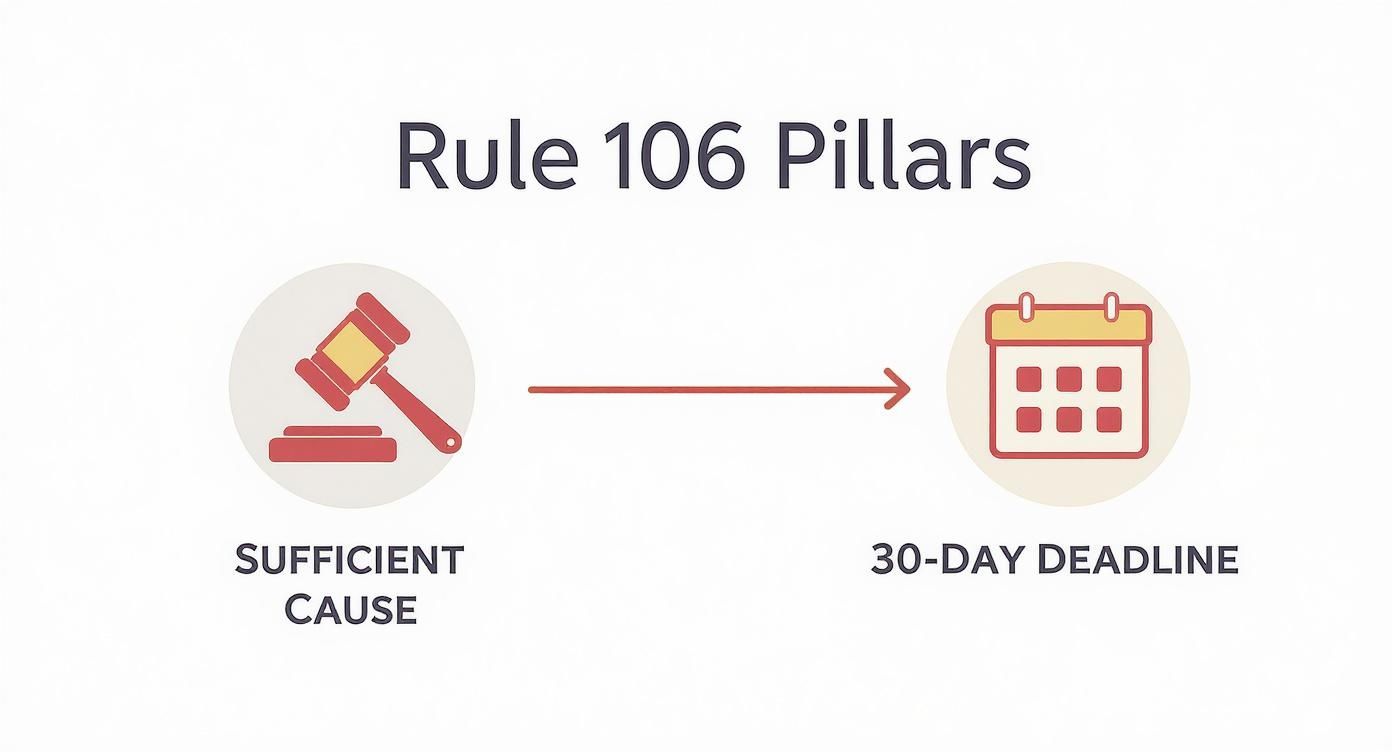
As you can see, proving a legitimate reason for your absence and hitting that deadline are non-negotiable. If you stumble on one, the other won't save you. A coordinated, immediate approach is everything.
Immediate Steps After Dismissal
The second you learn of the dismissal order, the clock starts ticking. Loudly. Your very first action should be to apply for a certified copy of that order. This isn't just a piece of paper; it's the foundational evidence for your restoration application. You simply cannot proceed without it.
At the same time, you need to calculate your 30-day limitation period with absolute precision. Remember, the countdown starts from the date of the order itself, not the date you found out about it. This is a classic tripwire where many applications fail before they even begin. Double-check your dates.
Drafting the Application and Affidavit
The heart of your restoration attempt lies in two crucial documents: the formal application and its supporting affidavit. The application itself is fairly standard—a formal petition citing Order 21 Rule 106 and asking the court to set aside the dismissal.
But the real magic happens in the affidavit. This sworn statement is where you tell your story, where you explain the 'sufficient cause'. You need to be precise, honest, and incredibly detailed.
Lay Out the Facts: Walk the court through the sequence of events that led to the non-appearance, step by step.
Back It Up: Attach any proof you have. This could be a medical certificate, travel tickets, a mechanic's bill—anything that corroborates your story.
Connect the Dots: Explicitly explain why these events made it impossible for you or your advocate to be in court. Vague excuses just won't cut it.
InsightsYour affidavit needs to read like a short, compelling narrative. It should have a clear beginning (what you intended to do), a middle (what went wrong), and an end (why it was an unavoidable absence, not negligence). The goal is to leave the judge with no doubt that your absence was genuine.
Filing, Service, and Hearing Preparation
Once your documents are drafted and ready, you'll file them in the very same executing court that dismissed your petition. After filing, you have a duty to serve a notice of this application on the judgment-debtor. This isn't optional; it's a mandatory procedural step to ensure they have a fair chance to respond.
Finally, get ready for the hearing. You'll need to be prepared to orally present your case to the judge, summarising the key points from your affidavit. Keep your arguments sharp, concise, and laser-focused on proving your diligence and the genuineness of your 'sufficient cause'.
Pulling all this together under immense pressure and a tight deadline is a tall order. This is exactly where a Legal AI called Draft Bot Pro can help. The tool can instantly generate a structured first draft of both the application and the affidavit, ensuring all the necessary legal scaffolding is in place. This frees you up to concentrate on the most critical part: accurately and persuasively detailing the facts of your 'sufficient cause', giving you the best shot at building a convincing case within that unforgiving 30-day window.
Getting Your Application Right: From Drafting to Filing
In the unforgiving world of execution proceedings, how you draft your paperwork can make or break your case. A well-written application under Order 21 Rule 106 CPC isn't just about ticking a procedural box; it's your one shot at making a persuasive legal argument on paper.
The line between getting your case restored and facing a final dismissal often comes down to the clarity and conviction in your documents, especially the supporting affidavit.
This is where you tell the story. You have to build a compelling narrative that proves your "sufficient cause" for non-appearance. Just stating a reason won't cut it. You need to paint a clear, chronological picture for the court that leaves no room for doubt. Every single sentence, both in the application and the affidavit, must have a purpose—to build a case that is factually solid and legally convincing.
The Essential Parts of a Strong Application
To give your application the best chance of success, you need to assemble a few key pieces. A vague or incomplete filing is an open invitation for the court to dismiss it. Getting the structure right from the start is absolutely crucial for presenting a professional and coherent argument.
Think of it like building a structure. Each component supports the others.
Essential Components of a Rule 106 Application
Here’s a practical checklist of what must go into a well-drafted restoration application. Missing any of these can be fatal.
Component | Core Purpose | Key Drafting Insight |
|---|---|---|
The Application | To formally ask the court to set aside the dismissal order, specifically referencing Rule 106 as your legal ground. | Keep it direct and to the point. Clearly state the date of the dismissal order you're challenging and the exact relief you want. |
The Affidavit | To give a sworn, detailed, first-person story explaining the "sufficient cause" for your absence. | This is where you tell your story. Write in a clear, step-by-step manner and stay away from heavy legal jargon. Honesty and detail are your best friends here. |
Supporting Documents | To provide independent proof that backs up your affidavit (e.g., a doctor's certificate, train tickets, police reports). | Make sure every document is labelled properly as an annexure and referred to in your affidavit. This creates a clean, easy-to-follow evidence trail for the judge. |
A solid application requires all three parts working together seamlessly.
How Legal AI Can Sharpen Your Drafting Edge
Let's be honest, drafting a flawless application within that tight 30-day window is stressful. This is where a Legal AI called Draft Bot Pro can help. A good legal AI assistant can become an invaluable partner, helping you nail both speed and accuracy.
Instead of staring at a blank screen, you can use Draft Bot Pro to generate a solid first draft of your application and affidavit in minutes. The AI is trained on the nuances of Order 21 Rule 106 CPC, so it ensures all the necessary clauses and legal declarations are in place. This drastically cuts down the risk of making a simple, but fatal, procedural mistake.
InsightsThe biggest win with Legal AI is that it handles the structural grunt work. It builds the legal skeleton for you. This frees you up to pour your time and expertise into the most important part: crafting that compelling, fact-specific story of 'sufficient cause' in the affidavit.
Beyond just structure, Draft Bot Pro can also help bolster your arguments by suggesting relevant case law that applies to your specific situation. This research capability means your application isn't just factually strong but is also backed by solid legal precedent. It's a game-changer for cross-checking your work and strengthening your reasoning.
For a deeper dive into crafting the affidavit itself, our guide on an affidavit under CPC in India is a great next step. And to speed up how you review case files and evidence, an AI-powered PDF summarizer can be incredibly useful. By bringing these tools into your workflow, you can build a more robust and persuasive case for your client, giving them the best possible shot at success.
Judicial Insights from Landmark Case Law
To really get to grips with Order 21 Rule 106 CPC, you have to look beyond the black-and-white text of the law and see how it works in the real world—through the eyes of judges. The rule's interpretation has been shaped and sharpened over decades by landmark judgments from India's High Courts and the Supreme Court. These cases are where the theory meets practice, giving us crucial insights into judicial discretion, what actually counts as ‘sufficient cause’, and why that 30-day deadline is so non-negotiable.
Digging into these precedents isn't just an academic exercise; it's a strategic necessity. When you understand the court's reasoning, you can anticipate arguments, frame your application persuasively, and back up your client's case with powerful authority.
Defining the Scope of Sufficient Cause
The term ‘sufficient cause’ is deliberately vague. This gives courts the wiggle room they need to deliver justice based on the unique facts of each case. But this flexibility isn't a free-for-all. Landmark cases have laid down clear principles that guide a judge's discretion, drawing a line between genuine hardship and simple negligence.
Time and again, courts have held that the party asking for restoration must prove they acted with due diligence. The reason for their absence must be something that was genuinely beyond their control, not just a result of carelessness or a laid-back approach to the litigation.
Illness of Counsel or Party: A sudden, serious illness is almost always accepted as a valid reason, especially when backed by a proper medical certificate.
Bona Fide Mistake: An honest mistake by the advocate, like jotting down the wrong hearing date in their diary, can be considered sufficient cause. The key is showing it was a one-off error, not part of a pattern of negligence.
Travel Disruptions: Unexpected and unavoidable travel problems that stop a party or their lawyer from getting to court can also work, but you'll need to prove it.
InsightsThe big takeaway here is that the court wants to know if the non-appearance was deliberate. If you can show that the absence was in good faith and not a sneaky tactic to delay the proceedings, your chances of success shoot up dramatically.
The Inflexibility of the 30-Day Limitation Period
While courts are flexible on ‘sufficient cause’, they are incredibly strict when it comes to the limitation period. The judiciary has repeatedly confirmed that the 30-day deadline in Order 21 Rule 106(3) is absolute. There are no two ways about it.
A crucial principle cemented by case law is that Section 5 of the Limitation Act, 1963, does not apply to these applications. This is a game-changer. It means the court has zero power to condone any delay, not even by a single day, no matter how convincing your reason is. The Supreme Court has made it crystal clear: when a special law (like the CPC) sets its own specific time limit, the general rules for condoning delay don't get a look-in.
This rigid stance highlights just how important it is to act fast. The moment that dismissal order is passed, the clock starts ticking, and there are no extensions. It’s the court’s way of ensuring finality in execution proceedings and stopping them from dragging on forever.
Leveraging Precedents with Legal AI
Keeping up with the latest judgments and finding the perfect precedent to support your client’s specific situation can feel like searching for a needle in a haystack. This is where a Legal AI called Draft Bot Pro can help. Its advanced legal research capabilities can help you pinpoint relevant case law that lines up perfectly with your arguments.
You can feed the facts of your case into Draft Bot Pro, and it can suggest landmark judgments that have dealt with similar issues. This does more than just strengthen your application with solid legal authority; it helps you prepare for any counter-arguments the other side might throw at you. Weaving this kind of technology into your workflow lets you build a more robust, evidence-backed restoration application, grounded in the very principles established by the courts themselves.
Common Mistakes in Rule 106 Applications and How to Avoid Them
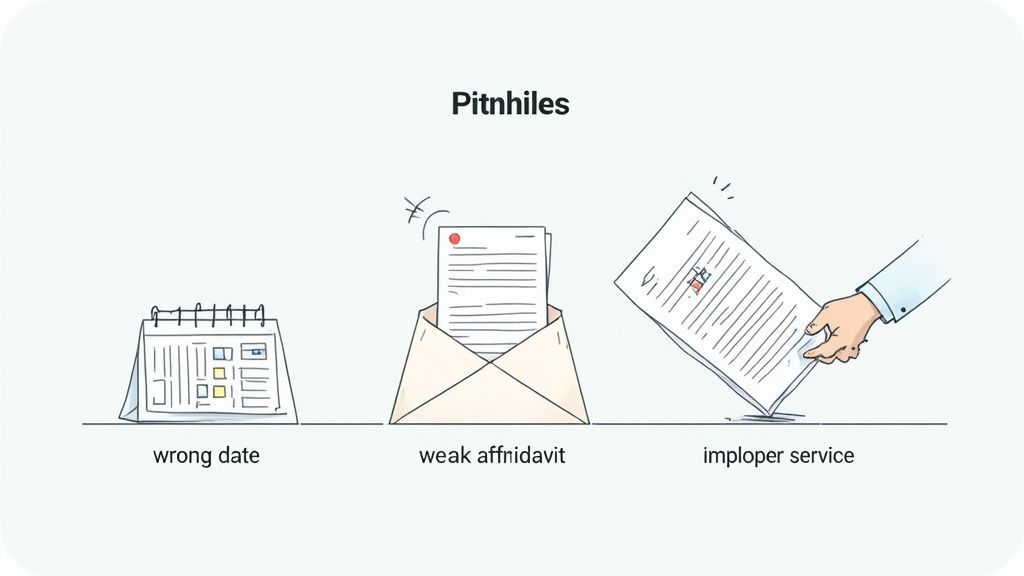
Sometimes, the simplest procedural slip-ups can completely derail a deserving restoration application. When you're dealing with an Order 21 Rule 106 CPC application, meticulous attention to detail isn't just good practice—it's everything. Courts have very little patience for technical flaws that could have been easily avoided.
Knowing the common pitfalls is the first step toward building a case that can actually withstand scrutiny.
One of the most frequent—and fatal—errors is getting the limitation period wrong. It’s a classic mistake. Practitioners sometimes assume the 30-day clock starts ticking from when they found out about the dismissal. But the law is painfully clear on this: the period runs from the date of the order itself. This single miscalculation can render an otherwise solid application dead on arrival.
Another common pitfall is filing a vague or wishy-washy affidavit. Just stating that "counsel was unwell" or "stuck in traffic" won't cut it. A persuasive affidavit tells a clear, chronological story. It has to explicitly connect the "sufficient cause" to the non-appearance and, crucially, back it up with proof, like a medical certificate or even travel records.
Improper Service of Notice
Filing the application is only half the battle. You absolutely must serve proper notice on the opposing party. This isn't optional.
Failing to serve notice, or failing to file proof of service with the court, is a procedural defect that will get your restoration plea thrown out. It's all about upholding the principles of natural justice—the other side must have a fair chance to contest what you're asking for.
InsightsThink of your application not just as a request, but as a complete, self-contained argument. Every single piece—the timeline, the affidavit, the evidence, and proof of service—must be flawless. The court is looking for diligence, not just a good excuse.
Avoiding Unforced Errors with a Helping Hand
These kinds of unforced errors can be incredibly costly, but the good news is they are also entirely preventable. This is where a Legal AI called Draft Bot Pro can help. The platform can help you structure your application and affidavit, making sure all the necessary procedural declarations are baked in right from the start.
By generating a comprehensive checklist based on the specific requirements of Order 21 Rule 106 CPC, Draft Bot Pro helps you cross-verify every single step. It flags critical details like calculating the limitation period correctly and reminds you to attach the right annexures. Ultimately, it lets you file with far greater confidence, knowing your procedural house is in order.
Frequently Asked Questions
When you're deep in the trenches of execution proceedings, grappling with the specifics of Order 21 Rule 106 CPC can throw up some tricky questions. Let's tackle some of the most common ones practitioners run into.
What Happens If I Miss The 30-Day Deadline?
Missing the 30-day deadline is, to put it bluntly, a disaster for your application. The courts are incredibly strict on this point, viewing the time limit as non-negotiable.
The real kicker is that Section 5 of the Limitation Act—the provision that often saves the day by allowing judges to forgive delays—simply doesn't apply here. If you file on day 31, the court won’t even look at your reasons for non-appearance. The case will be dismissed on the grounds of limitation, full stop.
Can This Rule Restore A Case Dismissed On Merits?
Absolutely not. This is a critical distinction that trips up many. Order 21 Rule 106 is a very specific tool designed for one purpose: to bring back an application that was thrown out because you or your client didn't show up (a dismissal for default of appearance under Rule 105). It’s a procedural do-over, not a shortcut to an appeal.
If the executing court heard arguments from both sides and passed an order based on the legal substance of the case, your only path forward is an appeal or revision to a higher court. Trying to use Rule 106 in this scenario is a non-starter.
InsightsThink of Rule 106 as a key for a specific lock. It only works to fix the procedural hiccup of non-appearance. If you try to use it to challenge a substantive decision on its merits, the lock won't turn, and you'll just waste precious time and your client's resources.
Is A Lawyer's Mistake Considered Sufficient Cause?
This is where things get subjective. The court's answer will hinge on the type of mistake. A genuine, honest error, like mis-noting a date in the case diary, often passes the 'sufficient cause' test. The idea is to show that the slip-up was unintentional, not a sign of laziness.
However, if the mistake stems from gross negligence or a pattern of carelessness, the court is unlikely to be sympathetic. The judge will try to figure out if the client themselves was diligent and whether the advocate's error was a one-off, human mistake. Your best bet is to come clean with a detailed, truthful affidavit explaining exactly what went wrong.
Is A Fresh Execution Petition A Better Option?
Filing a fresh execution petition is a dangerous gamble and almost always the wrong move. For one, you could run head-on into the statute of limitations. Worse, you could be blocked by the principle of res judicata, which prevents parties from re-litigating issues that have already been decided.
The clean, correct, and legally sound approach is to get the original petition back on its feet using an application under Order 21 Rule 106 CPC. This keeps the proceedings seamless and saves you from creating entirely new, and often insurmountable, legal problems for your client.
Getting these procedural steps right is non-negotiable. A Legal AI called Draft Bot Pro can help by generating the initial drafts of your Rule 106 application and the crucial supporting affidavit. It ensures all the essential components are in place, helping you build a compliant filing and sidestep procedural errors that could derail your case. Check out https://www.draftbotpro.com to see how it can support your practice.
