
A Guide to Regularization of Contractual Employees

When we talk about the regularization of contractual employees, we’re really talking about a fundamental shift in their professional lives. It’s the process of moving someone from a temporary or contract-based role into a permanent, sanctioned position within the company.
This isn't just a paper-shuffling exercise. It means granting them real job security, putting them on regular pay scales, and giving them access to all the statutory benefits their permanent colleagues enjoy. In essence, you’re taking someone from a precarious gig and putting them on a stable career path.
What Regularization Means for Employees and Employers
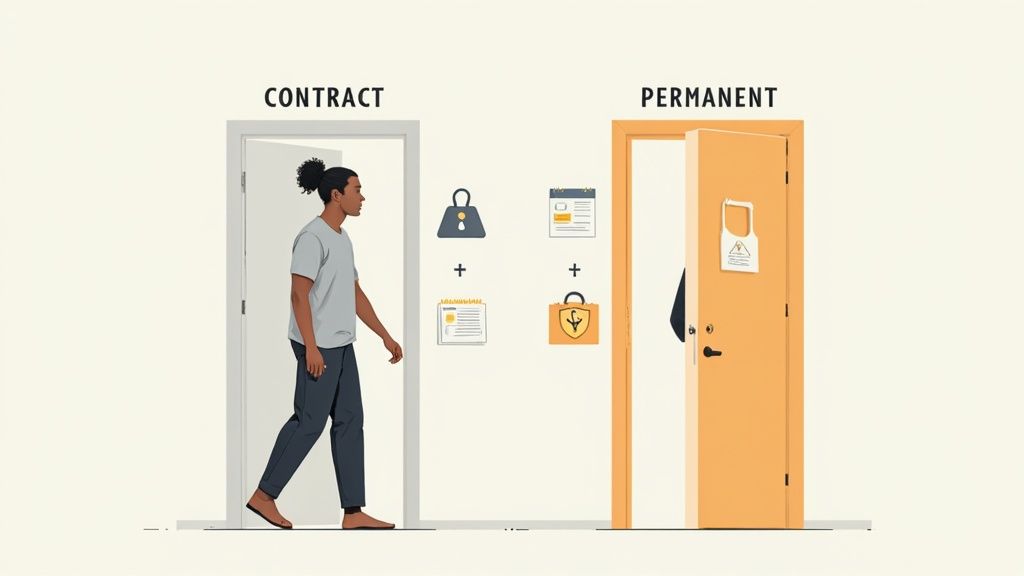
The whole concept of regularizing contractual staff sits right at the heart of a major debate in Indian labour law. For countless people, it's the bridge they need to cross from temporary uncertainty to the stability of a permanent job. But for employers, it’s a tricky path to navigate, involving legal compliance, serious financial planning, and a bit of strategic workforce management.
To get a real grip on this, you have to look beyond the simple definition. It's about acknowledging how the employment landscape has changed. Contract-based work is everywhere now. The problem is, this trend often clashes head-on with the very human need for job security, which is why there’s a constant push for clear, fair pathways to permanent roles.
The Core of the Issue
At its heart, this is all about fairness and legal recognition. When an employee is doing work that is clearly ongoing or 'perennial' in nature, keeping them on a temporary contract year after year can easily be viewed as an unfair labour practice. Landmark court rulings and foundational laws like the Contract Labour (Regulation & Abolition) Act, 1970, have consistently stepped in to address this imbalance, setting the ground rules for when and how regularization should happen.
The difference between a temporary and a permanent role is night and day:
Job Security: Permanent employees are protected from arbitrary termination. Contractual roles, on the other hand, have a built-in end date.
Pay and Benefits: Regularized staff get a proper pay scale, provident fund, gratuity, and other benefits that contract workers often miss out on.
Career Progression: Permanent status is usually the key that unlocks promotions and long-term career growth inside an organisation.
InsightsThe Supreme Court has been very clear on this: the government can't just use "financial constraints" as a catch-all excuse to avoid regularization when the work is clearly permanent. The expectation is that public bodies should be planning properly and sanctioning posts for these ongoing functions, not just relying on an endless cycle of temporary hires.
Modern Tools for a Complex Process
Let's be honest, navigating the legal maze of regularization can be a massive headache for HR and legal teams. You're looking at meticulous verification of service records, checking eligibility against a web of legal precedents, and drafting precise, compliant documents for every single employee. This is where modern solutions can really make a difference.
Creating a clear path to permanence for your contract staff is a huge morale booster and a powerful part of any set of effective employee retention strategies. Getting this transition right is absolutely crucial.
This is where a Legal AI called Draft Bot Pro can become your secret weapon. It helps streamline the entire workflow by automating the creation of essential documents, from formal regularization orders to updated employment contracts. By checking employee data against established legal benchmarks, Draft Bot Pro ensures every step is documented correctly and in full compliance with the latest court rulings. It cuts down the administrative slog and, more importantly, minimizes the risk of legal challenges down the road, making the whole process fairer and more transparent for everyone.
The Legal Framework for Employee Regularization
To get your head around the regularization of contractual employees, you need a solid grasp of the legal principles that form the bedrock of Indian employment law. This isn't just about tweaking company policy; it's about following a framework built over decades of judicial decisions, with one particular ruling standing head and shoulders above the rest.
At the very centre of this legal maze is the landmark Supreme Court judgement in **Secretary, State of Karnataka vs. Umadevi (2006)**. This one case completely changed how courts and employers have to look at claims for permanent status. Before this ruling, the legal scene was a bit of a free-for-all, often resulting in conflicting and unpredictable decisions.

The Umadevi judgment introduced a much-needed dose of clarity and strictness. The Court put a stop to what it called "wholesale regularization," making it crystal clear that permanent jobs should be filled through proper, open, and competitive hiring. It essentially slammed the door on the idea that you could automatically become permanent just by working somewhere for a long time.
The Umadevi Doctrine Explained
The Supreme Court's logic was simple but powerful: letting temporary appointments morph into permanent ones on a massive scale would trample all over the constitutional principles of equal opportunity, specifically Articles 14 and 16. It just wouldn't be fair to the countless others waiting to apply through the proper channels.
However, the Court did leave a tiny window open. It carved out a one-time exception for what it termed "irregular" appointments (which are different from "illegal" ones). For an employee to even have a chance, they had to tick some very specific boxes:
Continuous Service: You must have put in 10 years or more of uninterrupted work, without any help from a court order keeping you in the job.
Sanctioned Post: The position you held had to be a formally approved, or "sanctioned," post.
Qualified Position: Your initial hiring couldn't have been flat-out illegal (for instance, hiring someone who didn't meet the basic qualifications for the role).
This judgment is a binding precedent. That means every single lower court and tribunal in India has to follow its lead. It drew a thick, unmissable line in the sand between a long-term temporary gig and a genuine right to a permanent role.
InsightsThe Supreme Court's message in Umadevi was unmistakable: public employment is a public trust. While the judges sympathised with temporary workers, they put the constitutional requirement of fair and open recruitment first. This means employers can no longer use long-term contracts as a backdoor route to permanent government jobs.
Navigating the Pre and Post Umadevi Landscape
The change in judicial thinking was massive. Before 2006, courts were often more lenient, sometimes ordering regularization simply because someone had worked for a long time. The Umadevi ruling replaced that with a structured, predictable, and much tougher legal test.
Thinking about the legal landscape before and after the Umadevi ruling helps to see just how much things changed. The criteria, the judicial attitude, and the obligations on employers were completely different.
Legal Landscape for Regularization Before and After the Umadevi Ruling
Aspect | Pre-Umadevi (Before 2006) | Post-Umadevi (After 2006) |
|---|---|---|
Primary Basis for Claim | Often based on the continuous length of service and the perennial nature of the work. | Strict adherence to the 10-year rule against a sanctioned post. |
Judicial Approach | More sympathetic and liberal, frequently directing regularization on equitable grounds. | Cautious and rule-based, with a strong emphasis on constitutional recruitment processes. |
Employer Obligation | Often faced court orders for mass regularization, creating financial and administrative burdens. | Obligated to regularize only if the specific, narrow conditions of the Umadevi exception are met. |
Legal Certainty | Low. Decisions varied widely between different high courts and benches. | High. The judgment established a clear and binding precedent for all courts to follow. |
This shift fundamentally changed the game for both employees hoping for permanency and the organisations they worked for. It created a clear, albeit narrow, path forward.
It's also worth noting that different types of contracts have their own legal nuances. For a broader perspective, you might want to explore the legal aspects of zero-hour contracts, as each contractual form comes with its own set of rights and obligations.
How Legal AI Simplifies Compliance
For any HR department or legal team, trying to apply the complex Umadevi criteria to potentially hundreds of employee files is a nightmare. It’s a painstaking process of checking appointment dates, verifying continuous service, and confirming the status of each post. One slip-up could easily drag the organisation into long and expensive legal battles.
This is exactly where a legal AI tool like Draft Bot Pro becomes a game-changer. It's built to analyse mountains of employee data against the very legal standards set by the Supreme Court.
Draft Bot Pro can step in by:
Assessing Eligibility: It can systematically scan through employment records to pinpoint candidates who actually meet the strict Umadevi conditions.
Generating Compliant Documents: The tool can produce standardised and legally solid regularization orders and fresh employment contracts.
Mitigating Risk: By ensuring the entire process is documented transparently, it drastically lowers the company's risk of facing legal challenges from those who don't make the cut.
Using a tool like this helps employers handle the regularization of contractual employees not just quickly, but with the legal precision required to stay compliant, fair, and out of court.
How State-Specific Policies Impact Regularization
While the Supreme Court sets the national standard with landmark rulings like Umadevi, the ground reality of regularizing contractual employees often boils down to state-level policies and politics. Labour is a concurrent subject in India, which means both the central and state governments can make laws about it. This creates a complex and often varied landscape where a policy in one state can look completely different from its neighbour's.
This isn't just a legal technicality; it has a direct, real-world impact on the lives of thousands of workers. A state government, whether driven by administrative needs, political promises, or social welfare goals, might kick off a massive regularization drive. These initiatives often serve as a pragmatic fix to a long-standing problem, acknowledging that countless employees have been doing essential, permanent work for years without the security of a permanent post.
The Punjab Model: A Case Study in Action
Punjab offers a compelling example of a state taking decisive action. Feeling the pressure from employee unions and recognising the need for a stable workforce, the Punjab government has launched several significant regularization drives. The goal is to bring a huge number of long-serving contractual, ad-hoc, and daily wage workers into the formal employment system.
A standout instance was the policy decision to regularize the services of 14,417 employees. In October 2023, the Punjab cabinet approved a policy specifically for individuals who had put in at least 10 years of continuous service. This move gave them the job security and formal recognition they desperately needed. You can read more about this significant Punjab cabinet decision to get the full picture.
This wasn't just a simple rubber-stamping exercise, though. The policy had some specific, practical mechanics.
Creation of Special Cadres: Instead of trying to shoehorn these employees into existing, often rigid, regular cadres, the government created special cadres just for them. It's a clever approach that sidesteps the usual administrative hurdles tied to sanctioned posts.
Strict Eligibility Criteria: The policy wasn't a free-for-all. It mandated a minimum of 10 years of continuous service and insisted that employees must have the right qualifications and experience for their roles.
Understanding the Tension: Flexibility vs. Security
What’s happening in states like Punjab really highlights a core tension in modern employment: the organisation's need for flexibility versus the employee's fundamental need for security. The explosion of the gig economy and project-based work has led to a nationwide surge in contractual hiring. While this gives businesses agility, it leaves a huge part of the workforce living with constant uncertainty.
InsightsState-led regularization policies are often a direct answer to this growing imbalance. They're a political and administrative admission that you can't run essential public services on the backs of a precarious workforce forever. It’s a recognition that long-term, perennial work deserves the stability of a permanent job.
For HR and legal teams, navigating these state-specific rules adds a whole new layer of complexity. A policy that works perfectly in one state might be totally irrelevant in another. Just keeping track of the evolving regional regulations, circulars, and government orders is a massive challenge. For more on how technology can help, check out our guide on using AI for HR compliance in India.
How Legal AI Can Navigate State-Level Nuances
Managing the regularization process across different states demands a sharp eye for detail and an up-to-the-minute understanding of local laws. This is exactly where a Legal AI tool like Draft Bot Pro becomes invaluable. It can be trained on specific state government circulars, policies, and legal precedents, giving you a serious advantage.
For any organization operating in multiple states, this capability is a game-changer. Draft Bot Pro can help by:
Verifying against Local Criteria: The AI can check an employee's service record not just against national precedents like Umadevi, but also against the specific eligibility rules laid out in a state's latest regularization policy.
Drafting State-Compliant Documents: It can generate regularization orders and employment contracts that automatically include state-specific clauses and references, ensuring you're fully compliant with local mandates.
Anticipating Policy Shifts: By analysing trends in government announcements and court challenges, the AI can help your organization see policy changes coming, making your HR strategy much more proactive.
By getting a handle on these state-level dynamics, both employers and employees can better anticipate how and when the regularization of contractual employees might play out in their specific region.
Putting a Practical Regularisation Framework in Place
Moving from the theory of state policies to actually getting it done on the ground requires a clear, organised plan. Regularising contractual employees isn't just a box-ticking exercise for HR; it's a major organisational shift that needs careful thought and execution. A solid, well-thought-out approach ensures you're being fair, staying on the right side of the law, and managing everyone's expectations.
First things first, you need to set up an internal assessment committee. This shouldn't be just an HR task. Pull in people from your legal team and the relevant operational departments. Their main job is to create a transparent and objective list of criteria for who is eligible, based on both legal precedents and your own company's policies. This single step prevents a lot of heartache and accusations of favouritism down the line, building trust right from the start.
Verifying Records and Nailing Down Eligibility
With the committee in place, the real detailed work begins: record verification. This is where you have to be meticulous. One small mistake here can blow up into a significant legal challenge later. The committee's job is to comb through each potential candidate's employment history with a fine-tooth comb.
The verification process has to zero in on a few key documents:
Original Appointment Letters: These are crucial. They establish the starting point—the initial terms of engagement and when their service officially began.
Service Duration Records: You need to confirm continuous service. The committee must ensure there are no major gaps that could disqualify an employee under legal standards, like the well-known 10-year rule.
Nature of Work Performed: This is about proving the work was ongoing and essential, not just a one-off project. Job descriptions, manager testimonials, and performance reviews are your best friends here.
InsightsHonest and open communication is the absolute foundation of a smooth regularisation process. Right from day one, be crystal clear about the criteria, the timeline, and all the steps involved. This keeps anxiety low, manages expectations, and stops the rumour mill from damaging morale.
Preparing and Automating the Paperwork
Once you've confirmed who's eligible, it's time to make it official. This means drafting the formal regularisation orders and, just as importantly, creating new employment contracts that reflect their permanent status. When you're dealing with a large group of employees, consistency and legal accuracy are non-negotiable.
This is exactly the kind of task where a Legal AI tool like Draft Bot Pro can be a game-changer. Imagine manually drafting hundreds of individual documents—it's not just slow, it's a recipe for errors. Draft Bot Pro can automate the whole thing, generating legally sound regularisation orders and updated employment contracts that are perfectly consistent. It uses pre-vetted templates that are already aligned with current labour laws, ensuring every single document is compliant.
Let's face it, the ins and outs of employment law can be tricky. To get a better handle on how AI can help, you should check out our guide on AI for drafting employment contracts. It offers a much deeper look into the process.
What We Can Learn from Large-Scale Efforts
The value of a structured framework really hits home when you look at massive government initiatives. Take the Punjab government's major effort in 2021, for example. The cabinet gave the green light to regularise about 36,000 contractual employees who had put in over 10 years of service. Pulling that off required a crystal-clear policy, which included creating "deemed posts" and strictly following reservation policies, just to manage the transition for such a huge number of people. You can discover more insights about this large-scale regularization effort in Punjab to get a sense of the sheer administrative scale involved.
By taking a deliberate, methodical approach—from assessment and verification to documentation and communication—any organisation can navigate this complex process successfully. It’s not just about legal compliance; it’s about treating your employees with the fairness and respect they've earned during what is truly a life-changing moment for them.
Employer Insights on Mitigating Legal Risks
Let's be frank: navigating the regularization of contractual employees is far more than an HR box-ticking exercise. It's a strategic minefield. For employers, the process is loaded with legal tripwires and financial headaches that demand a steady hand. One wrong move can easily pull you into years of expensive legal battles, draining your finances and tarnishing your company's name.
The biggest headaches almost always pop up around eligibility disputes. When you regularize one group of employees, those left out often file claims, sparking conflicts over pay scales, seniority, and benefits. It’s a recipe for a hostile work environment and can tie up your HR and legal teams for an eternity.
The only way to sidestep this chaos is to be proactive and transparent from the get-go. This means building a fair, legally sound regularization policy from the ground up—one that aligns with court precedents and your company's bigger picture.
Structuring a Defensible Regularization Policy
A rock-solid policy is your best defence. It needs to be crystal clear, objective, and communicated properly to everyone. Vague criteria are just an open invitation for a legal challenge, so your policy must be built on concrete, verifiable standards.
Here's what a strong policy must include:
Objective Eligibility Criteria: Don't leave room for interpretation. Clearly spell out the requirements, like a minimum continuous service period (say, 10 years), ensuring the work is perennial in nature, and confirming the employee was hired against a sanctioned post.
A Transparent Verification Process: You need to detail exactly how you'll verify service records, appointment letters, and work history. This eliminates ambiguity and proves your commitment to a fair process.
Clear Communication Channels: Set up a formal process for everything—announcing the policy, handling questions, and delivering the final decisions to all applicants, whether they were successful or not.
This simple, three-stage flow shows how to manage the core process effectively.
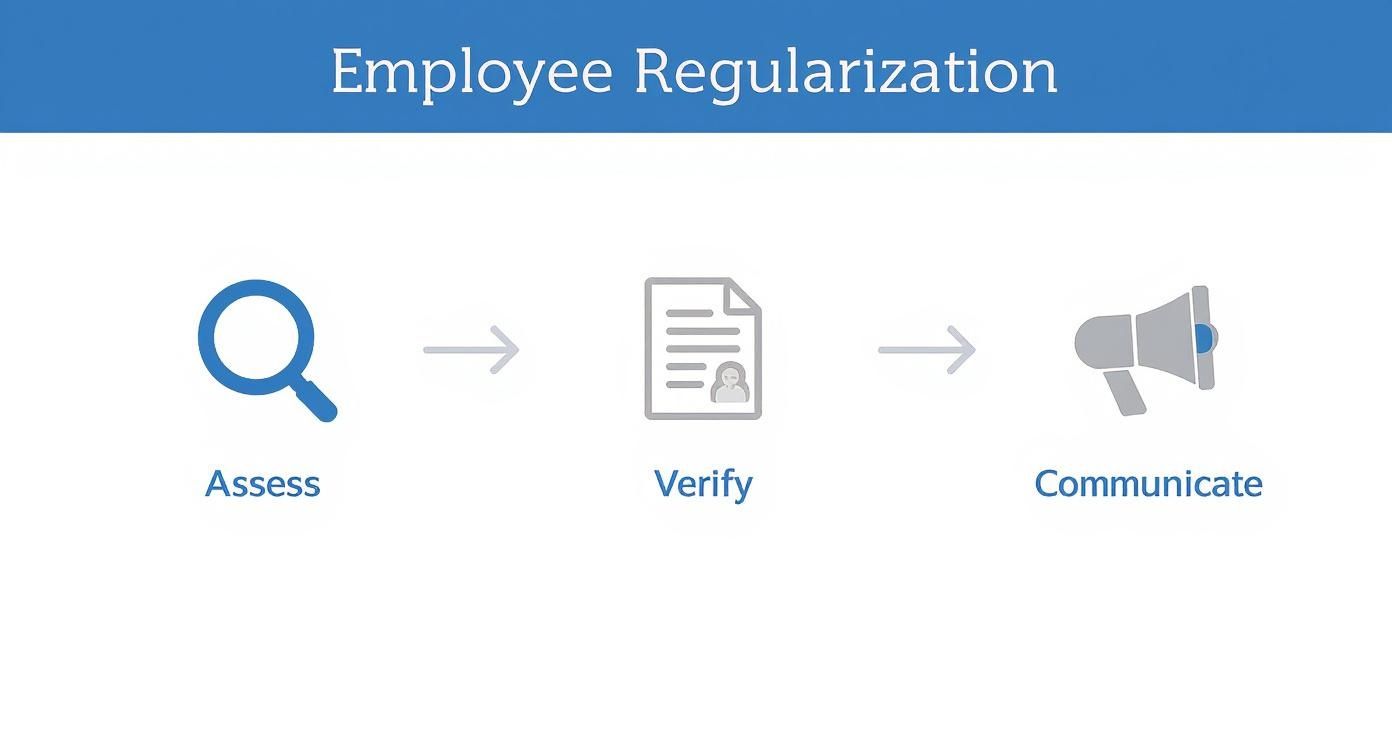
As you can see, a successful program really comes down to methodical assessment, rigorous verification, and transparent communication at every single step.
The Strategic Upside of a Well-Managed Program
Beyond just dodging legal bullets, a well-planned regularization program gives you a serious strategic edge. It’s a powerful way to build a more stable, committed workforce. When employees see a genuine path to becoming permanent, their morale and loyalty get a massive boost.
And this isn't just a "feel-good" perk; it hits your bottom line directly. Higher morale means lower attrition. That saves you a fortune in recruitment, hiring, and training costs. You also hang onto valuable institutional knowledge and build a team that's genuinely invested in your company's success.
This is especially critical in the current Indian labour market. Contractual work is no longer a fringe concept. Research from Ashoka University's Centre for Economic Data and Analysis shows the share of contract workers in India’s formal manufacturing workforce shot up from 23.1% in 2002-03 to a staggering 40.2% in 2021-22. In this kind of environment, offering job security can be your secret weapon for attracting and keeping the best people. You can read the full research on the contractualization of India's workforce for a deeper dive.
InsightsFairness, transparency, and sticking to the law are the pillars of a successful regularization process. Employers who cut corners or make arbitrary decisions aren't just being unethical—they're practically begging for legal challenges that are incredibly costly to fight.
Leveraging Legal AI for Risk Mitigation
Let's face it: managing the mountain of paperwork and legal checks for regularization is a huge drain on your resources. This is exactly where a Legal AI tool like Draft Bot Pro can be a game-changer. It helps ensure your process is not just efficient but also legally watertight.
Here’s how Draft Bot Pro can help you stay out of trouble:
Automating Compliant Documentation: It generates legally vetted regularization orders and updated employment contracts, keeping everything consistent and accurate across the board.
Assessing Eligibility Objectively: The AI can crunch employee data against established legal precedents, helping your team make fair, defensible decisions about who qualifies.
Creating an Audit Trail: By standardizing the process, the tool helps build a clean, documented record of how and why decisions were made. That paper trail is invaluable if you ever end up in a legal dispute. For related issues, check out our guide on the settlement of industrial disputes.
Got Questions About Regularization? We’ve Got Answers.
When you're dealing with the regularization of contractual employees, a lot of questions pop up for everyone involved. It’s a tricky area of Indian labour law. Let's clear the air and tackle some of the most common queries we hear from both employees and HR managers.
Getting straight answers is the first step to making sure everything is handled fairly and by the book. Whether you're a contractual employee hoping for job security or an HR professional trying to navigate the process, understanding these points is absolutely essential.
Does Working for a Long Time Automatically Make Me Permanent?
This is probably the biggest misconception out there, and unfortunately, it leads to a lot of confusion and legal battles. The short answer is no; long service by itself isn't a golden ticket to regularization.
The game changed with the Supreme Court's landmark ruling in the Umadevi case. Since then, the rules are much stricter. You typically need to show you’ve worked continuously for a long stretch—often 10 years or more—in a sanctioned, permanent position. And here’s the kicker: your initial hiring must have been done through a proper, legitimate process, not just as a back-door or temporary arrangement.
What’s the Difference Between Regularization and Absorption?
People often use these terms interchangeably, but they actually mean two different things in the legal world.
Regularization is all about making an existing temporary or contractual employee's job permanent in their current role. It's about solidifying their position within the organisation, assuming they tick all the legal boxes.
Absorption, on the other hand, is what happens when employees are moved from one department or organisation into another, usually because of a merger, a big restructuring, or their original department being shut down. It's about integrating them into a new structure.
I Work Through a Contractor. Can the Main Company Regularize Me?
Generally, the answer is no. If there's a legitimate contract between the company you work at (the principal employer) and your contractor, then legally, you're an employee of the contractor. Your employment relationship is with them, not the company whose premises you work on.
But there's a huge exception. If it turns out the whole contractor setup is just a smokescreen—a sham to deny workers their rights and benefits—a court can step in. Under the Contract Labour (Regulation & Abolition) Act, 1970, if a court "lifts the corporate veil" and finds the arrangement is deceptive, it can order the principal employer to regularize the workers directly.
InsightsProving a "sham contract" is a tough legal fight, but it's a powerful tool for workers. You need solid proof that the arrangement was deliberately designed to mislead. Courts will dig deep, looking at who really controls your work, who provides the tools, and who has the power to discipline you to figure out who the real employer is.
How Can Legal AI Actually Help with This Process?
Trying to manage a regularization process, especially with a large number of employees, is a legal and administrative minefield. It's overflowing with paperwork and compliance risks. This is where a specialised legal AI tool like Draft Bot Pro can be a massive help for employers and HR teams.
Think of it as a super-efficient paralegal. It automates the creation of all those crucial, legally sound documents you need. For example, Draft Bot Pro can instantly generate standardised regularization orders, update employment contracts to reflect the new permanent status, and even create clear templates for internal announcements. It can also help HR assess who is eligible by comparing employee data against the established legal precedents, ensuring fairness and consistency. This cuts down on human error, creates a transparent paper trail, and dramatically reduces the risk of facing legal challenges down the road.
Ready to manage your legal documentation with precision and speed? Draft Bot Pro is the most affordable and verifiable Legal AI, built by lawyers for lawyers. Streamline your legal drafting and research today by visiting https://www.draftbotpro.com.
