
section 315 crpc: Rights, Risks & Strategy for Defense Witnesses

Section 315 of the Code of Criminal Procedure (CrPC) gives an accused person a powerful right: the chance to become a competent witness in their own defence. This provision hands the accused a key to the witness box, but with one crucial condition—it must be on their own written request. This is a choice, never a compulsion, offering a critical opportunity to confront the prosecution's story head-on.
Understanding Your Rights Under Section 315 CrPC

In the theatre of a criminal trial, the accused is the central character, but their voice is often heard indirectly. Section 315 CrPC flips this script entirely. It allows the accused to step out from the dock and into the witness box, transforming them from a passive subject into an active participant who can tell their side of the story directly to the court.
This right is a serious weapon in the defence's arsenal. Think of it as the ultimate chance to explain, clarify, and dismantle the evidence stacked against them. While a statement under Section 313 lets an accused explain incriminating circumstances, it isn't given under oath and can't be cross-examined. Testimony under Section 315, on the other hand, is sworn evidence. It carries real weight.
The Core Principles of the Right to Testify
Deciding whether to take the stand is one of the most nail-biting strategic calls in any criminal case. It's a delicate balancing act, weighing potential breakthroughs against significant risks. The principles underpinning this right are all about ensuring fairness and respecting the accused's decision.
Here’s a breakdown of the foundational elements:
It Must Be Voluntary: The choice to testify belongs to the accused and the accused alone. No court, prosecutor, or anyone else can force them to take the stand.
A Written Request is Mandatory: A formal, written application is non-negotiable. This procedural step ensures there's a clear, undeniable record that the decision was made deliberately, not under pressure.
The Accused Becomes a Full-Fledged Witness: Once the application is granted, the accused is treated just like any other witness. They will face examination-in-chief, be subjected to cross-examination, and can be re-examined.
This structured process is crucial for maintaining the integrity of the trial. For a closer look at the procedural nuts and bolts, you can learn more about navigating India’s criminal rules of practice in our detailed guide.
The table below summarises the core components of this provision, offering a quick reference for advocates and their clients.
Core Principles of Section 315 CrPC
Component | Description | Key Condition |
|---|---|---|
Right to Testify | The accused can voluntarily become a witness in their own defence. | Must be the accused's own choice, free from any form of coercion. |
Procedural Requirement | A formal application must be submitted to the court in writing. | A verbal request is not sufficient; a written record is mandatory. |
Evidence under Oath | The testimony given by the accused is sworn evidence. | This means the testimony carries significant legal weight and can be penalised for falsehood. |
Subject to Cross-Examination | The prosecution has the right to cross-examine the accused. | The accused cannot give their version of events without facing scrutiny from the opposing side. |
Understanding these principles is the first step toward making a sound strategic decision.
Insights Testifying under Section 315 CrPC is a high-stakes gamble. A credible, composed performance in the witness box can completely dismantle the prosecution's case and plant the seeds of reasonable doubt. But a poor showing under the fire of cross-examination can be a catastrophe, potentially cementing the prosecution's narrative and undoing all the hard work of the defence.
How Legal AI Can Help in This Crucial Step
Preparing for such a pivotal moment demands meticulous planning. This is where modern legal tools can give you a real edge. A legal AI assistant like Draft Bot Pro can be invaluable for advocates. It can help draft a legally sound written application under Section 315, ensuring every procedural detail is handled correctly.
Beyond that, it can assist in structuring the examination-in-chief, helping you formulate clear, powerful questions designed to bring out the most compelling testimony from your client. This kind of technological support frees up legal professionals to focus on what really matters: the human element of courtroom strategy.
The Purpose of Section 315 in Ensuring a Fair Trial
At its heart, the criminal justice system is all about fairness. Section 315 CrPC is one of the pillars holding up this ideal. Think of it this way: a criminal trial shouldn't be a one-sided lecture where the prosecution presents a story and the accused just sits there. Section 315 levels the playing field, turning the accused from a passive subject into an active participant with a voice.
This provision is a direct application of the principles of natural justice. It brings to life the fundamental idea that everyone deserves a chance to be heard (audi alteram partem). By allowing the accused to step into the witness box, the law hands them a formal, powerful platform to tell their side of the story directly to the judge.
Upholding the Constitutional Promise
The importance of Section 315 CrPC goes far beyond just being a procedural rule; it's deeply woven into the constitutional promise of a fair trial. This right is a game-changer. It gives the accused the power to challenge evidence, clear up misunderstandings, and provide a personal account of events—all under the weight of a formal oath.
The scope is crystal clear: the testimony can be used to disprove charges against the accused or anyone else being tried alongside them. This ensures the court hears every possible perspective before making a life-altering decision, cementing the integrity of the entire judicial process.
Insights The point of Section 315 CrPC isn't just to let the accused talk; it's to ensure their words are treated as real, substantive evidence. Unlike a simple unsworn statement from the dock, testimony given under oath can be tested through cross-examination. This gives it a credibility and weight that can genuinely shift the outcome of a case.
This provision acts as a critical safety net, making sure that justice isn't just done, but is also seen to be done. It’s a powerful statement about our commitment to a transparent and balanced legal fight.
Balancing Rights with Safeguards
One of the most brilliant aspects of Section 315 is how it works hand-in-hand with Article 20(3) of the Indian Constitution—the right against self-incrimination. The law strikes a masterful balance between the right to speak and the right to stay silent. The accused can never be forced to be a witness; the choice must be completely voluntary and backed up by a written request.
This is a crucial difference. Section 315 of the Code of Criminal Procedure (CrPC) makes an accused person a competent witness for their own defence. This means they can give evidence under oath to fight the charges against them or a co-accused. But it's their call to make, and it must be put in writing. This mirrors the constitutional protection under Article 20(3), which shields people from being forced to incriminate themselves. You can discover more insights about Section 315 on restthecase.com to get the full picture.
This voluntary nature guarantees that the provision remains a shield for the accused, not a weapon for the prosecution. Courts have repeatedly confirmed that if an accused person chooses not to give evidence, that silence cannot be used to presume their guilt.
How Legal AI Can Sharpen Your Strategy
Getting to grips with these legal nuances takes solid research and a sharp strategic mind. Luckily, modern tools are making this a whole lot easier. A legal AI assistant like Draft Bot Pro can give a lawyer a real edge when prepping a case involving Section 315 CrPC.
With Draft Bot Pro, a lawyer can instantly pull up landmark judgments that have shaped how this section is applied. This kind of AI-powered research helps you to:
Pinpoint key precedents that back up your defence strategy.
See how courts have handled similar situations in the past.
Build a much stronger, evidence-based argument for (or against) the accused taking the stand.
By getting quick access to the right case law, advocates can make smarter strategic calls, knowing their approach is built on a solid legal foundation. This kind of tech support frees up lawyers to do what they do best: craft a compelling and fair defence for their client.
Taking the Stand: The Step-by-Step Courtroom Process
Once you and your client have made the critical decision to testify under Section 315 CrPC, the game plan shifts. Now, it's all about navigating the precise, structured procedure that follows. This isn't just about speaking; it's about transforming the accused into a formal witness who will give evidence under oath.
Every single step is crucial. Getting the sequence right is non-negotiable for both the defence lawyer and the accused. Knowing what's coming demystifies the whole affair, paving the way for better preparation and a far more confident performance in the witness box.
This diagram breaks down the core idea behind Section 315. It shows how giving the accused a voice is a direct line to upholding natural justice and ensuring a genuinely fair trial.
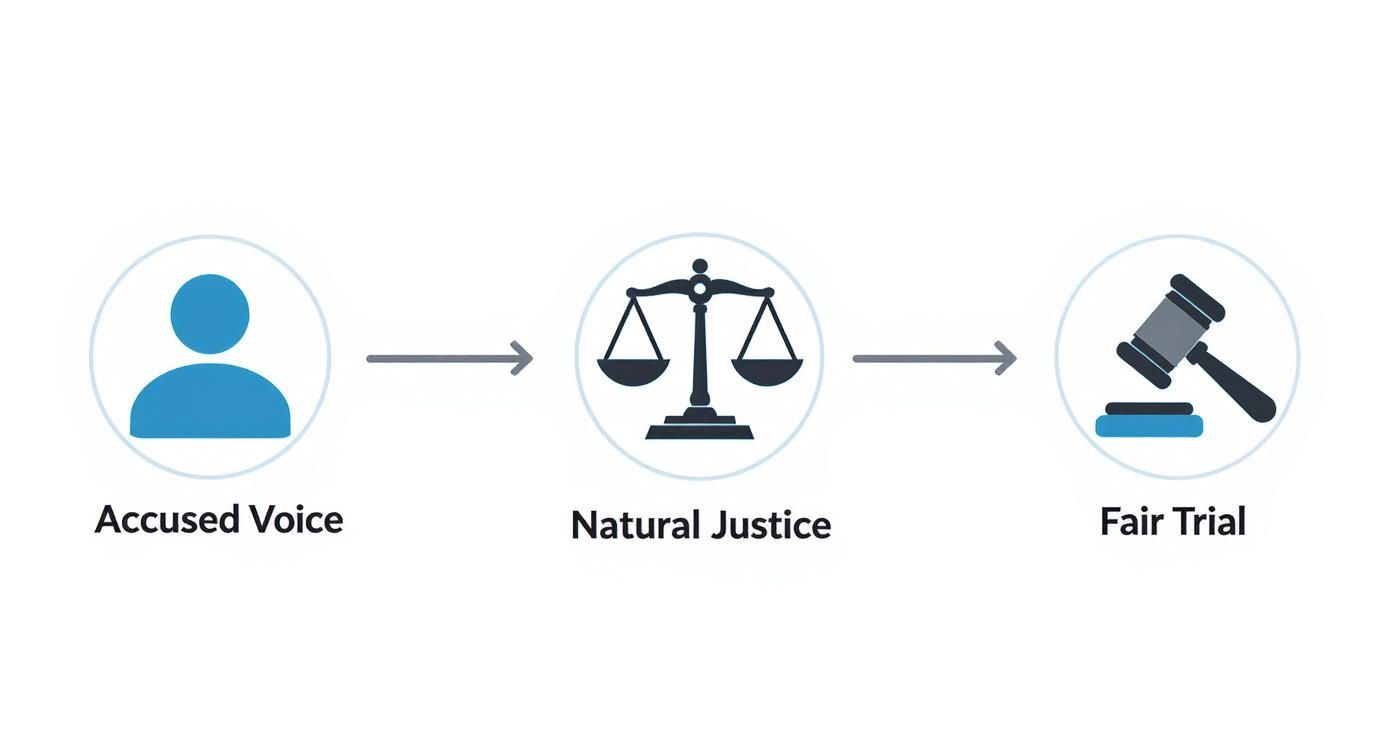
Ultimately, it illustrates a simple but powerful truth: giving the accused a platform to speak for themselves is a cornerstone of any just legal outcome.
Step 1: The Formal Written Request
The whole process kicks off with one vital action: a formal written request. Let me be clear—an oral application simply won't cut it. This document is the legal key that unlocks the witness box for your client, creating an official record of their choice to testify.
This written application is usually a straightforward document filed with the court, clearly stating the accused's wish to give evidence as a competent witness. This isn't just a formality; it's a critical safeguard that shuts down any future argument that your client was somehow pressured or forced into testifying.
Step 2: The Examination-in-Chief
With the court's approval, the accused takes the stand. The first round is the examination-in-chief, and it's your show as the defence lawyer. Your goal is to help your client lay out their side of the story in a clear, compelling, and believable way.
You'll use open-ended questions to guide them through their narrative, letting them explain their actions, challenge the prosecution's evidence, or establish an alibi. This is your chance to build a strong foundation for the defence. Of course, preparing your client is only half the battle; getting other individuals ready is just as important. You can get a better sense of this by reading our guide to summons to witness in Indian law.
Insights The strategic calculation here is immense. A powerful, credible testimony during examination-in-chief can really connect with a judge, humanising your client and offering a compelling alternative narrative. But you have to weigh this against the very real risk of a brutal cross-examination, where one slip-up or contradiction could torpedo your entire case.
Step 3: Facing the Cross-Examination
Next up, the prosecution gets its turn. This is the cross-examination, and it's often the single most stressful part of the trial for an accused person. The prosecutor's mission is simple: poke holes in the testimony, find inconsistencies, and destroy your client's credibility.
They'll come armed with leading questions designed to trip up your client and expose any weakness in their story. Staying calm, sticking to the facts, and being consistent under this kind of fire is absolutely essential. Any hint of dishonesty can be fatal.
Step 4: The Re-examination
Finally, you get one more chance with a re-examination. This isn't a do-over or a time to introduce new evidence. It’s your opportunity to perform damage control. You can clarify any confusing answers or repair any harm done during the cross-examination. The goal is to tie up loose ends and leave the court with a final, strong impression.
How Draft Bot Pro Helps with Procedural Accuracy
Getting these steps right demands precision. This is where a tool like Draft Bot Pro can be a massive help for lawyers. It can generate a procedurally perfect written application under Section 315, ensuring that crucial first step is handled flawlessly. Beyond that, its research tools can pull up relevant case law on examination procedures in seconds, helping you prepare your strategy and anticipate what the other side might throw at you.
How Section 315 Fits Into the Bigger Picture
Criminal law isn’t just a collection of standalone rules; it’s a web of interconnected safeguards designed to balance the scales of justice. Section 315 CrPC is a perfect example of this. It doesn't exist in a vacuum. To truly grasp its power, you have to see how it interacts with other critical protections for the accused.
Think of it like a lawyer's toolkit. You have different instruments for different jobs, but they all work together. In this scenario, the three key players are Section 315 CrPC, Section 313 CrPC, and the ultimate constitutional shield, Article 20(3). Together, they form a framework that respects the accused's right to both speak up and stay silent.
The All-Important Difference: Section 315 vs. Section 313
It's a common point of confusion, but the distinction between an accused person testifying under Section 315 and making a statement under Section 313 is massive. They might both give the accused a voice, but the legal weight and consequences are worlds apart.
A statement under Section 313 is the court giving the accused a chance to personally explain any incriminating evidence that has come up. Here’s the key: this statement is not under oath. Because of this, the accused cannot be cross-examined on what they say. It’s more of a direct dialogue between the judge and the accused, a procedural backstop to ensure fairness.
Section 315, on the other hand, is the real deal. When an accused decides to step into that witness box, they are sworn in and treated just like any other witness. Their testimony is formal evidence, carrying significant weight. But with that comes the heat of cross-examination from the prosecution. It's a high-stakes, high-reward decision that can make or break a defence.
Article 20(3): The Constitutional Bedrock
Everything we’re discussing rests on one unshakable foundation: Article 20(3) of the Indian Constitution. This is the fundamental right against self-incrimination. It’s the constitutional promise that no one accused of a crime can be forced to be a witness against themselves.
This is precisely why the procedure under Section 315 is so strict. The requirement for a written request from the accused isn't just red tape; it's a critical safeguard. It creates an undeniable record that the accused is willingly setting aside their right to silence. Courts have been crystal clear on this: you cannot draw an adverse inference just because an accused person chooses not to testify. Their silence can never be treated as a confession of guilt.
Insights This interplay creates a tough strategic choice for the defence. A Section 313 statement is a safe, low-risk way to get an explanation on record, but it doesn't have the punch of sworn testimony. Stepping into the box under Section 315 can be incredibly powerful—a chance to look the judge in the eye and tell your side of the story. But it also opens the door to a gruelling cross-examination that could backfire badly.
How Legal AI Helps Navigate This Maze
Trying to manually sift through decades of case law to understand these fine distinctions is a huge task. This is where a legal AI assistant like Draft Bot Pro can be a game-changer. An advocate can use it to instantly pull up Supreme Court and High Court judgments that have clarified and cemented the boundaries between these provisions.
When you can analyse judicial precedent this quickly, you can build a much more solid strategy. Knowing the subtle differences between legal provisions is what separates a good case from a great one. You can explore more about how AI can assist with evidence act analysis in India to see how this technology sharpens legal thinking. This kind of AI-powered research helps you make the right call: should the client make a statement under 313, brave the witness box under 315, or exercise their constitutional right to remain silent?
Strategic Reasons for an Accused to Testify
Moving from legal theory to the reality of the courtroom, the decision for an accused to testify under section 315 crpc is always a calculated risk. The potential for a disastrous cross-examination is very real, but there are powerful strategic reasons why taking the stand can be a game-changing move for the defence.
Sometimes, the accused is the only person who can provide that one piece of crucial context, dismantle the prosecution’s story brick by brick, or simply show their human side to the court. This is where the abstract principles of law crash into the raw, unpredictable nature of courtroom advocacy.
Challenging the Prosecution's Narrative Directly
The prosecution meticulously builds its case on a specific version of events. Testifying gives the accused a direct line to confront this story. It’s their one chance to look the judge in the eye and say, "That's not how it happened."
This direct challenge can be incredibly powerful in planting the seeds of reasonable doubt. For example, if the prosecution’s entire case is built on circumstantial evidence, the accused’s personal testimony can offer a logical, alternative explanation that the court might just find plausible. It transforms the accused from a silent figure in the dock into an active participant in their own defence.
Insights A well-prepared, credible testimony can do more than just counter facts; it can shift the entire emotional tone of the trial. When an accused person speaks with clarity and conviction, they can connect with the judge on a human level, making it harder for the court to see them as just the sum of the charges against them.
Providing Indispensable Context or Alibis
Certain defences can only be truly and effectively established through the accused's own words. Think about these common scenarios:
Establishing an Alibi: Sure, other witnesses can support an alibi. But it's the accused’s own detailed account of where they were and what they were doing that gives it the ring of authenticity needed to be believed.
Explaining Intent (or Lack Thereof): In cases where the mental state (mens rea) is a key ingredient of the offence, the accused is the only one who can explain their state of mind. This testimony could be the very thing that separates a conviction from an acquittal.
Clarifying Ambiguous Evidence: The prosecution can present evidence that looks damning without the right context. The accused can explain why they were at a certain place or why they made a particular phone call, turning a seemingly incriminating fact into something completely harmless.
The pressures of the Indian criminal justice system often make clear testimony even more vital. As a study from the Bureau of Police Research and Development found, a staggering 7,000 witnesses out of nearly 8,000 surveyed reported facing difficulties during trials. Given these systemic challenges with witnesses, the provision in section 315 crpc allowing an accused to testify on their own written request is a carefully controlled mechanism. You can read the full research about witness participation challenges here.
How Draft Bot Pro Prepares You for the Stand
Deciding to testify is just the first step. Success hinges on meticulous preparation. This is where a Legal AI assistant like Draft Bot Pro becomes an indispensable tool for advocates in this high-stakes phase.
First, it can generate a legally sound and procedurally perfect written application under Section 315, making sure that foundational step is flawless. More strategically, Draft Bot Pro can help you put together a comprehensive list of questions for the examination-in-chief, all designed to build a coherent and persuasive narrative.
Crucially, it can even help you run simulated cross-examination drills. By anticipating the prosecution’s likely lines of attack, you can prepare the accused to stay calm, consistent, and credible under fire. This is the kind of preparation that turns a risky decision into a winning strategy.
Frequently Asked Questions About Section 315 CrPC
When you're deep in the weeds of criminal procedure, it's natural for questions to pop up, especially around a provision as significant as Section 315 CrPC. I've put this section together to tackle the most common points of confusion I see from law students, young advocates, and even seasoned professionals.
Think of this as a quick-reference guide to clarify the tricky bits about letting an accused take the stand. Getting these nuances right is absolutely critical for making smart, strategic moves in the courtroom.
Can the Court Force an Accused to Testify?
No, not a chance. The entire spirit of Section 315 rests on the idea that testifying is a choice, never a command. The accused has to take the initiative and submit a written request to get into the witness box.
This isn't just a procedural quirk; it's a fundamental safeguard. Neither the judge nor the prosecution can drag an accused person to the stand against their will. This links directly back to the constitutional right against self-incrimination under Article 20(3), making sure this provision acts as a shield for the defence, not a sword for the prosecution.
What Happens if an Accused Gives False Evidence?
The moment an accused person opts to testify under Section 315 CrPC, they're put under oath, just like any other witness. This is a game-changer. Their testimony isn't just a story; it's formal, substantive evidence.
If they knowingly lie, they open themselves up to a separate criminal case for perjury under the Indian Penal Code. This is a massive risk that needs to be weighed very carefully. A perjury conviction doesn't just come with its own serious penalties; it can completely torpedo the credibility of their entire defence.
Insights The decision to testify is a classic double-edged sword. It's a powerful chance to tell their side of the story directly to the judge, but the obligation to be truthful is absolute. Defence counsel has to do more than just prep their client for cross-examination; they must ensure every word of the testimony is factual to avoid the disaster of a perjury charge.
Can One Accused's Testimony Be Used Against a Co-Accused?
Yes, it certainly can. Testimony given under Section 315 is substantive evidence, period. That means the court can use it to establish any fact in the case.
So, if one accused person takes the stand and, in defending themselves, says something that incriminates a co-accused, the court is fully entitled to consider that evidence against the co-accused. This makes the decision a huge strategic play in multi-accused trials. It can create a ripple effect, potentially forcing the other defence teams to completely change their game plan.
Is a Written Application Always Required?
Yes, it's non-negotiable. An oral request in open court just won't cut it. The law demands a formal, written application to invoke the rights under Section 315 CrPC.
This isn't just red tape. The written document creates a clear, undeniable record that the accused is voluntarily giving up their right to remain silent. It's a crucial procedural step that shuts down any later arguments about being forced or pressured to testify, keeping the whole process transparent and above board.
How a Legal AI Can Help with Section 315 CrPC
Handling the strategy and procedure of Section 315 CrPC demands meticulous preparation. This is where modern legal tech can give you a serious edge. A specialised legal AI assistant can be an incredibly powerful ally in making sure you get it right.
Here's how a tool like Draft Bot Pro can help:
Drafting the Application: It can generate a procedurally perfect written application in moments, ensuring this critical first step is flawless and meets every legal requirement.
Case Law Research: The AI can pull up relevant High Court and Supreme Court judgments on how Section 315 has been interpreted, helping you build a more informed and robust strategy.
Preparing for Examination: It can help you structure your examination-in-chief and even run you through potential cross-examination scenarios, getting the accused mentally prepared for the pressure of the witness box.
By using a purpose-built tool, you can walk into court fully prepared to leverage this powerful provision of the CrPC.
Are you ready to bring your practice into the future? Draft Bot Pro is the most verifiable and affordable legal AI assistant, built by Indian lawyers specifically for Indian lawyers. Stop wasting time on repetitive drafting, get AI-powered research that's actually accurate, and watch your productivity soar. Join over 46,379 legal professionals who trust us.
