
Coercion in Contract Law A Guide for India

When someone signs a contract with a gun to their head—literally or figuratively—is it really a deal? Of course not. That’s the core idea behind coercion in contract law. It’s when one party is forced into an agreement through unlawful threats or actions, completely stripping away their free will. Any contract built on such a shaky foundation is legally dead on arrival because genuine consent, the very soul of a valid agreement, was never there.
Unpacking Coercion in Indian Contract Law
Imagine this: you're presented with a contract, but the other party is threatening to illegally detain your property or harm a family member unless you sign. Would that signature truly represent your agreement? The law gives a firm "no." This is the classic textbook case of coercion in contract law. It’s a direct assault on the principle of consensus ad idem—the "meeting of the minds"—which is the bedrock of any and all contracts.
The entire legal framework for contracts is built on the simple idea that people enter into them willingly. The moment coercion enters the picture, that foundation crumbles. The resulting "agreement" isn't a product of mutual understanding; it's a product of fear. That makes it legally defective right from the start.
The Legal Definition Under Section 15
To avoid any grey areas, the Indian Contract Act, 1872, gives us a very precise definition. Section 15 nails down coercion as committing, or even just threatening to commit, any act that the Indian Penal Code (IPC) forbids. The goal is simple: to stop someone from being strong-armed into a deal. For a deeper dive into what counts as an "act forbidden by law," you can find a detailed analysis of coercion on TheConcords.com.
This definition gives us a few clear scenarios where coercion is at play:
Committing an Unlawful Act: Actually doing something forbidden by the IPC.
Threatening an Unlawful Act: The mere threat of doing something illegal is enough.
Unlawful Detention of Property: Illegally holding onto someone's property to force their hand.
Threatening Unlawful Detention: Similarly, just threatening to unlawfully hold property counts.
Insights: Here's a crucial point many miss: the threat doesn't have to be aimed directly at the person signing the contract. If someone threatens your spouse or child to get your signature on a document, that's absolutely coercion under the law.
To make this crystal clear, here’s a quick summary of what you need to prove coercion in court.
Key Elements of Coercion at a Glance
This table breaks down the essential components needed to establish that a contract was formed under coercion, as outlined by the Indian Contract Act, 1872.
Element | Description |
|---|---|
Commitment or Threat | The action can be either the actual commission of a forbidden act or simply a threat to commit one. |
Act Forbidden by IPC | The act committed or threatened must be something that is prohibited under the Indian Penal Code. |
Unlawful Detention of Property | This includes wrongfully seizing, holding back, or threatening to detain any property belonging to the other person. |
Intention to Compel | The primary motive behind the threat or unlawful act must be to force the other person to enter into the agreement. |
Against Any Person | The threat or act doesn't have to be directed at the contracting party; it can be against any other person, including a stranger. |
Understanding these elements is the first step for any lawyer or law student looking to challenge or defend a contract on the grounds of coercion.
The Impact on Contract Validity
So, what happens to a contract signed under coercion? It isn't automatically thrown out. Instead, it becomes voidable. This is a massive distinction.
It means the power shifts entirely to the person who was coerced. They get to decide what happens next. They can either:
Scrap the Contract: Go to court and have the contract cancelled entirely, as if it never existed.
Stick with the Contract: If things change or they still see value in the deal, they can choose to uphold it and move forward.
This gives the victim of coercion total control over the situation, offering a powerful way to fight back against being exploited.
How Legal AI Provides a Safety Net
In today's legal practice, catching the signs of coercion early on—during the drafting stage—is a game-changer. This is where a specialised legal AI tool like Draft Bot Pro becomes your secret weapon.
When you run a draft through the system, it can flag clauses that are ridiculously one-sided or predatory. These are often the tell-tale signs of a power imbalance that could lead to a coercion claim down the road. For lawyers and law students, Draft Bot Pro acts as an intelligent paralegal, highlighting red flags long before they turn into a full-blown courtroom battle.
The Legal Anatomy of Coercion
To challenge a contract based on coercion, you have to go deeper than just a surface-level claim of being "pressured." The Indian Contract Act, 1872, lays out a very specific legal anatomy for coercion, and proving your case means dissecting the situation to find these precise elements.
The law isn’t interested in vague feelings of pressure; it demands proof of specific, unlawful acts. At its heart, a coercion claim hinges on a direct, causal link: a wrongful act was committed, and that act is what forced someone to sign the agreement. Get this connection wrong, and the claim will almost certainly fall flat.
The Two Pillars of Coercive Acts
Under Indian law, coercive acts are sorted into two main buckets. Proving just one can be enough to tear down the contract's validity.
Acts Forbidden by the Indian Penal Code (IPC): This is the most straightforward type of coercion. It involves committing—or even just threatening to commit—any act that qualifies as a crime under the IPC. Think threats of physical violence, assault, criminal intimidation, or even defamation. A classic example? Threatening to file a completely bogus criminal case against a business owner to strong-arm them into selling their property for a low price. The act is illegal, and the intent is crystal clear.
Unlawful Detention of Property: The second pillar recognises that coercion isn't just about physical threats. It also covers the unlawful holding—or threat to hold—someone's property hostage. If you illegally seize a company's essential equipment or freeze its assets and refuse to release them until the owner signs an unfair contract, you've stepped squarely into this territory.
This is how these two pillars work together to undermine a contract:
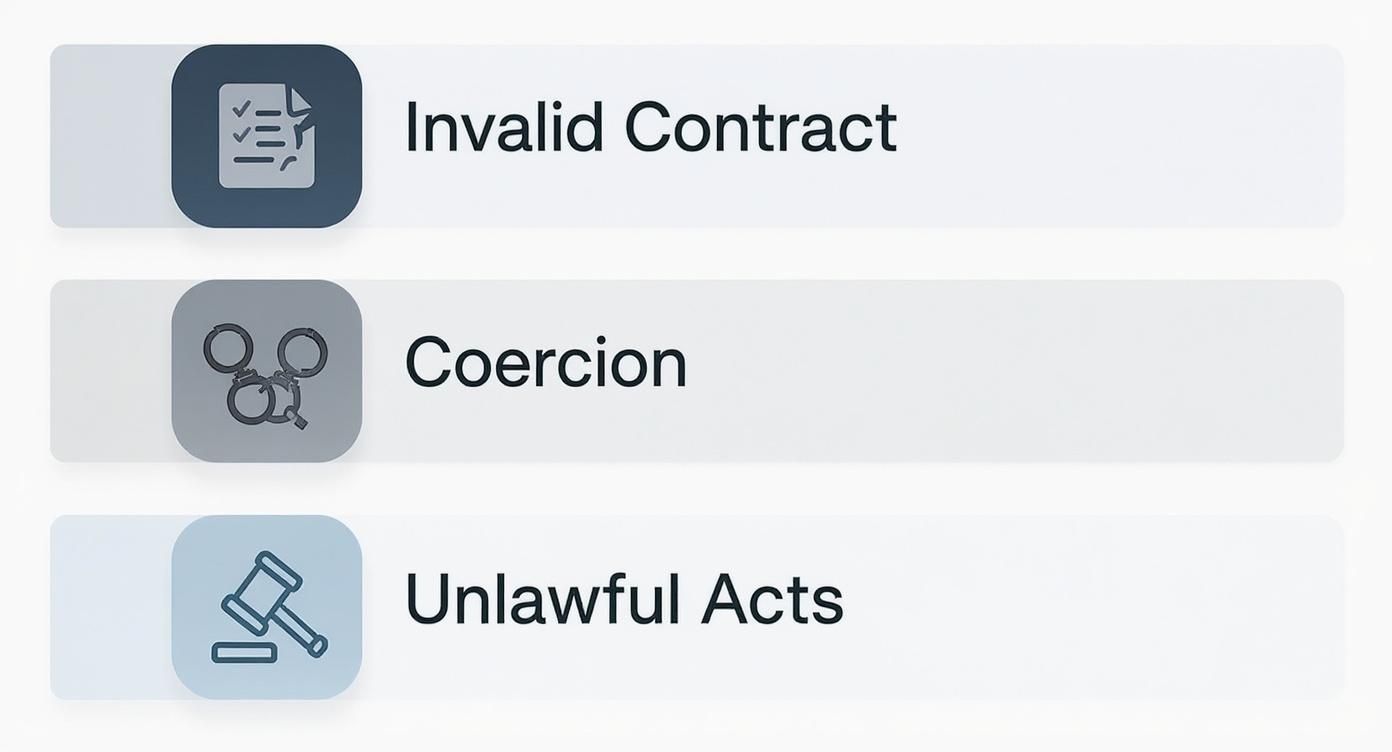
As you can see, the moment coercion enters the picture, rooted in these unlawful acts, the very foundation of the contract's validity crumbles.
Establishing the Coercive Intent
Just proving a forbidden act took place isn't enough. You also have to show clear intent. The law is very specific: the act must have been done with the intention of causing any person to enter into an agreement. This element of mens rea, or the "guilty mind," is absolutely critical.
Imagine two business partners who are also tangled in an unrelated personal dispute that has led to criminal complaints. If they happen to sign a new business deal during this time, it might not be coercion. But, if one party explicitly says, "Sign this partnership agreement, or I’ll move forward with this (false) criminal complaint," the intent to coerce is undeniable.
Insights: The burden of proof in a coercion case rests squarely on the party making the allegation. You cannot simply claim you felt pressured; you must present credible evidence to the court that a specific, unlawful act occurred and that this act was the direct cause of you entering the agreement.
The Role of Evidence and Burden of Proof
Whoever alleges coercion has to back it up. Solid evidence is non-negotiable and can come from many sources:
Written communications like emails, letters, or text messages that contain direct threats.
Testimony from witnesses who saw the coercive behaviour firsthand.
Documents proving that property was being unlawfully detained.
This is where meticulous record-keeping can make or break a case. In complex deals, especially where there's a huge power imbalance, modern tools can give you an edge. Legal AI platforms like Draft Bot Pro can analyse draft contracts for predatory clauses that often go hand-in-hand with coercive tactics. If the dispute ever lands in court, having an audit trail that shows these exploitative terms were flagged from day one can powerfully support the argument that consent was never freely given.
While coercion can be a tough claim to win, a solid grasp of its legal ingredients gives you a fighting chance. If you're interested in related principles, our guide on understanding Section 70 of the Indian Contract Act dives into obligations that arise from non-gratuitous acts, a topic that sometimes intersects with battles over a contract's validity.
How Landmark Cases Have Defined Coercion
Legal principles are just abstract ideas until courts throw them into the ring with messy, real-world situations. The concept of coercion in contract law is no different. It’s through the landmark judgments that we truly get to grips with how Section 15 of the Indian Contract Act, 1872, actually works as a shield against exploitation.
These cases aren't just dusty old footnotes; they are the living, breathing precedents that shape how lawyers argue and judges decide coercion claims today. Think of them as a practical blueprint for spotting the line where aggressive negotiation crosses over into unlawful pressure.
The Controversial Case of Chikkam Ammiraju
One of the most debated and foundational cases is Chikkam Ammiraju v. Chikkam Seshamma (1917). The facts were pretty dramatic: a man threatened to commit suicide to force his wife and son to sign away properties to his brother.
This landed a complex question squarely in the lap of the Madras High Court. Does threatening suicide—an act which isn't punishable under the Indian Penal Code, though attempting it is—count as an act "forbidden by the Indian Penal Code" for coercion purposes?
In a split decision, the majority said yes. Their logic was that even if the act itself wasn't a crime, it was certainly forbidden by the IPC. This ruling stretched the definition of coercion beyond direct violence against someone else, establishing that threats of self-harm could absolutely destroy free consent.
Insights: This case is a masterclass in a critical legal nuance. The court's focus wasn't on whether the act was punishable, but whether it was forbidden. It shows a willingness to look past technicalities to uphold the core principle of genuine consent.
When Economic Pressure Becomes Coercion
While classic coercion brings to mind physical threats, our courts have long recognised that economic pressure can be just as potent. The judiciary has often stepped in to protect parties who are on the weaker end of a negotiation from being strong-armed into ridiculously one-sided deals.
A powerful example of this principle came from a case involving the Central Inland Water Transport Corporation, a state-owned entity. The Supreme Court took one look at the employment contract terms and struck them down as unconscionable. The Court found the terms were so lopsided, given the huge power imbalance between a massive state corporation and a single employee, that they simply couldn't have been agreed to freely. You can get more insights on this judicial approach to unequal bargaining power on academic.oup.com.
Unlawful Detention of Property as a Coercive Tactic
Coercion isn't just about threats to a person's body or mind. The old English case of Astley v. Reynolds (1731), which heavily influenced Indian law, shows how holding property hostage is a classic coercive move.
In that case, someone pawned a plate for £20. When he came back to get it, the pawnbroker demanded an extra £10 in interest and refused to return the plate otherwise. The owner paid the extra money just to get his property back and then sued to recover it. The court agreed, calling it a textbook case of compulsion. The agreement to pay the extra cash wasn't voluntary at all; it was made under the duress of having his property unlawfully detained.
This very principle is baked right into Section 15, making it crystal clear that holding someone’s property hostage to force an agreement is a straight-up form of coercion in a contract.
How Draft Bot Pro Helps Analyse Legal Precedents
For any lawyer or law student, staying on top of how the courts interpret these principles is a full-time job. This is where legal AI can be a massive help.
Case Law Analysis: A tool like Draft Bot Pro can instantly dig up and summarise relevant case law on coercion. This helps you build a much stronger argument that's firmly rooted in established precedents.
Identifying Red Flags: When you're drafting or just reviewing a contract, the AI can scan its clauses against a database of court decisions, flagging terms that have been shot down in the past as coercive or unfair.
Strengthening Legal Memos: By weaving in findings from these landmark cases, you can put together far more persuasive legal memos and opinions that speak the language of judicial reasoning.
By using tools like this, legal professionals can navigate the tricky waters of coercion far more effectively, ensuring they're always ready to protect their clients from exploitative deals.
Coercion vs. Undue Influence: Unpacking the Differences
While they both lead to the same result—a contract that can be voided—coercion in contract law and undue influence are worlds apart. It's a classic rookie mistake to mix them up, but doing so can completely torpedo your legal arguments. Both concepts attack the very heart of a contract by questioning whether consent was genuinely given, but they get there through totally different routes.
Here’s a simple way to think about it: Coercion is the legal equivalent of a brute-force attack. It's the proverbial "gun to the head." Undue influence, on the other hand, is a far more subtle game—a psychological infiltration that slowly erodes someone’s free will by exploiting a relationship built on trust.
Getting this distinction right isn't just an academic exercise; it's fundamental to your legal strategy. If you plead the wrong doctrine, you risk having your case thrown out because the evidence required to prove each one is completely different.
The Nature of the Pressure Applied
The biggest giveaway is the kind of pressure being used. Coercion is loud, aggressive, and obvious. It relies on open threats or unlawful acts that are often criminal or tortious in nature.
Undue influence is much more insidious. It doesn't need illegal threats. Instead, it thrives on moral or mental pressure. This is psychological warfare, stemming from a position of dominance and trust that has been twisted and abused.
Coercion: This involves threats forbidden by the Indian Penal Code, such as physical harm, or unlawfully detaining someone's property. It's raw, immediate, and often crude.
Undue Influence: This is about subtle manipulation. One person uses their position of authority or trust to completely overpower the will of another. No explicitly illegal act is necessary.
Think of a landlord threatening a tenant with trumped-up criminal charges to force them to sign a new lease—that's textbook coercion. Now, contrast that with a spiritual guru persuading a vulnerable devotee to sign over their entire estate for a pittance. That's a classic case of undue influence.
The Relationship Between the Parties
The pre-existing relationship—or lack thereof—is another major point of difference. Coercion can be pulled off by anyone, even a total stranger. The relationship between the parties is irrelevant. All that matters is the wrongful act itself.
Undue influence, however, is entirely dependent on a relationship where one person is in a position to dominate the other. In fact, the law automatically presumes undue influence exists in certain types of relationships where trust is a given.
Insights: The law specifically presumes undue influence in relationships like a doctor and patient, lawyer and client, or parent and child. In these situations, the tables turn. The burden of proof shifts to the dominant party, who now has to prove that the contract was fair and wasn't a product of their influence. This legal presumption simply doesn't exist for coercion.
This is a critical distinction in practice. With coercion, the burden is on you to prove the threat happened. With undue influence, if you can establish a dominant relationship, the court might just presume foul play unless the other side can prove otherwise.
The Legal Framework: Sections 15 vs. 16
The Indian Contract Act, 1872, gives these two concepts their own separate homes, cementing their status as distinct legal wrongs.
Section 15 is dedicated entirely to Coercion.
Section 16 deals exclusively with Undue Influence.
This deliberate separation makes it clear: these aren't just different flavours of the same problem. They are two unique grounds for challenging the validity of a contract.
To make these differences crystal clear, let's break them down side-by-side.
Coercion vs. Undue Influence: Key Legal Differences
This table breaks down the fundamental distinctions between coercion and undue influence as laid out in Indian contract law.
Basis of Distinction | Coercion (Section 15) | Undue Influence (Section 16) |
|---|---|---|
Nature of Action | Involves physical or criminal force. Consent is snatched by committing or threatening an act forbidden by the IPC. | Involves moral or psychological pressure. Consent is obtained by overpowering the will of the other party. |
Relationship | The relationship between the parties is immaterial. A stranger can commit coercion. | A pre-existing relationship where one party can dominate the other is essential. |
Legal Basis | Based on unlawful acts or threats that are explicitly illegal. | Based on the abuse of a fiduciary or other trusted relationship. |
Criminal Liability | The act of coercion itself may lead to separate criminal charges under the Indian Penal Code. | The act of undue influence generally does not create criminal liability on its own. |
Getting this right from the start is crucial for building a strong case.
How Legal AI Can Help Differentiate
Telling these two apart can be tricky, especially when the facts of a case are a tangled mess. This is where a legal AI tool like Draft Bot Pro can be a game-changer. You can upload your case files and client statements and ask the AI to analyse the facts against the legal definitions in both Section 15 and Section 16. It can flag the pieces of evidence that point towards one doctrine over the other, helping you build a sharper, more effective legal strategy right from the get-go.
Coercion in Modern Employment and Commercial Contracts
When we hear the word “coercion,” it’s easy to picture old-school, physical threats. But the truth is, coercion in contract law is alive and well in today’s business world—it just wears a more sophisticated disguise. Instead of brute force, modern coercion often shows up as intense economic or professional pressure, especially in employment and commercial deals where one party clearly holds all the cards.
While it might not be as dramatic as a physical threat, the outcome is identical: it obliterates genuine consent and makes the agreement fundamentally unfair. It’s that silent, crushing pressure that forces someone to choose between signing a predatory contract and facing disaster.

Coercion in the Workplace
Employment contracts are practically a breeding ground for coercive tactics. The power dynamic is already skewed—the employer has the job, the salary, the security. This imbalance can easily be exploited, pushing pressure past the legal line into outright coercion.
Think about these all-too-common scenarios:
The Unfair Non-Compete: An employer slides a ridiculously restrictive non-compete agreement across the desk and tells a current employee to sign it or they're fired. Faced with losing their income, the employee signs. That’s not agreement; that’s fear.
Forced Arbitration Clauses: A company makes signing away the right to sue in court a condition of employment, forcing all disputes into binding arbitration. The threat of losing the job offer turns this into a coercive act, not a free choice.
Compensation Changes Under Duress: An employer threatens to demote an employee or move them to a dead-end role unless they accept a major pay cut or a terrible new commission structure.
In every one of these examples, the employer isn't negotiating—they're leveraging their power to force consent through threats of professional and financial ruin.
Insights: The most severe form of this is bonded labour, where a person is forced to work to pay off a debt under terms they can never escape. This isn't just a contract dispute; it's a profound violation of human rights and a criminal act.
Predatory Practices in Commercial Agreements
Coercion isn't just an employer-employee problem. It happens all the time in business-to-business deals, especially when a massive corporation is negotiating with a small supplier or a startup.
This is what we call economic coercion. A larger company uses its market dominance to bully a smaller, dependent partner into accepting oppressive terms. Imagine a huge retailer threatening to pull a small supplier's products from all its shelves unless they agree to rock-bottom prices or payment terms that stretch out for months. Facing financial collapse, the supplier is coerced into a deal that will slowly drain their business. These dynamics aren't unique to retail; understanding the literary agent's role in contract negotiation also sheds light on how power imbalances are managed in creative industries.
The Global Scope of Labour Coercion
This problem goes far beyond individual contracts; it's a massive global issue. Labour coercion, a particularly nasty subtype, is rampant in many developing nations, including parts of India where workers face conditions that look a lot like forced labour. According to the International Labour Organization (ILO), a shocking 12.3 million people around the world are victims of forced labour. It’s a stark reminder of how serious contractual exploitation can get. You can dive deeper into this research from the Massachusetts Institute of Technology.
How Legal AI Can Protect Against Modern Coercion
In such a complex environment, the best defence is catching coercion before a contract is ever signed. And this is where legal technology is changing the game. A legal AI tool like Draft Bot Pro can act as a powerful, proactive shield for legal professionals.
By running a draft agreement through its system, Draft Bot Pro can automatically flag clauses that reek of a power imbalance or are known to be predatory. For example, it can spot:
Overly restrictive non-compete clauses that a court would likely strike down.
One-sided liability or indemnification clauses that dump all the risk onto the weaker party.
Terms that are wildly out of step with industry norms, signalling an exploitative deal.
This kind of analysis gives lawyers the hard data they need to advise their clients properly, empowering them to push back on unfair terms or even walk away from a coercive agreement. This is equally vital in property law, where mastering the agreement to sale format is key to ensuring a fair transaction. By catching these red flags early, legal AI helps ensure clients aren't trapped in agreements born from compulsion, not consent.
Your Legal Remedies Against Coercion
If you've been pressured into signing a contract, the law isn't going to leave you high and dry. Realising you've been a victim of coercion in a contract is the first step, but understanding what you can actually do about it is what really matters. The Indian Contract Act, 1872, lays out a clear path to get justice.
The most important consequence of coercion is that it makes the contract voidable. This is a critical legal term. It doesn't mean the contract is automatically invalid; instead, it puts all the power in your hands—the person who was wronged. You're now at a fork in the road with a decision to make.
Rescission and the Power to Cancel
Your most direct and potent remedy is to rescind the contract. In simple terms, you can choose to cancel the whole thing.
When you rescind, you're officially stating that your consent was never genuine. This action essentially treats the contract as if it never existed, wiping the slate clean and putting you back in the position you were in before the whole mess started.
The Principle of Restitution
Once you decide to rescind the contract, another legal principle kicks in: restitution. This is covered under Section 64 of the Indian Contract Act, and it’s all about fairness.
Insights: The idea behind restitution is straightforward: nobody should get to profit from their own wrongdoing. If you cancel a contract because of coercion, both sides have to give back whatever they got out of the deal.
For instance, if someone forced you to sell your land and you received an advance payment, you must return that money when you cancel the contract. In turn, they have to give back the property title and anything else they gained. It’s a two-way street designed to prevent anyone from being unjustly enriched by the cancelled deal.
Seeking Criminal Recourse
Sometimes, coercion crosses the line from a civil issue into a criminal offence. If the pressure involved a threat or an act forbidden by the Indian Penal Code (IPC)—like assault, criminal intimidation, or extortion—you can also file a criminal complaint.
This criminal action runs alongside your civil remedies. While a civil court deals with cancelling the contract, a criminal court can prosecute the person who coerced you, which could lead to fines or even jail time. This two-pronged approach ensures they are held accountable on every level. In some complex cases, such as workplace disputes, knowing the framework of a domestic enquiry in labour law can also offer useful context on procedural fairness.
How Draft Bot Pro Supports Your Claim
Proving coercion requires solid, meticulous evidence. This is where a legal AI tool like Draft Bot Pro becomes invaluable for legal professionals.
By analysing the contract, the AI can quickly spot and document one-sided or predatory clauses that often signal a coercive agreement. This creates a documented trail, showing that the unfair terms were a red flag from the beginning. For a lawyer, this AI-generated report can be powerful supporting evidence, strengthening the argument that the contract's very structure points to a lack of genuine consent.
Common Questions About Coercion in Contract Law
When you start digging into coercion in contract law, a few questions always pop up. Let's tackle some of the most common queries that lawyers and law students run into, clearing up the confusion around these crucial concepts.
Coercion vs Economic Duress
One of the most frequent points of confusion is telling coercion and economic duress apart in the Indian context. Coercion, as laid out in Section 15, is a very specific, narrow concept. For it to apply, there must be an act forbidden by the Indian Penal Code or the unlawful detention of property. It's quite a high bar.
Economic duress, on the other hand, is a much wider idea. Think of it as illegitimate commercial pressure—like threatening to breach a critical contract just to strong-arm another party into accepting terrible terms. While our courts are increasingly acknowledging economic duress, it's still a concept evolving through judicial decisions. Coercion, by contrast, is right there in the statute book.
What About Threats of Civil Lawsuits?
So, is threatening to file a civil lawsuit considered coercion? Generally, no. Filing a lawsuit to enforce a legitimate claim is a legal right, not some act forbidden by the IPC. It’s a standard tool for resolving disputes.
But context is everything. If the threat is to file a lawsuit you know is completely baseless or malicious, purely to intimidate someone into signing a contract, you're entering murky waters. That could be seen as part of a larger coercive strategy.
Insights: Legitimacy is the key. Threatening to enforce a valid legal right is just negotiation. Threatening to abuse the legal process to snag an unfair advantage? That's when you start chipping away at the foundation of free consent.
How Can Legal AI Help in a Coercion Case?
This is where modern tools come into play. Legal AI like Draft Bot Pro can be a massive help, both in preventing coercion claims and in dealing with them after the fact.
Before the Fact: Think of it as a proactive defence. The AI can scan draft agreements, flagging one-sided clauses and terms that scream "power imbalance"—often a tell-tale sign of a coercive environment. This helps you spot and fix potential problems before they ever blow up.
After the Fact: If someone alleges coercion, the tool becomes your analyst. It can rapidly dissect the contract, pinpointing and documenting exploitative terms. This gives you structured, concrete evidence to build your argument for getting the contract voided.
With Draft Bot Pro, you can break down complex agreements and spot the red flags of coercion before they escalate into a full-blown legal battle. Our AI-powered assistant is like a paralegal on steroids, helping you draft, review, and research with more precision. It ensures every contract you touch is built on the solid ground of fairness and genuine consent.
Ready to shield your practice from unfair contracts? Check out our features at https://www.draftbotpro.com.
