
A Guide to Section 269T of Income Tax Act 1961

At its core, Section 269T of the Income Tax Act 1961 is the rulebook for how you pay back borrowed money. Think of it this way: it strictly forbids the repayment of any loan, deposit, or similar sum of ₹20,000 or more in cash. Getting a grip on this rule is vital for everyone, from individuals to large corporations, if you want to stay on the right side of the law and avoid some pretty hefty penalties.
Why Does Section 269T Even Exist?
Picture the entire country's financial system as one enormous, transparent ledger. Every time you make a transaction through a banking channel—whether it’s a cheque, a bank draft, or an electronic transfer—it leaves a clear, traceable footprint. This is exactly the kind of transparency the government is aiming for.
Section 269T is a critical piece of this puzzle. It's designed to clamp down on cash transactions, which can easily fly under the radar and fuel the circulation of "black money."
But it doesn't work alone. It's the other half of a pair, working hand-in-hand with its sibling provision, Section 269SS, which deals with taking loans and deposits. So, while 269SS says you can't accept a loan over ₹20,000 in cash, 269T says you can't repay it in cash either. Together, they build a solid wall that forces significant financial dealings into the open.
The Bigger Picture
The main goal here is to put a stop to tax evasion. When large transactions are pushed through the banking system, the Income Tax Department gets a much clearer view of the money flowing through the economy. This makes it easier to ensure all income is accounted for and properly taxed, which is good for everyone.
Here’s what the rule aims to achieve:
Boost Financial Transparency: Forcing repayments through banks creates an undeniable audit trail for every major transaction.
Tackle Black Money: It throws a spanner in the works for anyone trying to use unaccounted cash to settle debts, disrupting the shadow economy.
Nudge Us Towards Digital: The provision naturally encourages people and businesses to adopt formal banking and digital payment methods.
To give you a clearer picture, we've broken down the key aspects of Section 269T into a simple table.
Section 269T At a Glance Key Provisions
Provision | Description |
|---|---|
Threshold | The rule applies to any repayment of a loan, deposit, or specified sum of ₹20,000 or more. |
Prohibited Mode | You cannot repay this amount in cash. |
Permitted Modes | Repayment must be made via an account payee cheque, account payee bank draft, or electronic clearing system (ECS) through a bank account. |
Penalty for Violation | A penalty equal to 100% of the amount repaid can be levied under Section 271E. |
Who is Affected? | This applies to all persons, including individuals, HUFs, companies, firms, etc. |
This table serves as a quick cheat sheet, but the real devil, as always, is in the details of the law itself and how it's interpreted.
A Look at the Legal Framework
The lawmakers' intention behind Section 269T of the Income Tax Act 1961 couldn't be clearer: regulate how loans and deposits are repaid to stop people from dodging taxes.
Let’s say you owe a friend ₹30,000. You can't just hand them ₹25,000 in cash and call it a day. The entire repayment must go through proper banking channels, like an account payee cheque or a digital transfer like NEFT or RTGS. Slip up, and the penalty can be a staggering sum equal to the amount you repaid in cash. You can dive deeper into how tax laws are interpreted by checking out some landmark case laws on income tax you must know.
InsightsTrying to keep up with all the nuances of tax law can feel like a full-time job. This is where a Legal AI tool like Draft Bot Pro can be a game-changer. It can help you draft loan agreements that are fully compliant, with specific clauses that mandate repayment only through approved banking channels. It’s also great for researching relevant case law, making sure your financial practices are always airtight.
What Transactions Fall Under Section 269T?
To stay on the right side of Section 269T of the Income Tax Act 1961, you need to be crystal clear on exactly what kinds of transactions it covers. While the law uses some specific terms, the core idea is pretty straightforward. It's not just about repaying a standard loan; its net is cast much wider.
At its heart, the section deals with the repayment of any "loan or deposit." In the eyes of the taxman, this is any money you've borrowed. But it also loops in something called a "specified sum." This is a fancy term for any advance or other receivable amount connected to the transfer of immovable property—even if the property deal never actually goes through.
What does this mean in practice? The rule doesn't just apply to traditional loans you might get from a friend or a bank. It also covers things like advances paid for a flat or a piece of land. The law is clearly designed to track the movement of significant sums of money in a variety of situations.
Deconstructing the ₹20,000 Threshold
One of the biggest tripwires for people is misunderstanding the ₹20,000 limit. Many assume it only applies to a single, one-off repayment. That’s a dangerous mistake and an easy way to land in hot water. The law looks at the aggregate amount owed, not just the individual repayment instalment.
Here's the crucial part: if the total amount you owe to a single person or entity is ₹20,000 or more, then you cannot repay any part of it in cash. Period.
Let's make this real. Imagine you owe a friend ₹30,000. You might think you're clever by repaying it in two cash instalments of ₹15,000 each. Bad idea. The moment you make that second payment, you've crossed the line. You have now repaid a loan of over ₹20,000 using cash, which is a direct violation of the law.
This simple decision tree breaks down how to check if your repayment method is compliant.
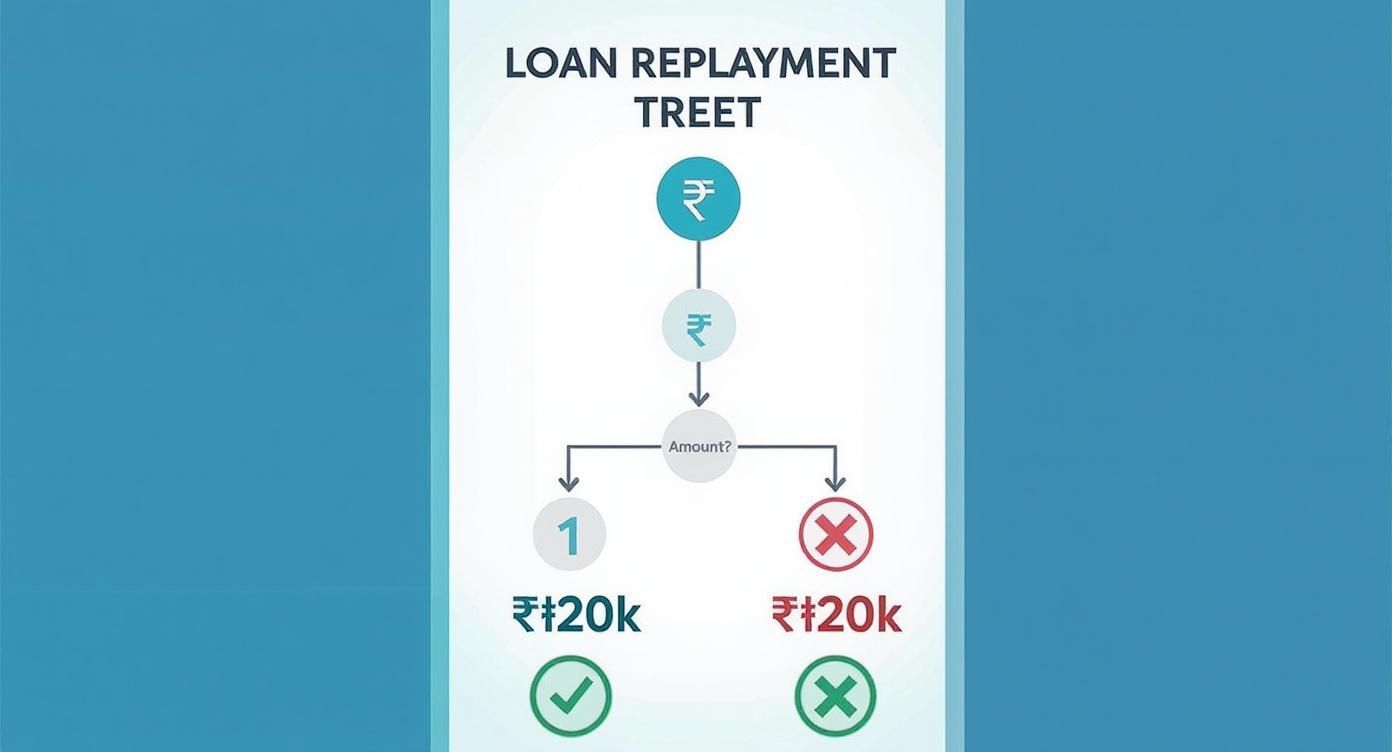
As the infographic shows, the second your loan or deposit amount hits that ₹20,000 mark, cash is off the table. You have to use banking channels.
Who Bears the Responsibility?
Knowing who's on the hook is essential. Under Section 269T, the responsibility falls squarely on the person or entity making the repayment. This includes:
Individuals and Hindu Undivided Families (HUFs): When you're repaying personal loans or deposits.
Companies and Firms: When they're settling debts with creditors, directors, or partners.
Associations or Body of Individuals: For any group repaying a debt they hold collectively.
The law makes no distinction between personal and business transactions. If you are the one repaying a loan of ₹20,000 or more, you are legally bound to do it through a bank. The person receiving the money isn't penalised under this specific section; the burden is entirely on the payer to follow the rules.
For example, if a company repays a ₹50,000 loan to one of its directors in cash, it’s the company that has violated Section 269T, not the director who took the cash. This clear line of responsibility makes enforcement much more direct.
InsightsNavigating these definitions can feel a bit complex, especially when you're juggling multiple transactions. This is where modern tools can lend a hand. A Legal AI assistant like Draft Bot Pro can help you analyse loan agreements or transaction records to spot potential compliance risks. It can scan your documents for clauses that might lead to a non-compliant repayment, helping you steer clear of penalties before they become a problem.
The Steep Price of Non-Compliance: Understanding the Penalties

Ignoring the rules in Section 269T of the Income Tax Act 1961 isn't just a minor oversight—it's a very expensive mistake. The government comes down hard on this provision, and the penalties are designed to be a serious deterrent against unrecorded cash transactions.
The main consequence for breaking the rules of Section 269T is a penalty under Section 271E of the Income Tax Act. This is no small fine or a mere rap on the knuckles. The penalty is a staggering sum, equal to 100% of the loan, deposit, or specified sum repaid in cash.
Let that sink in for a moment. If you repay a loan of ₹75,000 in cash, you could be staring at a penalty of another ₹75,000. It effectively doubles the cost of the transaction, turning a simple repayment into a major financial headache.
How the Penalty Works
The power to slap on this penalty lies with the Joint Commissioner of Income Tax. This senior officer examines cases of non-compliance and can impose the penalty after giving the taxpayer a fair chance to explain their side of the story.
This is considered a quasi-criminal proceeding, which means the authorities don't just apply it automatically for every tiny breach. However, if a clear violation is proven without a really good reason, the penalty is almost a certainty. This shows just how seriously the tax department treats these violations. While Section 269T is specific to cash, the general pain of missing tax rules is universal, a point often highlighted when understanding tax penalties for late payments.
InsightsGetting a penalty notice under Section 271E can be incredibly stressful. This is where a Legal AI tool like Draft Bot Pro can be a lifesaver. It lets you quickly dig into relevant case law where similar penalties were challenged, giving you a solid idea of potential defences. You can also use it to draft a clear, well-argued response to the notice, helping you properly articulate your position and any "reasonable cause" you might have had for the cash transaction.
How Do They Even Find Out?
You might be wondering how the Income Tax Department discovers these cash repayments in the first place. The answer is simple: the tax audit system is built to catch exactly these kinds of things.
The main culprit here is Form 3CD, which is the tax audit report. Auditors are legally required to report specific details about their clients' finances, and that includes any transaction that breaks the rules of Sections 269SS and 269T.
More specifically, Clause 31 of Form 3CD forces the auditor to disclose:
Whether the person has accepted any loan or deposit in cash, violating Section 269SS.
Whether the person has repaid any loan or deposit in cash, violating Section 269T.
This mandatory reporting creates a direct, undeniable paper trail for the tax authorities. When an auditor flags a transaction under Clause 31, it's a huge red flag that practically screams for scrutiny and almost guarantees a penalty proceeding will be started.
Both the person paying and the person receiving the money have to report these transactions in their tax returns, creating a system of dual accountability. This is all part of the government's push to clamp down on large, unaccounted cash flows. Following the rules isn't just good advice; it's absolutely critical for your financial well-being.
Key Exemptions and the "Reasonable Cause" Lifeline
While the rules of Section 269T seem incredibly strict, the law isn't entirely rigid. It recognises that some situations and certain entities simply don't fit the mould, warranting a clear exception from the cash repayment ban. Honestly, understanding these exceptions is just as important as knowing the rules themselves.
The most straightforward exemptions are for repayments made to official bodies. The logic is simple: these institutions are already so heavily regulated and transparent that the risk of funny business with cash is practically zero.
Who is Exempted from Section 269T?
The restrictions on cash repayments are completely waived when you're paying back any of the following:
The Government.
Any banking company, post office savings bank, or co-operative bank.
Corporations set up by a central, state, or provincial Act.
Government companies, as defined in the Companies Act.
Any other institution the Central Government notifies in the Official Gazette.
Basically, if you're repaying a loan to one of these big, official entities, you can do it in cash—even if it's way over ₹20,000—without worrying about the penalties under Section 271E.
The All-Important Escape Hatch: Reasonable Cause
Now, this is where the law shows its more human, nuanced side. Beyond that list of exempted bodies, there's a powerful safety net built right into the tax act: the concept of "reasonable cause." This principle, found in Section 273B, can be the one thing that saves you from a hefty penalty.
Section 273B essentially says that no penalty will be slapped on you if you can prove there was a "reasonable cause" for the slip-up. The catch? The Act never actually defines what a "reasonable cause" is. That decision is left to the courts, based on the unique facts of every single case.
InsightsWhen that penalty notice lands on your desk, the ball is in your court. You have to prove you had a valid "reasonable cause." This usually means diving deep into case law to find precedents that support your situation. This is where a Legal AI tool like Draft Bot Pro becomes a game-changer. You can run lightning-fast, accurate legal research on past judgments related to Section 273B, helping you find cases that back up your argument and build a rock-solid response for the tax authorities.
So, What Actually Works as a Defence?
What kind of excuses have the courts actually bought? Generally, it's something that was genuinely out of the taxpayer's control or stemmed from an honest belief, with absolutely no intention of dodging taxes. The authenticity of the transaction is always front and centre.
Let's look at a real-life example. A person repaid a loan of over ₹6,70,000 in cash to a finance company. Naturally, the tax officer kicked off penalty proceedings. The assessee's defence was that the finance company itself insisted on cash because of previous delays in paying the instalments.
The court looked at the whole picture and noted a few critical things:
The transaction was 100% genuine and properly recorded in the books.
The person's income tax return had been accepted without any red flags, which further proved the deal was legitimate.
There wasn't a shred of evidence suggesting bad faith or an attempt to evade taxes.
The assessee was basically forced into the cash payment by the lender.
In the end, the High Court decided that the lender's insistence was a perfectly "reasonable cause" under Section 273B. Since the transaction was legitimate and the reason for using cash was justifiable, the penalty was thrown out. This case is a fantastic reminder that a simple technical breach, especially one that doesn't cost the government any revenue, might not lead to a penalty if you have a good story to tell. Other valid reasons could be ignorance of the law in a remote rural area with no banks, or an urgent, unavoidable business emergency.
A Practical Checklist for Staying Compliant
Knowing the rules of Section 269T of the Income Tax Act, 1961, is one thing, but putting them into practice is where it really counts. To help you move from theory to action, we’ve put together a practical checklist. It's designed to help individuals and businesses handle their repayment obligations correctly and steer clear of those painful penalties.
Think of these steps less as a burden and more as smart financial habits. When you build them into your routine, what seems like a complex legal rule becomes a simple, manageable part of your financial life.
Foundational Compliance Habits
Let's start with the basics. These are the non-negotiables, the absolute bedrock of staying on the right side of Section 269T.
Always Use Banking Channels: This is the golden rule. For any loan, deposit, or specified sum repayment of ₹20,000 or more, it has to go through an account payee cheque, an account payee bank draft, or an electronic system like NEFT, RTGS, or UPI. No exceptions.
Meticulous Documentation: Keep detailed records of every loan and repayment. This means holding onto the loan agreement, proof of payment like bank statements or cheque copies, and any letters or emails exchanged. Good records are your best defence if a transaction is ever questioned.
Accurate Reporting: Make sure every one of these transactions is correctly reported in your books of account and disclosed in your tax returns. Transparency leaves no room for doubt during an assessment.
Proactive and Strategic Measures
Going beyond the basics can give you an extra layer of protection from accidental slip-ups. These proactive steps embed compliance right into your financial agreements and daily workflow.
A simple but incredibly effective tactic is to write specific repayment clauses directly into your loan agreements. Legally spell out that all repayments must be made only through the prescribed banking channels. This turns a statutory rule into a contractual obligation, reinforcing it for both parties.
InsightsWe're lucky to have technology on our side. A Legal AI assistant like Draft Bot Pro can instantly generate compliant loan agreements with clauses that mandate repayments through approved banking channels. Setting up these automated safeguards makes compliance an automatic, stress-free part of your financial management, catching potential mistakes before they happen.
For businesses, it’s a smart move to create a clear internal policy for all loan repayments. Train your finance team on the specifics of Section 269T and the hefty penalties under Section 271E. When everyone on the team knows the rules, the risk of a costly error drops significantly.
Permitted vs Prohibited Modes of Repayment Under Section 269T
To cut through any confusion, let’s lay it out clearly. Here’s a simple table breaking down what’s allowed and what’s strictly forbidden when you’re repaying ₹20,000 or more.
Permitted Modes (Compliant) | Prohibited Modes (Non-Compliant) |
|---|---|
Account Payee Cheque | Cash |
Account Payee Bank Draft | Bearer Cheque |
NEFT/RTGS/IMPS/UPI | Self-Cheque cashed by the borrower |
Any Electronic Clearing System (ECS) | Repayment through a third-party in cash |
As you can see, any method that doesn't leave a clean, traceable banking trail is completely off-limits. Sticking to this simple guide is the key to avoiding violations.
Even with the best intentions, you might find yourself facing a notice. In those situations, knowing how to generate an AI reply to income tax notices can give you a structured and legally sound starting point for your response.
Ultimately, mastering compliance with Section 269T comes down to diligence and foresight. By adopting these practical habits and using technology to your advantage, you can manage your financial obligations with confidence and stay firmly on the right side of the law.
Streamlining Compliance with Legal AI
Let's be honest, navigating the complexities of section 269t of income tax act 1961 can be a real headache. It’s a meticulous, time-consuming task for any professional. Even with the best intentions, it's easy to miss the finer points of compliance, but modern technology offers a powerful ally for legal and finance experts.
A Legal AI assistant like Draft Bot Pro can turn this daunting legal chore into a much more manageable process. It acts as a force multiplier, boosting both accuracy and efficiency and helping you get ahead of potential compliance headaches before they snowball.
For instance, imagine you need to draft a loan agreement. Instead of starting from a blank page, you can generate a fully compliant document in minutes. The AI can automatically weave in specific clauses that mandate all repayments stick to the banking channels prescribed by law, effectively building compliance right into the contract's DNA.
Proactive Risk Management with AI
Beyond just drafting, Legal AI brings some serious analytical power to the table. Let’s say you’re faced with a situation where a cash repayment was simply unavoidable. Draft Bot Pro can rapidly scan a massive library of case law related to Section 273B, helping you gauge the strength of a potential 'reasonable cause' defence.
That kind of capability is invaluable for building a solid, well-supported response to any notice from the tax authorities. The tool can also help you create customised internal compliance checklists for your business, ensuring your whole team understands and follows the right procedures for handling loan repayments. To really step up your game, exploring the benefits of Compliance Artificial Intelligence (AI) is a significant move forward.
InsightsLegal AI shifts your entire approach from being reactive to proactive. Instead of just fighting fires and responding to tax notices, tools like Draft Bot Pro empower you to build a robust compliance framework from the get-go. This saves a huge amount of time, effort, and, of course, potential penalties.
By automating the grind of research, drafting, and analysis, Legal AI helps you manage risk, lock in accuracy, and reclaim your valuable time. To see more on how technology is changing the game for legal pros, check out our detailed guide on using AI for tax law professionals.
Frequently Asked Questions
When you get down to the brass tacks of Section 269T of the Income Tax Act, 1961, a lot of real-world questions pop up. Let's tackle some of the most common scenarios that people and businesses run into, so you can navigate these tricky situations correctly.
Repaying Loans to Family Members
Q: Does Section 269T apply if I repay a ₹40,000 loan to my brother in cash?
Yes, it absolutely does. Section 269T doesn't care about the relationship between the borrower and the lender. The rules are the same for everyone, including family members.
Because the total loan amount is ₹40,000, which is well over the ₹20,000 limit, paying back any portion of it in cash is a straight-up violation. You have to make the repayment through proper banking channels, like an account payee cheque or a bank transfer (NEFT/RTGS), if you want to steer clear of a nasty penalty under Section 271E.
Business and Partnership Transactions
Q: What if a business partner repays a loan to the firm in cash, and it's over the ₹20,000 limit?
That’s a textbook violation. The rules of Section 269T apply just as much to firms, companies, and other business entities as they do to individuals. When a partner repays a loan to their firm, the partner is the one making the payment.
If that loan is ₹20,000 or more, the partner is legally bound to use a banking channel for the repayment. A cash payment would put the partner (the payer) on the hook for a penalty equal to the amount they repaid. On top of that, the firm's tax auditor would have no choice but to flag this non-compliance in Form 3CD.
Exceptions for Emergencies
Q: Are there any exceptions for genuine emergencies that force an immediate cash repayment?
The Act itself doesn’t have a specific "emergency" clause. However, if you're faced with a genuine, unavoidable crisis, you might be able to argue it as a "reasonable cause" under Section 273B, which can get the penalty waived.
But be warned, this isn't an easy out. You'd need rock-solid, verifiable proof of the emergency and demonstrate that using a bank was truly impossible at that moment. The transaction also needs to be completely legitimate and properly recorded. Whether this argument works really boils down to the specific facts of your case and the discretion of the tax authorities.
The Appeals Process
Q: If I get slapped with a penalty under Section 271E, what’s the process to appeal it?
If the Joint Commissioner hits you with a penalty under Section 271E, you have the right to fight it. Your first stop is an appeal to the Commissioner of Income Tax (Appeals), or CIT(A).
If you don't get the result you want from the CIT(A), you can take your case to the next level: the Income Tax Appellate Tribunal (ITAT). Beyond the ITAT, if your case involves a major question of law, you can even go to the High Court and, ultimately, the Supreme Court.
InsightsGetting a penalty notice and navigating the appeals maze can be a real headache. This is where a Legal AI assistant like Draft Bot Pro can be a game-changer. It can help you dig up relevant case law in minutes to back up your "reasonable cause" argument. It can also assist in drafting a well-structured, persuasive appeal to the CIT(A), making sure you put your best foot forward.
Navigating the thicket of tax law demands precision. Draft Bot Pro is an AI-powered legal assistant built to help legal professionals draft accurate documents, conduct deep research, and stay on top of compliance. See how our tools can support your practice by visiting https://www.draftbotpro.com.
